
Cinemark’s Strategic Footprint and Financial Rebound After Industry Challenges
Cinemark leverages its premium formats, subscription model, and geographic diversity to drive recovery and resilience in theatrical exhibition.
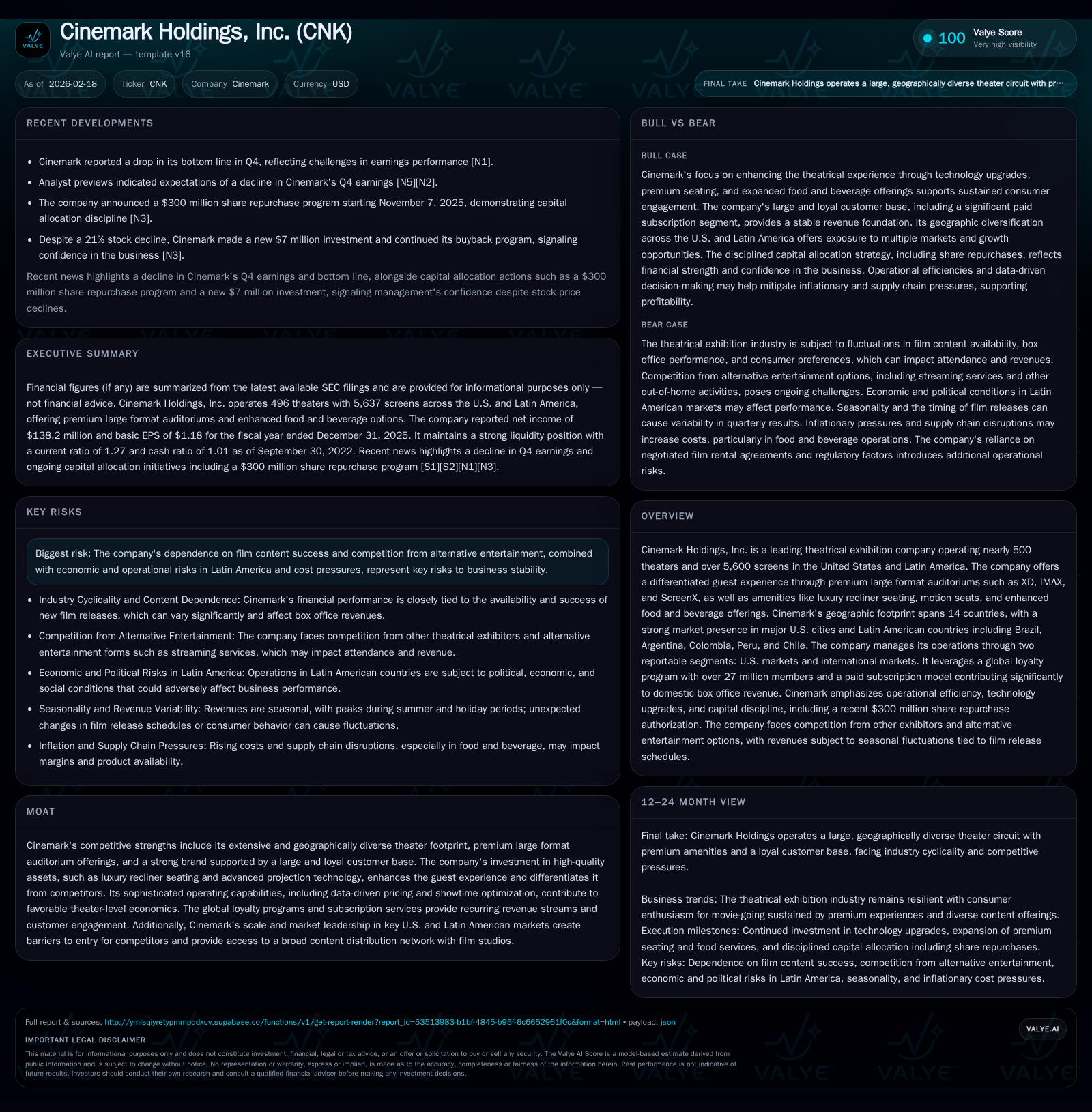
Cinemark Holdings has emerged from pandemic-era turmoil with robust profitability in 2025, anchored by a large-scale footprint across the U.S. and Latin America and pioneering premium auditorium experiences. The company’s strategic investment in luxury recliners, advanced projection technology, and a growing subscription base underpin improved theater-level economics and steady box office returns. Capital discipline is evident in opportunistic share repurchases despite near-term earnings pressure. Key risks remain around content success dependency and competition from streaming, but Cinemark’s data-driven operational tactics and diversified market presence position it well for navigating evolving industry dynamics.
Recovery Trajectory: From Pandemic Impact to Recent Profitability Gains
Cinemark faced substantial financial headwinds during the pandemic years when theatrical attendance plummeted due to global health restrictions. The company reported significant operating income losses of -$287 million in FY2020 and -$252 million in FY2021 [F1]. This erosion stemmed largely from shuttered theaters and constrained box office receipts. However, by FY2025, Cinemark decisively reversed this trajectory, achieving $138.2 million in net income [F1] — returning to profitability with a sharper focus on operational leverage.
Operating cash flow showed a strong rebound from a negative $330 million in 2020 to positive levels pre-pandemic ($562 million in 2019) and stabilizing through recovery years [F1]. Capital expenditure peaked at $304 million in 2019 aligned with expansion and asset upgrades but was scaled back to more sustainable levels (around $110 million) during recovery phases [F1]. This evidences prudent capital management aimed at shoring up balance sheet strength without sacrificing facility quality.
Historical performance (annual)
| FY | Net ($mm) | Net YoY |
|---|---|---|
| 2025 | 138 | -55.4% |
| 2024 | 310 | +64.6% |
| 2023 | 188 | +169.4% |
| 2022 | -271 |
Note: Omitted columns lack sufficient annual XBRL coverage in the provided tags (need ≥2 annual points): Rev, CFO, OpInc, Capex, Div, Buybacks, FCF, ROE%. Source: SEC companyfacts cache [F1].
*Operating income latest available mid-year June '22 [F1]. **Net income peaked at $309M in '24 before a decline to $138M in '25 [F1].
This historical data highlights Cinemark's gradual yet sustained recovery progression driven by reopening theatres globally while managing operating expenses and capital deployment carefully.
Premium Large Format and Amenities: Differentiation Driving Foot Traffic
Cinemark’s strategic investment in premium large format auditoriums constitutes a core competitive moat. With over 301 XD-branded auditoriums — the largest branded premium large format footprint worldwide — alongside IMAX (16) and ScreenX (12) venues, the company offers immersive viewing experiences characterized by wall-to-wall screens, advanced Barco Auro-Max sound systems, and ongoing laser projection upgrades covering roughly one-fifth of global auditoriums [S14][S17].
Beyond sight and sound innovation, Cinemark has integrated Luxury Lounger recliner seating extensively into its domestic circuit (69% coverage), plus motion seats offering synchronized kinetic activity across over 548 auditoriums [S14]. These ergonomic enhancements elevate guest comfort significantly.
Concession innovation complements auditorium upgrades with expanded food & beverage menus including craft beer/wine/cocktails, freshly prepared Pizza Hut pizzas, gourmet sandwiches, chef-inspired items, full bar offerings — often delivered directly to guests’ seats or home via third-party platforms [S14][S16]. Mobile concession ordering is available across all U.S locations streamlining service throughput boosting impulse sales incidence.
This combined assortment of technological amenities plus enhanced F&B offerings captures premium spending segments seeking experiential entertainment beyond traditional movie-going norms — key for driving foot traffic amid diversifying leisure alternatives.
Subscription Revenue and Loyalty Program: Recurring Streams Fueling Box Office Growth
Subscription models have disrupted cinematic monetization channels; Cinemark commands approximately 1.5 million paid Movie Club members contributing around 30% of domestic box office revenues [S13][N1]. Movie Club provides monthly ticket credits with waived fees alongside discounts on companion tickets plus exclusive concession savings that escalate customer lifetime value (LTV).
Further segmentation within Movie Club includes platinum tiers delivering credits for premium screen upgrades (XD/IMAX/ScreenX/motion seat access), incentivizing higher visit frequency among engaged customers [S15]. Loyalty extends internationally via local equivalents providing annual or monthly memberships offering discounted admissions/concessions — amplifying recurring revenue streams globally.
These programs foster stickier customer relationships amid competitive pressure from digital content providers by creating habitual entertainment habits supported by personalized marketing campaigns utilizing Cinemark’s omni-channel platform reaching over 33 million customers worldwide [S23][S13]. As such, subscriptions act as stabilizers against episodic fluctuations tied to blockbuster release success.
Geographic Market Strengths: U.S. Leadership and Latin America Opportunities with Regional Nuances
Cinemark maintains strong market leadership positioning within highly fragmented North American theatrical circuits where it ranks first or second by box office revenue across 21 of its top 25 U.S. markets — including Dallas, San Francisco Bay Area, Houston, Salt Lake City among others [S4]. The company operates over 300 theaters domestically spanning 42 states [S18], offering broad regional coverage.
Internationally it commands leading positions as the largest exhibitor in Brazil (84 venues) and Argentina (23 venues), plus meaningful presence across Colombia (31 sites), Peru (15 sites), Chile (20 sites), Central America (17 venues covering six countries), Bolivia, Paraguay — totaling nearly half the circuit footprint outside the U.S.[S18][S27]. Latin America generated preliminary estimated box office revenues of ~$1.2 billion for Cinemark's scope markets in 2025 [S18], albeit subject to macroeconomic volatility rooted in currency fluctuations and political unrest which may affect consumer spending power.
Local cultural preferences impact content resonance; blockbuster Hollywood franchises may over or underperform relative to North American benchmarks depending on thematic relevance — requiring localized market insight from country general managers who adapt programming accordingly [S27]. Seasonal release timing differences also require agile scheduling reflective of regional holidays.
Operational Sophistication: Data-Driven Pricing, Showtimes, and Cost Controls
Cinemark harnesses extensive data analytics to optimize pricing mechanics at the individual theater level focusing on attendance maximization while preserving concession incidence [S16][S17]. Film rental rates are negotiated on sliding-scale formulas tied closely to box office performance metrics ensuring flexible cost exposure relative to realized revenue.
Showtime scheduling is continuously refined based on weekly demand fluctuations optimizing theater capacity utilization without compromising guest convenience [S17]. Theater operations benefit from technology-enabled inventory management systems minimizing stockouts at concession points complemented by trained employees certified across food safety standards enhancing guest satisfaction while controlling waste/productivity drivers [S10][S16].
Supply chain interruptions affecting concessions are mitigated through diversified vendor sourcing strategies allowing agility amidst inflationary cost pressures particularly noted since pandemic disruptions in core commodities like popcorn kernels or frozen drink ingredients [S9][S16]. Digital ordering platforms — including proprietary mobile apps enabling contactless purchases for pickup/delivery within theaters — reduce congestion at points of sale accelerating throughput during peak windows enhancing margin capture.
These investments translate into improved theater-level economics underpinning Cinemark’s operational resilience against rising fixed-cost bases inherent to venue operations.
Capital Allocation Strategy: Share Buybacks as a Signal Amid Earnings Pressure
Despite earnings headwinds observed with Q4 results lagging estimates according to recent reports [N3][N7], management affirmed confidence via launching a $300 million open-market share repurchase program authorized November 2025 encompassing opportunistic buybacks executed under Rule10b5-1 plans mitigating blackout exposure risk [S7][S29].
The decision underscores belief in intrinsic equity value amid current valuation dislocations post-pandemic disruptions; total repurchases recorded for FY25 approximated $275 million supporting net reduction of share count enhancing per-share metrics despite volatile quarterly earnings trajectories [F1].
Free cash flow generation remains positive with an approximate $55 million surplus derived from operating cash flows versus maintenance-level capex expenditures endorsing sustained ability to fund capital returns while investing prudently back into theater upgrades/staffing initiatives supporting long-term enterprise value growth goals [F1].
Return on equity stands near an impressive ~42.8%, reflecting robust profit absorption relative to equity base following gradual deleveraging throughout earlier pandemic periods [F1], buttressing shareholder value creation capacity going forward.
Risks to Watch: Content Dependency, Alternative Entertainment, and Macroeconomic Factors
Cinemark’s fundamental reliance on Hollywood studio film slates introduces significant variability; success or failure of marquee tentpole releases materially influences box office throughput given licensing terms predominantly negotiated theater-by-theater per-film basis post-expiry consent decrees limiting longer-term contracts [S8][S12][S16].
Streaming services continue attracting consumer time-share away from theatrical exhibition challenging attendance frequency especially amidst broader shifts toward digital consumption habits accelerated by COVID-era behavior shifts [N3][S24].
Economic instability notably across Latin American countries featuring inflation volatility currency devaluations risk dampening discretionary spending for entertainment impacting international revenue streams requiring vigilant local management oversight supported by country-specific executives familiar with socio-political nuances [S27][N3].
Cost pressures stemming from labor inflation taxonomy disruptions supply chain shocks further complicate margin management necessitating continuous operational discipline combined with ongoing technology investments addressing evolving consumer expectations such as cybersecurity governance overseen by longstanding CTO enabling controlled risk frameworks around information security protocols mitigating possible business disruptions [S1][N8].
Outlook & Milestones: Film Slate Releases Drive Near-Term Catalysts Amid Continuous Innovation Efforts
Looking ahead into calendar year 2026 several high-profile releases are scheduled including The Super Mario Galaxy Movie, Avengers: Doomsday sequel entries, Toy Story 5, Minions 3, Moana, Jumanji 3, Dune Part Three plus streaming-adjacent tentpoles like The Mandalorian & Grogu spin-off feature set for theatrical windows offering vital spectacles driving seasonal revenue peaks reminiscent of historically successful summer/holiday cycles typical industry behavior patterns observed historically[S18][N1][N6][N7].
Executives signal continued emphasis on refining subscription tier pricing elasticity experimenting with offers aimed at incremental subscriber gain targeting both volume increases coupled with attach rate improvement per member aiming heightened lifetime consumer engagement [N1]. Given box office timing dependence on staggered regional release schedules stronger synchronization efforts between distribution partners could further mitigate quarter-to-quarter volatility reinforcing steady performance profiles.
Additional initiatives include ongoing conversion of auditoriums to energy-efficient Barco RGB laser projectors currently at ~22% completion globally along with expanding premium amenities such as recliners and motion seats while testing expanded entertainment options like bowling or arcade games signaling multi-year growth investments enhancing guest experience differentiation [S14][S21].
Note: Metrics such as revenue figures are not available from provided XBRL tags; this report relies strictly on disclosed financials without extrapolation beyond cited sources.
Disclaimer: This is research-only, informational analysis and not investment advice. It may include AI-generated interpretation and general industry context. Always verify important details using primary sources.

Comments