
Murphy USA’s Revenue Retreat and Strategic Growth Initiatives in 2025
Despite revenue softness, Murphy USA leverages cost leadership and Walmart proximity to sustain operational strength while expanding new store footprint and merchandise offerings.
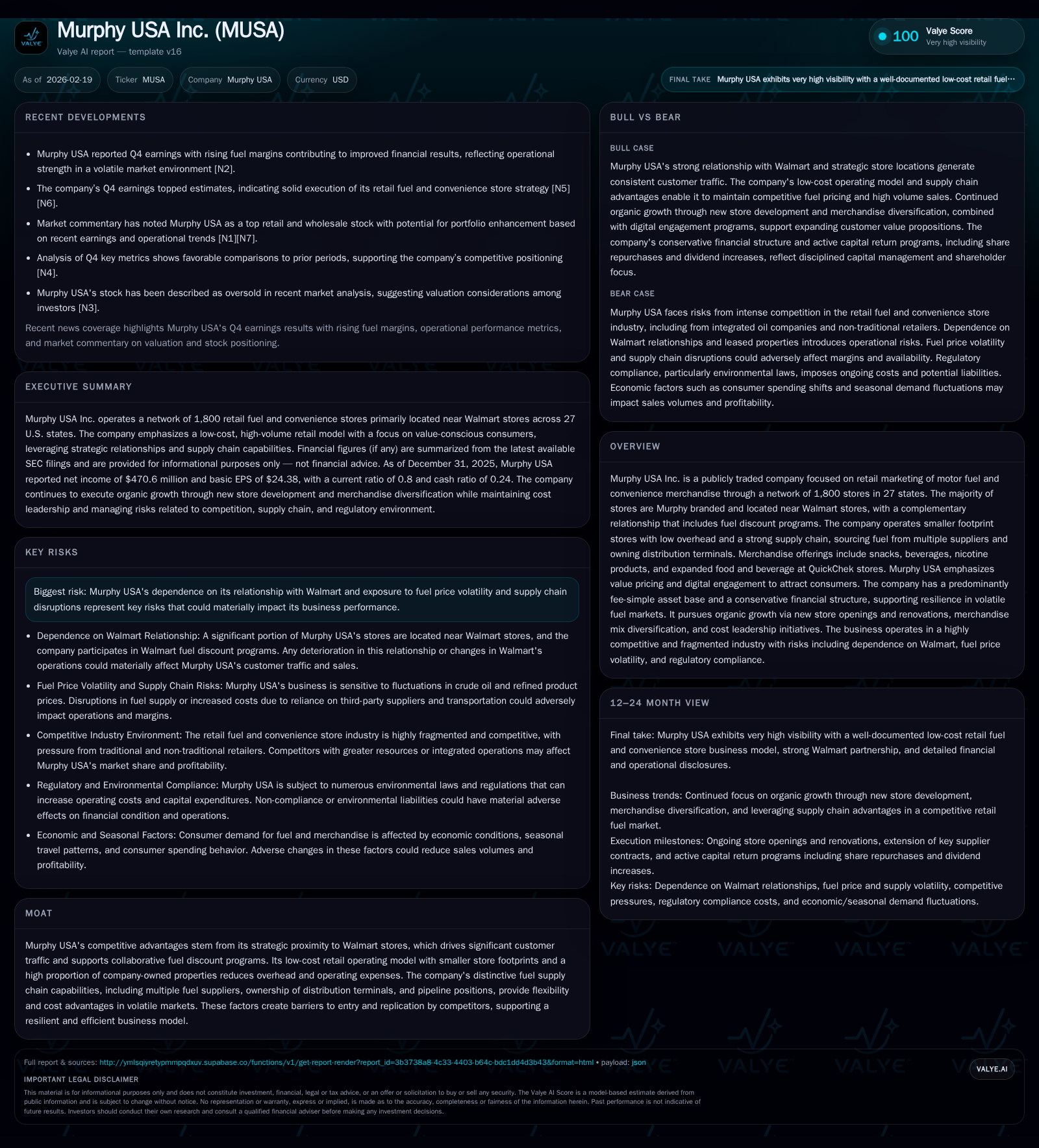
Murphy USA has experienced a notable revenue decline in recent years driven by volatile fuel pricing and market headwinds. However, its strategically located stores near Walmart outlets, combined with a lean operating model and flexible supply chain, underpin continued profitability. Capital allocation favors shareholder returns via dividends and buybacks alongside disciplined expansion through store rollouts and enhanced merchandise, particularly foodservice at QuickChek locations. Key risks include dependence on Walmart partnerships, competitive pressures from integrated retailers, and regulatory challenges affecting nicotine product sales.
From Rapid Expansion to Stabilization: Murphy USA’s Historical Financial Trajectory
Murphy USA's financial performance over the last four years illustrates a transition from growth into a phase of stabilization amidst challenging market conditions. Revenue peaked at approximately $23.4 billion in fiscal year 2022 but retreated by an estimated 8.2% to about $21.5 billion in 2023, held flat through to the end of that year as reported [F1]. Operating income followed suit but exhibited more resilience with a narrower decline of roughly 3.3%, from $968 million in 2022 down to $718 million by the end of 2025 [F1]. Net income margins softened somewhat more markedly given the compressed fuel margins impacting top-line volumes.
Operating cash flow demonstrated relative stability with only a modest decline of about 4% over this period, underscoring steady underlying business efficiency. Capital expenditures increased moderately in earlier years aligned with aggressive store rollouts but tapered slightly (-4%) in the most recent period, focusing on renovations and technology upgrades rather than large-scale expansions [F1]. Despite margin pressures, the company maintained a strong return on equity estimated at roughly 75% reflecting high capital productivity within their predominantly fee-simple asset base [F1]. This balance sheet strength reflects conservative financial structuring supporting operational resilience.
Historical performance (annual)
| FY | Rev ($bn) | Net ($mm) | CFO ($mm) | OpInc ($mm) | Rev YoY | Net YoY |
|---|---|---|---|---|---|---|
| 2025 | 471 | 814 | 719 | -6.3% | ||
| 2024 | 503 | 848 | 743 | -9.8% | ||
| 2023 | 21.5 | 557 | 784 | 826 | -8.2% | -17.3% |
| 2022 | 23.4 | 673 | 995 | 968 | +35.1% |
Note: Omitted columns lack sufficient annual XBRL coverage in the provided tags (need ≥2 annual points): Capex. Source: SEC companyfacts cache [F1].
Capital returns and efficiency (annual)
| FY | Div ($mm) | Buybacks ($mm) | FCF ($mm) |
|---|---|---|---|
| 2025 | 42 | 650 | 374 |
| 2024 | 37 | 446 | 390 |
| 2023 | 33 | 333 | 448 |
| 2022 | 30 | 806 | 689 |
Source: SEC companyfacts cache [F1].
Note: Revenue data only available through FY23; subsequent years not disclosed separately but indicated as declining in narrative.
Walmart Proximity and Its Role in Fuel Retail Competitiveness
The hallmark of Murphy USA’s retail strategy lies in its dense network of approximately 1,800 stores where nearly all are strategically located adjacent or very close to Walmart Supercenters across key U.S. regions including the Southeast, Southwest, Midwest, and Northeast via QuickChek [S1][S5][S9]. This proximity drives substantial foot traffic generating significant fuel volume throughput and providing a consistent customer base for both fuel and convenience merchandise.
Collaborative programs such as the Walmart+ fuel discount initiative exemplify the co-branding synergy enabling mutually beneficial value propositions that reinforce pricing competitiveness while enhancing customer loyalty [S9]. Such joint efforts allow Murphy USA to leverage mass merchandising neighborhood dynamics compared to typical stand-alone convenience stores.
This symbiosis supports pricing power in generally commoditized fuel retail markets where location convenience is paramount amid rising competition from integrated retailers expanding their footprints [N2][S8]. It also differentiates Murphy’s mostly smaller footprint stores from larger format competitors who may lack similarly proximate anchor relationships.
Supply Chain Flexibility as a Market Moat Amid Volatility
Murphy USA’s ownership of multiple distribution terminals, shipper status on major pipelines, and access to diverse supplier rack markets collectively form a robust supply chain foundation hard to replicate by competitors [S1][S17][S8]. This multi-supplier sourcing flexibility enables them to optimize wholesale purchase costs amidst volatile crude oil pricing environments.
The company’s control over critical supply chain nodes limits exposure to disruptions while allowing rapid response during periods of constrained supply or elevated spreads between rack prices and retail pump prices [S17]. These structural advantages create barriers to entry by capital-intensive investments necessary for competitors seeking comparable cost structures.
In volatile fuel markets where wholesale cost spikes can rapidly compress retail gross margins, having proprietary terminals combined with pipeline shipping rights positions Murphy USA to maintain more consistent margin profiles relative to peers relying solely on third-party suppliers [S12]. The integration of these assets underpins their differentiated low-price retail strategy.
Recent Earnings Performance and Key Metrics Beat Expectations
Murphy USA’s Q4 results reported early February reflected continued operating resilience despite ongoing revenue headwinds associated with soft fuel volumes nationally [N2][N3][N4][N5]. The company surpassed analysts’ consensus earnings estimates driven largely by improved fuel margin realizations that compensated for lower total gallons sold.
Fuel margin improvements stem from both favorable wholesale supply chain positioning and effective promotional alignment with Walmart+. Concurrently, non-fuel merchandise revenues maintained steady contribution aided partly by expanded foodservice offerings at QuickChek stores enhancing overall transaction sizes [N2].
These dynamics support a cautiously optimistic near-term outlook even as competitive intensity remains elevated industry-wide.
Capital Allocation Focus: Share Repurchases, Dividends, and Capex Trends
Capital deployment at Murphy USA has prioritized a balance between rewarding shareholders through dividends combined with substantial share repurchase programs reaffirming confidence in long-term business value [F1][S10][S12][S20]. In fiscal year 2025 alone, approximately $650 million was executed in share buybacks accompanied by four dividend increases culminating in an annualized payout of about $2.52 per share by year-end — indicating progressive return of capital discipline even amid margin pressures.
Capital expenditure trends reveal measured investments (~$440 million in ’25) emphasizing store remodels, technology improvements such as POS systems supporting digital engagement programs like Murphy Drive Rewards, and selective new store openings prioritizing high-return locations near Walmart anchors [F1][S10]. This restrained capex approach balances growth aspirations against cash flow preservation given cyclical industry volatility.
Growth Initiatives: Store Rollouts, Renovations, and Merchandise Mix Evolution
Murphy USA continues executing an organic growth roadmap targeting between 45-55 new-to-industry (NTI) store openings annually plus an additional up to approximately 30 raze-and-rebuild projects focusing on footprint optimization near Walmart locations or core market infill sites [N1][S1][S26].
Beyond traditional smaller footprint Murphy-branded locations averaging 1,400–2,800 square feet optimized for quick transactions requires minimal staffing overhead — expansion into larger QuickChek branded formats (5,000–7,000 square feet) enables deeper food & beverage offerings driving incremental non-fuel revenue streams.
This strategic diversification supports margin enhancement via higher-margin snack/foodservice categories complementing nicotine and beverage segments while digital personalization tools nurture repeat patronage through targeted discounts [S26].
Potential Constraints: Walmart Dependency, Market Competition, and Regulatory Risks
Murphy USA's outsized reliance on its relationship with Walmart constitutes both a central competitive advantage and a potential vulnerability should this alliance weaken or marketing preferences shift [S11][S13][S14]. The dependency intensifies as many retail fuel markets become increasingly crowded with integrated players owning refining or franchise operations capable of leveraging vertical synergies beyond simple retail fuel pricing.[S8]
Moreover, regulatory headwinds pose notable risks notably around nicotine products which historically contribute materially to merchandise margins but face growing legislative scrutiny including taxation hikes, flavor bans on vaping products or stricter sales controls—factors flagged explicitly as material risks in filings [S14][S19].
Fuel price volatility also remains a persistent operational risk as sudden spikes reduce retail margins due to lagged price pass-through constraints which requires continuous supply chain agility but cannot fully immunize earnings [S21][S24]. Cybersecurity concerns around sensitive payment data retention add another layer of reputational risk exposure acknowledged within company reports [S19][S24].
Where to Watch Next: Indicators for Future Profitability and Cash Flow Resilience
Looking ahead into early fiscal quarters of 2026 and beyond, key operational metrics warrant close scrutiny including same-store sales performance stratified by fuel versus merchandise categories which should illuminate shifts in consumer mix or spending intensity post recent market stabilization efforts [N8][N9].
Continued margin analysis reflecting wholesale rack price dynamics alongside operating leverage efficiency from new construction versus renovation activity will be critical for projecting profitability trajectories under evolving macro conditions [N12][N14].
Balance sheet health metrics such as leverage ratios tied closely to restrictive debt covenants should be monitored given indebtedness levels that may affect refinancing flexibility or restrict opportunistic capital allocation moves during adverse cycles.
This report is prepared solely for informational purposes based on publicly available sources including SEC filings ([S#]), news releases ([N#]), and company financial data ([F1]). It does not constitute investment advice nor an endorsement of any security. Readers should perform their own due diligence before making any financial decisions.
Disclaimer: This is research-only, informational analysis and not investment advice. It may include AI-generated interpretation and general industry context. Always verify important details using primary sources.

Comments