
Texas Pacific Land Corp Leverages Permian Basin Dominance to Expand Water and Tech Revenues
TPL’s vast landholdings in Texas underpin diversified revenue streams, balanced between oil royalties and innovative water services.
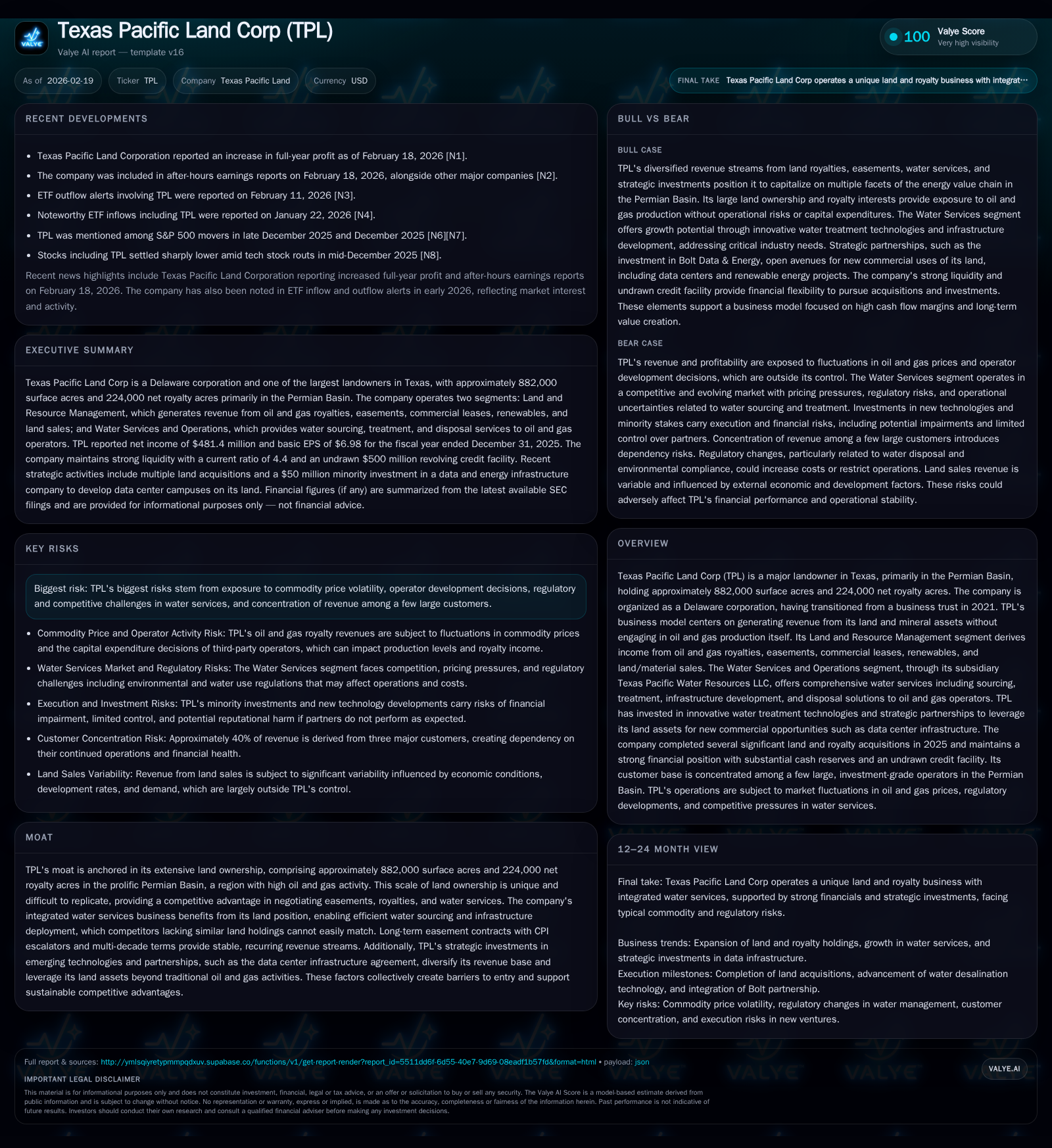
Texas Pacific Land Corp (TPL) stands as one of the largest landowners in Texas, controlling roughly 882,000 surface acres and 224,000 net royalty acres predominantly in the oil-rich Permian Basin. Historically, its revenue has been driven by oil and gas royalties, easements, leases, and mineral sales. Recently, TPL has expanded into integrated water services through its subsidiary Texas Pacific Water Resources, capitalizing on its land advantage to offer sourcing, treatment, and disposal solutions amid evolving regulatory landscapes. Additionally, strategic ventures into infrastructure for data centers signal a deliberate diversification beyond energy-based revenues. While commodity price volatility and regulatory uncertainties pose risks, TPL's strong cash flow generation, disciplined capital allocation, and enviable asset moat position it well for sustainable growth.
Company Overview
Texas Pacific Land Corporation (TPL) is an established major landowner in Texas with an extraordinary footprint of approximately 882,000 surface acres concentrated within the prolific Permian Basin — one of the world’s premier oil and gas producing regions. Additionally, TPL controls about 224,000 net royalty acres (NRA), derived from a mix of nonparticipating perpetual royalties at various fractional interests across approximately 489,000 gross acres. This unique scale of ownership encompasses surface rights and mineral interests that generate revenue streams without the company engaging directly in downstream production activities [S24][S1].
Originally structured as a trust since 1888 to hold former Texas & Pacific Railway lands, TPL converted into a Delaware corporation in early 2021 with the goal of increasing corporate governance flexibility and enhancing growth initiatives [S24].
Historical Performance Drivers
TPL’s historically consistent financial performance derives primarily from two operating segments:
Land and Resource Management: This segment reflects revenues from oil and gas royalties (~52% of consolidated revenue in 2025), fees from easements (pipeline right-of-ways with long-duration contracts often including CPI escalators), commercial leases (e.g., processing/storage facilities), renewable energy leases, sales of minerals/materials like caliche and sand used by operators during infrastructure development phases, and periodic land sales [S20][S11].
Water Services and Operations: Through wholly-owned subsidiary Texas Pacific Water Resources LLC (TPWR), TPL offers sourced water supply, produced-water treatment including disposal solutions, infrastructure construction (e.g., pipelines/facilities), plus beneficial reuse technology development. This segment accounted for roughly 38% of revenue in 2025 with notable growth driven by increased water-related activity supporting drilling completions and hydraulic fracturing operations [S23][S6].
Key historical financial metrics over recent years reveal steady expansion:
Historical performance (annual)
| FY | Net ($mm) | CFO ($mm) | OpInc ($mm) | Net YoY |
|---|---|---|---|---|
| 2025 | 481 | 546 | 592 | +6.0% |
| 2024 | 454 | 491 | 539 | +11.9% |
| 2023 | 406 | 418 | 486 | -9.1% |
| 2022 | 446 | 447 | 562 |
Note: Omitted columns lack sufficient annual XBRL coverage in the provided tags (need ≥2 annual points): Rev, Capex, FCF. Source: SEC companyfacts cache [F1].
Capital returns and efficiency (annual)
| FY | Div ($mm) | Buybacks ($mm) | ROE% |
|---|---|---|---|
| 2025 | 148 | 8 | 33.0 |
| 2024 | 347 | 29 | 40.1 |
| 2023 | 100 | 43 | 38.9 |
| 2022 | 247 | 88 | 57.8 |
Source: SEC companyfacts cache [F1].
Note: Revenue data not available within provided tags.
Operating margins remain high given the asset-light nature of the royalty business; capex is minimal relative to free cash flow generation—capped around $20 million annually mainly driven by technological investments [F1]. The company’s near-term ROE approximates a robust ~33% based on latest net income relative to stockholders’ equity.
Expansion Initiatives & Growth Catalysts
Growth going forward appears anchored first on continued leverage of its vast acreage base. Recent notable developments include:
Strategic Acquisitions: In calendar year 2025 alone, TPL acquired approximately over a combined ~26,000 net royalty acres and nearly ~8,000 surface acres primarily within key Permian regions including Midland Basin and Martin County at aggregate acquisition costs exceeding $490 million [S10]. These deals bolster both production outlooks tied to royalty revenues as well as expand footprint for ancillary commercial opportunities.
Water Services Scaling: TPWR has invested significantly in expanding water sourcing capacity alongside evolving produced-water treatment technologies such as energy-efficient desalination systems aimed at addressing environmental constraints limiting subsurface injection sites due to seismic activity regulation [S19]. Capitalized costs for R&D related to this advanced water tech amounted to approximately $38.8 million as of year-end with further facility construction expected mid-2026 completion [S19]. The strategy attempts to capture deeper value across lifecycle water needs while supporting sustainability goals.
Data Center Infrastructure Partnership: In late-2025 TPL committed $50 million in a minority stake plus strategic alliance with Bolt Data & Energy Inc., co-founded by former Google executive Eric Schmidt. The objective is to develop large-scale data center campuses on company lands leveraging low-cost power connectivity options and abundant land availability. This marks an explicit intent toward broadening revenue sources into future-facing digital infrastructure arenas beyond traditional hydrocarbons [S10].
Financial Outlook & What To Watch
Explicit forward guidance is limited but investors should monitor:
- Oil price trends: Given that roughly half revenues come from oil/gas royalties which are subject to commodity price volatility.
- Operator development activity: Delays or accelerations in drilling/completions directly impact royalties and water service demand.
- Regulatory environment: Especially around water disposal restrictions due to induced seismicity could materially affect TPWR operational scale or cost structure.
- Execution on desalination technology commercialization: Successful scaling can unlock incremental margin uplift amid sustainability pressures.
- Further land acquisitions or divestitures affecting revenue composition.
Capital Allocation & Returns
TPL maintains prudent capital management practices balancing shareholder returns with growth investments:
Cash Dividends: Payouts have fluctuated materially over recent years but remain meaningful—$148 million paid out during fiscal ’25 although down from an elevated $347 million the prior year reflecting occasional lumpiness [F1][S7]. Dividend policy is discretionary depending on cash flows and capital needs.
Share Repurchases: Buybacks declined sharply in ‘25 (~$8 million) compared with prior higher levels suggesting focus shifted toward acquisitions/investments instead [F1]. Program remains flexible but opportunistic.
Debt Management: No borrowings currently drawn under a recently established $500 million revolving credit facility maturing late-2029 providing liquidity optionality without immediate leverage pressure [S7][S28]. This conservative approach supports operational resilience.
Free cash flow remains significant after modest capex (~$18 million in ’25 excluding some capitalized R&D) yielding roughly $527 million available after operating expenses for allocation actions or reinvestment [F1].
Strategic Moat & Industry Context
TPL’s competitive advantage lies principally in its unrivaled asset scale coupled with integrated service capabilities:
- The sheer extent of surface acreage provides not only stable recurring royalty income but strong bargaining power when negotiating new easements or commercial leases.
- Full vertical integration across water sourcing/treatment/disposal via TPWR is difficult for competitors lacking geographic proximity or rights.
- Long-term contractual arrangements often feature CPI escalators sustaining inflation-adjusted revenues.
- Diverse commercial applications spanning renewables, data centers, carbon capture projects establish optionality beyond core hydrocarbons [S11][S24].
The upstream oilfield services landscape is dynamically shifting—water management increasingly critical due to environmental regulations restricting conventional options; this creates room for innovative firms like TPL equipped with proprietary tech pilots.
Risk Factors Summary
While exhibiting durable fundamentals, risks include:
- Commodity price fluctuations impacting operator decisions thereby reducing drilling/completion volume affecting royalties/water demand [S1][S15].
- Dependency on relatively few large customers (~40% revenue from top three investment-grade operators reflecting customer concentration risk) [S6].
- Regulatory changes especially those that affect produced water disposal capacity (e.g., Texas Railroad Commission’s seismic response areas) requiring business model adaptation [S16].
- Competitive pressure within emerging water services space from diversified providers possessing geographic breadth or cost efficiencies [S16].
- Operational risks inherent to estimating reserve lives impacting royalty valuations which rely on assumptions around production decline curves and recovery rates [S13].
Conclusion
Texas Pacific Land Corp exemplifies a company uniquely positioned at the intersection of substantial natural resource ownership combined with progressive diversification strategies targeting resiliency amid an evolving energy landscape. Its dominant Permian Basin acreage underpins stable cash flow generation largely insulated from direct operating costs typical in production companies. Expansion into technology-driven water solutions combined with selective real estate partnerships suggests thoughtful growth execution aligned with sustainability trends. However, stakeholders should maintain awareness around commodity cyclicality factors alongside emerging regulatory frameworks governing natural resource utilization.
This analysis is intended solely for informational purposes regarding Texas Pacific Land Corp’s business model and industry context. It does not constitute investment advice or recommendations concerning any securities.
Disclaimer: This is research-only, informational analysis and not investment advice. It may include AI-generated interpretation and general industry context. Always verify important details using primary sources.

Comments