
Occidental Petroleum’s Revenue Decline and Strategic Refocus as OxyChem Exit Nears
Occidental Petroleum posts narrowing earnings losses amid business streamlining and prepares for a pivotal asset divestiture.
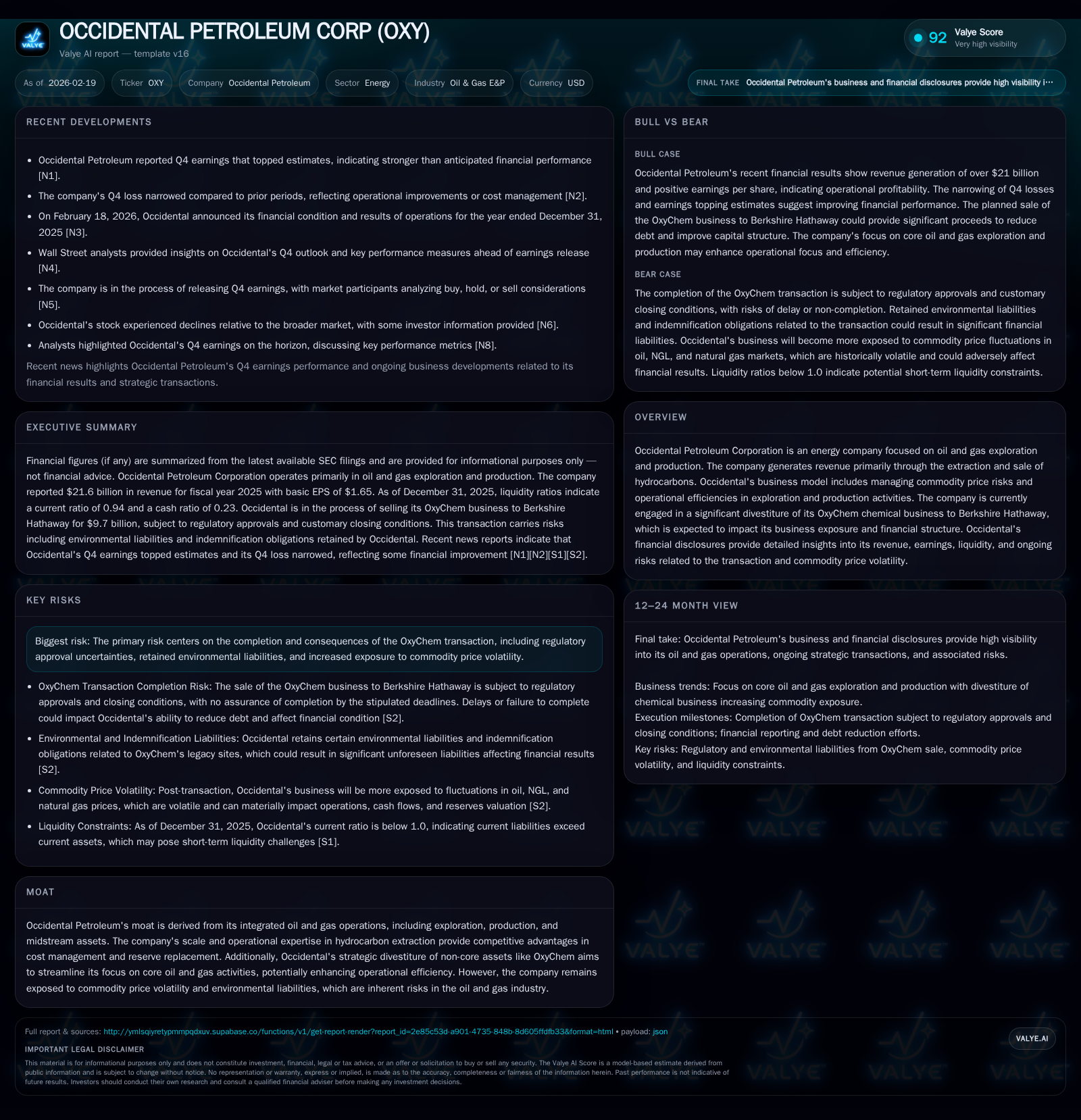
Occidental Petroleum has reported a notable narrowing of its Q4 2025 earnings losses, despite a substantial year-over-year revenue decline largely tied to the anticipated divestiture of its OxyChem chemical segment. The company’s ongoing exit from non-core assets underscores its strategic push toward concentrating on upstream oil and gas exploration and production amid increased commodity price exposure. Capital allocation trends reveal a commitment to debt reduction funded by divestiture proceeds, restrained buyback activity, and moderated capital expenditures. Risks persist around regulatory approval of the OxyChem transaction and resultant volatility in earnings tied to commodity markets.
Recent Earnings and Operational Performance Trends
In late February 2026, Occidental Petroleum reported Q4 results that surpassed expectations with a narrowed loss compared to prior quarters despite top-line softness [N1,N8,S3]. The company’s ability to generate strong operating cash flows amidst shrinking revenues showcased operational resilience within core upstream activities. Adjustments implemented during the quarter improved cost structures and mitigated some headwinds from lower commodity prices affecting total sales volumes.
The quarterly earnings beat contrasts sharply with a declining revenue trend across FY2025 as divestitures reshaped the business. Operating efficiencies partially offset top-line pressures, demonstrating Occidental’s focus on expense control even amid restructuring.
Declining Revenues and Profitability: Root Causes and Year-on-Year Dynamics
Fiscal year 2025 ended with revenue of approximately $21.6 billion, down nearly 19.2% from $26.7 billion in FY2024 [F1]. This steep contraction reflects principally the upcoming sale of the OxyChem division, which historically contributed diversified revenue streams beyond oil and gas exploration and production. Losing this industrial chemical business has exposed Occidental more directly to the volatility of commodity prices in hydrocarbon markets.
Net income suffered disproportionately with a plunging 64.7% drop compared to the prior year, illustrating tighter upstream margins compounded by diminished downstream contributions [F1]. Capital expenditures were prudently reduced by about 8.4%, signaling restrained investment aligned with rationalizing asset portfolios during transitional phases.
The year-over-year operating cash flow decreased by roughly 7.9%, yet remained solid at over $10 billion – underscoring the underlying strength in upstream production economics where reserve replacement costs remain competitive relative to peers [F1]. The company’s midstream integration approach helped optimize cost efficiency but now faces headwinds with less industrial diversification.
OxyChem Divestiture: Implications for Business Focus and Commodity Exposure
The agreement signed on October 1st, 2025 to sell OxyChem for $9.7 billion in equity before customary financial adjustments signals Occidental’s deliberate pivot towards its core oil & gas E&P operations [S2]. Completion is contingent upon regulatory consents that currently introduce timing uncertainty up to a potential extension through June 2026.
Beyond a refined strategic footprint focused on production growth and reserve replenishment, the divestiture simplifies capital allocation and accelerates debt repayment plans financed by after-tax proceeds from the sale [S2,S6]. However, shedding the chemicals business amplifies exposure to commodity market fluctuations—prices for crude oil, NGLs, and natural gas are known for pronounced volatility affecting both operating revenues and cash flow stability.
Environmental liabilities retention associated with the sale introduces legal risk considerations that may manifest in contingencies or unforeseen costs impacting financial statements even post-closing [S4,S5].
Capital Allocation: Debt Reduction, Cash Flow Management, and Shareholder Returns
Capital deployment in FY2025 reflected disciplined management: capex contracted by approximately $599 million or -8.4%, aligning investment with streamlined operational priorities [F1]. The absence of share repurchases in fiscal 2025 contrasted against modest buybacks in previous years suggests liquidity conservation amid transition phases rather than yield enhancement via capital return programs.
Dividend payments remained relatively consistent through FY2025 signaling a commitment to baseline shareholder returns despite earnings pressures [F1]. Free cash flow (operating cash flow minus capex) stood near $4.1 billion supporting substantial capacity for accelerated debt reduction promised as part of strategic use of sale proceeds from OxyChem.
Return on equity approximated at 13% based on trailing net income over stockholders’ equity highlights moderate profitability efficiency considering cyclical commodity challenges and structural recalibration underway [F1]. This portfolio rationalization may improve cost of capital over time if debt paydown milestones meet expectations.
Historical Financial Performance Overview
Historical performance (annual)
| FY | Rev ($bn) | Net ($bn) | CFO ($bn) | Capex ($bn) | Rev YoY | Net YoY |
|---|---|---|---|---|---|---|
| 2025 | 21.6 | 10.5 | 6.4 | -19.2% | ||
| 2024 | 26.7 | 11.4 | 7.0 | -5.4% | ||
| 2023 | 28.3 | 4.7 | 12.3 | 6.3 | -22.9% | -64.7% |
| 2022 | 36.6 | 13.3 | 16.8 | 4.5 |
Note: Omitted columns lack sufficient annual XBRL coverage in the provided tags (need ≥2 annual points): OpInc, Div. Source: SEC companyfacts cache [F1].
Capital returns and efficiency (annual)
| FY | Buybacks ($bn) | FCF ($bn) | ROE% |
|---|---|---|---|
| 2025 | 0.0 | 4.1 | |
| 2024 | 0.0 | 4.4 | |
| 2023 | 1.8 | 6.0 | 15.5 |
| 2022 | 3.1 | 12.3 | 44.2 |
Source: SEC companyfacts cache [F1].
Note: Net income annual figures for recent years are only partially available; dividends/paybacks omitted where data is insufficient or missing for recent periods per provided tags [F1].
Risks Remaining: Regulatory Challenges and Market Volatility After OxyChem Sale
Completion of the OxyChem deal remains subject to customary closing conditions including complex global antitrust reviews alongside U.S.-specific regulatory approvals potentially delaying or derailing anticipated timelines beyond March/June 2026 deadlines [S2,S4]. Failure could disrupt planned accelerated deleveraging strategies thereby increasing Occidental's weighted average cost of capital.
Further lingering exposures include retained environmental liabilities detailed in risk factors sections of filings that may expose Occidental to remediation expenses or litigation over formerly held chemical assets post-sale closure [S4,S5].
With diminished asset diversity following exit of chemicals operations, earnings will likely exhibit elevated sensitivity to oil/NGL price swings complemented by natural gas market fluctuations universally noted for their inherent volatility—factors jointly heightening reported earnings uncertainty ahead [S2,S5].
Outlook: What Investors Should Watch in Upcoming Quarters
Key upcoming milestones for market attention revolve around final regulatory clearances authorizing transfer of OxyChem ownership expected possibly extending into Q2-Q3 calendar year 2026 given complexity noted [N3,N9]. Early impacts on Occidental's leverage profile post-closing will signal success of strategic capital redeployment intended primarily toward meaningful debt reduction financed by transaction proceeds [S6,N6].
Commodity price trajectories remain pivotal — price recovery or deterioration in oil/NGL markets will disproportionally affect earnings per share given the new streamlined portfolio lacking cushioning downstream sectors [N3,N9].
Operational execution must maintain stable production performance while integrating optimized reserve replacement tactics amid evolving upstream economics characterized by ongoing emphasis on tightening per-barrel costs through midstream integration approaches enhancing throughput efficiency.
Continuous evaluation will be necessary around legal contingencies from environmental liabilities associated with prior chemical operations potentially subjecting financial results to episodic charges or reserve augmentations as litigations develop or comply regulatory requirements evolve.
-- This analysis is based solely on publicly available disclosures including SEC filings dated February 18th, 2026, accompanied news releases and historical financial data snapshots captured therein. It does not constitute investment advice or recommendations but aims for objective examination grounded within reported facts.
Disclaimer: This is research-only, informational analysis and not investment advice. It may include AI-generated interpretation and general industry context. Always verify important details using primary sources.

Comments