
NewAmsterdam Pharma’s Clinical Progress and Financial Trajectory in LDL Cholesterol Therapy
Obicetrapib’s advanced clinical results, strategic partnerships, and financial management position NewAmsterdam Pharma at a pivotal stage amid continuing development costs and regulatory scrutiny.
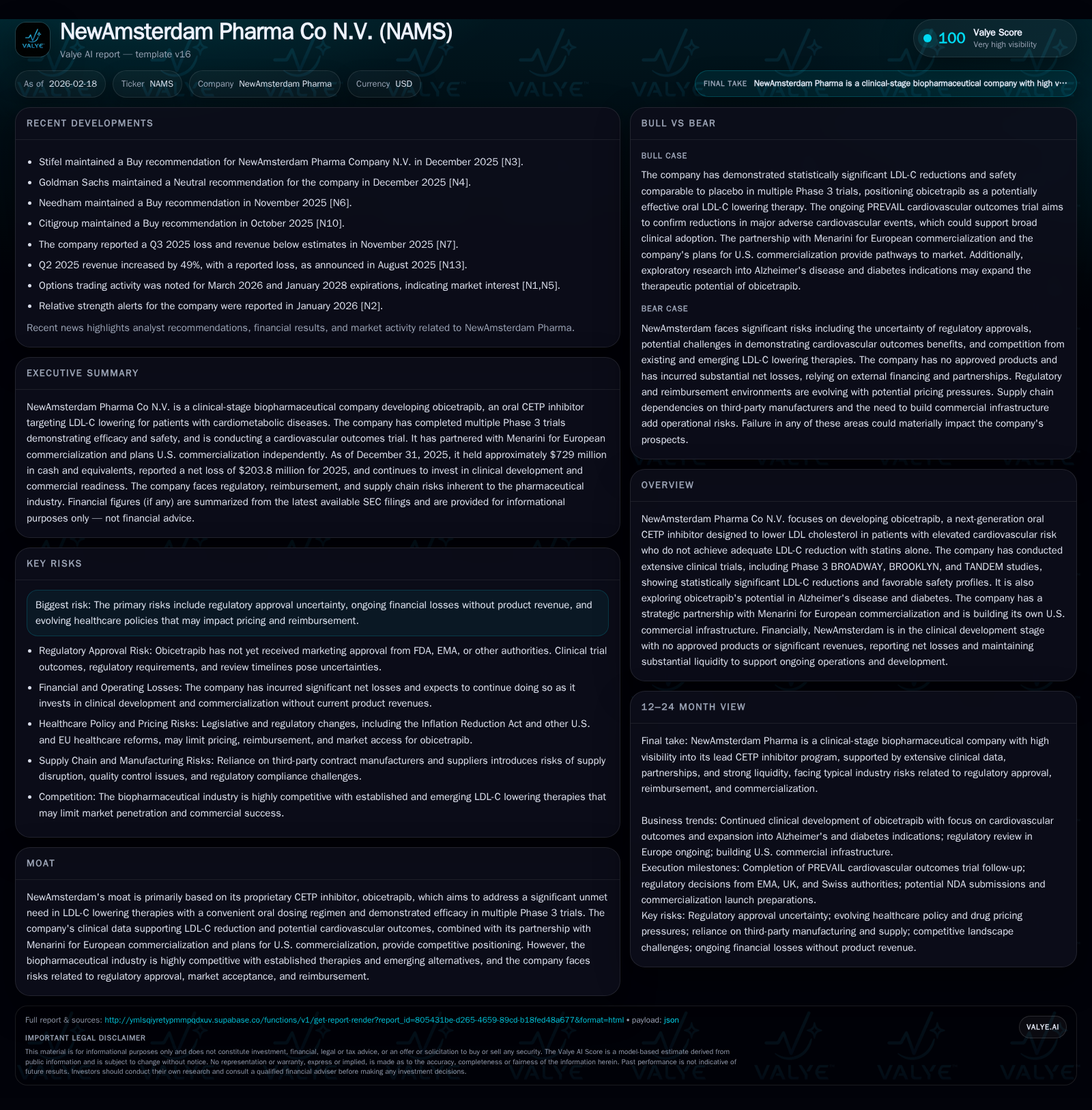
NewAmsterdam Pharma Co N.V. is advancing obicetrapib, a next-generation oral CETP inhibitor targeting LDL cholesterol reduction in patients inadequately served by current statins. Clinical data from multiple Phase 3 trials demonstrate meaningful LDL-C lowering and favorable safety, underpinning ongoing cardiovascular outcome studies and exploration into other indications. Despite no product revenue and sustained net losses, the company maintains a strong liquidity position to fund development and US commercial infrastructure buildout. The partnership with Menarini for European commercialization complements its US strategy but regulatory and healthcare policy risks remain significant headwinds. Investors will closely monitor PREVAIL CVOT readouts and regulatory filings for commercial viability milestones.
Clinical Development Milestones and Historical Performance
NewAmsterdam Pharma has focused its development efforts on obicetrapib, an oral cholesteryl ester transfer protein (CETP) inhibitor designed to lower low-density lipoprotein cholesterol (LDL-C), a well-validated surrogate biomarker linked to the risk of major adverse cardiovascular events (MACE). Unlike first-generation CETP inhibitors which either had limited efficacy or safety issues, obicetrapib shows promise as a next-generation agent with potent LDL-C lowering ability when used adjunctively with high-intensity statins.
Across pivotal Phase 3 trials—BROADWAY and BROOKLYN—obicetrapib met both primary and secondary endpoints showing statistically significant LDL-C reductions exceeding 20%. Safety profiles revealed tolerability similar to placebo with no significant increases in muscle-related adverse effects or treatment-emergent serious adverse events (TESAEs). The TANDEM study further showcased efficacy in combination with ezetimibe as an adjunct to statins, reinforcing the potential for fixed-dose combinations to improve patient adherence via oral once-daily dosing.
In Phase 2 trials (TULIP, ROSE, OCEAN, ROSE2, and Japan Phase 2b), obicetrapib demonstrated consistent LDL-C reductions either as monotherapy or combined with ezetimibe. These aggregate clinical findings from over 3,500 patients affirm obicetrapib's profile that supports further cardiovascular indications exploration including potential applications in Alzheimer's disease given CETP’s role in lipid metabolism involved in neurodegenerative pathways [S1].
Crucially, LDL-C lowering by CETP inhibition has precedent for MACE risk reduction via the REVEAL trial for anacetrapib. NewAmsterdam's exploratory data from BROADWAY indicate approximately a 21% reduction in composite MACE components including coronary death and non-fatal myocardial infarction. The ongoing PREVAIL Phase 3 cardiovascular outcomes trial serves as a confirmatory evaluation of obicetrapib’s impact on hard clinical endpoints essential for regulatory approval and payer acceptance.
Evolution of Financial Results and Operating Metrics
NewAmsterdam remains fully entrenched in clinical-stage operations without approved products or revenues. The financials portray a scale-up of operational intensity as trials progress through late-stage development and preparatory steps for commercialization unfold.
Historical performance (annual)
| FY | Net ($mm) | CFO ($mm) | OpInc ($mm) | Capex ($) | Net YoY |
|---|---|---|---|---|---|
| 2025 | -204 | -148 | -226 | 246000 | +15.6% |
| 2024 | -242 | -159 | -176 | 672000 | -36.5% |
| 2023 | -177 | -141 | -183 | 24000 |
Note: Omitted columns lack sufficient annual XBRL coverage in the provided tags (need ≥2 annual points): Rev, Div, Buybacks. Source: SEC companyfacts cache [F1].
Capital returns and efficiency (annual)
| FY | FCF ($mm) | ROE% |
|---|---|---|
| 2025 | -148 | -29.8 |
| 2024 | -159 | -31.9 |
| 2023 | -141 | -61.4 |
Source: SEC companyfacts cache [F1].
Note: Revenue data unavailable due to pre-commercialization status.
Operating losses deepened from $182.9 million in FY2023 to $225.7 million in FY2025 reflecting greater R&D expenditures tied to clinical advancement activities including PREVAIL initiation and expanded manufacturing/supply chain investments [F1][S1]. However, net losses exhibited some improvement by nearly 16% from prior year despite rising operating expenses suggesting beneficial non-operating income or expense items.
Negative operating cash flow hovered near $140-$160 million annually with modest capital expenditures indicative of reliance on third-party manufacturing rather than heavy fixed asset investments typical of clinical-stage biopharma companies focusing capital deployment on trials rather than infrastructure [F1]. The company reported stockholders' equity growth due mainly to recent financings at $683 million year-end 2025.
Approximate return on equity (ROE) remains deeply negative at ~-30%, underscoring the developmental stage wherein shareholder capital funds innovation absent earnings [F1]. There have been no dividends or share repurchases declared or conducted owing to prioritization of cash preservation for research operations.
Obicetrapib’s Potential Market Position and Strategic Partnerships
Despite widespread statin use worldwide, a substantial proportion of patients with elevated cardiovascular risk fail to reach target LDL-C levels due to intolerance or residual hyperlipidemia refractory to existing therapies such as PCSK9 monoclonal antibodies that require injections biweekly or monthly altering patient compliance negatively [S1].
Obicetrapib aims to fill this gap by offering a convenient once-daily oral therapy capable of delivering clinically meaningful LDL-C reductions when added to optimized statins potentially improving adherence through fixed-dose combinations (FDCs) with ezetimibe which itself modestly lowers cholesterol . This positioning could facilitate reimbursement coverage as adjunct therapy for suboptimal responders.
Commercially, NewAmsterdam has licensed rights for European markets to Menarini Group who will oversee all local development activities including marketing authorization filing strategies across countries in their designated geographies [S1]. Separately, NewAmsterdam is assembling its U.S.-based sales force targeting cardiologists and lipid specialists recognizing the complexity of introducing novel LDL-C agents that compete within heavily managed care formularies.
This bifurcated strategy reflects common industry practice for biotech firms at late clinical stages leveraging partner expertise abroad while retaining critical control stateside where market access dynamics are particularly complex due to PBM contracts/payer negotiations . Obicetrapib's differentiation leans heavily on oral dosing convenience alongside robust efficacy/safety demonstrated clinically.
Regulatory Environment and Product Approval Risks
NewAmsterdam confronts multifaceted regulatory hurdles across jurisdictions involving FDA in the U.S., EMA in Europe, along with other national agencies [S4][S5][S6]. Regulatory approval depends not only on robust demonstration of safety/efficacy but also stringent enforcement around promotion communications prior to approval under U.S. law prohibiting off-label claims or premature marketing that could incur warning letters or sanctions adversely affecting reputation.
Emerging U.S health policy reforms introduce additional uncertainty notably Medicare Most Favored Nation (MFN) price negotiation models effective progressively from 2026 onward impacting single-source drug pricing subject to negotiation ceilings potentially compressing future revenues upon launch [S6][S15][S18]. Manufacturers must also navigate Medicaid rebate recalculations under ACA amendments potentially increasing cost liabilities alongside state-level pricing controls further complicating reimbursement landscapes.
Advertising restrictions extend into EU territories where direct-to-consumer prescription drug ads are prohibited necessitating careful compliance with national anti-bribery laws governing physician engagement limiting incentive inducements [S7][S8][S11]. Failure in compliance can attract serious civil/criminal penalties compounding operational challenges before full market access realization.
Post-approval commitments including continuing safety monitoring (pharmacovigilance), manufacturing cGMP compliance audits, REMS programs if required impose recurrent obligations adding cost burden [S23][S24]. Such complex layers imply execution risks remain material despite promising clinical profiles.
Anticipated Clinical Endpoints and Commercial Launch Readiness
Central near-term catalyst rests on the PREVAIL cardiovascular outcomes trial aiming at definitive evidence linking obicetrapib's LDL-C lowering effect with meaningful MACE reduction—a gold standard endpoint pivotal for broad clinician adoption and payor willingness to reimburse expensive adjunct therapies [S1]. Achievement of statistically significant CV endpoint improvement would bolster label claims enabling marketing beyond surrogate marker claims elevating commercial prospects substantially.
Secondary indications such as diabetes comorbidity management or Alzheimer's disease mitigation represent potential pipeline expansion pathways hinging on CETP biology but are currently exploratory requiring additional validation before materializing into marketable products.
Commercial launch preparations encompass integration of Menarini's regional marketing capabilities alongside internal U.S. sales team structuring involving hiring experienced field representatives specialized in lipidology plus formulary access strategists primed ahead of anticipated regulatory approvals [S1].
Investors should monitor NDA/BLA submission timelines post-PREVAIL results release alongside FDA/EMA advisory committee review dates which dictate subsequent marketing authorization award schedules influencing revenue inflection points later forecasted .
Capital Allocation, Balance Sheet Strength, and Return Metrics
As of December 31, 2025, NewAmsterdam held approximately $490 million in cash and cash equivalents against current liabilities under $86 million yielding a strong current ratio near 7.9x reflective of solid short-term liquidity underpinning operational continuity [F1]. Capital expenditure levels remain modest (<$0.3 million annually) consistent with outsourcing manufacturing versus asset-heavy builds.
Consistent negative free cash flows approximating $148 million (operating cash flow minus capex) emphasize ongoing dependency on equity financings characteristic for clinical biopharma devoid of revenue streams yet investing heavily into critical late-stage trials [F1][S1]. No dividends or share repurchase programs have been initiated given prioritization toward funding R&D programs plus US commercial infrastructure rollouts rather than returning capital prematurely [F1].
This disciplined capital allocation aligns closely with typical sector patterns where early biotech companies maintain burn rates driven primarily by trial costs while preserving optionality via large cash buffers extending runway beyond two years assuming no material unexpected expenses emerge.
ROE remains negative at nearly -30%, illustrating absence of profitability attributable predominantly to net losses exceeding $200 million annually driven by intensive investment into clinical development infrastructure pre-commercialization phase gains [F1]. Thus, shareholder returns are currently tied more tightly to successful value creation from pipeline progress than operational earnings.
Key Risks from Healthcare Policy and Competitive Dynamics
The principal risks confronting NewAmsterdam encompass FDA/EMA regulatory approval uncertainties including potential delays triggered by requests for additional data or unfavorable safety signals; cost-based restrictions imposed by US federal/state healthcare reforms; evolving pricing rules like Medicare’s MFN negotiations causing downward pressure on realized prices post-launch; plus intensified scrutiny around pre-approval promotional activities risking fines if guidelines are breached inadvertently .
Competitive forces include entrenched statin therapies that dominate baseline lipid lowering globally complemented by monoclonal antibodies targeting PCSK9 receptors showing deep LDL-C reductions though at higher cost with injectable delivery limiting uptake among some patients . Emergence of novel modalities like RNAi therapeutics heightens landscape complexity putting premium on differentiators such as superior tolerability profile, oral route convenience offered by obicetrapib.
Payor challenges loom large since inclusion on formularies requires demonstration beyond surrogate LDL improvements encompassing hard CV outcomes alongside cost-effectiveness validations constraining uptake if pricing is deemed excessive relative to alternatives . Compliance burdens related to federal anti-kickback statutes amplify operational overhead requiring constant oversight.
Outlook: What Investors Should Monitor Next
Key near-term milestones include completion timelines for PREVAIL Phase 3 CVOT expected within upcoming fiscal years with interim analysis readouts potentially serving as pivotal valuation triggers . Parallel efforts will focus on preparing NDA submissions leveraging positive results from BROADWAY/BROOKLYN/TANDEM cohorts coupled with supportive safety databases establishing dossier completeness critical for FDA review success.
Commercial execution markers involve Menarini advancing filings/launch plans within Europe followed by progressive scale-up within US specialty sales teams signaling readiness levels which presage revenue ramp opportunities post-approval while burn rate sustainability remains linked closely with these developmental/commercial bridging expenses measured against existing liquidity cushions estimating runway through mid-late 2027 absent major financing events [F1] [N1][N2][S3].
Fluctuations in healthcare policies around drug pricing reform warrant vigilance given potential impacts altering reimbursement terms unpredictably affecting margin profiles enjoyed by new entrants post-launch . Specialist prescribing dynamics amidst an increasingly crowded cardiovascular space demand continued innovation communication strategies enhancing physician engagement informing competitive positioning evolution continuously.
Disclaimer: This report is provided solely for informational purposes based on publicly available filings and news sources as cited herein; it does not constitute investment advice or recommendations regarding NewAmsterdam Pharma Co N.V.'s securities or business prospects.
Disclaimer: This is research-only, informational analysis and not investment advice. It may include AI-generated interpretation and general industry context. Always verify important details using primary sources.

Comments