
From Title Plants to Tech Edge: First American’s Blueprint for Sustained Growth
First American Financial leverages proprietary title plants and AI-driven digital transformation to drive robust growth and operational efficiency.
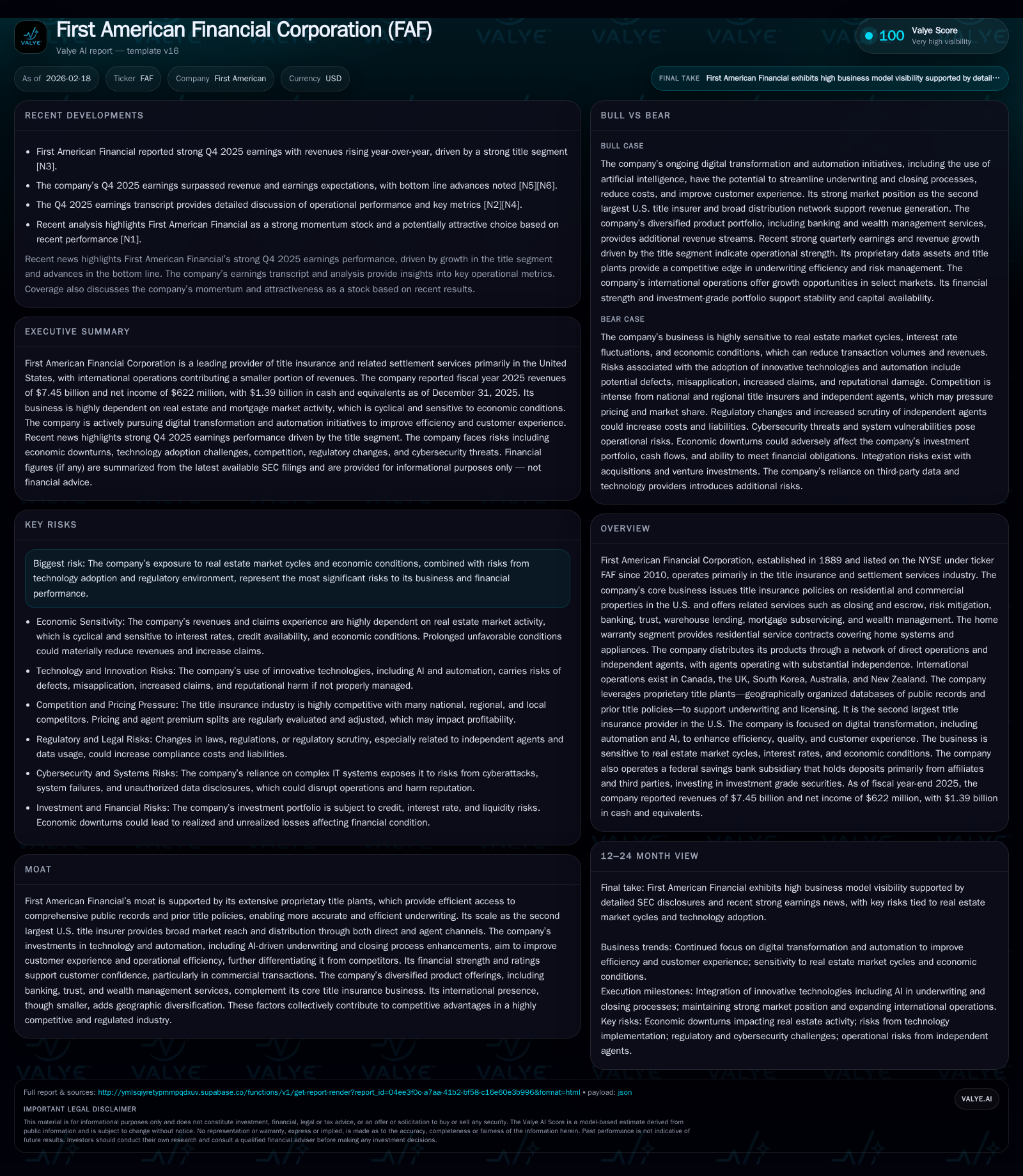
First American Financial Corp (FAF), the second largest U.S. title insurer, posted a notable revenue rebound in 2025 fueled by strong title insurance performance and enhanced operational efficiencies from its digital initiatives. Proprietary title plants remain a core competitive advantage enabling faster, more accurate underwriting while strategic capital allocation supports sustained shareholder returns. The company balances growth with risks tied to real estate cyclicality and evolving regulatory scrutiny, as it pushes forward with innovation and geographic expansion. Key financials highlight healthy cash flow generation, rising equity, and disciplined dividends and buybacks.
Revenue and Profit Recovery in 2025: Examining the Turnaround
First American Financial Corp demonstrated a sharp financial recovery in fiscal year 2025 after a period of relative stagnation. Revenue jumped to $7.45 billion, marking a 21.6% increase over the $6.13 billion reported in 2024 [F1]. This surge contrasted with essentially flat revenues between 2023 ($6.00 billion) and 2024 [F1]. Net income posted an even more pronounced reversal, soaring to $622 million in 2025—a staggering rise of approximately 374% compared to $131 million the previous year [F1]. This rebound was underpinned by strong demand for the company's core title insurance products amid relatively stable U.S. residential real estate markets.
Q4 earnings commentary confirmed this momentum with beats on both top- and bottom-line estimates, attributing gains primarily to increased transaction volumes and improved underwriting outcomes within the title segment [N1][N2]. Operational improvements including process automation also contributed positively by reducing costs and shortening closing cycles.
Title Insurance and Settlement Services: The Core Growth Engine
The title insurance and settlement services segment dominates FAF's revenue profile, accounting for over 93.6% of consolidated sales in 2025 [S8]. This segment encompasses issuance of title insurance policies on both residential and commercial properties across the United States, complemented by international operations contributing about 7.6% of segment revenues [S16][S18]. Distinctive features include proprietary geographically organized title plants—comprehensive databases indexing public records by location rather than party names—that enhance search efficiency and undergird faster policy issuance [S18].
Beyond insurance underwriting, FAF offers escrow services integral to closing processes where it manages the secure handling of funds until transaction completion—a critical touchpoint ensuring timeliness and compliance [S8]. Additional related offerings such as warehouse lending facilities support mortgage originators’ liquidity needs while trust, wealth management, and banking services further diversify revenue streams [S15]. The sizable network of independent agents operates with substantial autonomy but benefits from FAF's marketing support focused on pricing competitiveness, underwriting consistency, and technology access [S16].
Digital Transformation and Proprietary Title Plants: Enhancing Operational Efficiency
FAF continues investing heavily in digital innovation aimed at streamlining traditionally paper-intensive processes intrinsic to real estate transactions. Artificial intelligence plays an increasingly pivotal role in automating underwriting decisions that were formerly manual—reducing human error while accelerating turnaround times [S6][S8]. Automated closing workflows simplify communication among stakeholders including buyers, sellers, lenders, agents, attorneys, contributing to improved customer satisfaction metrics.
The value of FAF's proprietary title plants extends beyond internal efficiency gains—they are leveraged commercially through licensing arrangements granting other industry participants access to their curated datasets [S18]. Expansion of these data assets coupled with advanced analytic tools enhances fraud detection capabilities along with compliance monitoring.
Managing Market Cycles and Regulatory Risks
Real estate market cyclicality remains a central risk factor given FAF's dependence on transaction volumes driven by housing purchases, refinances, and commercial deals [S19]. Residential activity fluctuates seasonally with slower winter months followed by spring/summer upticks but remains vulnerable to interest rate changes impacting mortgage originations.
Regulatory complexity has intensified with growing oversight from state insurance departments, CFPB, federal banking regulators overseeing FAF’s savings bank subsidiary as well as international jurisdictional authorities affecting overseas operations [S4][S5][S11][S24]. Title insurance rates are subject to state-level approval processes limiting rapid price adjustment agility which could compress margins in downturns or fast-moving markets [S26][S29]. Additionally, data privacy laws impose significant compliance costs; failure risks fines or litigation.
Legal exposure factors include ongoing class action lawsuits across jurisdictions targeting alleged violations or business practices—all underscoring the need for robust enterprise risk frameworks that integrate centralized oversight with local underwriting authority distributed across various levels within FAF’s organizational structure [S2][S23].
Capital Allocation Priorities: Dividends, Buybacks, and Investment Strategy
FAF maintained consistent capital return discipline during its growth phase. Dividends paid reached approximately $223 million in 2025 versus $221 million in 2024—reflecting stability amid earnings gains [F1]. Share repurchases nearly doubled year-over-year from $68.5 million to $122 million as management balanced returning excess capital with strategic reinvestment commitments.
The company also holds a venture investment portfolio targeting emerging real estate technology firms complementing its core competencies without diluting focus—positioned as strategic ecosystem plays rather than primary profit centers [S6][S7]. With return on equity running near 11.3% based on trailing twelve months net income against stockholders’ equity at ~$5.5 billion end-2025, FAF demonstrates moderate capital efficiency consistent with its asset-heavy business model [F1].
Financial Metrics Spotlight: Cash Flow Strength and Return on Equity
Underlying EBITDA or operating income figures are not disclosed explicitly in available filings; however, net cash provided by operating activities advanced steadily by almost 6% year-on-year reaching roughly $951 million in fiscal 2025—from $898 million a year earlier—emphasizing solid recurring free cash flow generation capacity [F1]. Capital expenditures declined about 14%, down to $188 million supporting technology upgrades but reflecting disciplined spending focus relative to past years’ ~$260 million baseline [F1]. Estimated free cash flow (operating cash flow less capex) thus approximates $763 million for the year.
Equity base expanded consistently over four years from $4.66 billion in 2022 to $5.50 billion at end-2025 supporting stable capitalization amid growth investments; this scale underpins FAF’s strong insurer ratings which favorably influence commercial underwriting credibility across large transactions [F1][S15][S28].
Historical performance (annual)
| FY | Rev ($bn) | Net ($mm) | CFO ($mm) | Capex ($mm) | Rev YoY | Net YoY |
|---|---|---|---|---|---|---|
| 2025 | 7.5 | 622 | 951 | 188 | +21.6% | +374.3% |
| 2024 | 6.1 | 131 | 898 | 218 | +2.1% | -39.5% |
| 2023 | 6.0 | 217 | 354 | 263 | -21.1% | -17.6% |
| 2022 | 7.6 | 263 | 780 | 260 |
Note: Omitted columns lack sufficient annual XBRL coverage in the provided tags (need ≥2 annual points): OpInc. Source: SEC companyfacts cache [F1].
Capital returns and efficiency (annual)
| FY | Div ($mm) | Buybacks ($mm) | FCF ($mm) |
|---|---|---|---|
| 2025 | 223 | 122 | 763 |
| 2024 | 221 | 69 | 679 |
| 2023 | 217 | 73 | 91 |
| 2022 | 217 | 441 | 520 |
Source: SEC companyfacts cache [F1]. Note: "YoY %" columns represent Year-over-Year percentage changes; "-" denotes insufficient prior data.
What to Watch in Upcoming Earnings and Strategic Moves
Looking forward into the remainder of the earnings cycles for early-to-mid-2026, important indicators include monitoring progression on FAF’s digital transformation initiatives—specifically integration of AI-driven underwriting modules—as well as evaluation of recent acquisition impacts boosting footprint or data repositories [N8][N11][S3]. Regulatory developments around data security standards or state insurance rate approvals may impact pricing strategies or capital deployment flexibility.
Mortgage market dynamics remain crucial barometers; volume fluctuations tied to interest rate movements directly affect core title premium inflows warranting close observation given their outsized revenue contribution.
This analysis is based on publicly available financial disclosures including SEC filings (10-K/10-Q/8-K), recent news reports dated through February 18, 2026, alongside company facts XBRL numerical data as cited. It does not constitute investment advice but aims to provide a rigorous review of First American Financial Corporation's business model evolution, financial performance trends, operational strengths leveraging proprietary data assets & technologies, as well as associated risks inherent within real estate-related financial services sectors.
Disclaimer: This is research-only, informational analysis and not investment advice. It may include AI-generated interpretation and general industry context. Always verify important details using primary sources.

Comments