
Expand Energy Corp’s Remarkable Turnaround and Growth Rebound
EXE's post-merger performance in 2025 showcased a sharp recovery through expanded shale operations and disciplined capital management.
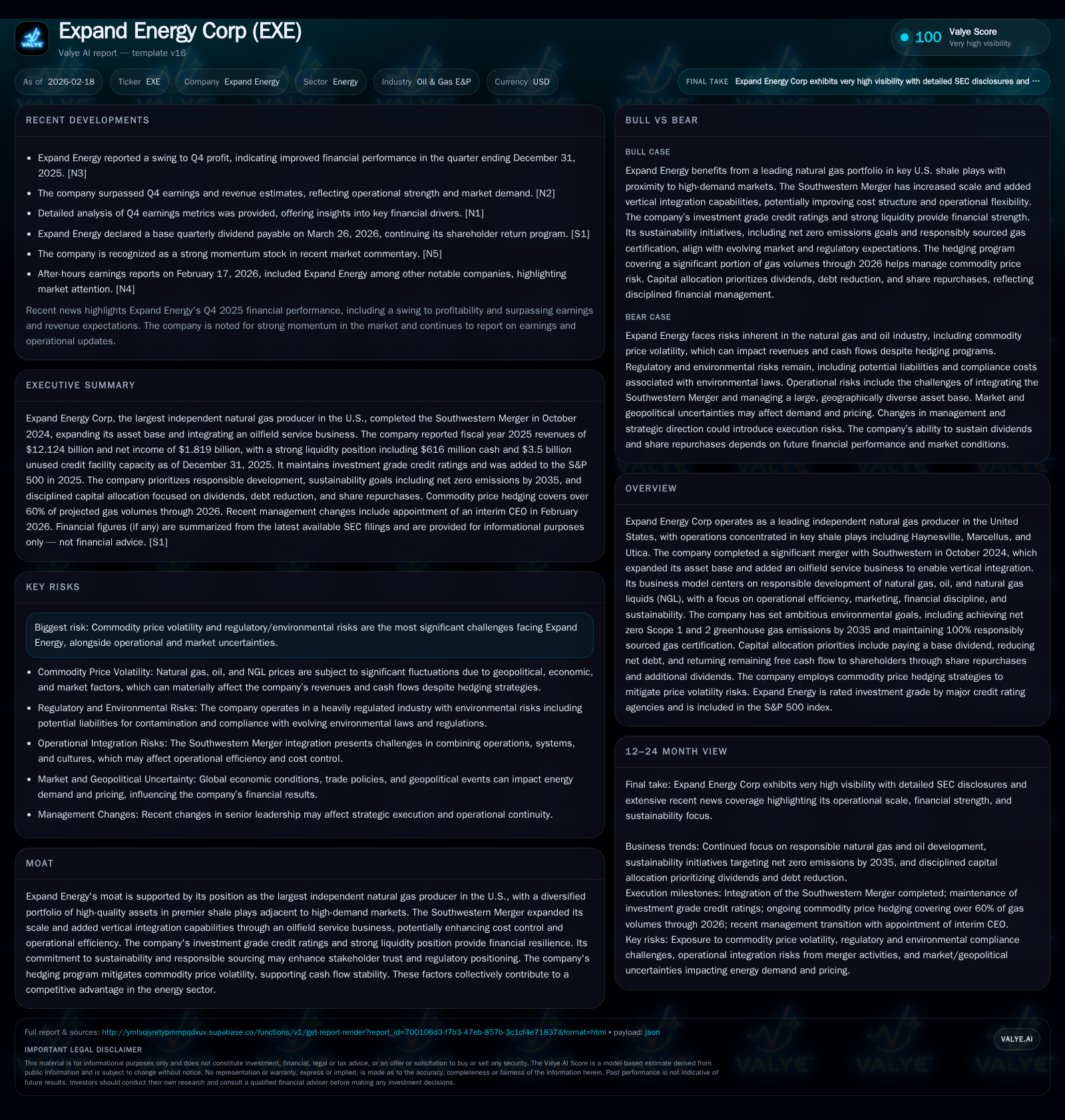
Expand Energy Corp (EXE) delivered a striking financial turnaround in 2025 following its strategic merger with Southwestern in late 2024. Revenue nearly tripled year over year to $12.1 billion, operating income swung from a deep loss to a $2.47 billion profit, and net income turned positive by $1.82 billion, highlighting operational leverage and synergy realization. The expanded asset footprint across premier U.S. shale plays combined with vertical integration of oilfield services underpinned cost efficiencies and margin improvements. EXE maintained capital discipline by prioritizing base dividends and debt reduction while allocating incremental free cash flow to share repurchases. Sustained sustainability commitments support regulatory positioning but commodity price volatility and environmental risks remain key challenges.
From Struggles to Strength: EXE’s Financial Recovery in 2025
Expand Energy Corp demonstrated an impressive financial turnaround in fiscal year 2025 following a challenging performance in 2024 marked by operating losses. The company’s revenue jumped nearly threefold, climbing from $4.24 billion in 2024 to $12.12 billion in 2025 — an increase of approximately 186.3% year over year [F1]. This sharp revenue expansion was underpinned by the October 2024 merger with Southwestern, which significantly enlarged EXE’s asset base.
More strikingly, operating income swung from a sizable loss of $803 million in 2024 to a robust profit of $2.47 billion in the subsequent year, representing an over 400% improvement [F1]. Net income followed suit, rebounding from a negative $714 million to a positive $1.82 billion — signaling recovery beyond core operations into bottom-line profitability [F1]. These results underscored how the company leveraged its expanded scale alongside improved commodity prices and operational execution.
Historical performance (annual)
| FY | Rev ($bn) | Net ($bn) | CFO ($bn) | OpInc ($bn) | Rev YoY | Net YoY |
|---|---|---|---|---|---|---|
| 2025 | 12.1 | 1.8 | 4.6 | 2.5 | +186.3% | +354.8% |
| 2024 | 4.2 | -0.7 | 1.6 | -0.8 | -51.4% | -129.5% |
| 2023 | 8.7 | 2.4 | 2.4 | 3.1 | -25.7% | -51.0% |
| 2022 | 11.7 | 4.9 | 4.1 | 3.8 |
Note: Omitted columns lack sufficient annual XBRL coverage in the provided tags (need ≥2 annual points): Capex. Source: SEC companyfacts cache [F1].
Capital returns and efficiency (annual)
| FY | Div ($mm) | Buybacks ($mm) | FCF ($bn) |
|---|---|---|---|
| 2025 | 765 | 100 | 1.8 |
| 2024 | 388 | 0 | 0.0 |
| 2023 | 487 | 355 | 0.6 |
| 2022 | 1212 | 1073 | 2.3 |
Source: SEC companyfacts cache [F1].
Note: Buybacks data for FY2024 shown as zero due to no repurchases reported.
Operational Backbone: Shale Assets and Vertical Integration Synergies
EXE's operational strength is anchored in its diverse portfolio across major U.S shale basins — notably the Haynesville, Marcellus, and Utica plays — regions known for their prolific natural gas reserves adjacent to key markets [S7][S18]. The merger with Southwestern not only broadened this footprint but importantly brought an oilfield services business under EXE's umbrella [S7][S18]. This vertical integration is critical: it reduces reliance on third-party contractors, enables better cost control on completion services, and improves supply chain coordination — all crucial levers for lowering unit production costs and enhancing operating leverage.
From an upstream capital intensity perspective, expanding vertically allows EXE to capture efficiencies especially when maintaining or ramping rig counts across multiple basins simultaneously [S26]. For example, upstream integration can mitigate exposure to input cost inflation seen frequently with specialized frac services or equipment rentals.
Revenue and Income Transformations: Drivers Behind the Surge
The near-tripling of revenue emanated largely from increased production volumes after incorporating Southwestern's assets and higher realized commodity prices stabilized through hedging programs designed to protect cash flow downside while allowing upside participation [N3][N11][S6]. According to recent earnings commentary, hedge positions cover over 60% of projected natural gas volumes into late-2026 using structures like costless collars that smooth price shocks [S6].
Moreover, notable was the swing from negative to positive operating income linked partly to favorable mark-to-market adjustments on derivatives tied to natural gas and NGL pricing [N11]. This prudently constructed hedge book has thus complemented physical volume growth with stabilized revenue streams against price volatility typical within E&P sectors.
Sustainability Commitments Impacting Long-Term Operations
EXE’s strategic vision extends beyond immediate financial gains toward embedding sustainability as a competitive moat [S15][S16]. The company has committed ambitiously to achieving net zero Scope 1 and Scope 2 greenhouse gas emissions by the year 2035 while maintaining certification for sourcing all produced gas responsibly [S15][S16].
These environmental benchmarks not only address rising regulatory scrutiny—which could otherwise delay permitting or escalate compliance costs—but also signal stewardship attractive to increasingly ESG-conscious investors and customers in energy markets shifting towards cleaner fuels.
Capital Allocation: Dividends, Buybacks, and Debt Management
Financial discipline is evident in EXE’s capital allocation framework detailed in its latest filings [S6][S9][S17][N2]. The company maintains a base quarterly dividend established at $0.575 per share as of early 2026—reflecting confidence in sustainable cash flow generation—with dividends paid amounting to roughly $765 million during calendar year 2025 [F1][S9].
Share repurchases totaled around $100 million last year—modest relative to earlier years—as deleveraging remained prioritized following merger-related balance sheet expansions [F1][S6]. This aligns with management’s communicated focus on reducing net debt by approximately $1 billion annually while distributing about three quarters of excess free cash flow beyond dividend commitments back to shareholders through buybacks or additional dividends when favorable [S6][S9].
The company generated about $4.58 billion in operating cash flow against capex spending of nearly $2.74 billion during the same period yielding roughly $1.84 billion free cash flow—adequate coverage for dividend growth plus debt repayment initiatives without excessive leverage pressures [F1]. With equity at approximately $18.58 billion at year-end resulting in an estimated return on equity close to ~9.8%, EXE balances growth reinvestment with responsible returns effectively [F1].
Liquidity remains strong; EXE held approximately $616 million cash alongside full borrowing availability of roughly $3.5 billion under its revolving credit facility with no outstanding draws as of December 31, 2025—a testament to prudent treasury management post-merger [S4][S14].
Governance and Leadership Changes: Steering Toward Stability
In February 2026, EXE announced a leadership transition appointing board chairman Wichterich as interim CEO replacing Domenic Dell’Osso Jr., who stepped down but remains available as external advisor during the handover phase [S1]. This governance change suggests intensified focus on integration execution disciplines amid ongoing operational scaling.
Such leadership recalibrations can provide fresh impetus essential for managing complex post-merger corporate dynamics—including harmonizing cultures between legacy firms and optimizing capex allocation for sustainable growth trajectories.
Forecast Indicators and Key Milestones to Monitor
While explicit forward guidance is limited publicly at present [N6], key metrics warrant close attention in upcoming quarters:
- Continued margins expansion driven by further operational synergies captured through integrated oilfield services deployment,
- Capital efficiency indicators including wells drilled vs completed ratio improvement,
- Rig count stability or growth focusing on high-rate-of-return wells within core shale acreage,
- Realized hedge position adjustments amid commodity price shifts,
- Progress updates on sustainability initiatives relative to mid-term ESG targets.
Monitoring these will illuminate if EXE sustains momentum against both macroeconomic headwinds and sector-specific challenges highlighted below.
Risks in Commodity Prices and Regulatory Dynamics
Despite effective hedging buffers mitigating some price exposure risks, EXE remains vulnerable given commodity market cyclicality inherent in natural gas and liquids sectors [S15][S16]. Sharp downward price movements could compress margins rapidly if hedges unwind or buffer periods lapse unhedged.
Additionally, evolving regulatory landscapes focusing on methane emissions limits and broader environmental compliance impose operational uncertainties potentially causing capital reallocation or project delays particularly impacting shale plays which face heightened scrutiny due to hydraulic fracturing activities.
Legal contingencies concerning legacy litigation from pre-merger entities exist but current management assessments deem unlikely material adverse impacts based on reserves set aside for probable losses [S16]. Nonetheless, any shifts could alter expected cash flow stability assumptions underlying recent recovery narratives.
Disclaimer: This document is prepared solely for informational purposes based on publicly available data as of February 18, 2026, including SEC filings and news reports cited herein ([F1], [N#], [S#]). It does not constitute investment advice or endorsement of any securities or companies discussed herein.
Disclaimer: This is research-only, informational analysis and not investment advice. It may include AI-generated interpretation and general industry context. Always verify important details using primary sources.

Comments