
SoFi Technologies Balances Rapid Growth with Regulatory and Operational Complexity
SoFi leverages its integrated digital financial platform for growth but faces significant regulatory and operational risks amidst evolving fintech dynamics.
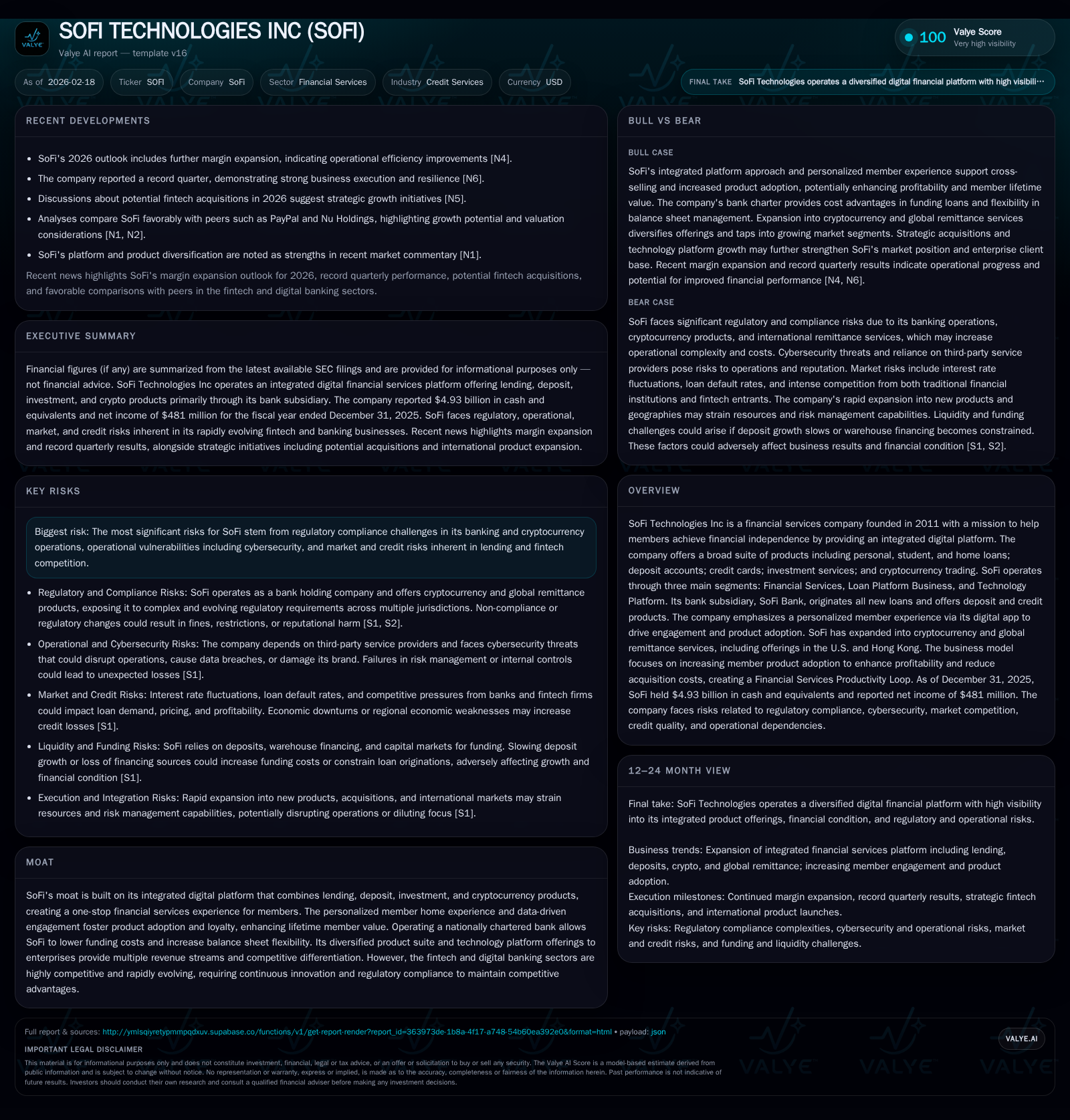
Founded in 2011, SoFi Technologies has developed a broad suite of financial products delivered through an integrated digital platform aimed at helping members 'Get Your Money Right.' The company's expansion into various segments including lending, deposits, investing, and cryptocurrency drives growth but also increases operational complexity and regulatory scrutiny. Recent financials show improved profitability on a net income basis for 2025, though cash flow remains negative, underscoring capital demands and investment needs. Going forward, SoFi's ability to scale while navigating competition, regulatory compliance, and macroeconomic headwinds will determine future performance.
Company Overview and Business Model
SoFi Technologies Inc (ticker: SOFI) was founded in 2011 with a mission centered on helping members achieve financial independence—not purely wealth creation but enabling members' personal financial goals at different life stages such as buying homes or pursuing careers [S7]. Its value proposition is an integrated digital platform offering a diversified product suite covering personal, student, and home loans; deposit accounts; credit cards; investment services including robo-advisory; cryptocurrency trading; and international remittance. This comprehensive approach distinguishes SoFi from more narrowly focused lending or fintech peers by fostering high member engagement across multiple financial touchpoints.
SoFi operates predominantly through three segments: Financial Services (direct lending and deposit products via SoFi Bank), Loan Platform Business (loan referrals/originations facilitated through third parties), and Technology Platform (B2B offerings enabling clients to launch financial products). The bank subsidiary serves as the originator for all new loans since obtaining a nationally chartered bank status [S7][S12]. This vertically integrated structure allows SoFi to utilize lower-cost deposits to fund loans rather than relying solely on warehouse lines or securitizations.
A defining feature is the personalized "member home experience" within its flagship app which delivers customized daily content prompting members to engage financially—whether executing tasks or considering new products—driving cross-product adoption that increases lifetime member value [S9].
Historical Performance: Growth Trajectory and Profitability
Financial data extracted from SEC companyfacts shows SoFi's trajectory from operating losses toward profitability in recent years (all amounts in USD):
Historical performance (annual)
| FY | Net ($mm) | CFO ($bn) | Capex ($mm) | Net YoY |
|---|---|---|---|---|
| 2025 | 481 | -3.7 | 242 | -3.5% |
| 2024 | 499 | -1.1 | 154 | +265.8% |
| 2023 | -301 | -7.2 | 111 | +6.1% |
| 2022 | -320 | -7.3 | 93 |
Note: Omitted columns lack sufficient annual XBRL coverage in the provided tags (need ≥2 annual points): Rev, OpInc, Div. Source: SEC companyfacts cache [F1].
Capital returns and efficiency (annual)
| FY | Buybacks | FCF ($bn) | ROE% |
|---|---|---|---|
| 2025 | -4.0 | 4.6 | |
| 2024 | -1.3 | 7.6 | |
| 2023 | 0 | -7.3 | -5.7 |
| 2022 | 0 | -7.3 | -6.2 |
Source: SEC companyfacts cache [F1].
Net income swung positive starting in 2024 after consecutive annual losses from 2022-2023 [F1]. Despite this profitability turnaround—yielding an approximate ROE of 4.6% for FY2025 calculated as net income divided by equity—the company continues to exhibit large negative operating cash flows worsening to -$3.74 billion in 2025 as compared to -$1.12 billion in 2024. These cash flow deficits highlight substantial ongoing investments primarily directed towards enhancing technology infrastructure (evidenced by capex rising over 57% year-over-year in 2025), scaling lending volumes funded by SoFi Bank deposits plus warehouse facilities/subsequent securitizations [F1][S11][S23].
Share repurchases have been largely dormant since very modest buybacks of about $0.53 million in 2021 were reported [F1]. Dividends data is not available from the submitted filings.
Future Growth Prospects: Opportunities and Constraints
Growth at SoFi pivots strongly on leveraging its vertically integrated banking framework to fund loans more cost-effectively; increasing product adoption through enhanced personalization under the member home experience; expanding enterprise partnerships for Loan Platform Business and Technology Platform services; as well as penetration into emerging fintech spaces such as cryptocurrency trading and global payments [S7][N3].
The national bank charter offers critical advantages including deposit-based funding that reduces reliance on wholesale financing costs while increasing balance sheet flexibility by enabling longer loan retention periods to earn interest income [S12][N3]. Furthermore:
- The acquisition of Wyndham has expanded SoFi's home loan origination capacity allowing it to control origination end-to-end—a notable step given industry-wide emphasis on tech-enabled mortgage underwriting efficiency [S22].
- SoFi plans to explore tokenized deposits and potentially stablecoin issuance as part of future product innovation within the bank charter framework [S12].
- Enhancements around crypto offerings — now present also in Hong Kong — open avenues for incremental revenue streams albeit with associated regulatory complexity [S7][N10].
However growth may be capped or pressured by several factors:
- Regulatory risks surrounding banking operations (including fair lending rules under FHA/ECOA), CFPB enforcement focus on consumer protection practices especially regarding student loans/credit cards/crypto products increase compliance costs substantially [S4][S5][S16][S10].
- Crypto market volatility combined with layered jurisdictional oversight heightens operational risk exposure [S2].
- Competitive pressures remain intense from legacy banks pivoting digitally along with aggressive fintech entrants carving adjacent niches [S26][N2].
- Macro factors including interest rate fluctuations impact loan demand dynamics while investor sentiment influences equity/debt financing availability needed to sustain growth capital requirements [S11][N3].
Forecasts / Milestones / What to Watch
Explicit forward guidance was not detailed directly but the January earnings call commentary indicated expectations for continued margin expansion driven by improved deposit mix funding of loans along with efficiency gains from platform investments [N3][N4].
Key areas to monitor include:
- Loan growth rates by portfolio segment as new originations increasingly shift onto SoFi Bank’s balance sheet.
- Deposit growth trends as they underpin funding cost advantage critical for loan pricing competitiveness.
- Adoption rates of newer offerings like cryptocurrency trading accounts and enterprise platform client additions.
- Regulatory developments particularly CFPB actions or state-by-state licensing reviews impacting product scope or operational cost.
- Capital raise activities evidenced by debt or equity issuance filings which influence liquidity runway.
Returns & Capital Allocation Analysis
With positive net income reported recently but persistent negative free cash flow implied by large CFO deficits exceeding capex outlays ($-3.74 billion CFO vs. $242 million capex FY2025), SoFi’s current capital allocation is focused heavily on reinvestment for growth rather than shareholder returns such as dividends or buybacks [F1]. This reflects a classic fintech scale-up profile where expansion trumps near-term profitability sustainability.
No dividends have been declared per latest filings; share repurchases are negligible indicating capital is retained internally primarily to fund technology development and balance sheet lending capacity expansion rather than shareholder distributions. The equity base has nearly doubled between 2024 ($6.53 billion) to 2025 ($10.49 billion), pointing toward fresh equity injections likely accompanying operational growth initiatives [F1][S11].
Industry Context & Sector Details (Analysis)
The US digital banking landscape increasingly rewards platforms capable of seamless cross-product experience fostering customer loyalty essential for reducing acquisition costs over time—SoFi’s "Financial Services Productivity Loop" concept aligns closely with this trend. National bank charters enable fintech companies like SoFi to tap into federally insured deposits offering much cheaper funding relative to capital markets reliance prevalent pre-bank charter era.
Mortgage market dynamics remain contingent upon tech-enabled underwriting improvement enabling faster processing times alongside competitive pricing shifting from commoditized loans toward fee-based ancillary services—SoFi’s Wyndham acquisition fits this evolving model well. Furthermore crypto integration into mainstream fintech apps remains nascent but promising; however regulatory ambiguity coupled with price volatility creates a delicate balancing act.
Risks Summary
Per latest SEC disclosures [S1][S4]-[S6]:
- Persistent regulatory compliance challenges across banking (fair lending laws), securities (broker-dealer oversight), crypto laws (multi-jurisdictional licensing/regulation).
- Litigation exposure arising from alleged discriminatory lending practices or consumer-protection violations could impose fines or injunctive relief affecting operations.
- Cybersecurity threats pose reputational and operational risks needing robust mitigation frameworks.
- Funding availability influenced by macroeconomic conditions impacting capital market access required for loan warehouse lines/securitizations.
- Operational risks from scaling internal processes especially post-Wyndham acquisition involving direct mortgage underwriting responsibilities previously externalized.
Conclusion
SoFi Technologies embodies a modern digital finance firm extending beyond simple fintech into a full-spectrum national bank holding company balancing multifaceted product presence with complex regulation inherent in banking and crypto arenas. The company’s financial profile indicates successful steps toward profitability transition complemented by ambitious investments supporting platform expansion. However sustained success depends critically on managing regulatory headwinds efficiently while maintaining competitive differentiation through integrated member experiences driving product adoption. Cash flow dynamics underscore ongoing capital needs requiring vigilant liquidity management amid fluctuating market conditions.
This report is prepared solely for informational purposes without offering investment advice or recommendations. Readers should conduct their own due diligence before making any business decisions related to the subject company.
Disclaimer: This is research-only, informational analysis and not investment advice. It may include AI-generated interpretation and general industry context. Always verify important details using primary sources.

Comments