
Itron’s Financial Turnaround: Rising Profits and Strategic Resilience
Itron has shifted to strong profitability by leveraging its integrated IIoT platform and focusing on recurring revenue streams amid industry headwinds.
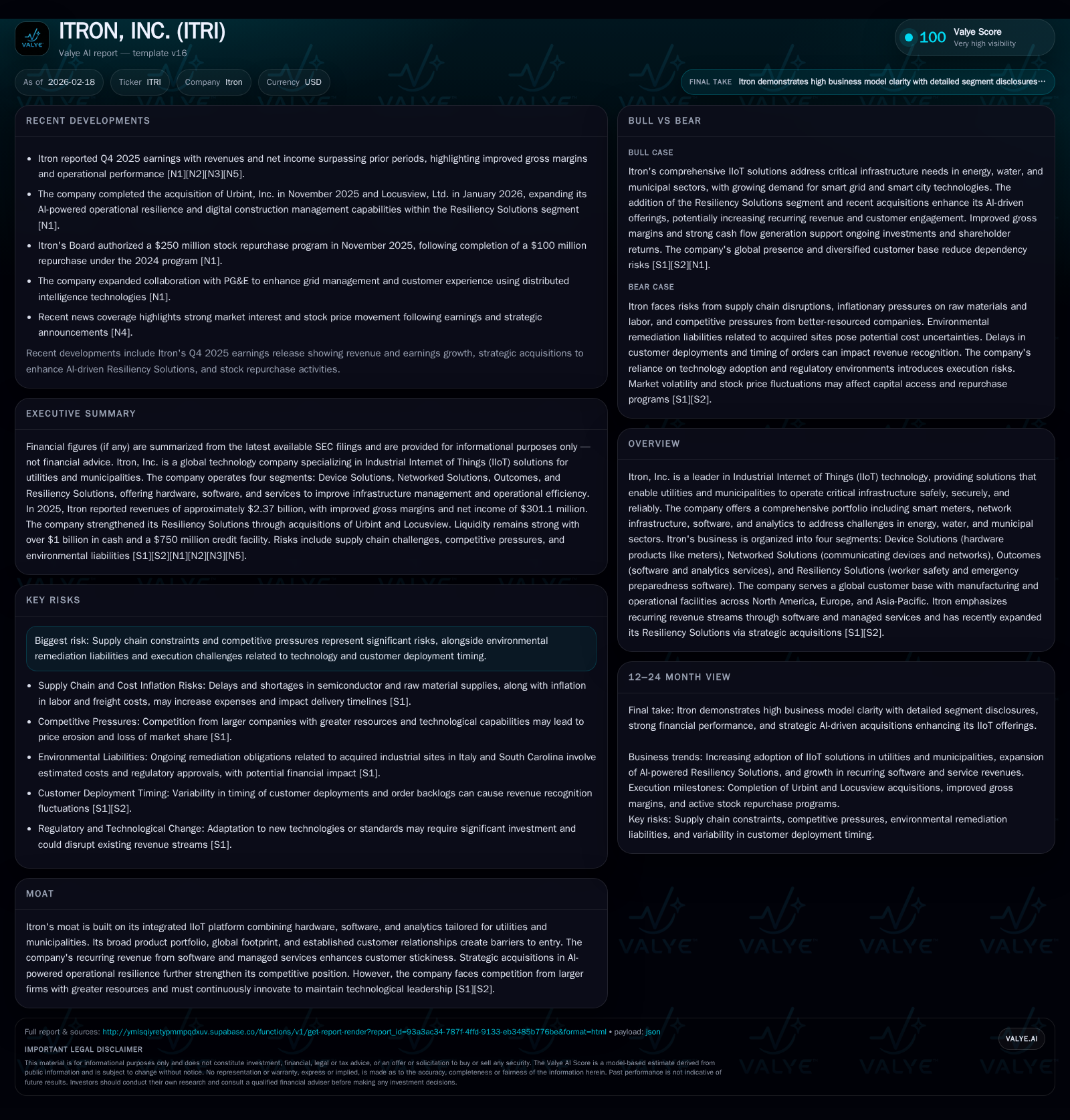
Itron, Inc. has demonstrated a substantial financial recovery from operating losses in 2022 to robust profitability in 2025, driven by operational leverage and strategic focus on software and managed services. Despite challenges like supply chain constraints and regulatory uncertainties affecting revenue growth, the company’s diversified IIoT portfolio spanning hardware, network infrastructure, analytics, and resilience solutions anchors its competitive moat. Capital discipline is evident in improved cash flow generation, sustained share repurchases, and moderate capex supporting innovation. Going forward, key metrics such as order backlog, AMI deployment progress, and recurring revenue growth will be critical to watch.
Financial Performance Evolution: From Losses to Profitable Growth
Itron’s financial trajectory over the past four years reveals a remarkable turnaround from operating losses in FY2022 (operating loss of $7.4 million; net loss of $9.7 million) to solid profitability by FY2025 with operating income of $313 million and net income of $301 million [F1]. This translates into an 18.5% year-over-year increase in operating income compared with FY2024’s $264 million, alongside a 25.9% increase in net income [F1]. The reinvigoration of earnings reflects improved operational leverage amid fluctuating revenue trends typical of the utility sector characterized by long sales cycles and erratic capital expenditures [S1].
Operating cash flow surged by an impressive 70.4% YoY to nearly $406 million in FY2025, reflecting stronger cash conversion compared to $238 million the prior year [F1]. Capex spending declined by 25.1% YoY to $22.9 million after higher investment levels in earlier periods signifying a phase of more measured capital allocation focused on innovation support rather than expansion [F1]. Roughly calculated ROE stands at approximately 17.5%, underscoring enhanced effectiveness in equity capital utilization as shareholders’ equity rose from $1.39 billion in FY2024 to $1.72 billion recently [F1]. Consistent share repurchases ($100 million annually during the last two years) further demonstrate shareholder return focus following minimal buybacks before 2024 [F1]. Dividends data is not available.
Historical performance (annual)
| FY | Net ($mm) | CFO ($mm) | OpInc ($mm) | Capex ($mm) | Net YoY |
|---|---|---|---|---|---|
| 2025 | 301 | 406 | 313 | 23 | +25.9% |
| 2024 | 239 | 238 | 264 | 31 | +146.7% |
| 2023 | 97 | 125 | 129 | 27 | +1095.9% |
| 2022 | -10 | 25 | -7 | 20 |
Note: Omitted columns lack sufficient annual XBRL coverage in the provided tags (need ≥2 annual points): Rev, Div. Source: SEC companyfacts cache [F1].
Capital returns and efficiency (annual)
| FY | Buybacks ($mm) | FCF ($mm) | ROE% |
|---|---|---|---|
| 2025 | 100 | 383 | 17.5 |
| 2024 | 100 | 208 | 17.2 |
| 2023 | 0 | 98 | 7.4 |
| 2022 | 17 | 5 | -0.8 |
Source: SEC companyfacts cache [F1].
*Significant CFO rebound after low base in FY2022; ROE for earlier years omitted due to losses or insufficient data.
Note: Revenue figures unavailable; analysis relies on profit and cash flow trends.
Drivers of Growth: Comprehensive IIoT Portfolio and Market Adoption
Itron’s structure into four segments—Device Solutions, Networked Solutions, Outcomes, and Resiliency Solutions—enables it to address utilities’ multifaceted needs comprehensively [S4][S16][S18]. Device Solutions encompass core hardware such as standard and communicating electricity, gas, water meters plus heat allocators with embedded communication capabilities adaptable across global markets and compliance standards [S2].
Networked Solutions integrates these devices with advanced network infrastructure—supporting Automated Meter Reading (AMR), Advanced Metering Infrastructure (AMI), Distributed Energy Resource Management Systems (DERMS), grid edge intelligence devices, smart lighting systems, and smart city sensors—all managed via multi-purpose interoperable networks [S9][S16][S18]. This segment powers robust data acquisition essential for complex grid management.
Outcomes delivers value-added software & analytics harnessing artificial intelligence (AI), machine learning (ML), statistical models to transform anonymized data into actionable insights enabling optimized grid operations, non-revenue water reduction, DER integration management, energy forecasting, consumer engagement, and smart payment solutions [S9][S18]. This segment generates recurring revenue streams providing stability beyond hardware sales.
Resiliency Solutions is a newly integrated suite centered around workforce safety analytics, emergency preparedness, damage prevention complemented by AI-based event prediction models enhancing compliance and incident mitigation—activities amplified post-acquisition of Urbint in late 2025 [S19][N10].
Growth drivers also hinge on regulatory incentives promoting smart grids worldwide which encourage utilities toward AMI deployments supported by subsidies or mandates; however, sales cycles remain lengthy due to budgeting approvals and regulatory reviews that can extend over years [S1][S10]. Moreover, increasing adoption of DERs necessitates sophisticated DERMS platforms and grid edge intelligence fostering demand for Itron's integrated offerings.
Challenges and Uncertainties in the Utility Industry Landscape
The utility sector’s signature long sales cycles manifest via multi-phase purchasing processes involving technical evaluations, cost-benefit analyses & regulatory approvals leading to inherent unpredictability in procurement timing [S1]. Furthermore, irregular capital spending coupled with macroeconomic factors such as interest rate volatility or construction slowdowns may cause customers to defer purchases or reprioritize budgets resulting in fluctuating revenues.
Supply chain risks also weigh on Itron’s manufacturing inputs—with dependencies on critical raw materials like copper (integral in brass castings for meters), aluminum, plastics resins plus electronic components including semiconductors creating vulnerability amid industry-wide shortages or price inflation accelerating input costs without immediate price pass-through capability [S1]. These constraints amplify risks of delivery delays affecting device shipment schedules.
Regulatory risk also persists: delays or modifications in government mandates on smart meter rollouts can materially alter replacement frequencies impacting order flows given that many contracts are bid-based with order timing tied closely to inventory replenishment cycles at utilities [S1][S10]. Technological obsolescence risk arises as Itron continually adapts product portfolios integrating emergent AI innovations without alienating entrenched customer bases reliant on legacy devices.
Recurring Revenue Model Enhances Customer Stickiness
Significant emphasis is placed on recurrent revenue generation specifically via the Outcomes segment which builds upon subscription-like models delivering ongoing software services including grid planning analytics, non-revenue water management tools & revenue assurance services delivered remotely [S1][N10]. Such offerings deepen client integration enhancing switching costs while smoothing revenue volatility inherent in hardware sales.
Complementing this subscription model is management of third-party device products entailing direct oversight functions embedded within Itron’s network platforms allowing utilities a unified service experience heightening customer retention probabilities [S18]. Integration capabilities across device-network-software strata set entry barriers amidst intensifying competition from larger technology conglomerates.
Strategic M&A and Technology Innovation Pipeline
The acquisition of Urbint added sophisticated AI-powered operational resilience capabilities expanding Resiliency Solutions' scope substantially addressing workforce safety & emergency response challenges faced by infrastructure operators [S19][N10]. Furthermore, partnerships such as the collaboration with Snowflake enhance grid planning using AI-driven analytics enabling dynamic resource optimization across distributed grids heavily reliant on unpredictable DERs [N10].
Despite these advances competitive pressures from large-scale peers mandate continuous R&D investments raising complexity in harmonizing hardware developments with evolving software/analytics ecosystems while managing time-to-market risks due to complexity-induced delays or initial reliability issues endemic during digital transformation initiatives [S1].
Capital Allocation: Robust Cash Flow Generation and Shareholder Returns
Cash flow management illustrates disciplined allocation where operating cash flow jumped over 70% YoY aided by enhanced margins while capex was curtailed following prior escalations supporting new product developments ($22.9M vs $30.6M prior year) yielding free cash flow of approximately $383M for FY2025 sustaining liquidity strength [F1][S20].
The company deployed $100M towards share repurchase consistently for two consecutive years reinforcing shareholder value alongside stable equity growth from $1.39B to $1.72B evidencing retained earnings accumulation supporting ~17.5% ROE—a commendable outcome reflecting higher profitability coupled with capital efficiency amid ongoing investments [F1][S23][S24]. Dividend information remains undisclosed but regulatory filings indicate no current payout commitments.
Financial flexibility is bolstered by an undrawn revolving credit facility totaling $750 million available until September 2030 plus orderly convertible note maturities providing ample borrowing headroom without pressure on refinancing needs short-term [S5][S6][S7][S17][S21]. Debt covenants impose prudent limitations but compliance is maintained thereby reducing refinancing risk.
Key Metrics and What to Watch Going Forward
While explicit forward-looking guidance remains sparse publicly, monitoring critical indicators including remaining performance obligations approximated at about $2.1 billion combining near-term ($1.1B) and longer-term ($1B) backlog provides insight into demand visibility underpinning near-future revenues [S19]. Analytics related metrics such as monthly subscription growth rates within Outcomes segment along with AMI deployment penetration rates embody operational health markers given their linkage to recurring revenue expansion.
Earnings call transcripts hint at maintaining margin progression targets alongside managing supply chain normalization timelines which could alleviate recent input-related margin pressures [N2][N6][N7]. Tracking regulatory shifts especially policy updates tied to renewable integration incentives will act as catalysts or constraints influencing capital spending by utility customers.
Further scrutiny towards integration success of rapid acquisitions like Urbint will reveal sustainability of technological differentiation designed around AI-enabled resiliency enhancement in critical infrastructure sectors beyond traditional metering domains.
Environmental Liabilities and Risk Management
Itron discloses relatively limited environmental liabilities primarily rooted in legacy remediation responsibilities assumed during historic acquisitions—most notably the Frosinone Italy site related cleanup provisions stood at around $2.6 million end-2025 duly backed by indemnification agreements transferring financial responsibility back to original owner Schlumberger mitigating material exposure risk [S1].
Similarly ongoing remediation efforts at Greenwood South Carolina industrial site involve contested cleanup plans estimated above several millions but disputed liability boundaries reduce direct outflow expectations while necessitating close monitoring through active engagement with regulators for resolution [S10]. These contingencies appear manageable within current financial frameworks without impinging significantly upon operations or capital availability.
This analysis is based exclusively on public filings up to February 2026 and recent news disclosures without offering investment recommendations.
Disclaimer: This is research-only, informational analysis and not investment advice. It may include AI-generated interpretation and general industry context. Always verify important details using primary sources.

Comments