
Cadence Design Systems Strengthens Foothold with AI-Driven Innovation and Strategic Capital Deployment
An analysis of Cadence’s robust financial trajectory powered by AI-centric semiconductor design solutions and prudent capital management.
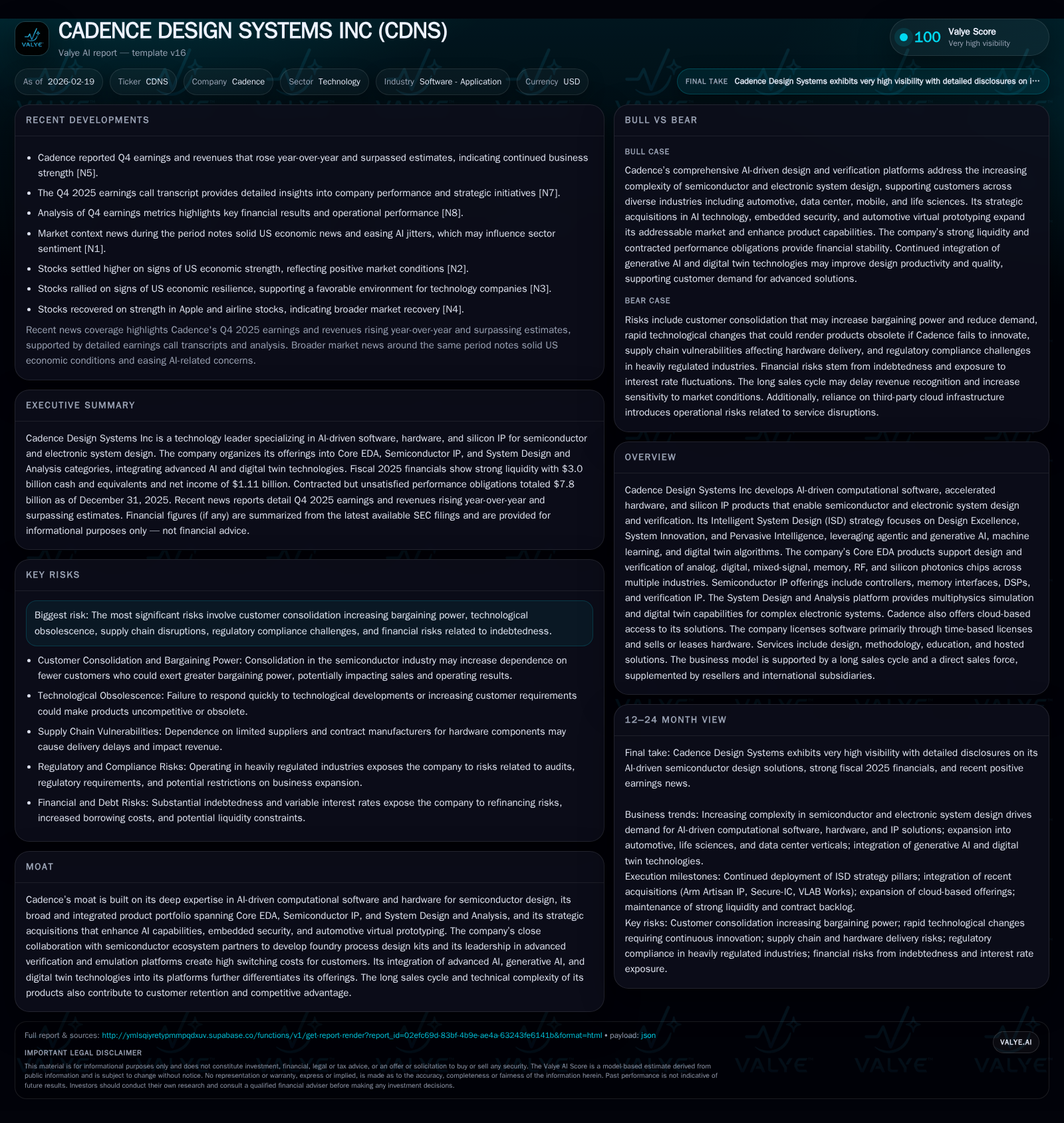
Cadence Design Systems has leveraged its Intelligent System Design strategy, incorporating agentic AI and digital twin algorithms, to fuel steady growth in its semiconductor design software and silicon IP offerings. The company reported stronger operating income and cash flow growth in fiscal 2025, supporting increased share repurchases while maintaining strategic investments in innovation. Key growth drivers include expansion in AI-powered EDA tools and cloud-based delivery models, yet geopolitical trade restrictions and complex sales cycles remain potential constraints. Market reception following Q4 2025 earnings surpassed estimates, reflecting investor confidence aligned with Cadence’s sustained execution and ecosystem integration.
Strong Historical Growth Fueled by Expanding AI-Driven Semiconductor Solutions
Cadence Design Systems has demonstrated consistent financial performance gains driven by its focused Intelligent System Design (ISD) strategy that emphasizes Design Excellence, System Innovation, and Pervasive Intelligence through agentic and generative AI integration. Fiscal year 2025 operating income reached $1.49 billion—a 10.5% increase from $1.35 billion in 2024—indicating growing market acceptance of its AI-infused electronic design automation (EDA) software encompassing analog, digital, mixed-signal, memory, RF, and silicon photonics chips [F1].
Net income growth was more moderate but positive at a 5.1% increase year-over-year reaching $1.11 billion in FY25 from $1.06 billion the prior year [F1]. The more pronounced jump in operating cash flow—up 37.1% to $1.73 billion—reflects improved working capital management alongside strong revenue quality [F1]. Capital expenditures remained stable around $142 million annually since FY24 supporting ongoing enhancements in accelerated hardware platforms and System Design and Analysis digital twin technologies that underpin Cadence’s next-generation computational infrastructure [S1].
Historical performance (annual)
| FY | Net ($mm) | CFO ($mm) | OpInc ($mm) | Capex ($mm) | Net YoY |
|---|---|---|---|---|---|
| 2025 | 1109 | 1729 | 1492 | 142 | +5.1% |
| 2024 | 1055 | 1261 | 1351 | 143 | +1.4% |
| 2023 | 1041 | 1349 | 1251 | 102 | +22.6% |
| 2022 | 849 | 1242 | 1074 | 123 |
Note: Omitted columns lack sufficient annual XBRL coverage in the provided tags (need ≥2 annual points): Rev, Div. Source: SEC companyfacts cache [F1].
Capital returns and efficiency (annual)
| FY | Buybacks ($mm) | FCF ($mm) | ROE% |
|---|---|---|---|
| 2025 | 925 | 1587 | 20.3 |
| 2024 | 550 | 1118 | 22.6 |
| 2023 | 700 | 1247 | 30.6 |
| 2022 | 1050 | 1119 | 30.9 |
Source: SEC companyfacts cache [F1].
Note: Revenue data not available; dividends data unavailable.
Analysis: The continued infusion of AI capabilities such as reinforcement learning into core EDA tools enhances design verification throughput while semiconductor IP portfolios including controllers and memory interfaces consolidate Cadence's comprehensive offering [S1], cementing sustained engagement from leading chipmakers adopting increasingly complex nodes.
Emerging Opportunities and Headwinds in Semiconductor Computational Platforms
Looking forward, Cadence is well positioned to capitalize on several technological tailwinds within semiconductor computational platforms. Its Intelligent System Design framework leverages agentic AI agents coupled with generative AI models and physics-based digital twins that improve chip-level system modeling accuracy—a critical capability amid tightening industry demands for low power/high performance designs [S1][N2]. Cloud-enabled access to these tools further deepens scalability for customers juggling varied process technologies across geographies.
However, geopolitical frictions manifest notably through export license requirements imposed by U.S. BIS authorities particularly affecting China-focused sales of sophisticated EDA products classified under ECCNs related to advanced node IC design software, casting uncertainty on addressable markets [S1][S14]. Customer consolidation trends potentially intensify negotiation leverage against Cadence while long sales cycles anchored by technical complexity slow revenue visibility [S1]. These cyclical patterns necessitate careful operational steering to mitigate revenue timing fluctuations.
Market sentiment following recent Q4 earnings has grown cautiously optimistic as analyst Rosenblatt issued an upgrade citing strong execution against expansion targets within automotive virtual prototyping segments enhanced by recent acquisitions boosting embedded security offerings [N13]. This indicates growing investor confidence in Cadence’s long-term growth runway despite short-term external risks.
Monitoring Critical Milestones and Market Expectations into 2026
The Q4 FY25 results announced February 17th exceeded consensus estimates on both profitability and revenue metrics underscoring momentum entering calendar year '26 [N1][N3][N14]. While explicit forward guidance remains undisclosed, management commentary highlights near-term focus areas including accelerated adoption rates of next-gen verification platforms utilizing AI heuristics which may drive incremental bookings [N2]. Tracking revenue recognition timing — sensitive due to multi-element contracts blending licenses, hardware units, and services — will be crucial for accurate quarterly assessments.
Semiconductor industry cyclicality linked to foundry capital expenditures also underpins broader demand rhythms impacting Cadence's bookings pipeline; hence investors must observe fab capacity expansions or slowdowns closely as indirect proxies for end-market strength.
Analysis: Absence of official forward guidance directs analytical emphasis onto operational execution cadence communicated during earnings calls along with real-time market pricing dynamics as early indicators ahead of the next fiscal reporting cycle.
Robust Financial Metrics Reflect Disciplined Capital Allocation
Cadence’s return on equity stands at an estimated robust ~20.3%, derived from its net income of roughly $1.11 billion relative to $5.47 billion in shareholder equity at fiscal year-end [F1]. This ROE underscores efficient utilization of invested capital alongside profitability measures emphasizing strategic balance between reinvestment and shareholder returns.
Capital deployment manifests a sharp increase in share repurchase activity escalating variably over the last four years but peaking at $925 million in FY25 from $550 million prior year [F1], highlighting management’s commitment towards offsetting dilution from stock compensation plans while returning excess liquidity amid recurring liquidity generation exceeding capex requirements.
Free cash flow approximates $1.59 billion (operating cash flow less capex), reflecting substantial financial flexibility to pursue inorganic growth avenues or further stabilize capital return policies absent dividend distributions—which were not reported or declared within public filings [F1][S5][S19].
This disciplined allocation reinforces investor perceptions that Cadence prioritizes enhancing intrinsic shareholder value through calibrated buybacks paired with sustained R&D investment supporting future product development pipelines.
Strategic Vertical Integration and Ecosystem Partnerships Maintain High Switching Costs
At the core of Cadence’s moat is its deeply integrated portfolio spanning Core EDA software combined with licensed silicon IP components plus multiphysics simulation via the System Design & Analysis platform . By collaboratively developing process design kits (PDKs) with leading foundries globally—including advanced nodes demanding tailored PDKs—the company locks customers into an ecosystem where substituting critical workflow elements entails prohibitive integration efforts.
Moreover, Cadence’s leadership in advanced verification platforms augmented by emulation hardware raises switching barriers substantially since engineering teams incur elevated retraining costs alongside risk exposure when running verification regressions vital for tape-out schedules.
The company’s ongoing deployment of generative AI agents embedded across these layers enhances automation and accelerates runtime efficiency thus entrenching client dependence while differentiating its value proposition further against emerging competitors.
Industry analysis: Foundry-specific PDK adaptations embody a significant entry barrier favoring incumbents as they require co-engineering cooperation often unattainable by smaller rivals lacking process node expertise or relationships.
Risks from Geopolitical Tensions, Regulatory Environment and Supply Stability
Cadence faces multiple interlinked risks materially elaborated within its latest Form 10-K [S1][S4][S9], notably:
- Export controls amplifying compliance burdens potentially limiting sales into China and allied markets critical for semiconductor fab activity.
- Supply chain vulnerabilities related primarily to limited sourcing options for hardware component manufacturing causing delivery delays affecting evaluation platform shipments impacting license timing recognition.
- Intellectual property infringement claims potentially escalating legal expenses detracting focus away from innovation endeavors.
- Regulatory scrutiny connected with evolving statutes on artificial intelligence governance posing operational compliance challenges in integrating novel agentic AI solutions safely.
- Indebtedness constraints due to senior notes maturing between FY27-FY34 require cautious liquidity management given variable interest rate exposure increasing debt service costs in high-rate environments.
These factors collectively exacerbate the complexity of sustaining uninterrupted growth trajectories requiring resilient risk mitigation frameworks embedded within corporate governance structures.
Analyst Sentiment and Market Position Following Recent Q4 Earnings Beat
Post-Q4 FY25 disclosure events produced a favorable market response highlighted by Nasdaq reports capturing robust share price movements attributed primarily to better-than-expected profit margins alongside optimistic commentary surrounding expansion into automotive virtual prototyping niches–a segment gaining traction due to advancing electric vehicle development timelines [N12][N13].
The Rosenblatt upgrade reinforced investor conviction emphasizing Cadence’s differentiated AI-powered platform roadmaps aligned with secular trends favoring embedded security integrations coupled with automotive software validation pipelines enabling long-lived customer contracts.
This positive analyst feedback juxtaposed with concrete executive disclosures lends credence to an expectation framework premised on continued innovation investment balanced against thoughtful capital redeployment maximizing shareholder value without compromising R&D momentum.
DISCLAIMER: This analysis is based on publicly available information as of early 2026 including SEC filings and market disclosures; it does not constitute investment advice but aims at providing institutional-grade insights into Cadence Design Systems’ operational trajectory, financial health, industry positioning, risks, and market perceptions.
Disclaimer: This is research-only, informational analysis and not investment advice. It may include AI-generated interpretation and general industry context. Always verify important details using primary sources.

Comments