
AtriCure's FY25 Revenue Growth Contrasts With Ongoing Operating Losses
Strong revenue expansion driven by surgical Afib devices and cryoablation pain management, yet profitability remains elusive amid clinical investments and operating leverage challenges.
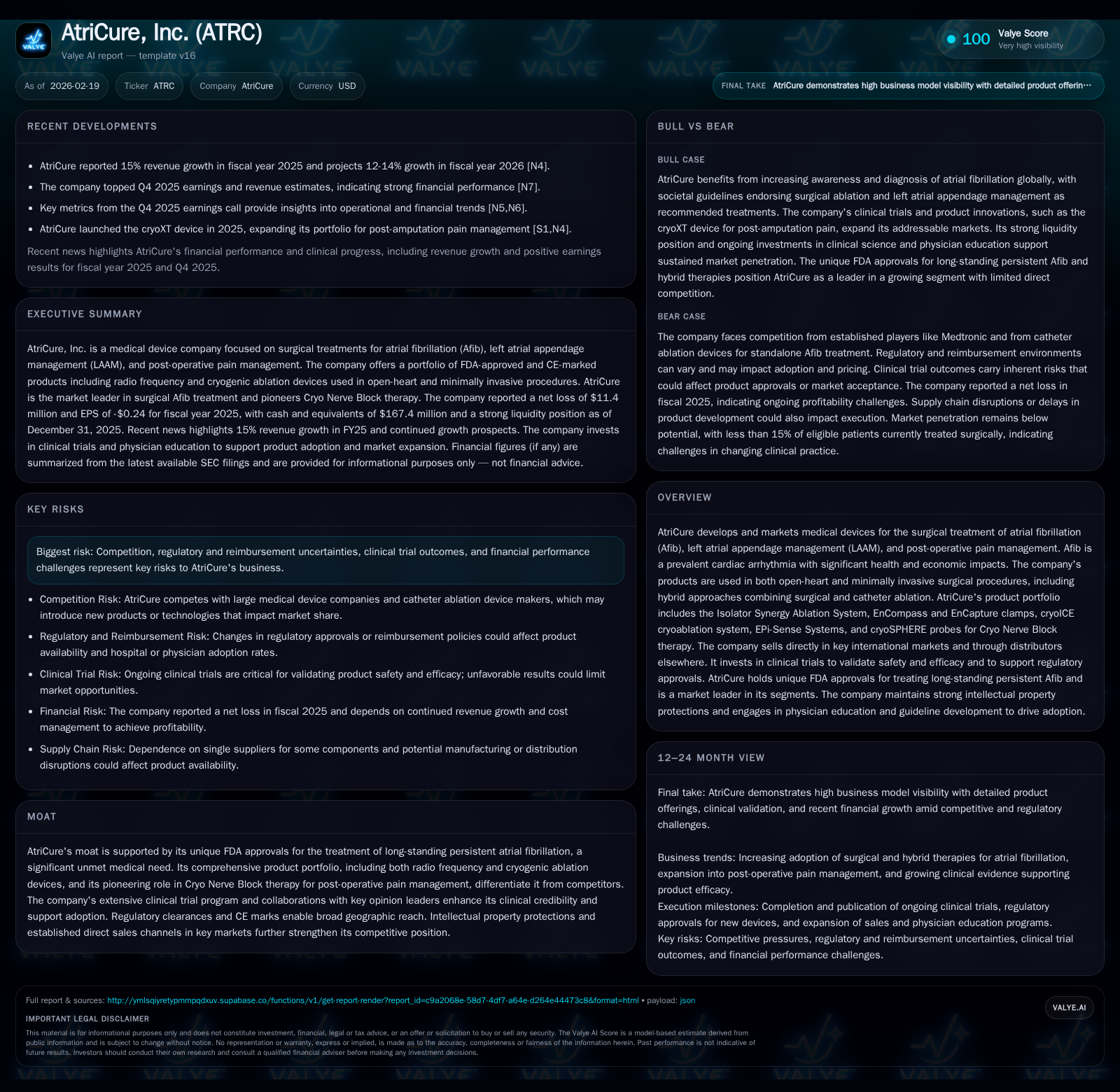
AtriCure, a leader in surgical atrial fibrillation (Afib) treatment and novel cryo nerve block therapies for post-operative pain, delivered a robust 15% revenue growth in FY25. This growth reflects successful adoption of its differentiated Isolator Synergy Ablation System and extensions in left atrial appendage management (LAAM). However, the company continues to report operating and net losses, though significantly reduced from prior years, reflecting investments in clinical trials and international market expansion. Its strong cash flow generation and ample liquidity underpin ongoing R&D and commercial efforts. Key milestones include enrollment progress in pivotal trials like LeAAPS and BoxX-NoAF, which may broaden indications and support reimbursement. Competitive pressures from Medtronic and evolving reimbursement landscapes remain key risks.
Overview
AtriCure, Inc. operates at the forefront of surgical treatments for atrial fibrillation (Afib), left atrial appendage management (LAAM), and post-operative pain control through Cryo Nerve Block technology [S1],[S28]. Afib affects over 59 million people globally and often coexists with multiple cardiovascular comorbidities; the company specifically addresses a niche of long-standing persistent Afib patients (>1 year duration), an unmet need with historically limited effective solutions [S1]. Its product portfolio combines radiofrequency (RF) ablation systems like the Isolator Synergy device and cryogenic platforms including the cryoICE system supporting cryoSPHERE probes [S1],[S29]. The presence across open-heart surgeries, minimally invasive standalone procedures, and hybrid surgical-catheter approaches sets AtriCure apart in the cardiothoracic market.
Historical Performance
AtriCure’s financial history signals steady growth punctuated by fluctuating profitability. Revenue rose steadily from $35.9M in FY2015 to about $52.9M by FY2018—the latest full-year figure available via XBRL tags—with FY25 results reflecting a robust ~15% increase YoY supported by demand for existing products as well as expansions into post-operative pain markets like amputation nerve blocks [F1],[N1],[S25].
Profitability remains challenged due to investments in clinical trial programs essential for regulatory clearance extensions as well as medical education to drive adoption. Operating losses have materially decreased from -$42.7M in FY22 to -$9.4M in FY25 while net losses contracted similarly from -$46.5M to -$11.4M over this period [F1]. The improvement reflects operational leverage gains alongside targeted spending on R&D ($45M+ annually) and clinical initiatives [F1],[S7].
Historical performance (annual)
| FY | Net ($mm) | CFO ($mm) | OpInc ($mm) | Capex ($mm) | Net YoY |
|---|---|---|---|---|---|
| 2025 | -11 | 57 | -9 | 9 | +74.4% |
| 2024 | -45 | 12 | -40 | 11 | -46.8% |
| 2023 | -30 | 4 | -27 | 12 | +34.5% |
| 2022 | -46 | -22 | -43 | 17 |
Note: Omitted columns lack sufficient annual XBRL coverage in the provided tags (need ≥2 annual points): Rev, Div, Buybacks. Source: SEC companyfacts cache [F1].
Capital returns and efficiency (annual)
| FY | FCF ($mm) | ROE% |
|---|---|---|
| 2025 | 48 | -2.3 |
| 2024 | 1 | -9.7 |
| 2023 | -8 | -6.5 |
| 2022 | -39 | -10.2 |
Source: SEC companyfacts cache [F1].
Note: Some historic revenue figures only available up to FY2018 via XBRL; recent data supplemented from news releases.
Future Growth Prospects
Growth drivers include:
- Continued penetration of differentiated ablative devices with unique FDA approvals targeting persistent Afib subpopulations underserved by catheter ablation alone [S22]. AtriCure claims exclusivity on FDA-approved devices for long-standing persistent Afib treatment.
- Advancement of large-scale clinical trials such as LeAAPS assessing prophylactic stroke risk reduction via LAA exclusion (over 6,500 patients enrolled as of mid-2025) and BoxX-NoAF trial examining concomitant ablation's impact on post-operative Afib with enrollment started late-2025 [S16]. Trial outcomes could enable label expansions or new reimbursement codes.
- Expansion of cryo nerve block therapy indications beyond cardiac/thoracic surgery into post-amputation pain management markets through novel products like the cryoXT probe recently launched with real-world registry data collection ongoing [S21],[N3].
- Geographic expansion into Europe, Canada, Australia supported by direct sales teams combined with distributor networks covering parts of Asia & South America where regulatory clearances have been secured [S17].
Risks include intensifying competition from dominant catheter ablation providers such as Medtronic; potential delays or unfavorable trial results affecting regulatory approvals; reimbursement uncertainties especially beyond US Medicare frameworks; and challenges scaling emerging therapies within hospital budgets under pressure [S22],[S5],[S8].
Financial Expectations & Milestones
Management projects continued top-line growth of approximately 12–14% for FY26 reflecting confidence in sustained demand [N1]. Key milestones include:
- Presentation of clinical trial data at prominent cardiovascular conferences throughout 2026 (e.g., American Association of Thoracic Surgery), potentially influencing clinical guidelines endorsed by societies such as STS or AHA [S19].
- Expansion of reimbursement coverage particularly for standalone minimally invasive procedures and novel Cryo Nerve Block applications given current reliance on bundled MS-DRG hospital payments which provide adequate but potentially conservative margins [S9],[S8].
- Potential opportunistic acquisitions focused on complementary technologies or adjacent markets consistent with stated corporate strategy [S7].
No formal profit guidance or specific pipeline event timelines have been disclosed recently; these indicators serve as directional barometers for operating performance.
Returns & Capital Allocation
AtriCure reported an approximate negative Return on Equity (ROE) near -2.3% based on net losses relative to equity exceeding $490M at fiscal year-end FY25 [F1]. Operating cash flows swung markedly positive reaching $57M driven by improved earnings quality and working capital management enabling free cash flow generation north of $48M after capital expenditures (~$9M capex slightly down YoY reflecting stable equipment investment levels) [F1],[S7].
No dividends or share repurchases were disclosed in filings or press releases, indicating reinvestment focus toward organic growth initiatives including clinical research programs and international commercialization efforts [F1],[N3]. Cash balances remained robust near $167M providing liquidity alongside a revolving credit facility capped at $125M with favorable covenants extended through early 2029 offering financial flexibility [S11],[S14].
Competitive Positioning & Moat Analysis
Key competitive advantages include:
- Unique FDA clearances addressing critical patient subsets with persistent to long-standing persistent Afib where alternatives are limited.
- Integrated platforms combining RF surgical ablation with cryogenic technologies enabling multimodal therapeutic options tailored to diverse patient needs.
- Innovation leadership in Cryo Nerve Block therapies showing opioid-sparing benefits that reduce hospital stays.
- Established collaborations with key opinion leaders across cardiothoracic surgery/electrophysiology ensuring procedural education uptake.
- Regulatory certifications including CE marks enable broad market access complemented by direct sales forces across major Western markets backed by experienced commercial teams [S22],[S17],[S19].
Competitors mainly offer catheter-based solutions cleared primarily for paroxysmal/persistent Afib or surgical tools lacking long-standing persistent indication status; this confers temporary differentiation pending pivotal trial outcomes and reimbursement acceptance sustaining leadership.
Industry Context (Analysis)
Afib prevalence continues rising globally due to aging populations coupled with enhanced diagnostic awareness aided by wearable technologies enabling earlier detection though often asymptomatic cases complicate care pathways. Healthcare systems emphasize minimally invasive interventions balancing efficacy with economic constraints leveraging bundled payments analogous to Medicare MS-DRGs affecting hospital utilization patterns.
Emerging analgesic approaches like Cryo Nerve Block align with broader trends reducing opioid dependency while improving perioperative outcomes but require integration into standard surgical workflows—a process necessitating engagement across multifaceted provider ecosystems.
Conclusion
AtriCure demonstrates solid revenue momentum supported by clinically compelling products validated through extensive research partnerships positioning it well within a niche yet growing surgical arrhythmia treatment landscape accompanied by expanding applications into perioperative pain management enhancing addressable markets.With operational progress evidenced by margin improvement and cash flow strength offsetting lingering unprofitability linked largely to innovation cycle investments,AtriCure stands cautiously optimistic pending key clinical data milestones likely shaping near-to-midterm growth amid evolving competitive dynamics.
This report is based solely on publicly available information including recent SEC filings ([S1]-[S29]) and news articles ([N1]-[N4]). It does not constitute investment advice or recommendations.
Disclaimer: This is research-only, informational analysis and not investment advice. It may include AI-generated interpretation and general industry context. Always verify important details using primary sources.

Comments