
Littelfuse’s Transition Tests: From Consistent Profitability to Recent Setbacks
A century-old industrial tech leader faced a sharp earnings reversal in 2025 amid strategic pivots and volatile market conditions.
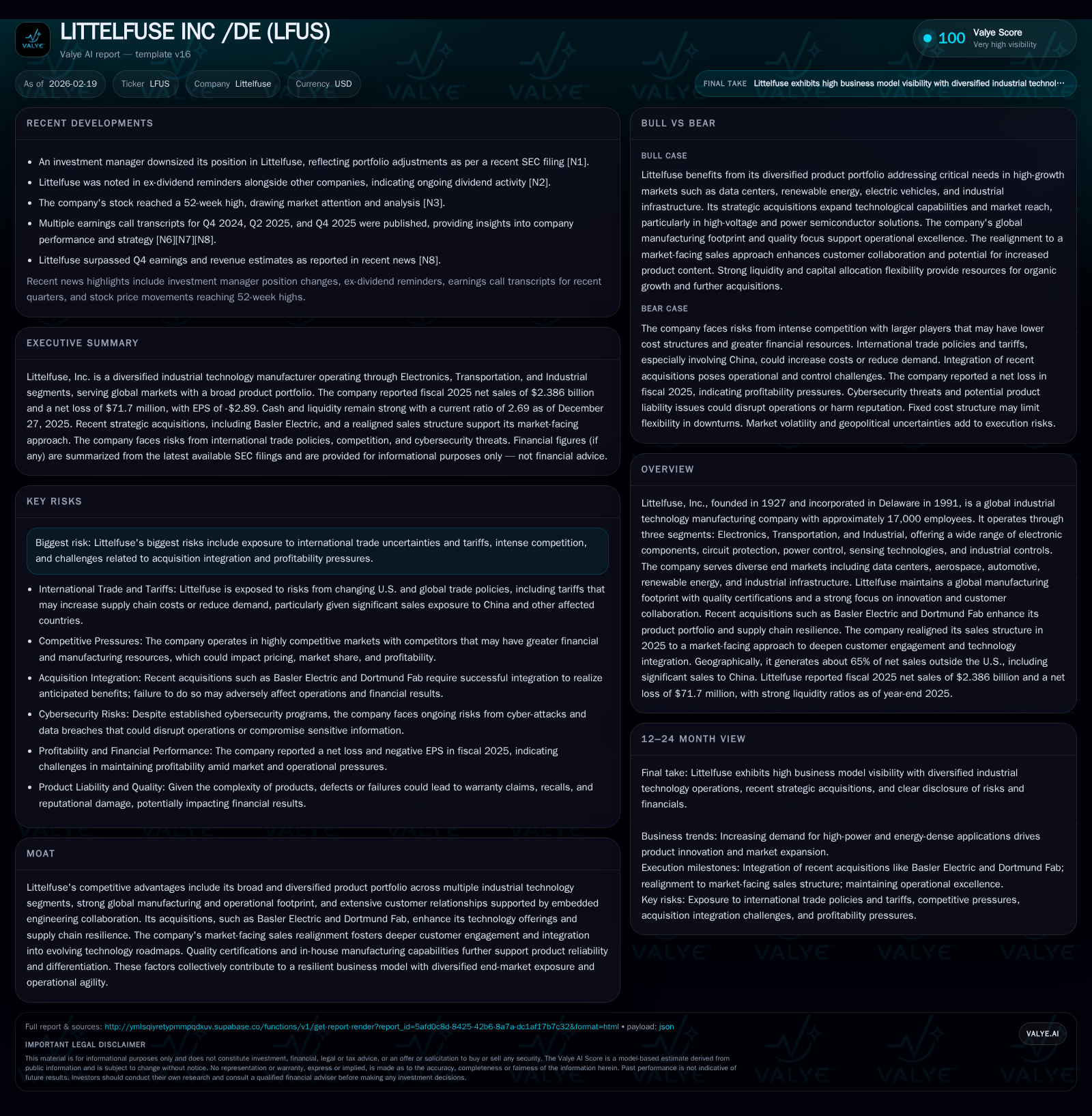
Littelfuse Inc., a nearly 100-year-old diversified industrial technology manufacturer, posted strong revenue growth and profitability through fiscal 2024 driven by broad product innovation across Electronics, Transportation, and Industrial segments. However, in 2025, the company’s operating income fell sharply by over 76%, alongside a net loss, reflecting acquisition-related costs, margin pressure, and macro headwinds such as tariffs and product mix shifts. Despite this earnings disruption, Littelfuse’s operating cash flows remained robust, supported by disciplined capital expenditure and a realigned market-facing sales strategy emphasizing data center infrastructure and aerospace end markets. Risks persist from intense competition and international trade uncertainties, while future milestones include monitoring margin recovery and integration benefits from recent acquisitions.
Legacy Performance and Drivers Through Fiscal 2024
Littelfuse’s financial narrative until fiscal 2024 was characterized by stable growth anchored on its broad product portfolio spanning Electronics, Transportation, and Industrial segments [S4][S5]. With over 17,000 employees worldwide and manufacturing hubs certified under ISO standards across several countries [S14], the company leveraged extensive embedded engineering collaboration to embed its technologies across sectors such as data centers, automotive electrification, aerospace & defense, and renewables.
From FY2022 through FY2024, Littelfuse reported consistent operating income generation — for instance, $500.8 million in FY2022 decreasing somewhat to $360.9 million in FY2023 but rebounding to $158.8 million in FY2024 before the plunge in FY2025 [F1]. These periods saw revenue marginally fluctuate yet remained within the $2.2 billion-$2.4 billion range annually [S6]. The Electronics segment notably provided one of the industry's broadest arrays of circuit protection technologies — including transient voltage suppressor diodes (TVS), PTC resettable fuses, ESD suppressors, power semiconductors such as SiC MOSFETs — underpinning increasing product content per customer platform [S6][S14]. This technical breadth allowed Littelfuse to serve mission-critical applications where system safety against power surges or electrical faults is paramount.
The embedded R&D effort expended roughly $108 million annually supporting accelerating complexity demands across high-power density systems — enabling swifter design-in cycles with customers [S7]. The transportation segment contributed stable revenues serving OEMs with switching solutions tailored for commercial vehicles and electric vehicles’ battery management systems [S12]. Meanwhile, the Industrial segment broadened reach into grid infrastructure and energy storage markets through acquisitions like Western Automation (2023), enhancing electrical shock protection offerings [S7][S12].
Historical performance (annual)
| FY | Net ($mm) | CFO ($mm) | OpInc ($mm) | Capex ($mm) | Net YoY |
|---|---|---|---|---|---|
| 2025 | -72 | 434 | 38 | 68 | -171.6% |
| 2024 | 100 | 368 | 159 | 76 | -61.4% |
| 2023 | 259 | 457 | 361 | 86 | -30.5% |
| 2022 | 373 | 420 | 501 | 104 |
Note: Omitted columns lack sufficient annual XBRL coverage in the provided tags (need ≥2 annual points): Rev. Source: SEC companyfacts cache [F1].
Capital returns and efficiency (annual)
| FY | Div ($mm) | Buybacks ($mm) | FCF ($mm) |
|---|---|---|---|
| 2025 | 72 | 28 | 366 |
| 2024 | 67 | 41 | 292 |
| 2023 | 62 | 371 | |
| 2022 | 56 | 0 | 315 |
Source: SEC companyfacts cache [F1].
Note: Buybacks data incomplete before FY2024; Revenue figure for FY2022 not directly available from provided tags.
This historical performance highlights Littelfuse’s prior ability to generate significant operating leverage despite competing in price-sensitive markets with competitors such as Eaton Corporation and ON Semiconductor [S17].
Dissecting the Sharp Downturn in Fiscal Year 2025: Key Factors
Fiscal year 2025 marked a pronounced inflection point when operating income plummeted by approximately three-quarters compared to FY2024 levels while the company reported a net loss of $71.7 million [F1]. This swing occurred despite revenue continuing to increase modestly (+8.9%) to $2.39 billion [F1].
The primary drivers behind this earnings collapse appear multifaceted based on management discussions during Q2 & Q4 earnings calls [N3][N4], filings [S3], and risk factor disclosures [S1][S19]:
- Acquisition-Related Costs: Integration expenses tied especially to the Basler Electric acquisition completed late December 2025 led to elevated amortization charges and operational disruptions impacting margins.
- Margin Pressure: Pricing headwinds emerged from escalating tariffs influencing cost of goods sold (particularly raw materials like copper alloys and semiconductor inputs sourced globally), compounded by competitive pricing dynamics outlined in risk sections [S1][S21].
- Product Mix Shifts: Variability across end markets with temporary softness in data center infrastructure demand due to macroeconomic factors affecting order fulfillment cadence.
- One-Time Charges/Impairments: Non-cash impairment expenses related to supply chain adjustments or acquired intangible assets further weighed on profitability.
Segment-level commentary indicated the Electronics segment maintained broad demand for TVS diodes protecting sensitive server infrastructure but faced compressions due to component shortages or partial cost pass-through limitations [N4][S6]. The Transportation division contended with supply chain challenges affecting OEM deliveries while navigating price pressures in aftermarket circuits [N3][S12]. The Industrial segment benefited from recent acquisitions expanding addressable markets but bore short-term margin dilution associated with integration scale-up costs including new high-voltage excitation modules from Basler Electric [N3][S28].
Despite steep profit erosion at the net income level, operating cash flow showed resilience growing +18% year-over-year reaching nearly $434 million [F1], signaling underlying operational strength tempered by accounting or non-cash adjustments.
Growth Priorities Rooted in Market-Facing Sales Realignment and Acquisitions
In fiscal year-end reports and disclosures for late-2025, Littelfuse pivoted its salesforce organization from product-centric teams to market-facing units targeting client verticals such as data center energy infrastructure, aerospace & defense electronics subsystems, battery energy storage systems (BESS), renewable grid controls among others [S20][N3]. This restructuring aims at deeper technical collaboration unlocking design-win pipelines where integrated circuit protection combined with sensor fusion technologies deliver differentiated value propositions.
Acquisitions remain pivotal; Basler Electric (Dec ’25) added expertise in high-voltage industrial-grade excitation equipment alongside advanced relay protection systems boosting Industrial segment breadth substantially [S28][N3]. Earlier buys such as Western Automation broadened exposure into electric vehicle charging infrastructures reinforcing positions aligned with secular EV growth trajectories.
These moves are intended not only to increase revenue streams but also improve margins long term by embedding Littelfuse solutions within multi-layered system architectures beyond commoditized components.
Financial Health: Cash Flow Strength Against Earnings Pressure
The juxtaposition within Littelfuse’s recent financials is stark: GAAP earnings faltered dramatically while cash flow from operations climbed robustly +18% YoY topping approximately $434 million in FY2025 [F1]. This divergence reflects significant portions of losses stemming from non-cash items — amortizations related to intangibles post-acquisition, restructuring charges within SG&A or write-downs — rather than pure operational cash burn.
Liquidity remains sound: current assets totaled $1.44 billion against current liabilities near $533 million yielding a current ratio around ~2.7x indicating solid short-term solvency [F1]. Capital expenditures declined roughly -11% YoY reflecting prudent discipline ensuring free cash flow generation remains strong ($366 million after capex) even amid investments into manufacturing upgrades supporting innovation roadmaps [F1][S7].
This balance underscores operational resilience enabling ongoing capital deployment flexibility amidst macroeconomic uncertainties.
Capital Allocation: Dividends, Buybacks & Investment Trends
Littelfuse maintained steady dividend growth averaging ~7%-10% annual increases culminating at ~$72 million paid out in dividends despite earnings setbacks [F1], reflecting confidence supported by reliable cash flows.
Conversely buybacks contracted substantially dropping from ~$41 million repurchased shares down to about $28 million reflecting cautious stewardship amid losses but without cessation of repurchases [F1].
Capex moderation aligns with temporary spending slowdown but remains focused on facility modernization supporting semiconductor fabrication capabilities necessary for competitive advantage given rising application complexities [S7][S28]. R&D investment held steady near $107 million annually underscoring commitment towards innovation leadership underpinning incremental product content gains targeted via market-facing model implementation.
Risk Exposure: Competition, Trade & Integration Challenges
Risks include intense competition from global conglomerates such as Eaton Corporation alongside specialized semiconductor manufacturers benefiting from economies of scale or lower-cost geographies challenging pricing power especially in lower-margin components markets [S17][S9].
International trade uncertainties loom following intensified tariffs primarily between U.S., China (~24% sales exposure), Mexico among others imposing reciprocal levies elevating input costs constraining gross margins unless offset by price pass-through which may dampen demand or shift sourcing toward local suppliers favoring incumbents unaffected by tariffs [S19][S21][N6].
Integration risks linked with recent acquisitions pose execution hurdles; realizing anticipated synergies depends on managing cultural alignment across dispersed manufacturing footprints spanning North America, Europe & Asia-Pacific while retaining key technical talent — delays or missteps could impair profitability improvements over forecast horizons [S1][N3].
Environmental regulatory compliance including legacy liabilities requires monitoring though currently not material but poses potential long-term cost uncertainty needing budgeting attention [S24][S27]. Cybersecurity threats remain evolving requiring robust defenses given increasing attack sophistication that could impact operations or brand reputation if breached materially [S15][S23].
Outlook & Milestones To Monitor
Littelfuse has not disclosed explicit forward guidance post-FY25 losses; however management highlighted margin recovery intent leveraging backlog growth (~$1.07 billion at December ‘25 vs $665 million prior-year-end) driven mainly by orders from prioritized sectors including data center infrastructure upgrade cycles & automotive electrification encouraging focus on sequential quarterly operating income trends following sales realignment efforts alongside bookings metrics detailed during earnings calls [N3][N4][S23].
Upcoming investor events such as May ’26 Investor Day will provide strategic clarity outlining organic R&D acceleration intertwined with selective bolt-on acquisitions aimed at broadening technology breadth deeper vertical integration within mission-critical applications requiring close attention for validating recovery narratives [S25].
Capital expenditure pacing relative to free cash flow ratios will indicate if investments sustainably support innovation-led growth without excessive leverage considering dividend stability versus moderated share repurchases observed recently.
Given geopolitical tensions extending tariff unpredictability alongside fierce competitive dynamics evolving rapidly especially within semiconductor-equipped protection devices segments invested stakeholders should track tariff developments impacting China exposure plus internal updates on Basler Electric integration that carry upside potential balanced against realization risks ahead.
This analysis is based exclusively on publicly available information including SEC filings up to February '26 and latest transcript disclosures without speculation beyond stated disclosures or evidence explicitly cited herein [F1]-[N#]-[S#]. No investment advice or recommendations are expressed or implied.
Disclaimer: This is research-only, informational analysis and not investment advice. It may include AI-generated interpretation and general industry context. Always verify important details using primary sources.

Comments