
Philips’ 2025 Turnaround Balances Regulatory Headwinds and Innovation-Driven Growth
Royal Philips reported returning to profitability in 2025 with modest revenue contraction amid ongoing remediation and quality improvements.
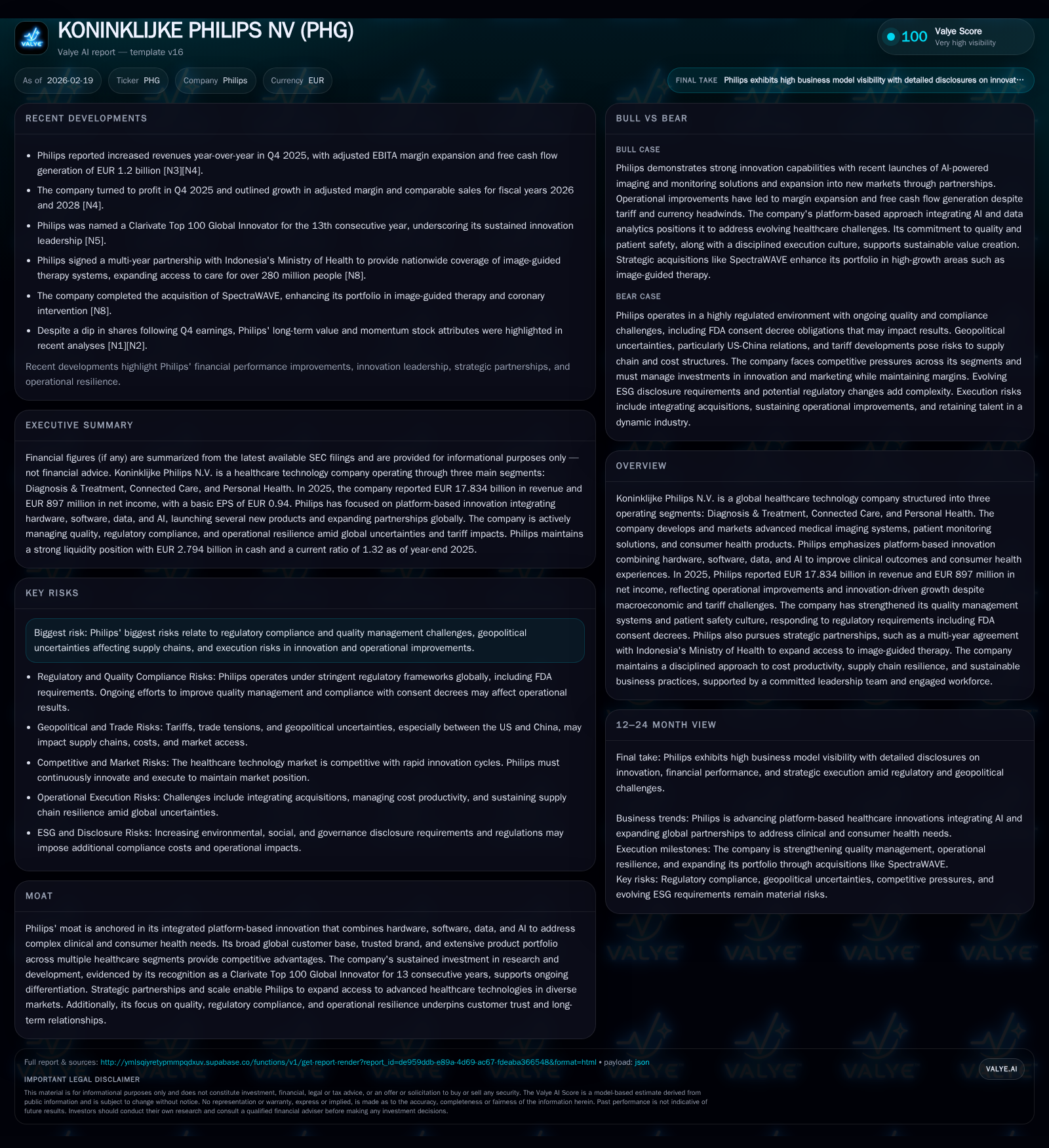
Royal Philips posted €17.83 billion in revenue for 2025, a slight 1% decline year-on-year, alongside a €897 million net profit turnaround from losses in prior years. This recovery reflects Philips’ intensified focus on innovation across its Diagnosis & Treatment, Connected Care, and Personal Health segments, as well as resolution of major Respironics litigation and enhanced operational discipline. Despite improved margins and earnings, risks remain from regulatory compliance and supply chain dynamics. Capital allocation strategies include a proposed dividend hike to €0.85 per share and targeted share repurchases supporting long-term incentive plans. Investors should monitor ongoing execution on AI-enhanced product rollouts, evolving regulatory frameworks, and potential impacts of geopolitical tensions.
Historical Performance Highlights
Philips’ financial trajectory over the last four years has been shaped significantly by recurring operational challenges related to the Respironics recall and consequent regulatory actions. Revenue remained relatively stable but showed a mild downward trend from €18.8 billion in 2022 to €17.83 billion in 2025 (a nominal decline of about 1%), indicating resilience amid external pressures [F1]. Notably, despite top-line stability, the company posted substantial losses in prior years due largely to hefty provisions tied to personal injury settlements linked with recalled respiratory devices.
The turning point came in 2025 when Philips swung back into profitability with a net income of €897 million compared to a net loss of €698 million in 2024. This turnaround was driven by operational improvements including enhanced supply chain management, more favorable product mix from newer innovations, cost control initiatives, and the conclusion of large one-time settlement payments [S4][S6][F1]. Comparable sales growth provided further evidence that the core businesses maintained momentum (2% growth in constant currency terms) even as nominal sales dipped slightly.
Historical performance (annual)
| FY | Rev ($bn) | Net ($mm) | Rev YoY | Net YoY |
|---|---|---|---|---|
| 2025 | 17.8 | 897 | -1.0% | +228.5% |
| 2024 | 18.0 | -698 | -0.8% | -50.8% |
| 2023 | 18.2 | -463 | +1.9% | +71.2% |
| 2022 | 17.8 | -1605 |
Note: Omitted columns lack sufficient annual XBRL coverage in the provided tags (need ≥2 annual points): CFO, OpInc, Capex, Buybacks, FCF. Source: SEC companyfacts cache [F1].
Capital returns and efficiency (annual)
| FY | Div ($mm) | ROE% |
|---|---|---|
| 2025 | 330 | 8.2 |
| 2024 | 32 | -5.8 |
| 2023 | 70 | -3.8 |
| 2022 | 418 | -12.1 |
Source: SEC companyfacts cache [F1].
Note: Operating income and free cash flow not fully disclosed in XBRL data; dividends significantly variable due to prior losses.
Industry Positioning and Moat
Philips has built a robust moat centered on integrated health technology that marries hardware with proprietary software platforms, advanced data analytics, and increasingly AI-driven solutions targeting clinical care pathways and consumer health needs . As one of few global players with broad coverage—from diagnostic imaging through patient monitoring to personal health products—Philips leverages scale advantages across multiple regulated markets. Its recognition as a Clarivate Top-100 Global Innovator for thirteen consecutive years underscores sustained R&D commitment [N5].
This platform approach enables Philips to embed continuous innovation such as SmartSpeed Precise MR enhancement for improving image acquisition speed and clarity—a critical differentiator amid intense competition from Siemens Healthineers, GE Healthcare, and Canon Medical Systems [S20][N1]. Furthermore, multi-year partnerships like the nationwide deployment agreement with Indonesia’s Ministry of Health extend Philips’ market reach while entrenching workflow-centric solutions like IntelliVue patient monitors embedded with AI capabilities [S20].
Recent Operational Developments
In Q4 and full-year 2025 reports [N1][N2], Philips highlighted key milestones:
- Comparable order intake accelerated throughout the year reaching +6–8% quarterly by Q4, suggesting strengthening demand.
- Improvement in adjusted EBITA margin particularly in Diagnosis & Treatment (over 13%) driven by portfolio premiumization and efficiency gains.
- Expanded monitoring contracts at major US integrated delivery networks reflect commercial traction for connected care offerings.
- Innovations such as Flash Ultrasound System tailored for rapid diagnostics bolster competitive positioning.
However, challenges linger from pharmaceutical-like rigor demanded by regulators following Respironics-related product recalls. The company continues substantial investment into quality management systems to satisfy FDA consent decree requirements and broader international standards [S4][S8]. Field-action running costs related to remediation remain material (~€112 million in recent quarters), though steadily declining provisions signal progress toward closure.
Future Growth Prospects
Growth catalysts are poised around several thematic pillars:
- AI Embedded Products: Continued rollout of AI-enabled imaging solutions can enhance Philips’ clinical differentiation while enabling revenue-enhancing service contracts via cloud-connected platforms.
- Connected Care Expansion: Telehealth adoption accelerates interest in remote monitoring tools; integration into healthcare systems could generate meaningful recurring revenues.
- Personal Health Segment: Consumer demand for wellness devices sustained momentum (+6% comparable sales), partially offsetting declines in China—a key variable given geopolitical tensions.
- Geographic Diversification: Emerging market expansions (Middle East/Turkey/Central & Eastern Europe) offer high-single-digit growth opportunities despite macro uncertainties.
Potential constraints include escalating compliance complexity given new regional ESG reporting standards (e.g., EU CSRD), tariff volatility affecting cost base, and risks related to U.S.–China relations impacting supply chains or market access [S5][S20].
Milestones & Guidance to Watch
Philips has not issued detailed formal guidance beyond general outlook statements emphasizing margin improvement goals for fiscal years beyond 2026 [N2]. Observers should monitor:
- Progress against quality management KPIs linked to FDA approvals or lifting of consent decrees.
- Quarterly sales trends within core segments particularly connected care adoption rates.
- Currency exposure effects given significant global operations.
- Execution on announced partnerships like Indonesia’s Ministry of Health contract rollout.
Returns & Capital Allocation
Philips generated positive net income after several years of loss-laden periods, delivering an approximate ROE of about 8.2% based on reported net income (€897M) relative to FY25 equity (€11B) [F1]. While historical dividends were minimal or suspended during loss years, the company reinstated shareholder returns progressively:
- Dividend declared for FY25 proposed at €0.85/share (~€330M total), payable optionally in cash or shares reflecting robust cash flow.[S6]
- Share repurchase programs initiated primarily aimed at fulfilling LTIP obligations (~6 million shares targeted through forward contracts settled as late as Q4 2027).[S21][S18]
Free cash flow generation remains challenged but improving amid capex investments—roughly €660M spent on capital expenditures primarily towards expansion/upgrades [S19][S25]. Net debt burden stands at approximately €6.6 billion (39% net debt/equity ratio), manageable but necessitating ongoing deleveraging focus given prior contingent liabilities [S15].
| Metric | FY22 | FY23 | FY24 | FY25 |
|---|---|---|---|---|
| Net Income (€M) | -1605 | -463 | -698 | +897 |
| Equity (€B) | 13.28 | 12.06 | 12.04 | 10.99 |
| Approx ROE (%) | -12.1% | -3.8% | -5.8% | 8.2% |
| Dividends Paid (€M) | 418 | 70 | 32 | 330 |
| Net Debt/Equity | - | - | - | - |
Note: Detailed free cash flow not fully disclosed but operating cash flows have shown solid recovery.
Sector-Specific Context:
Healthcare technology faces accelerating transformation toward digitalization and AI integration amidst persistent regulatory scrutiny that notably affects legacy device manufacturers exposed to recall risks—Philips exemplifies this transition phase with its hybrid business model combining capital equipment sales plus software-as-a-service elements tied closely to clinical workflows.
Meanwhile, tariff fluctuations impact input costs given extensive global supply chains spanning Asia-Europe-Americas corridors. Furthermore, regulatory bodies globally raise barriers with additional precautions on patient safety emphasizing reliability testing protocols which Philips is aggressively addressing post-respironics incident.
Conclusion
Philips’ financials suggest a cautiously optimistic rebound catalyzed by disciplined operational execution, renewed innovation pipelines incorporating AI capabilities across imaging & monitoring technologies, and resolution of legacy legal liabilities associated with product recalls. The reinstatement of dividends alongside measured share buybacks signals restored financial confidence although balance sheet leverage remains elevated. Future growth depends heavily on sustaining innovation leadership while navigating complex regulatory frameworks that could introduce cyclically higher compliance costs or constrain product launches. Investors should stay attuned to Philips' progress on its extensive quality culture overhaul—considered both a strategic imperative and a potential risk factor—as well as commercial execution in diverse geographies amid geopolitical volatility.
This analysis is based solely on publicly available information including recent SEC filings and news releases up to February 2026; it does not constitute investment advice.
Disclaimer: This is research-only, informational analysis and not investment advice. It may include AI-generated interpretation and general industry context. Always verify important details using primary sources.

Comments