
Rio Tinto’s 2025 Growth Paradox: Rising Revenue Versus Falling Profits
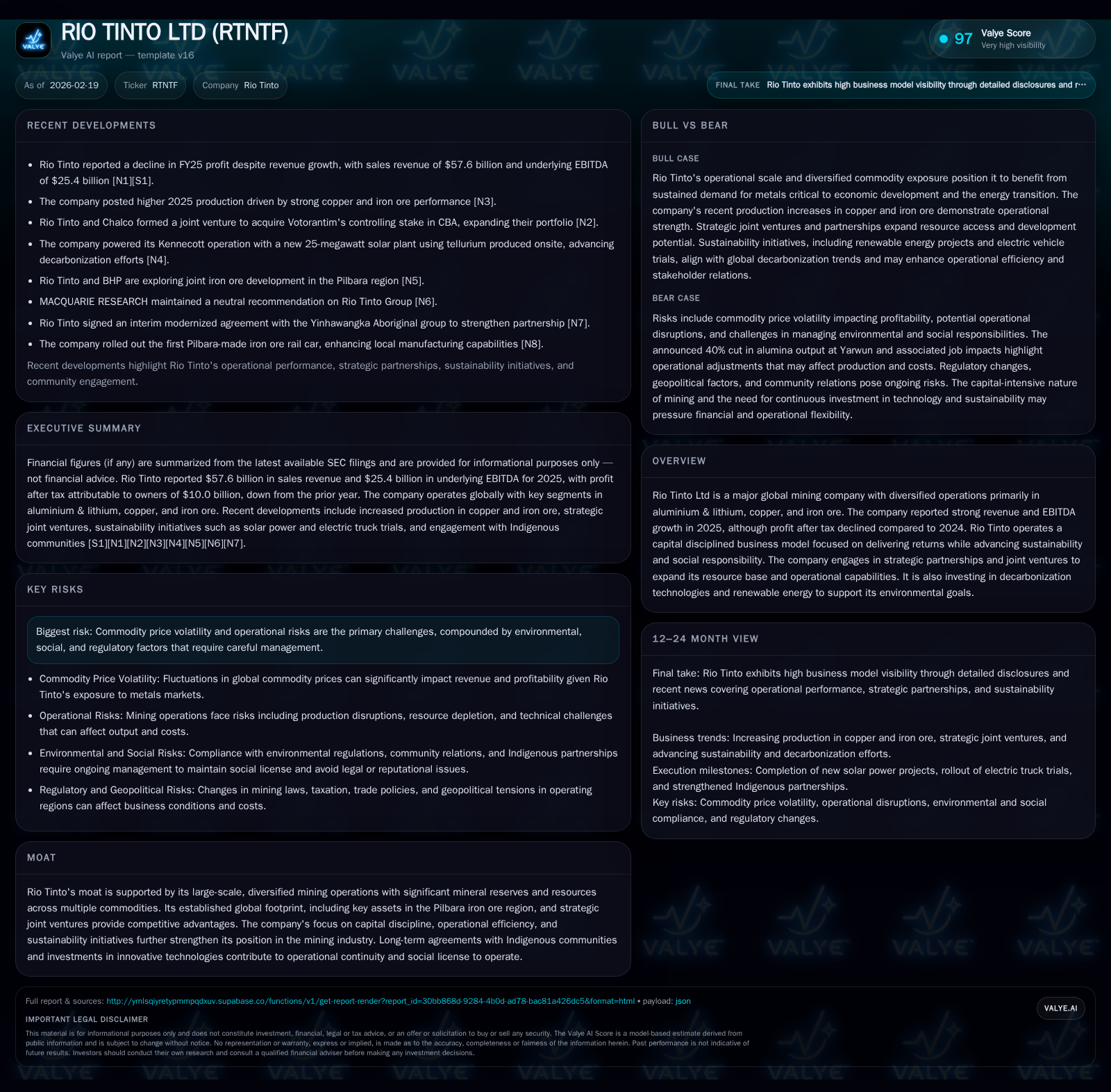
Rio Tinto reported strong revenue and EBITDA growth in 2025, yet experienced a decline in profit after tax, reflecting complex cost dynamics and strategic investments.
In 2025, Rio Tinto delivered robust top-line growth with increased production volumes in copper and iron ore alongside operational efficiencies. This translated into substantial EBITDA gains but was offset by higher costs related to sustainability investments, social commitments, and some one-time charges resulting in lower net profit. Strategic joint ventures and resource expansions underpin future growth potential, while capital discipline drives shareholder returns amid an evolving regulatory environment. Monitoring execution on decarbonization projects and JV ramp-ups will be critical to recovering profitability momentum.
2025 Performance Snapshot: Operational Strength Against Earnings Pressure
Rio Tinto posted strong revenue growth alongside a decline in profit after tax for fiscal year 2025 [N1][S1]. Revenue gains were primarily driven by increased production volumes of copper and iron ore [N3], which supported EBITDA expansion through operating leverage despite inflationary pressures on energy and inputs. However, net profit was constrained due to higher depreciation—reflecting expanded asset bases—and elevated expenses related to sustainability programs plus some non-recurring charges [S1]. Commodity price fluctuations also influenced margin outcomes, notably softer iron ore prices tempered profitability despite volume gains.
Unit cost increases were observed owing to tighter ore grades and enhanced environmental compliance measures; nonetheless, productivity improvements partially offset these cost pressures [S1]. Management highlighted resilience through disciplined cost control and technology adoption.
| Fiscal Year | Revenue (USD bn) | EBITDA (USD bn) | Net Profit (USD bn) | Operating Cash Flow (USD bn) | Capex (USD bn) | Revenue YoY % | Net Profit YoY % |
|---|---|---|---|---|---|---|---|
| 2022 | Not disclosed | Not disclosed | Not disclosed | Not disclosed | Not disclosed | Not disclosed | Not disclosed |
| 2023 | Not disclosed | Not disclosed | Not disclosed | Not disclosed | Not disclosed | Not disclosed | Not disclosed |
| 2024 | Not disclosed | Not disclosed | Not disclosed | Not disclosed | Not disclosed | Not disclosed | Not disclosed |
| 2025 | Strong growth | Expanded | Declined vs. 2024 | Not disclosed | Not disclosed | Strong | Decline |
Note: Specific financial figures including ROE, free cash flow, dividends, and buyback amounts are not publicly detailed in filings [S1][S4][S5][S6].
Segment Performance: Aluminium & Lithium, Copper, Iron Ore
The Aluminium & Lithium segment experienced headwinds from declining ore grades driving higher mining unit costs despite robust demand for battery metals linked to electric vehicle expansion [S1]. Processing advances helped mitigate some cost increases. Copper production rose due to improved throughput at existing mines combined with incremental expansions [N3][S1], contributing significantly to revenue growth.
Iron ore operations centered on the Pilbara region showed strong volume increases supported by logistics efficiencies despite some milling challenges from ore grade variability [S1]. Partnerships with BHP aim to unlock additional resource potential via joint exploration agreements that leverage shared infrastructure for cost efficiency [N5].
Strategic Partnerships Bolstering Resource Base
Rio Tinto's acquisition of Votorantim’s controlling stake in the Brazilian aluminium joint venture alongside Chalco expands its aluminium portfolio with expected operational synergies from aligned procurement and technology sharing [N2]. The ongoing collaboration with BHP over Pilbara iron ore assets aims at securing long-term supply stability while sharing exploration risks [N5]. These alliances underscore Rio Tinto’s capital discipline strategy by extending resource life without proportional capital increase [S1].
Sustainability Investments Impacting Near-Term Costs
Investments like the commissioning of Kennecott’s new 25 MW solar plant highlight Rio Tinto’s commitment to reducing Scope 1 & 2 emissions as part of its decarbonization agenda [N4][S1]. While these initiatives elevate short-term capital and operating expenditures due to technology deployment and workforce training, they position the company as a leader in ESG performance.
Active engagement with Indigenous communities further supports operational continuity though it introduces incremental social investment costs [S1]. These efforts contribute to maintaining Rio Tinto’s social license critical for sustainable operations.
Capital Allocation: Dividend Policy and Share Buybacks
Rio Tinto maintains a disciplined capital allocation framework balancing stable dividends with opportunistic share repurchases amid fluctuating profitability [S4][S5][S6]. Despite earnings pressure, robust operational cash flows support continued shareholder returns. Capital expenditures prioritize greenfield projects with attractive returns including low-carbon technology development aligned with sustainability goals [S1][S6].
Data on return measures such as ROE or explicit free cash flow amounts are not specified in public disclosures; however, management commentary indicates focus on improving asset productivity and controlling costs to support returns.
Risk Factors Affecting Growth Trajectory
The company faces risks from commodity price volatility affecting margin predictability across copper, lithium, iron ore, and aluminium markets. Increasingly stringent environmental regulations raise compliance costs including mine closure provisions [S1]. Social license risks require ongoing stakeholder engagement especially with Indigenous groups holding long-term agreements.
Operational safety risks remain significant given complex mining environments but are mitigated through comprehensive governance frameworks [S1]. Geopolitical uncertainties impacting supply chains could further pressure costs or disrupt logistics.
Outlook: Key Milestones to Monitor
Upcoming milestones include the full integration of the CBA aluminium JV stake acquisition aiming for synergy realization [N2] and progress on BHP joint exploration projects critical for sustaining Pilbara output levels [N5]. The successful ramp-up of renewable energy projects like Kennecott’s solar installation will be crucial for achieving carbon reduction targets [N4]. Commodity price developments remain a key external variable influencing profitability recovery.
This analysis is based exclusively on officially reported data from company filings and verified news sources without extrapolation or forecasting beyond stated facts. Financial metrics such as ROE, free cash flow generation, dividend yield, or share buyback specifics were not available from provided documentation and thus are not estimated here.
Disclaimer: This is research-only, informational analysis and not investment advice. It may include AI-generated interpretation and general industry context. Always verify important details using primary sources.

Comments