
Emerson Radio Corp’s Growth Reliant on Microwave Sales and Retail Concentration
Strong brand recognition drives Emerson Radio, but customer and supplier reliance pose risks to expansion.
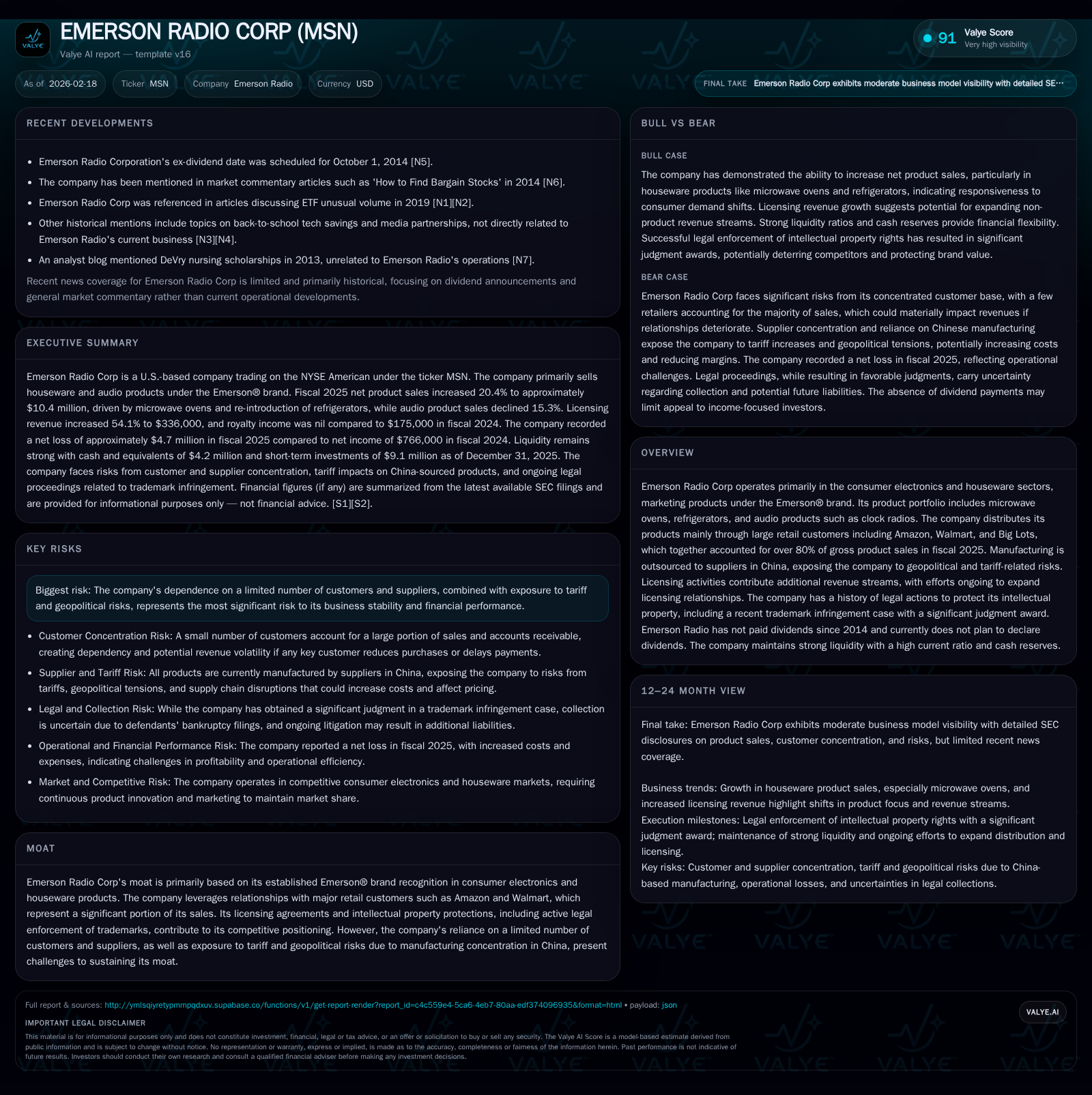
Emerson Radio Corp operates primarily in consumer electronics and houseware sectors, leveraging the established Emerson® brand to distribute products mainly through major retailers such as Amazon and Walmart. Its revenue growth in fiscal 2025 was largely propelled by microwave ovens sales, although audio products declined. The company faces significant customer and supplier concentration risks, with over 80% of sales from three main retailers and complete outsourcing of manufacturing to a handful of Chinese suppliers. Financially, Emerson has sustained operating losses over recent years with negative returns on equity and no dividend payments since 2014. Going forward, growth depends on expanding licensing agreements and internet sales channels amid geopolitical uncertainties impacting supply chains.
Company Overview and Historical Performance
Emerson Radio Corp operates predominantly within the consumer electronics and houseware markets, marketing under the legacy Emerson® brand. Its core product portfolio consists mainly of microwave ovens, refrigerators (recently reintroduced), and various audio products including clock radios [N1][S1]. Distribution relies heavily on large retail partners such as Amazon, Walmart, and Big Lots, cumulatively accounting for over 80% of gross product sales during fiscal year 2025 [S15][S23]. Manufacturing is fully outsourced to Chinese suppliers, creating notable exposure to geopolitical tensions and tariff-related risks [S18][S26]. Licensing forms a complementary revenue stream, with management actively pursuing new agreements.
Financially, Emerson has endured a challenging profitability landscape for several years. The latest fiscal data ending March 31, 2025 shows an operating loss of approximately $5.6 million and net income loss near $4.7 million [F1]. This traces a worsening trend compared to previous years where losses were smaller or briefly positive (net income was $766K in FY2024). Operating cash flow remains negative, albeit improving from -$5.3 million in FY2024 to -$3.6 million in FY2025, reflecting tighter working capital management [F1][S4]. Capital expenditures remained minimal around $195K annually.
Historical performance (annual)
| FY | Net ($mm) | CFO ($mm) | OpInc ($mm) | Capex ($) | Net YoY |
|---|---|---|---|---|---|
| 2025 | -5 | -4 | -6 | 195000 | -717.6% |
| 2024 | 1 | -5 | -3 | 119000 | +156.3% |
| 2023 | -1 | 0 | -2 | 0 | +62.5% |
| 2022 | -4 | -5 | -3 | 2000 |
Note: Omitted columns lack sufficient annual XBRL coverage in the provided tags (need ≥2 annual points): Rev, Div, Buybacks. Source: SEC companyfacts cache [F1].
Capital returns and efficiency (annual)
| FY | FCF ($mm) | ROE% |
|---|---|---|
| 2025 | -4 | -22.0 |
| 2024 | -5 | 2.9 |
| 2023 | 0 | -5.3 |
| 2022 | -5 | -13.5 |
Source: SEC companyfacts cache [F1].
- Fiscal year ends March 31
Note: Revenue figures not disclosed for these periods in provided tags.
Drivers of Past Growth
The primary catalyst for Emerson’s revenue increase in fiscal 2025 was a strong rebound in microwave oven sales, which represented approximately 51–69% of gross product sales across quarters ending December 31, 2025 [S15][S23]. This contrasts with FY2024 when microwaves composed roughly one-third (33%) of sales while audio products made up the majority (66%). The re-introduction of refrigerators also contributed modestly within the housewares segment [S15].
Conversely, audio products — traditionally a substantial part of Emerson’s offerings — experienced a decline of over 15% during the same timeframe due primarily to reduced demand for clock radios [S15]. The company’s strategy includes reinvigorating its legacy product lines while adapting to shifting consumer preferences.
Customer concentration remained significant with Amazon accounting for about 39%, Walmart about 31%, and Big Lots roughly 9% of net revenues in fiscal 2025 [S15]. Such dependence inherently magnifies risk but also ensures relatively stable volume commitments from large-scale retailers.
Product and Customer Concentrations
- Customers: In fiscal year 2025, three customers represented approximately 79% of net revenues ([Amazon (39%), Walmart (31%), Big Lots (9%)]) [S15]. Historic data shows similar patterns with slight shifts in customer mix but prolonged concentration.
- Products: Microwaves expanded their share from about one-third in FY2024 to more than half in FY2025 gross product sales; audio products proportionally decreased [S15][S23]. Refrigerators were reintroduced but remain a minor component.
- Suppliers: Procurement is highly centralized; about 95% of purchases derive from four largest factory suppliers with the biggest supplier delivering approx. 37–46% coverage during analyzed periods [S18][S19][S21]. Manufacturing outsourcing limits fixed asset investment but creates vulnerabilities related to supply interruptions or tariff disputes.
Future Growth Prospects
Growth potential lies in several vectors:
- Licensing Expansion: The company reports ongoing initiatives to develop additional licensing arrangements leveraging its existing trademark portfolio, which may provide relatively low-capital additional revenue streams [N1][S1].
- E-commerce Channel Development: Investment into expanding internet retail presence signals adaptation to evolving consumer purchase behaviors beyond traditional brick-and-mortar giants [N1][S15].
- Product Innovation & New Lines: Management aims to maintain relevance through innovation within core categories (microwaves/audio) as well as potential diversification (e.g., refrigerators).
However, growth is capped by multiple constraints:
- Retailer Dependency: Heavy reliance on few customers means any reduction or loss could materially impact revenues.
- Supply Chain Risks: Concentrated supplier base in China creates exposure to tariffs/tech disputes with attendant risks around price and delivery reliability.
- Competitive Pressure: Consumer electronics is intensely competitive with frequent new entrants and technological obsolescence demands constant innovation.
- Profitability Constraints: Ongoing operating losses emphasize challenges converting revenue growth into sustained profitability.
Forecasts / Milestones / Expectations
No explicit forward-looking financial guidance or milestones have been disclosed recently by the company. Stakeholders should monitor:
- Quarterly revenue trends particularly within microwaves versus audio segments.
- Any public disclosures regarding new licensing deals or expansion into novel product categories.
- Changes in customer concentration percentages reflecting diversification efforts or retention risk.
- Impact of geopolitical/climate developments on supplier relationships related to China manufacturing footprint.
Analysis suggests that success hinges on executional improvements both operationally (cost control/supply chain security) and strategically (licensing growth/internet sales scaling).
Returns / Capital Allocation
Financial fundamentals highlight suboptimal shareholder returns:
- Approximate Return on Equity calculated from latest annual net loss (
$4.7M) divided by average equity ($21M) yields negative ~22% ROE [F1]. - Operating cash flows have remained negative but showed improvement from FY2024 (-$5.3M) to FY2025 (-$3.6M), signaling some amelioration though still cash burn territory [F1].
- Free Cash Flow remains negative after modest capex (~$195K annually) is deducted from cash flow from operations.
- The company has not paid dividends since an extraordinary payout in September 2014 and currently has no plans to resume dividend distributions [S1].
- Share repurchases are not significant in recent years; treasury stock holdings remain substantial (~31 million shares cost basis vs ~21 million outstanding shares) reflecting possible past buybacks or private placements but no active program currently noted [F1][S12].
Given operational cash flow deficits coupled with lack of dividend payments or buyback programs indicates capital recycling has been limited toward shareholder returns; focus remains likely on liquidity preservation and strategic investments.
Brand Moat and Risks Summary
Emerson's competitive moat largely resides in its heritage Emerson® brand recognition within niche consumer electronics segments and longstanding partnerships with retail giants facilitating large-volume distribution [N1]. Additionally, licensing relationships coupled with vigilant intellectual property defense—including recent trademark suits securing judgments—help protect revenue streams against infringement competitors.
However:
- Overdependence on three major customers poses significant business risk.
- Supplier concentration solely within China exposes vulnerabilities amid global trade tensions or supply disruptions aggravated by tariff regimes.
- Slow progress toward profitability coupled with persistent operating losses tempers risk tolerance among investors and creditors.
- Cybersecurity risk management involves executive-level oversight acknowledging potential threats impacting operational continuity [S1].
Conclusion
Emerson Radio Corp illustrates a mid-sized consumer electronics marketer capitalizing on legacy branding allied with concentrated retail relationships that drive volume but elevate exposure risk. Revenue gains led by microwaves offer tangible momentum amidst declining audio product sales while ongoing licensing development diversifies income sources somewhat. Financial performance remains challenged by persistent losses and cash consumption underlying limited return metrics with no imminent dividend resumption visible. Future success hinges critically on maintaining supply chain resilience through China-based manufacturers amid geopolitical uncertainty while broadening customer base through e-commerce expansion and licensing growth initiatives. Investors must weigh solid brand presence against exposed upstream/downstream dependencies that constrain consistent scaling beyond current niches.
This analysis does not constitute investment advice or recommendations but aims to provide an informed overview based on available public filings.
Disclaimer: This is research-only, informational analysis and not investment advice. It may include AI-generated interpretation and general industry context. Always verify important details using primary sources.

Comments