
Clearwater Paper Corporation Examines Integration Challenges and Market Response
Analysis of Clearwater Paper’s operational and financial dynamics following a major acquisition and divestiture.
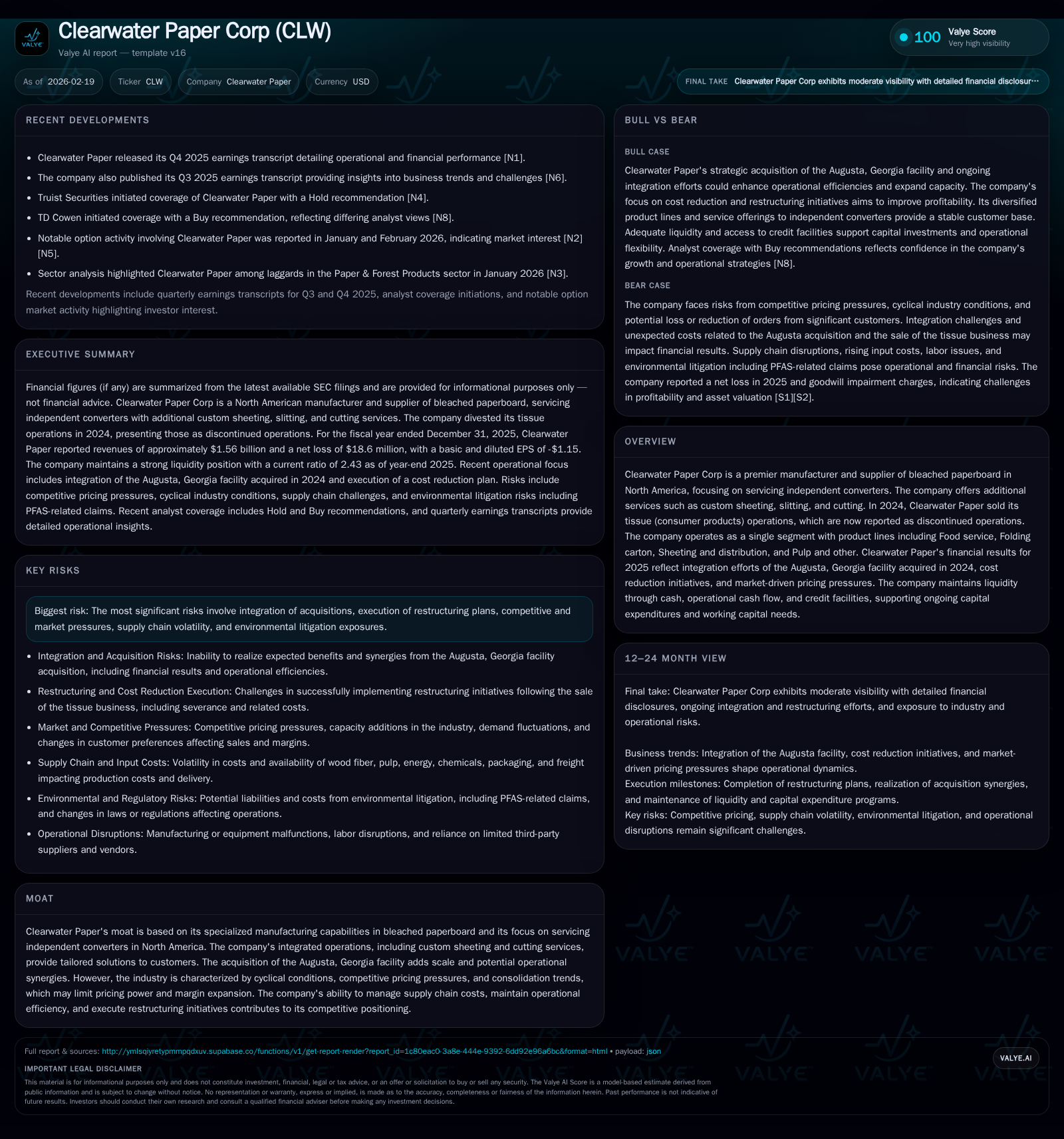
Clearwater Paper Corp experienced a dramatic revenue increase in 2025 following the divestiture of its tissue business and acquisition of the Augusta paperboard facility. While sales soared more than threefold year-over-year, operating losses persisted due to integration expenses, pricing pressures, and restructuring costs. The company maintains solid liquidity supported by credit facilities despite sharply reduced operating cash flow and negative free cash flow. Share repurchases continued but at a cautious pace amid capital intensity. Ongoing cost-control measures, margin improvement efforts, and successful Augusta integration are critical milestones to watch as industry cyclicality and supply chain volatility pose persistent risks.
Historical Performance Highlight: Revenue Surge and Profitability Pressures
Clearwater Paper Corp recorded a pronounced top-line rebound in fiscal year 2025 with revenues climbing to $1.56 billion, a remarkable 301.8% increase over the prior year's $387 million figure [F1]. This surge primarily stems from the acquisition of the Augusta, Georgia bleached paperboard facility completed during May 2024 [N1][S17], coupled with the divestiture of its tissue (consumer products) operations now classified as discontinued [S29]. Despite this sizable revenue growth, operating income remained negative at -$42.1 million for 2025, although this represented an improvement versus -$64.5 million posted in the divestiture-impacted prior year [F1]. The operating loss contraction indicates some recovery attempts balanced against persistent margin pressures.
Net income turned sharply negative, producing an $18.6 million loss compared to a substantial profit of nearly $200 million in 2024 [F1]. This swing reflects several factors including restructuring charges linked to integration efforts, goodwill impairment totaling $48 million recognized in 2025 [S21][S24], and market-driven price reductions impacting revenue quality.
The company’s cash flows from operations fell markedly by 80%, from $61.4 million in 2024 down to just $12.3 million in 2025 [F1]. The significant decline signals continuing execution challenges post-divestiture with the tissue business exit releasing stable cash sources previously contributing positively.
Historical performance (annual)
| FY | Rev ($bn) | Net ($mm) | CFO ($mm) | OpInc ($mm) | Rev YoY | Net YoY |
|---|---|---|---|---|---|---|
| 2025 | 1.6 | -19 | 12 | -42 | +301.8% | -109.3% |
| 2024 | 0.4 | 199 | 61 | -64 | -81.4% | +84.9% |
| 2023 | 2.1 | 108 | 191 | 177 | +0.1% | +134.1% |
| 2022 | 2.1 | 46 | 150 | 114 |
Note: Omitted columns lack sufficient annual XBRL coverage in the provided tags (need ≥2 annual points): Capex, Div. Source: SEC companyfacts cache [F1].
Capital returns and efficiency (annual)
| FY | Buybacks ($mm) | FCF ($mm) | ROE% |
|---|---|---|---|
| 2025 | 17 | -76 | -2.3 |
| 2024 | 10 | -55 | 23.3 |
| 2023 | 18 | 117 | 16.1 |
| 2022 | 5 | 117 | 8.0 |
Source: SEC companyfacts cache [F1].
Note: net income YoY not meaningful for years transitioning through divestiture; nm = not meaningful for percentage calculation.
Impact of the Augusta Facility Acquisition on Operational Scale and Synergies
The strategic acquisition of the Augusta bleached paperboard plant represents a fundamental growth vector for Clearwater Paper.[N1][S17] This addition expanded manufacturing footprint significantly within North America’s independent converter market segment, aimed at achieving scale economies as well as broadened product capabilities including custom sheeting and cutting services intrinsic to bleached paperboard manufacturing.
However, integration complexities tempered immediate margin improvements during the year. Management disclosed increased costs linked to facility ramp-up and alignment hurdles as key constraints impacting short-term profit restoration.[N1][N2] Integration costs recorded as "other operating charges" amounted to several million dollars quarterly reflecting ongoing organizational reshaping [S21][S25]. The importance of managing these transition risks is pivotal given that Augusta contributes substantially to full-year revenue yet drags profitability in early stages.
Despite these challenges, Clearwater aims to extract operational synergies through streamlined working capital management, efficiency gains in production scheduling, and optimized logistics anchored by enlarged scale that should incrementally ameliorate profitability trajectory.
Cost Reduction and Pricing Dynamics Under Market Pressure
Pricing velocity within bleached paperboard markets remains sluggish as consolidation among customers tightens negotiating leverage.[S11][N3] Despite volume increases reported post-Augusta acquisition, declining average realized prices contributed materially to margin compression throughout fiscal year 2025.[N1]
Responding proactively, Clearwater initiated structured cost reduction programs targeting overhead rationalization and labor optimization primarily in legacy facilities alongside severance-related expenses.[N1][S21] These initiatives partially offset raw material and energy inflation shocks encountered during periods of sustained input cost volatility prevalent across pulp and paper sectors.
Competition from larger integrated producers exerts relentless pressure on pricing envelopes constraining Clearwater’s ability to pass through elevated costs fully.[S11] The company highlighted planned maintenance timing shifts also negatively influencing quarterly gross margins through atypical production curtailments.[N1]
This combination of market pricing softness amid cyclical downturns underscores the delicate balance between maintaining volume growth with preservation of earnings quality.
Financial Position and Liquidity Profile in a Capital-Intensive Sector
Clearwater ended fiscal year with liquidity buffers sustained by $30.7 million in cash & equivalents alongside sizeable undrawn capacity under revolving credit facilities including a $375 million ABL line subject to borrowing base limits.[S8][F1] The current ratio stood robustly at approximately 2.43x evidencing coverage above near-term obligations [F1].
Total debt rose substantially from $282 million at end-2024 to approximately $338 million driven by finance required for acquisition funding combined with working capital needs linked to revenue ramp.[S6][F1] Interest expense correspondingly decreased reflecting repayment actions yet cautious leverage management is essential given cyclical earnings variability exposed through operating losses.[S26]
Revolving credit utilization displayed thoughtful conservatism fluctuating around mid-20% levels relative to borrowing base availability while covenants requiring fixed charge coverage ratios remain comfortably met according to company disclosures.[S8][S15]
Working capital metrics such as accounts receivable aging and inventory turnover have remained stable post-acquisition though require monitoring because capital-intensive nature of paperboard manufacturing can generate sensitivity during demand downturns.[N1][S16]
Capital Allocation: Share Repurchases, Capex, and Debt Management
Despite operating losses, Clearwater maintained its share repurchase program showing an uptick in buybacks totaling approximately $17.2 million during fiscal year compared to $10 million previous year [F1][S26]. This reflects a calibrated approach aimed at supporting shareholder returns while balancing constrained free cash flow environments.
Capital expenditure spending moderated by nearly one-quarter falling from $116.6 million in FY24 down to around $88.8 million after substantial investment associated with Augusta acquisition completed in mid-2024.[F1][S13] Allocation leans towards sustaining capacity enhancements rather than expansive capex campaigns amidst uncertain demand backdrop.
Debt maturity profiles reveal manageable near-term principal paydowns complemented by refinancing optionality embedded within credit agreements allowing some flexibility should operational performance stabilize further.[S6]
Free cash flow remains strained with approximately -$76.5 million (operating cash flow minus capex) indicating requirement for sustained EBITDA gains before deleveraging can become meaningful [F1]. Investors should note how this tradeoff reflects typical capital intensity inherent in bleached paperboard manufacturing sectors.
Industry Cyclicality and Competitive Challenges in Bleached Paperboard
The bleached paperboard industry is characterized by marked cyclicality where demand correlates strongly with consumables packaging trends often tied to consumer goods industries as well as broader macroeconomic health.[S11] Consolidation among converting customers presses bargaining power downward constraining producers like Clearwater reliant on specialized service offerings such as custom sheeting.
High fixed-cost structures paired with input volatility including pulp fiber prices elevate margin exposure especially when pricing velocity slows amidst excess capacity scenarios frequently seen in periods following large capacity additions across players.[N3]
Regulatory risks including emerging environmental litigation notably PFAS-related claims against recent acquisitions add uncertainty layers potentially impacting operating costs or capital expenditure burdens beyond forecast levels.[S11]
To maintain competitive positioning Clearwater must navigate cyclical troughs skillfully through structural cost transformations complemented by tactical price management despite external pressures from global competitors affecting product substitutability.
Signals to Watch: Upcoming Milestones and Potential Risks
While explicit guidance for upcoming quarters is absent publicly, market participants would benefit from focusing on several key indicators based on disclosure commentary:[N1][N4][S11]
- Progression metrics related to Augusta facility integration addressing efficiency targets and synergy realization estimated during acquisition negotiation phases,
- Execution pace of cost reduction plans including further headcount rationalizations or contractual savings,
- EBITDA margin stability or expansion evidence counteracting cyclicality,
- Compliance status for liquidity covenants under credit agreements given relatively thin operating cash flows,
- Resolution developments regarding environmental litigation exposures particularly surrounding PFAS regulatory frameworks imposed on acquired assets,
- Monitoring Truist Securities’ newly initiated coverage insights for valuation recalibrations considering operational performance nuances identified recently [N4].
Persistent uncertainties around macroeconomic conditions influencing packaging demand trajectories coupled with competitive restructurings signal ongoing complexity requiring vigilant financial discipline while pursuing strategic opportunities organically or via bolt-on acquisitions remain essential.
This analysis has been prepared solely for informational purposes utilizing available public disclosures without offering investment advice or recommendations. Readers should consider it within broader contextual research frameworks before forming any conclusions regarding Clearwater Paper Corporation.
Disclaimer: This is research-only, informational analysis and not investment advice. It may include AI-generated interpretation and general industry context. Always verify important details using primary sources.

Comments