
Frontier's Financial Volatility and Market Strategy in Ultra Low-Cost Aviation
Frontier Airlines leverages a fuel-efficient Airbus fleet and family-friendly ULCC approach amid significant earnings volatility and constrained liquidity.
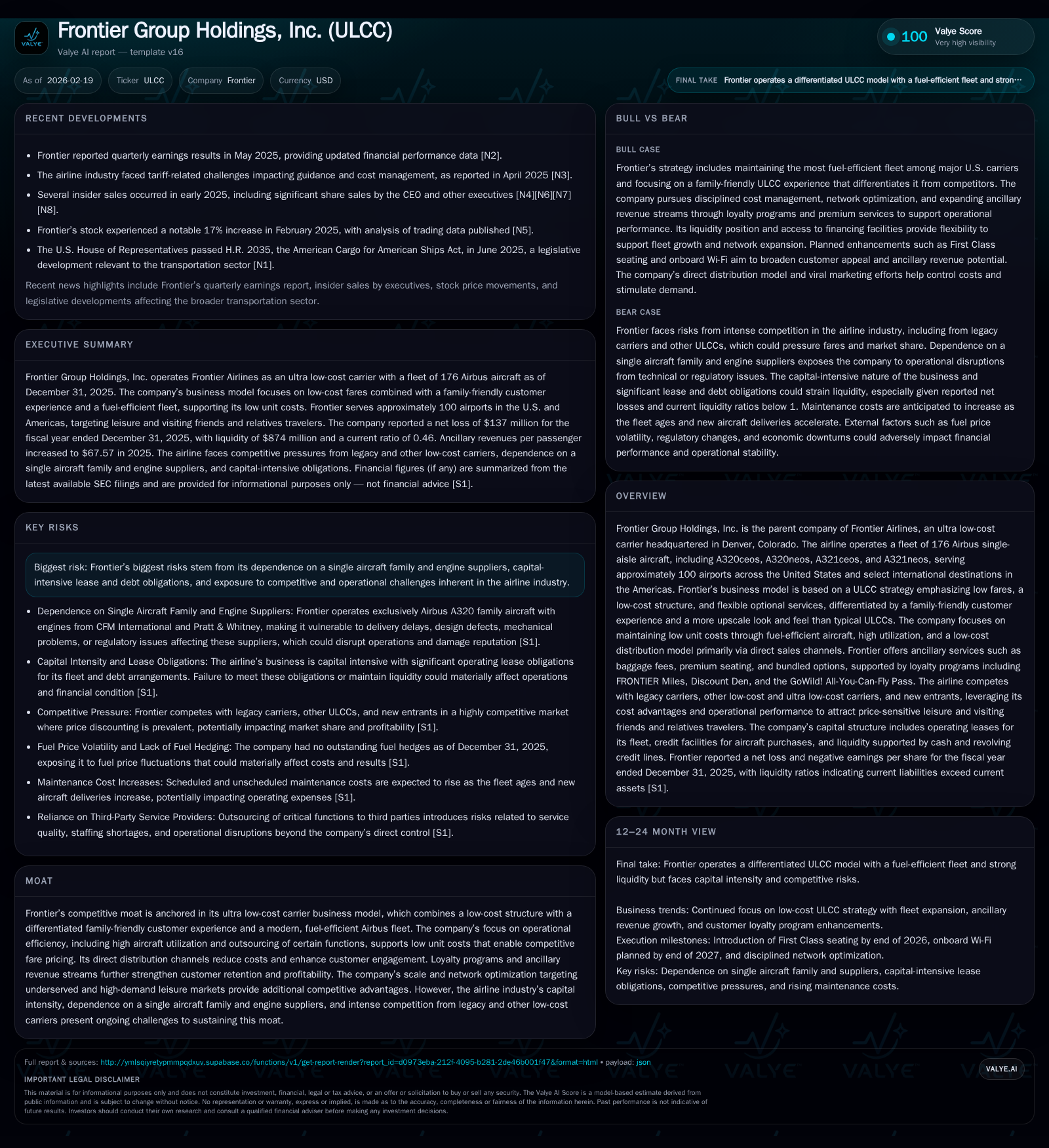
Frontier Group Holdings operates as an ultra low-cost carrier focused on low fares, a fuel-efficient A320neo family fleet, and customer-friendly ancillary services. Despite having the most fuel-efficient fleet among U.S. majors measured by ASM per gallon, Frontier posted a substantial operating loss of $149 million in 2025 after modest profitability in 2024. The airline faces capital and operational challenges including reliance on a single aircraft family, competitive pressures from legacy and low-cost carriers, labor market tightness, regulatory scrutiny, and macroeconomic risks that weigh heavily on its cash flows and equity base. Key metrics such as operating income, cash flow trends, loyalty program development, and cost management will be critical to monitor for potential inflection points in 2026.
Frontier’s Ultra Low-Cost Carrier Model: Efficiency Meets Customer Differentiation
Frontier Group Holdings operates primarily through Frontier Airlines as an ultra low-cost carrier (ULCC), headquartered in Denver. The airline maintains a fleet of 176 Airbus single-aisle aircraft as of December 31, 2025 — comprised of A320ceo/neo and A321ceo/neo variants.[S1][S13] This uniform fleet supports operational simplicity across maintenance, crew utilization, pilot training, and spare parts inventory.
The business model leverages this streamlined fleet alongside high-density seating configurations — including expanded 240-seat A321neos — underpinning one of the most fuel-efficient fleets among U.S. carriers when measured by available seat miles (ASM) per gallon of fuel consumed.[S12] Fuel efficiency is critical given fuel costs represent a significant portion of operating expenses.
Frontier differentiates itself by offering a "family-friendly" experience with an upscale cabin ambiance uncommon among ULCCs. Marketing initiatives feature animal mascots on tail fins and novelty cards for children onboard.[S5][S13] This approach aims to attract repeat leisure travelers while maintaining aggressive fare structures.
Distribution is primarily direct-to-consumer via Frontier’s website, mobile app, and contact centers accounting for about 70% of ticket sales, reducing distribution costs relative to global distribution systems (GDSs) or online travel agencies (OTAs), which still accounted for roughly 30% of bookings.[S5][S12] Ancillary revenues (baggage fees, seat selection charges, bundled services) reached approximately $67 per passenger in 2025,[S9] forming an essential complement to base fares. These revenues enhance profitability and provide pricing flexibility under cyclical demand swings.
Outsourcing non-core functions like ground handling and catering supports cost containment. Operational reliability efforts focus on minimizing cancellations and improving on-time performance through disciplined network planning.[S12]
Financial Performance Overview: Volatility Amid Industry Pressures
From FY2022 to FY2025,[F1] Frontier experienced notable volatility:
- Operating income was negative three out of four years except FY2024 ($58 million positive), then declined sharply to -$149 million in FY2025 (-357% YoY).
- Net income followed similar swings: losses of $37 million (FY22), narrowing loss ($11 million) FY23, positive $85 million (FY24), then back to -$137 million (FY25).
- Operating cash flow deteriorated significantly to -$525 million in FY25 from -$82 million prior year.
Capital expenditures remained stable near $75 million annually but are small relative to the cash burn.[F1] Shareholders’ equity decreased from $604 million at end-2024 to $491 million at end-2025 reflecting accumulated losses.
Historical performance (annual)
| FY | Net ($mm) | CFO ($mm) | OpInc ($mm) | Capex ($mm) | Net YoY |
|---|---|---|---|---|---|
| 2025 | -137 | -525 | -149 | 75 | -261.2% |
| 2024 | 85 | -82 | 58 | 76 | +872.7% |
| 2023 | -11 | -261 | -3 | 51 | +70.3% |
| 2022 | -37 | -78 | -45 | 41 |
Note: Omitted columns lack sufficient annual XBRL coverage in the provided tags (need ≥2 annual points): Rev, Div, Buybacks. Source: SEC companyfacts cache [F1].
Capital returns and efficiency (annual)
| FY | FCF ($mm) | ROE% |
|---|---|---|
| 2025 | -600 | -27.9 |
| 2024 | -158 | 14.1 |
| 2023 | -312 | -2.2 |
| 2022 | -119 | -7.3 |
Source: SEC companyfacts cache [F1].
Revenue data unavailable; buybacks/dividends not reported.
This volatility reflects inflationary pressures on labor and fuel costs,[S21][S27] competitive yield pressures,[S17] capacity adjustments,[S18] and integration challenges like first-class seating reconfigurations starting in 2026.
Fleet Composition & Operational Dynamics Impacting Costs
Frontier operates an all-Airbus fleet primarily composed (85% at end-2025) of next-generation A320neo family aircraft supplemented by older CEO variants.[S13] This includes approximately 89 A320neos, 60 A321neos plus smaller counts of A320ceos (6) and A321ceos (21).
The neo models incorporate advanced engines such as Pratt & Whitney PW1100G Geared Turbofan units with aerodynamic improvements supporting Frontier's leading ASM per fuel gallon efficiency.[S12][S24]
Operational strategy emphasizes high utilization with capacity adjusted seasonally toward underserved or leisure routes.[S12][S24] Pilot interchangeability across all Airbus types simplifies scheduling.
However, concentration risks exist due to reliance on Airbus and engine suppliers; disruptions could significantly impact operations given limited alternative aircraft types.[S24] Leasing obligations impose fixed costs that are difficult to reduce amid demand shortfalls.[S16]
Labor shortages can constrain schedule robustness despite efforts to maintain productivity.[S6]
Competitive Landscape: ULCC Positioning Within U.S. Aviation Market
Frontier competes against legacy Big Four carriers (American, Delta, United, Southwest), mid-tier carriers like JetBlue plus ULCC peers Spirit Airlines and Allegiant Travel Company.[S11][S17][S28]
Legacy airlines have introduced basic economy fares mimicking ULCC pricing backed by greater financial resources,[S17] intensifying competition.
Frontier’s competitive edge rests on its low unit costs combined with efforts to elevate customer experience within ULCC norms.
Its route network covers about 100 airports domestically plus select international destinations in the Americas focused on leisure markets stimulated by low fares.[S4][S9]
Distribution emphasizes direct sales (~70%), reducing reliance on higher-cost intermediaries while maintaining API connectivity with major GDS providers such as Amadeus.[S5][S22]
Operational quality initiatives target reduced cancellations/delays to foster brand loyalty among price-sensitive customers who might easily switch providers based on fare differences.[S12][S28]
Outlook Amid Economic & Regulatory Challenges
Frontier aims for profitable growth via network expansion into leisure destinations aligned with its low-cost structure.[S18] Introduction of first-class seating from 2026 suggests attempts at product upscaling but carries execution risks related to aircraft downtime during modifications.
The business remains sensitive to macroeconomic factors affecting discretionary travel demand:[S21] recession risks, inflationary cost pressures,[S27] pandemic uncertainties,[S21] geopolitical tensions impacting consumer confidence.
Labor market tightness requires balancing competitive compensation against cost advantages amidst turnover trends common across the sector.[S6]
Regulatory scrutiny over ancillary fees could constrain non-fare revenue growth potential,[S10][S19] though these remain vital for profitability given compressed base fares.
Environmental regulations may increase compliance costs but Frontier’s efficient fleet positions it favorably relative to competitors for future carbon regulations.[S26]
Capital Allocation & Returns: Liquidity Constraints Amid Losses
Despite sustained losses culminating in a net loss of $137 million in FY25,[F1] capital expenditures held steady near $75 million focused on fleet sustainability rather than aggressive expansion.
Operating cash flows have been persistently negative resulting in free cash flow deficits nearing $600 million in FY25 alone—a material liquidity strain given limited access to low-cost external capital amid risk perceptions tied to small equity bases.[F1][S16]
At end-2025 cash balances were approximately $671 million against current liabilities exceeding $2.1 billion yielding a current ratio around 0.46—indicating short-term liquidity pressure requiring careful working capital or refinancing management.[F1]
Returns remain deeply negative with approximate ROE near -28%, driven by net losses eroding shareholder equity over multiple years.[F1]
No dividends or share repurchases have been declared historically reflecting liquidity preservation priorities.
Investor Watchlist for 2026: Key Performance Indicators & Risks
No explicit forward guidance provided; investors should monitor:
- Operating income trajectory for signs of stabilization or return to profitability.
- Profitability metrics for new routes launched under growth initiatives.
- Load factor trends and yield changes signaling demand sensitivity.
- Labor market developments impacting cost structures.
- Loyalty program adoption rates including FRONTIER Miles enhancements.
- Distribution channel mix shifts affecting overall margins.
- Regulatory developments impacting ancillary fees or tax liabilities.
These indicators will reveal whether Frontier can stabilize finances within intense competition while leveraging strengths in fuel efficiency and differentiated customer experience.
Disclaimer: Analysis based solely on SEC filings through February 18, 2026; no company guidance or external estimates included.
Disclaimer: This is research-only, informational analysis and not investment advice. It may include AI-generated interpretation and general industry context. Always verify important details using primary sources.

Comments