
PUBLIC CO MANAGEMENT CORP Navigates Strategic Pivot Amid Prolonged Shell Status and Financial Pressures
PCMC remains a shell company focused on a potential healthcare real estate merger, facing liquidity constraints and competitive acquisition challenges.
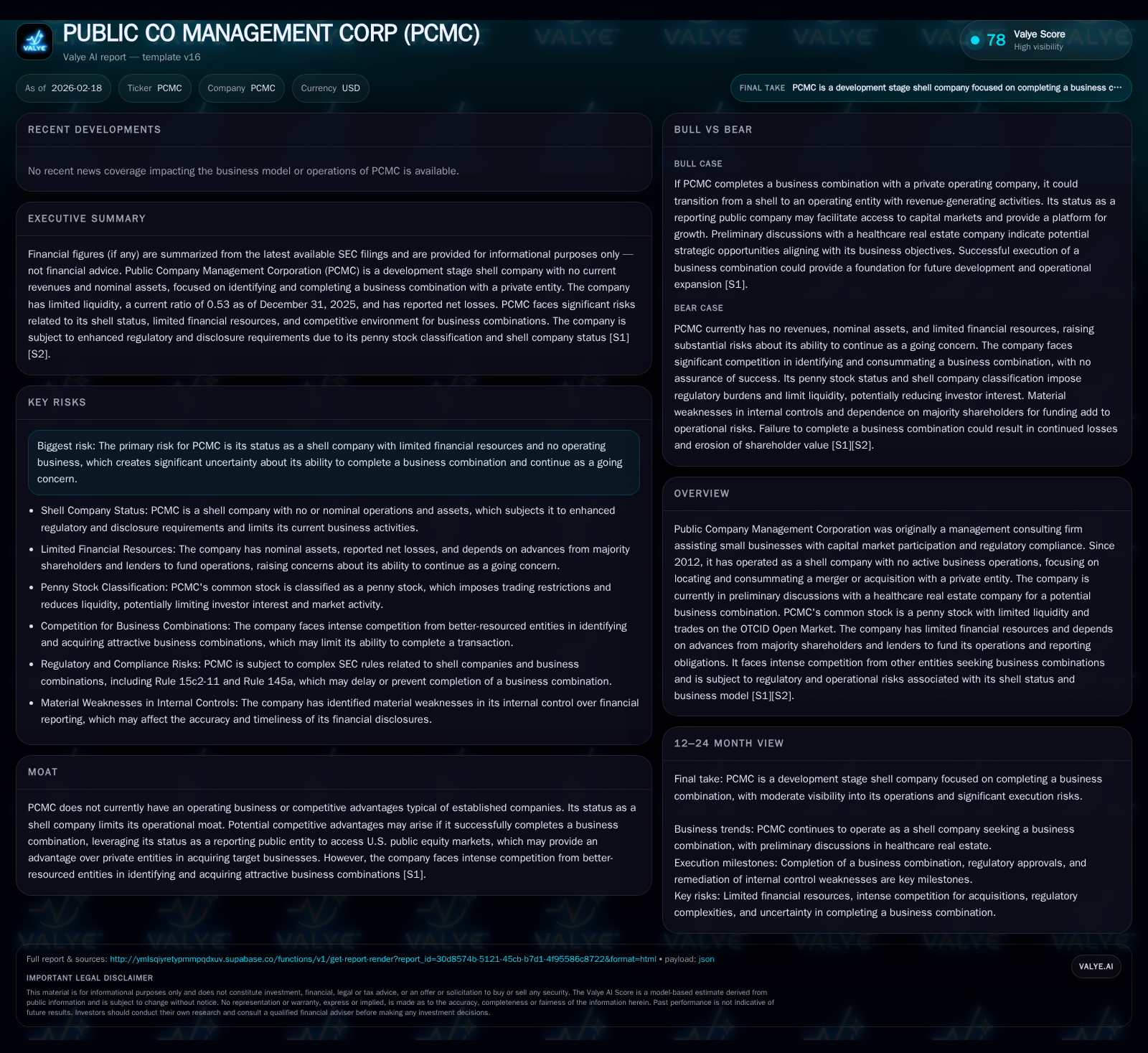
Public Company Management Corporation (PCMC) operates as a shell company with no active revenues since 2012, currently engaged in preliminary discussions to acquire a healthcare real estate business. Historically a management consulting firm, PCMC has experienced persistent operating losses and negative cash flows, sustained by shareholder advances amid limited liquidity. Growth prospects depend entirely on closing a business combination, with risks including competitive pressure from better-resourced entities, regulatory complexities, penny stock trading limitations, and internal control weaknesses. Milestones ahead include due diligence completion, definitive agreement execution, financing arrangements post-merger, and governance restructuring. No dividend or buyback activity is expected given the current financial profile.
Company Background and Historical Performance
Public Company Management Corporation (PCMC), incorporated in Nevada in 2000 as MyOffiz, Inc., rebranded in 2004 and operated primarily as a management consulting firm focused on assisting small businesses with corporate governance enhancement, regulatory compliance, and capital market access strategies. Revenues were generated mainly via consulting fees combining cash and restricted shares from clients pursuing public reporting status through subsidiaries such as GoPublicToday.com, Inc. and Pubco WhitePapers, Inc. [S10].
The economic downturn triggered by the 2008 subprime mortgage crisis severely impaired capital markets activity and intensified competition from investment banks and venture capital firms, leading to sustained unprofitability for PCMC.
Consequently, effective October 1, 2012, PCMC became a shell company dedicated solely to identifying and consummating mergers or acquisitions that confer operational substance [S6],[S14].
Financial Overview
Recent financials demonstrate persistent negative operating income and net loss trends alongside worsening cash flows:
Historical performance (annual)
| FY | Net ($) | CFO ($) | OpInc ($) | Net YoY |
|---|---|---|---|---|
| 2025 | -103817 | -165630 | -93554 | -37.5% |
| 2024 | -75517 | -58731 | -65017 | -110.9% |
| 2023 | -35808 | -20682 | -25308 | +2.5% |
| 2022 | -36713 | -2240 | -26213 |
Note: Omitted columns lack sufficient annual XBRL coverage in the provided tags (need ≥2 annual points): Rev, Capex, Div, Buybacks, FCF. Source: SEC companyfacts cache [F1].
Capital returns and efficiency (annual)
| FY | ROE% |
|---|---|
| 2025 | 50.1 |
| 2024 | 13.2 |
| 2023 | 7.2 |
| 2022 | 8.0 |
Source: SEC companyfacts cache [F1].
Note: Revenue data is not available from provided tags; analysis focuses on disclosed metrics.
The marked increase in negative operating income and net loss alongside sharply deteriorated cash flow underscores ongoing cash burn without active operations. The improvement in equity from −$572K to −$207K between FY2024 and FY2025 likely reflects capital injections or accounting adjustments documented in filings rather than operational gains [F1].
Liquidity remains constrained with current assets at approximately $257K against current liabilities near $481K as of December 2025 quarter-end—yielding a current ratio of 0.53 indicative of tight short-term funding capacity [F1],[S7].
Current Status: Shell Company Focused on Business Combination
With no ongoing revenue-generating activities since becoming a shell entity over a decade ago, PCMC depends heavily on unsecured non-interest-bearing advances from its majority shareholder holding about 70.3% equity for covering administrative expenses including legal and SEC filing fees [S7],[S12].
Management is actively engaged in preliminary discussions for a potential business combination with Physicians Capital Management Corporation—a Maryland-based firm specializing in healthcare-related real estate acquisition and development under long-term net leases providing stable occupancy solutions to healthcare operators [S1],[S16].
This strategic direction represents a significant departure from PCMC’s historical consulting services model toward an asset-backed real estate focus.
No definitive agreements are currently executed; all negotiations remain exploratory subject to due diligence findings and regulatory review [S16],[S25]. Completion of such transaction would likely require issuance of new securities diluting existing shareholders’ interests while transferring controlling ownership to the target’s shareholders [S11],[S19].
Competitive Landscape and Industry Context
While PCMC presently lacks direct industry classification pending acquisition closure, the prospective healthcare real estate sector combines characteristics of specialized REITs targeting medical properties with stable tenant bases.
Competition for attractive acquisition targets is intense among entities including venture capital funds, leveraged buyout firms, other SPAC-like vehicles or public shells pursuing similar objectives. Many competitors possess substantially greater financial resources and expertise which may constrain PCMC’s negotiating leverage despite the advantage of being an existing public registrant able to access U.S. equity markets directly [S9],[S26].
Additional risks arise from regulatory complexities inherent to real estate development such as environmental compliance issues, zoning challenges, contract litigation risks related to construction—all factors requiring thorough due diligence to mitigate post-combination liabilities [S21],[S27].
Growth Outlook & Milestones
Explicit growth projections or forward guidance are unavailable due to the early stage of negotiations without finalized contracts.
Key milestones for investors include:
- Execution of definitive agreements with Physicians Capital Management Corporation or alternative targets [S1],[S16]
- Completion of comprehensive due diligence assessing financial condition and regulatory risks within the target’s sector [S13]
- Fulfillment of SEC reporting requirements pre- and post-business combination filings [S8]
- Securing financing arrangements necessary to support ongoing operations after merger closure given PCMC’s lack of independent revenues [S20]
- Reconstitution of management and governance structures following probable control transfer to new shareholders post-merger [S19]
Until these milestones are reached successfully PCMC remains exposed to uncertainty regarding its transition from shell status to an operational entity capable of generating revenues.
Returns Profile & Capital Allocation
Given the absence of revenues or earnings infrastructure prior to any transaction completion there have been no dividends paid nor share repurchase programs implemented historically or planned imminently—dividends are unlikely until positive earnings emerge post-business combination execution [S15],[F1].
Return on equity calculations are distorted by negative equity balances; trailing twelve-month ROE approximated at +50% is driven by accounting effects rather than operational profitability improvements—reflecting capital restructuring more than business recovery [F1].
Capital expenditures for growth or R&D are not applicable at this stage due to shell status; future allocations will prioritize transaction-related costs followed by investments aligned with new operations post-acquisition.
Risks & Challenges
Principal risks include failure to consummate attractive deals within reasonable timeframes exposing PCMC to liquidity shortfalls that threaten going concern viability—already highlighted by auditors given lack of operational revenues or assets generating cash flow [S17],[S22].
Trading liquidity risks are heightened due to thin volume OTCID Open Market listing under penny stock rules which restrict resale ease thereby limiting marketability absent uplisting or increased trading activity [S18].
Material weaknesses in internal controls over financial reporting present additional investor confidence challenges until remediated satisfactorily [S22],[S28].
Competitive disadvantages relative to better-capitalized peers may force compromises on deal terms reducing economic benefits derived from acquisitions within the healthcare real estate space [S9],[S24].
External uncertainties such as lingering pandemic impacts or geopolitical factors may indirectly affect timing or valuation prospects though precise influences remain speculative currently [S29].
Summary Commentary
PCMC currently stands at a critical juncture having evolved from its consulting origins into a public shell poised for acquisition-led transformation focusing on healthcare real estate investment. Its balance sheet typifies shell company traits: minimal assets supported solely by shareholder loans enabling maintenance of existence alongside ongoing SEC compliance demands. Until binding acquisition agreements materialize converting latent potential into active revenue-generating operations growth trajectories remain theoretical. Investors must weigh considerable uncertainties encompassing competitive pressures against strategic advantages afforded by its public listing platform facilitating broader capital access relative to private competitors. Key near-term developments hinge upon concluding complex multi-party negotiations involving specialized lenders with successful execution determining whether PCMC emerges as viable operating concern or continues enduring inherent shell-company volatility.
Disclaimer: This is research-only, informational analysis and not investment advice. It may include AI-generated interpretation and general industry context. Always verify important details using primary sources.

Comments