
Appian’s Turnaround: From Extended Losses to Operating Breakeven on Scalable Automation Platform
Appian shifted from multi-year operating losses to near breakeven in 2025, leveraging its unified automation platform amid rising AI adoption and subscription growth.
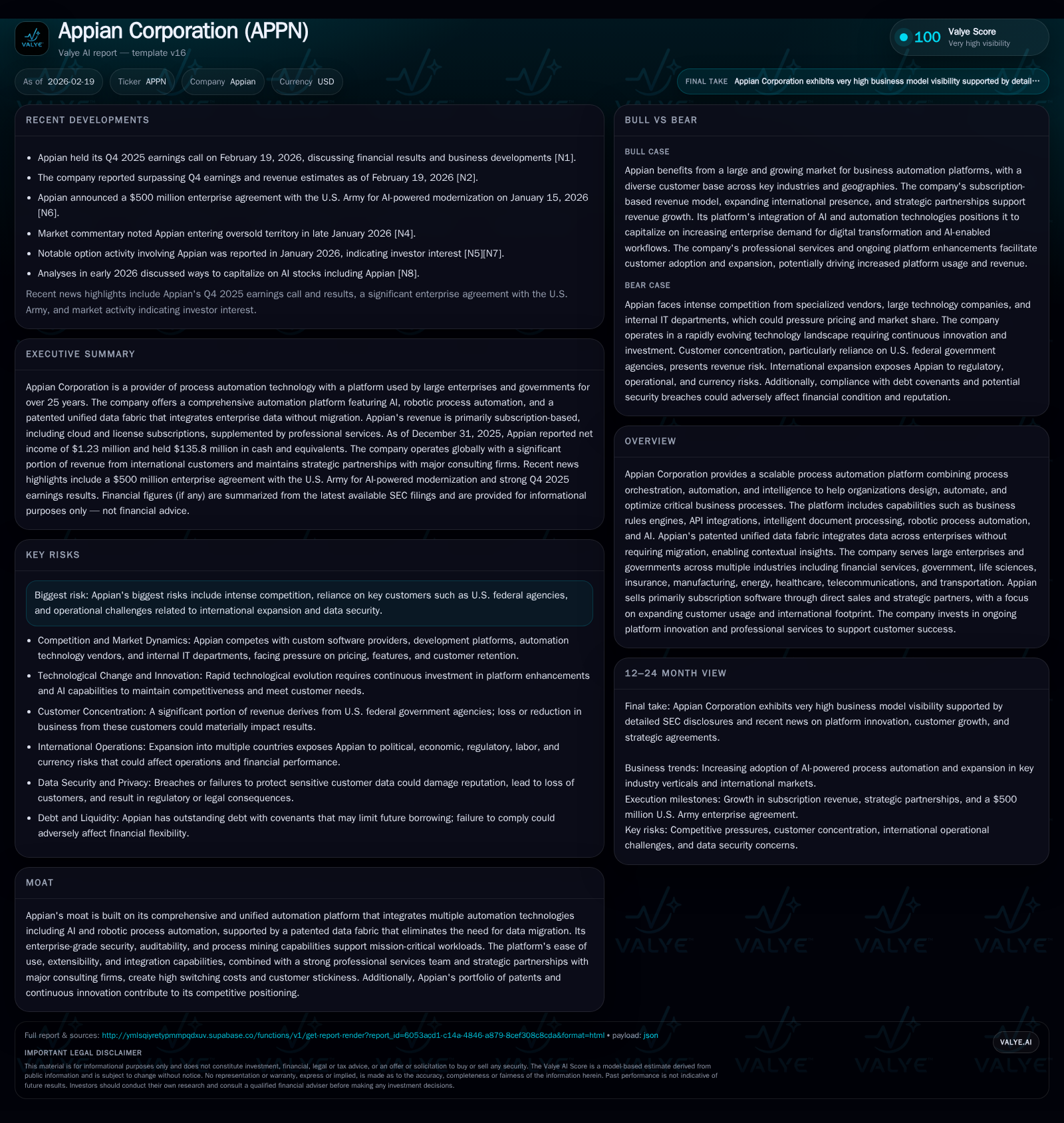
Appian Corporation has demonstrated a significant financial turnaround, growing revenue by over 30% annually from 2023 to 2025 and achieving positive operating income in 2025 after years of substantial losses. This performance reflects robust subscription revenue expansion driven by cloud migration and strategic government contracts, particularly within U.S. federal agencies. The company’s patented unified data fabric and integrated AI-enabled automation tools underpin its competitive advantage, helping to lock in large enterprise customers with high switching costs. While international expansion and operational scaling present challenges, disciplined capital allocation including share repurchases and sustained R&D investment support long-term growth potential. Key risks include competitive pressures, customer concentration in government sectors, evolving data security regulations, and historical accumulated losses impacting return on equity.
Historical Revenue Growth and Profitability Trends
Appian Corp’s financial trajectory over recent years underscores a remarkable turnaround story. Annual revenue increased from $545 million in fiscal year (FY) 2023 to $617 million in FY 2024, then surged further to $727 million by FY 2025—a compound annual growth rate approaching 19% ([F1], [S1]). This growth was largely fueled by subscription revenue expansion, notably the cloud subscription component which rose from $304.5 million in 2023 to $437.4 million by end-2025.
Operating income reflected even more profound improvement, recovering from a loss of $145 million in FY 2022 through gradual reductions of losses at -$108 million and -$61 million in FYs 2023 and 2024 respectively, reaching operating breakeven with $0.6 million profit by FY 2025 ([F1]). Net income also turned positive at $1.2 million for FY25 following large losses exceeding $90 million in prior years.
This evolution was accompanied by a shift from severely negative operating cash flows (-$110 million in FY 2023) to positive operating cash flow of $62.9 million (+814% YoY) in FY 2025, highlighting enhanced operational efficiency and scaled recurring revenues.
Historical performance (annual)
| FY | Net ($mm) | CFO ($mm) | OpInc ($mm) | Capex ($mm) | Net YoY |
|---|---|---|---|---|---|
| 2025 | 1 | 63 | 1 | 3 | +101.3% |
| 2024 | -92 | 7 | -61 | 4 | +17.2% |
| 2023 | -111 | -110 | -108 | 10 | +26.2% |
| 2022 | -151 | -107 | -145 | 9 |
Note: Omitted columns lack sufficient annual XBRL coverage in the provided tags (need ≥2 annual points): Rev, Div. Source: SEC companyfacts cache [F1].
Capital returns and efficiency (annual)
| FY | Buybacks ($mm) | FCF ($mm) | ROE% |
|---|---|---|---|
| 2025 | 20 | 60 | -2.6 |
| 2024 | 50 | 3 | 282.7 |
| 2023 | -120 | -212.9 | |
| 2022 | -116 | -103.6 |
Source: SEC companyfacts cache [F1].
Note: Free Cash Flow (FCF) calculated as Operating Cash Flow minus Capex; Revenue YoY % available for recent years; Operating Income change % is approximate.
Core Competitive Advantages of Appian’s Automation Ecosystem
Appian’s moat rests on its technically sophisticated yet user-friendly automation platform that converges multiple capabilities—process orchestration, AI-enhanced robotic process automation (RPA), intelligent document processing (IDP), business rules engines, API integrations—within a unified low-code development environment ([S1],[S8]).
Central to this is Appian’s patented unified data fabric technology which circumvents costly data migration through secure contextual data integration that delivers real-time insights across disparate enterprise systems—a critical enabler for embedding intelligence into workflows and unlocking AI’s full value ([S8]). This foundation allows the platform to offer enterprise-grade control features including security compliance frameworks and auditability essential for mission-critical workloads.
The iterative interactive design system accommodates collaboration between business users and developers using visual modeling tools assisted by AI-generated suggestions that accelerate workflow optimization — creating significant stickiness as customers’ operational processes become deeply embedded within Appian’s ecosystem.
Strategic partnerships with global consulting leaders such as Accenture, Deloitte, KPMG amplify its reach while its experienced professional services team ensures high implementation success rates underpinning customer retention.
Subscriptions Dynamics and Cloud Migration Impact
A key driver behind Appian’s improving financials is the pivot toward cloud-based subscription revenue which formed approximately three-quarters of total subscriptions revenue at $437 million out of $576 million total subscriptions sales in FY25 ([F1],[S4]). This represented over a +40% increase compared to the prior year benefiting from greater adoption amidst enterprises shifting away from license seats toward scalable consumption or user-based pricing models.
Though gross margins fluctuate due to associated hosting costs and support infrastructure investments required for cloud scalability—the cloud mix supports stable recurring revenue streams with predictable pricing enhancements driven by customer usage expansion ([S4]).
Professional services margins have been variable as subcontractor utilization increases but remain pivotal for accelerating customer deployment velocity.
The correlation between cloud subscription growth and margin improvements highlights monetization strength typical of platforms enjoying network effects via broad application deployment across clients’ organizations.
Key Customer Segments and Strategic Contracts
Appian targets larger organizations typically exceeding $2 billion in annual revenue spanning verticals such as financial services, government, life sciences, insurance, manufacturing among others ([S1]). Nearly one-quarter of total revenues come from U.S federal government agencies alone (25.3% in FY25), demonstrating deep penetration into highly regulated environments ([S12],[N4]).
The company frequently secures multi-year strategic agreements exemplified by the notable $500 million U.S Army AI modernization contract integrating Appian’s platform into critical defense workflows ([N4]). These agreements provide valuable pipeline visibility given their scale and length.
Customer concentration remains moderate as no individual client accounted for more than 10% of total revenue; however reliance on federal contracts exposes Appian to associated budgetary risks amid complex procurement cycles ([S12]).
AI Integration and Product Innovation as Growth Catalysts
Appian distinguishes itself through embedding AI directly within automated workflows as "digital workers" rather than treating AI as ancillary tools ([S8],[N1]). These digital workers operate under stringent "guardrails" encompassing policies that prevent hallucinations or erroneous outputs ensuring reliability crucial for mission-critical applications.
This contrasts with many firms deploying AI primarily for assistive or analytical purposes outside core operations. By integrating process mining capabilities alongside AI agents capable of dynamic decision-making within processes, Appian enhances adaptability and responsiveness to evolving automation demands.
Continuous product innovation focused on platform extensibility positions Appian well to address the rapidly evolving landscape where client requirements shift towards blending human expertise with autonomous intelligent agents.
International Expansion and Scaling Challenges
Approximately 38% of Appian's revenues originate outside the United States as of FY25 ([S1]), reflecting ongoing efforts to grow international presence with operations spanning sixteen countries.
Scaling globally entails complex challenges: managing expanded partner ecosystems where local channel partners require enablement; coordinating cross-border professional services deployment; compliance with diverse regulatory frameworks; maintaining infrastructure performance across geographies ([N6],[S12]).
While international markets offer substantial upside potential, these complexities could delay profitability improvement internationally or create execution risks related to standardizing sales and service delivery models.
Capital Deployment: Share Repurchases, R&D Investment, and Financial Health
Capital allocation reflects prioritization of long-term platform leadership combined with shareholder returns—highlighted by stock repurchases totaling approximately $20 million during FY25 following sizable repurchases ($50 million) in FY24 ([F1],[S18]).
Research & Development spending remained robust at around $172 million annually geared towards platform enhancements including AI capabilities whereas capital expenditures were modest (~$3 million annually), emphasizing SaaS cloud infrastructure leverage ([F1],[S21]).
Despite net income turning positive only recently ($1.2 million net income for FY25), return on equity remains negative (-2.6%) chiefly due to historical accumulated losses impacting equity base ([F1]), underscoring the importance of continued profitability improvement.
Liquidity remains solid with over $135 million cash on hand at year-end FY25 alongside credit facilities supporting operational flexibility ([S7],[F1]).
Outlook Commentary and Market Expectations
While explicit quantitative guidance is not provided beyond qualitative commentary regarding ongoing investments to enhance platform speed/capacity combined with plans for selective acquisitions targeting innovation boosts ([S15]), investors should monitor key metrics such as new large enterprise customer additions, expansion of application deployment per client (net ARR retention), subscription gross margin trends given hosting cost dynamics, renewal rates signaling customer stickiness, and incremental operating leverage converting top-line growth into earnings.
Seasonality impacts quarter-end results due to typical software industry buying patterns favoring Q4 contracts; hence sequential fluctuations may not indicate long-term trend deviations ([S15]).
Risks Affecting Long-Term Sustainable Growth
Appian faces multifaceted risks: vigorous competition spans incumbent process automation vendors offering individual solutions (BPM suites or standalone RPA/AI tools), low-code/no-code rivals appealing via rapid app creation speed; intensified post-AI emergence market disruption expected going forward ([S11],[S20]).
Customer concentration risk persists given roughly one-quarter revenue dependency on federal agencies which are subject to volatile budget cycles complicating forecast accuracy.
International market expansion exposes operational risks including partner enabling inefficiencies plus legal/regulatory compliance burdens around increasingly stringent global data privacy standards requiring costly adaptations ([S26]).
Additionally litigation risk remains tangible given past trade secret lawsuit versus Pegasystems resulting in large judgments favoring Appian; intellectual property disputes common in software sectors could impose financial/legal burdens potentially diverting management attention ([S17]).
In sum, sustaining competitive differentiation through continuous technology innovation coupled with managing execution risks on international fronts will be critical for durable profitable growth ahead.
Disclaimer: This analysis is based solely on publicly available information from SEC filings and news sources cited herein through February 19, 2026. It is intended solely for informational purposes without any explicit investment recommendation.
Disclaimer: This is research-only, informational analysis and not investment advice. It may include AI-generated interpretation and general industry context. Always verify important details using primary sources.

Comments