
JLL Leverages Integrated Services and Technology Investments Amid Transaction Volatility
Jones Lang LaSalle's broad global platform and technology focus drive strong revenue growth with cautious outlook on transaction-based risks.
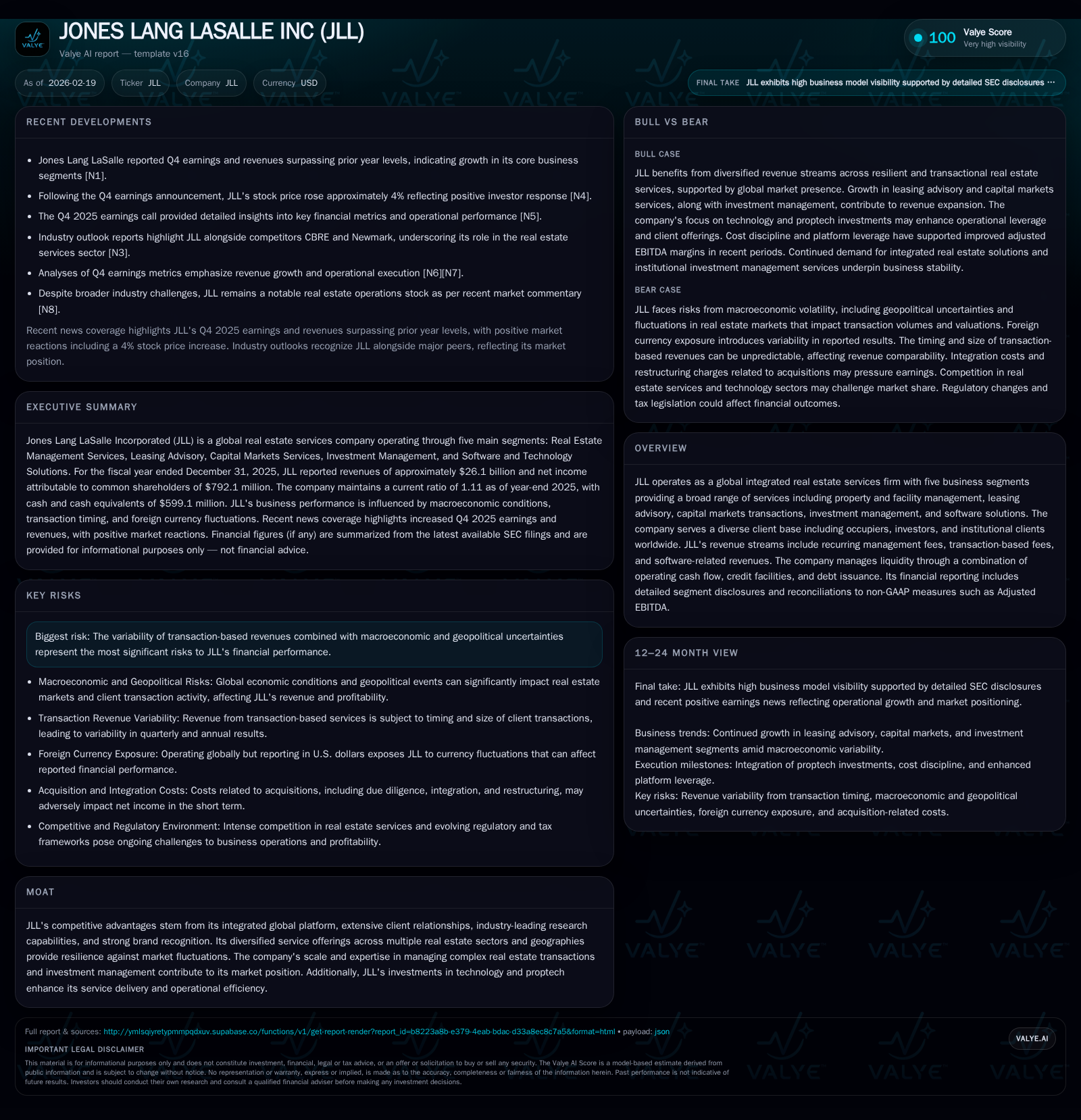
Jones Lang LaSalle (JLL) delivered robust top-line growth in 2025, driven by its diversified real estate services platform, including property management, leasing advisory, and capital markets. The firm’s expanded software solutions and strategic proptech investments underscore a pivot toward technology-enabled services. Operating income and net income increased significantly year-over-year, supported by operational leverage and strong cash flows. However, JLL faces risks from the inherent variability of transaction revenues and macroeconomic uncertainties. Capital allocation remains disciplined with sizable share repurchases but no dividends.
Historical Performance and Growth Drivers
Jones Lang LaSalle Incorporated (JLL) has demonstrated consistent top-line growth over recent years, with consolidated revenues increasing from approximately $20.7 billion in FY2023 to $23.4 billion in FY2024, culminating in $26.1 billion in FY2025 — an increase of 11.4% year-over-year [F1]. Operating income showed a notable upward trajectory rising by 26.5% in the latest period to $1.1 billion, reflecting improved operating efficiency alongside revenue growth.
This growth is chiefly fueled by JLL's multifaceted service offering across its five key business segments: Real Estate Management Services, Leasing Advisory, Capital Markets Services, Investment Management, and Software & Technology Solutions [S14]. The Real Estate Management Services segment alone generated approximately $20 billion in revenue for FY2025—a strong performance underpinned by Workplace Management and Project Management activities that expanded double digits year-over-year [S14]. Capital Markets Services saw significant uplift through debt advisory and investment sales transactions globally, especially in the U.S., UK, and Spain [S17].
Operational leverage was evident despite increased platform compensation and administrative expenses driven largely by incentive-based commissions aligned with transactional volume increases [S15][S18]. The Adjusted EBITDA margin improved across several segments owing to scale benefits.
Historical performance (annual)
| FY | Rev ($bn) | Net ($mm) | CFO ($mm) | OpInc ($mm) | Rev YoY | Net YoY |
|---|---|---|---|---|---|---|
| 2025 | 26.1 | 792 | 1194 | 1098 | +11.4% | +44.9% |
| 2024 | 23.4 | 547 | 785 | 868 | +12.9% | +142.6% |
| 2023 | 20.8 | 225 | 576 | 577 | -0.5% | -65.6% |
| 2022 | 20.9 | 655 | 200 | 868 |
Note: Omitted columns lack sufficient annual XBRL coverage in the provided tags (need ≥2 annual points): Capex, Div, FCF. Source: SEC companyfacts cache [F1].
Capital returns and efficiency (annual)
| FY | Buybacks ($mm) | ROE% |
|---|---|---|
| 2025 | 212 | 10.6 |
| 2024 | 81 | 8.1 |
| 2023 | 62 | 3.6 |
| 2022 | 601 | 10.9 |
Source: SEC companyfacts cache [F1].
Note: Capex data available only for latest periods; CFO = Operating Cash Flow; Buybacks = Stock Repurchases [F1]
Future Prospects: Growth Catalysts and Constraints
JLL's global integrated platform offers resilience through service diversification across real estate sectors and geographies . Recurring revenues from management fees provide stable cash flow streams complementing more episodic transaction fees that can vary significantly with market conditions.
A key future growth driver is JLL's continued push into technology-enabled services via its Software & Technology Solutions segment coupled with strategic investments in proptech startups and funds totaling nearly $893 million at the end of FY2025 [S16]. These investments aim to create differentiated digital tools enhancing client value propositions while driving internal operational efficiencies.
Additionally, JLL’s investment management business offers potential scale benefits given rising institutional investor appetite for global real estate exposure.
Constraints center on the inherent variability of transactional revenues such as capital markets deal flow and leasing activity which are sensitive to macroeconomic cycles and geopolitical tensions globally [S23]. Interest rate fluctuations could also influence client borrowing capacity impacting financing advisory demand.
Forecasts, Milestones & What to Monitor
While explicit forward guidance is not provided in recent filings or earnings releases [N3][S1], stakeholders should monitor:
- Quarterly trends in transactional fees within Capital Markets Services as indicators of market activity and deal momentum.
- Execution progress on software product rollouts alongside adoption rates among existing clients.
- Expansion or contraction in Assets Under Management (AUM) within Investment Management fueling fee income.
- Continuation of share repurchase programs indicating confidence in capital deployment strategy.
- Regulatory developments or indemnity claims that could materially impact risk exposure [S23].
Returns & Capital Allocation
On returns metrics, JLL achieved an approximate Return on Equity of roughly 10.6% based on FY2025 net income over average equity [$7.5B equity at year-end] [F1]. While not exceptional relative to some high-growth sectors, this reflects steady profitability amid cyclical sector dynamics.
The company’s cash flow generation improved robustly in FY2025 with operating cash flows reaching nearly $1.2 billion—an increase of more than 50% versus prior year—enabling greater financial flexibility [F1]. Free cash flow after accounting for elevated capex (focused on tech investments and leasehold improvements) was about $1.15 billion.
Capital return strategies emphasize share repurchases which doubled from prior year levels ($211 million vs $80 million), signaling shareholder return priority amidst absence of dividends (none declared since at least FY2010) [S16][F1]. This approach suggests management prefers buybacks as an efficient capital deployment tool while awaiting sustained free cash flow visibility before committing to dividends.
Liquidity & Debt Profile
At year-end 2025, JLL maintained strong liquidity with cash & equivalents near $600 million alongside undrawn capacity on a $3.3 billion unsecured revolver [S4][S10][F1]. No outstanding balances existed under this facility as of December 31, evidencing prudent balance sheet management against macro uncertainties.
Total debt stood around $890 million net of issuance costs with a blended maturity profile inclining towards medium-term notes bearing fixed coupon rates between approximately 2%-6.9%, providing interest expense predictability alongside variable rate exposure limited primarily to revolving credit drawn amounts when used [S10][S24].
Industry Context & Competitive Moat Analysis (Valye Perspective)
In commercial real estate services where cyclical deal volumes challenge stable margins, JLL’s moat derives from its deep client relationships augmented by global reach spanning multiple asset classes — office, industrial, multifamily — supported by industry-leading research capabilities that enhance market intelligence offered to clients .
Integrating technology platforms reduces friction points for customers managing large real estate portfolios or engaging complex capital transactions—thus differentiating full-service providers like JLL from smaller local brokers or tech-only disruptors lacking comprehensive service suites.
Sector-wide trends include continued migration towards proptech adoption focusing on data analytics for space utilization (hot desking), energy efficiency (impacting PUE – Power Usage Effectiveness considerations), and AI-driven valuation models influencing lending decisions — areas where JLL’s R&D investment positions it well across the competitive set .
Despite these strengths, episodic transaction fees inherently expose operators to volume unpredictability tied heavily to economic cycles including interest rate environments shaping property acquisition activity.
Conclusion
JLL’s financial results as of FY2025 illustrate solid progress growing both scale and profitability while investing substantially toward future-ready digital capabilities critical within evolving real estate ecosystems globally. The firm balances recurring management fee stability against transaction-related volatility which will remain a key earnings driver depending on macroeconomic conditions.
Capital discipline evidenced through significant buybacks without dividend commitments underscores focus on flexibility amid ongoing investment needs particularly in software development.
Watch points ahead include monitoring how technological innovations translate into incremental client value and scalable revenues alongside navigating potential headwinds from geopolitical risks affecting cross-border real estate investments.
This report is based on publicly available information as of February 19, 2026 including annual reports (10-K), quarterly filings (10-Q), recent earnings transcripts/news releases ([N#]/[S#]/[F1]), without giving specific investment advice or recommendations.
Disclaimer: This is research-only, informational analysis and not investment advice. It may include AI-generated interpretation and general industry context. Always verify important details using primary sources.

Comments