
Humana’s Integrated Care Model Drives Revenue Growth but Challenges Emerge in Returns
Humana’s strategic integration of insurance and healthcare services has propelled revenue expansion, while profitability and cash flow face mounting headwinds.
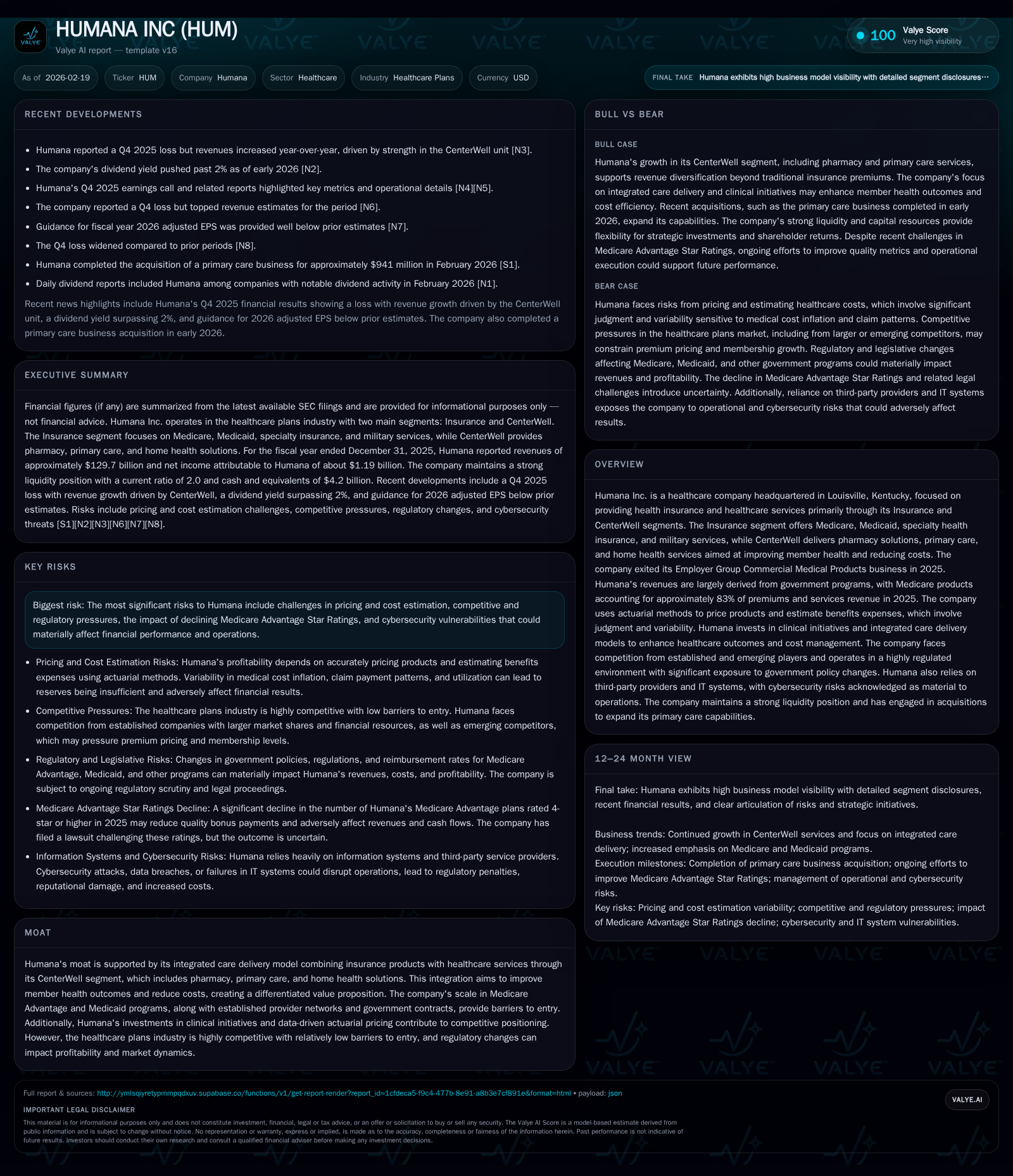
In fiscal year 2025, Humana Inc. reported robust revenue growth driven by its combined Insurance and CenterWell segments, reflecting focused Medicare Advantage and Medicaid portfolios alongside expanded pharmacy and primary care operations. However, operating income growth moderated to 5.5% while net income declined slightly due to rising medical costs and actuarial pricing complexities. The CenterWell segment’s progress offsets some membership declines in core insurance lines. Capital returns are constrained amid diminished operating cash flows and reduced share repurchases, highlighting tightening financial flexibility. Looking ahead, Humana’s investments in clinical programs aim to sustain growth but are tempered by ongoing regulatory pressures including Medicare Star Ratings reviews and reimbursement uncertainties.
Revenue Momentum Fueled by Integration of Insurance and Healthcare Services
Historical performance (annual)
| FY | Rev ($bn) | Net ($bn) | CFO ($bn) | OpInc ($bn) | Rev YoY | Net YoY |
|---|---|---|---|---|---|---|
| 2025 | 129.7 | 1.2 | 0.9 | 2.7 | +10.1% | -1.6% |
| 2024 | 117.8 | 1.2 | 3.0 | 2.6 | +10.7% | -51.5% |
| 2023 | 106.4 | 2.5 | 4.0 | 4.0 | +14.5% | -11.3% |
| 2022 | 92.9 | 2.8 | 4.6 | 3.8 |
Note: Omitted columns lack sufficient annual XBRL coverage in the provided tags (need ≥2 annual points): Capex. Source: SEC companyfacts cache [F1].
Capital returns and efficiency (annual)
| FY | Div ($mm) | Buybacks ($bn) | FCF ($bn) |
|---|---|---|---|
| 2025 | 430 | 0.2 | 0.4 |
| 2024 | 431 | 0.8 | 2.4 |
| 2023 | 431 | 1.6 | 3.0 |
| 2022 | 392 | 2.1 | 3.5 |
Source: SEC companyfacts cache [F1].
In fiscal year 2025, Humana delivered a revenue increase of 10.1%, reaching approximately $129.7 billion [F1], underscoring the effectiveness of its integrated business model composed primarily of two segments: Insurance and CenterWell healthcare services [S21]. The Insurance segment remains heavily concentrated on government health programs – notably Medicare Advantage plans representing around 83% of premiums and service revenue in 2025 [S21]. This dominant Medicare footprint was sharpened by strategic divestments such as the exit from the Employer Group Commercial Medical Products business in 2025, refocusing efforts squarely on government contracts which typically carry higher barriers to entry due to contracting complexity and compliance demands [F1][S21].
CenterWell contributes substantially to top-line growth through its expanding pharmacy solutions (mail-order and specialty pharmacy), primary care clinics embedded within senior-focused centers, and home health services [N12][S21]. This integration embodies payer-provider convergence—where capitation payment structures align incentives for cost management and quality care delivery—introducing efficiencies across utilization management and pharmacy benefit administration that drive volume and revenue expansion.
Shifts in Operating Income and Net Profit Margins: Analysis of Declining Returns
Despite healthy revenue progression, operating income recorded a more modest rise of 5.5%, reaching $2.7 billion compared to $2.56 billion a year prior [F1]. This moderation reflects growing pressures on underwriting results primarily caused by escalating benefit expenses tied to medical cost inflation and increased specialty drug usage [N1][S1]. In particular, the actuarial assumptions underpinning product pricing must contend with volatile claim payment patterns, rebate fluctuations mandated under CMS’s pharmacy volume rebate transparency rules, and demographic shifts within member populations that alter risk profiles dynamically throughout contract periods [S1].
Net income contracted by approximately 1.6%, falling to $1.19 billion from $1.21 billion previously despite overall revenue growth [F1], signaling margin compression particularly evident during the fourth quarter of 2025 where underwriting variability was noted due to adjustments in loss reserves related to prior period claims assessments as discussed during earnings calls [N1]. These signs suggest that while top-line growth from integration initiatives is robust, profitability faces tangible constraints driven by benefit cost volatility.
CenterWell Unit's Growth amid Medicare Membership Changes
The CenterWell segment acts as a critical growth engine cushioning the impact from a softening core Medicare Advantage membership base highlighted in recent investor discussions where membership declines prompt concern over short-term enrollment stability risks [N5][N12]. With primary care centers increasingly aligned with integrated value-based contracts paying capitation fees rather than traditional fee-for-service models, CenterWell leverages clinical initiatives aimed at reducing total cost of care through improved coordination across pharmacy fills, chronic condition management, and home-based services [S21]. This holistic approach buttresses not only revenue gains but also promises longer-term improvements in member health outcomes that may translate into enhanced retention.
Actuarial Pricing Complexities and Cost Estimation Risks Affect Profitability
The inherent uncertainty embedded in estimating future benefits expenses intensifies given recent developments across medical inflationary trends and prescription drug cost dynamics. Humana emphasizes use of actuarial methods involving extensive judgment encompassing claim payment timing patterns, changes in utilization management policies (e.g., preauthorization protocols), evolving rebate arrangements with manufacturers subject to full reporting under CMS Part D rules, as well as variable demographics altering expected utilization rates [S1][S4].
These pricing complexities introduce considerable risk that actual costs will exceed anticipated amounts fixed at annual premium setting stages—a structural feature limiting mid-year repricing ability—and necessitate ongoing reserve adjustments impacting current period results alongside premium deficiency reserve considerations [S1]. Furthermore, regulatory shifts around risk adjustment data validation (RADV) rules currently under litigation post-judicial vacating create further ambiguity influencing reimbursement certainty with material potential financial implications pending resolution [S13].
Future Outlook: Growth Drivers from Clinical Initiatives Contrasted with Regulatory Headwinds
Humana outlines clinical management programs—including chronic care innovation platforms—that underpin aspirations for sustained member health improvement combined with cost containment benefits referenced during FY26 guidance commentary which signaled adjusted EPS expectations below consensus estimates reflecting these headwinds plus broader market conditions [N13][S1]. Investment in enhanced data analytics capabilities supports these initiatives alongside expanded use of digital tools such as AI-driven member engagement solutions announced recently [N8], aiming to reduce avoidable healthcare utilization.
However, persistent pressures from unfavorable trends in Medicare Advantage Star Ratings metrics—the key performance indicator influencing plan bonus payments—and ongoing regulatory scrutiny including legislative reform discussions represent constraining factors potentially dampening achievable profitability trajectory absent mitigating operational improvements or policy shifts [N13][S4].
Capital Allocation Review: Dividends, Buybacks, and Cash Flow Analysis
Humana’s return on equity for FY2025 approximates a moderate 6.7%, derived from net income relative to shareholders’ equity of around $17.7 billion reported at year-end [F1]. Operating cash flows experienced a stark decline of nearly 69%, dropping from $2.97 billion in FY2024 to just $921 million in FY2025—a contraction accompanied by a modest reduction in capital expenditures that totaled approximately $546 million during the same period [F1], yielding constrained free cash flow around $375 million.
Dividend payments remained steady at approximately $430 million annually with dividend yield surpassing 2%, reflecting sustained shareholder income commitment despite tighter liquidity conditions [N9][N11][F1]. Conversely, share repurchases fell sharply to only $151 million compared to $817 million previous year reflecting prudent capital preservation given cash flow tightening amid ongoing investment needs and market uncertainties [F1][S16][S27].
Liquidity fundamentals remain sound supported by an amended revolving credit facility increased to $5 billion committed capacity with no borrowings outstanding at fiscal year-end coupled with manageable leverage metrics evidenced by debt-to-capitalization ratio near 41%, maintaining investment-grade credit ratings BBB (S&P) / Baa2 (Moody’s) [S14][S17].
What Investors Should Watch: Ratings, Membership Trends, and Regulatory Developments
Key forward-looking indicators for stakeholders include monitoring Humana’s trajectory on Medicare Advantage Star Ratings which materially affect bonus inflows tied to plan quality; trends in membership renewals following divestiture of employer group commercial lines impacting scale; as well as policy shifts emerging from Centers for Medicare & Medicaid Services’ evolving reimbursement frameworks especially regarding Part D drug cost sharing designs [N13][N5][S4]. Additionally, heightened cybersecurity risk exposures demand vigilance given potential operational or reputational impacts stemming from breaches as highlighted in risk disclosures [S29]. Awareness of legal proceedings surrounding compliance with federal marketing regulations adds another dimension influencing risk-adjusted valuation perspectives over near- to medium-term horizons.
This analysis is based solely on publicly available filings and news sources as cited without any incorporation of private or nonpublic data. It aims exclusively to provide a detailed operational and financial review without any investment recommendation or advice.
Disclaimer: This is research-only, informational analysis and not investment advice. It may include AI-generated interpretation and general industry context. Always verify important details using primary sources.

Comments