
Lunai Bioworks Advances AI-Driven Drug Discovery Despite Capital and Compliance Pressures
Lunai Bioworks pursues innovative AI-biological drug discovery amid severe liquidity constraints and Nasdaq listing risks.
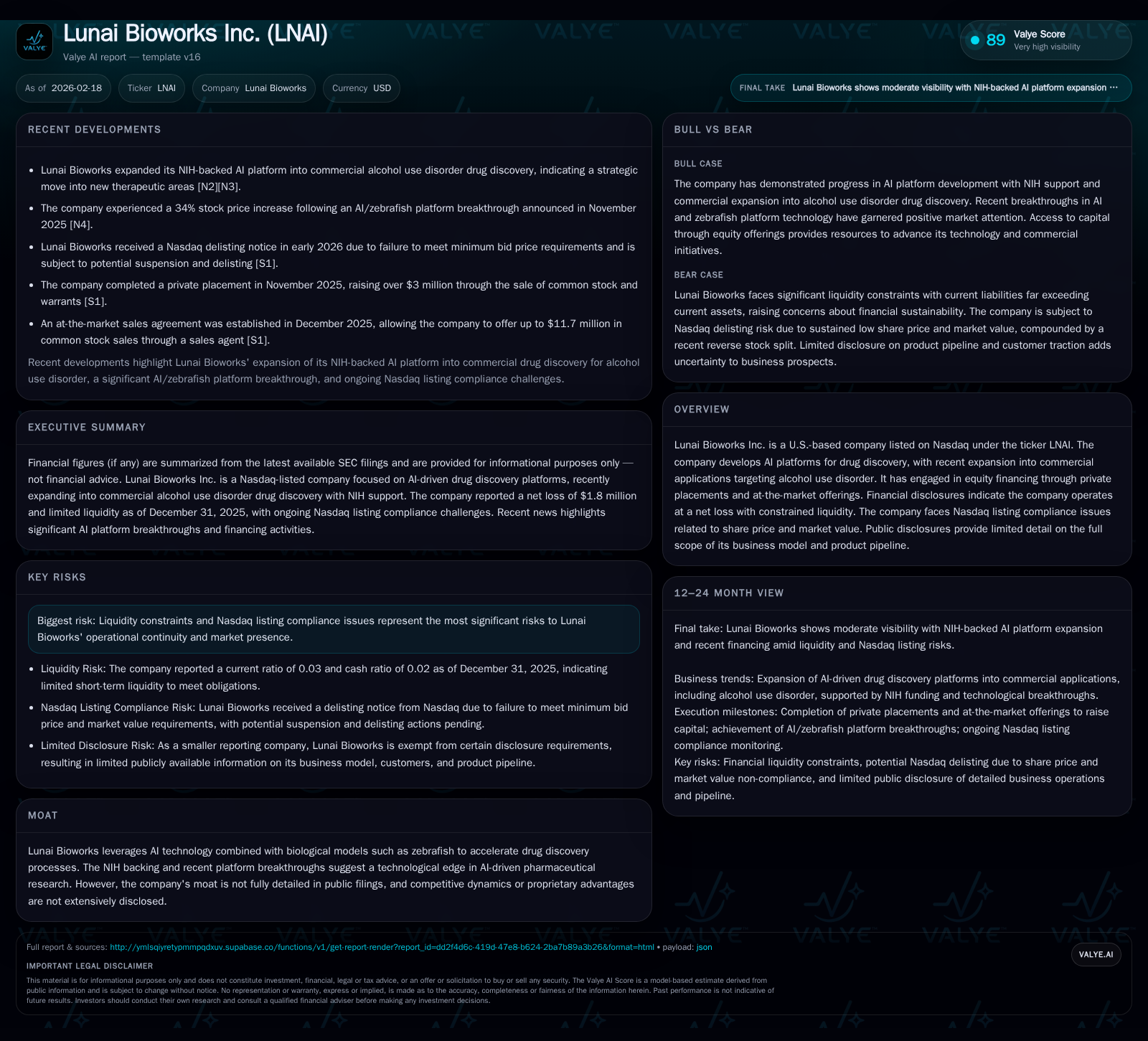
Lunai Bioworks Inc., a Nasdaq-listed biotech firm leveraging NIH-backed AI platforms integrated with zebrafish phenotypic assays, remains in the pre-revenue stage but is expanding into commercial alcohol use disorder therapeutics. Despite its technological promise and successful equity raises, Lunai faces escalating net losses, critical liquidity shortfalls, and aggressive Nasdaq delisting threats tied to market value and share price non-compliance. The company’s future hinges on navigating regulatory hurdles, improving capital structure, and delivering pipeline milestones to validate its AI-driven pharmaceutical discovery approach.
Historic Financial Trajectory: Deep Losses Amid R&D Investments
Lunai Bioworks operates at the cutting edge of pharmaceutical research employing artificial intelligence intertwined with biological models. This substantial innovation has come at a steep financial cost as reflected in the company's multiyear income statement trajectory [F1]. From FY2022 through mid-FY2025, Lunai's operating losses have more than doubled from approximately -$116 million to an annualized figure near -$189 million. Net income mirrors this trend with losses rising from -$113 million in FY2022 to roughly -$178 million by mid-2025.
Operating cash flows remain deeply negative but show some improvement percentage-wise, moving from -$15.7 million in FY2022 to about -$7.9 million in FY2025 after adjusting for low capital expenditures (under $100K annually). Notably, the company has reported zero revenues throughout this period, consistent with its pre-commercial focus on platform development rather than sales generation.
Historical performance (annual)
| FY | Net ($mm) | CFO ($mm) | OpInc ($mm) | Capex ($) | Net YoY |
|---|---|---|---|---|---|
| 2025 | -178 | -8 | -189 | 70430 | -101.3% |
| 2024 | -88 | -11 | -82 | 70430 | -122.8% |
| 2023 | -40 | -12 | -39 | 29774 | +65.0% |
| 2022 | -113 | -16 | -116 | 5156 |
Note: Omitted columns lack sufficient annual XBRL coverage in the provided tags (need ≥2 annual points): Rev, Div, Buybacks. Source: SEC companyfacts cache [F1].
Capital returns and efficiency (annual)
| FY | FCF ($mm) | ROE% |
|---|---|---|
| 2025 | -8 | 833.8 |
| 2024 | -11 | -67.0 |
| 2023 | -12 | -85.3 |
| 2022 | -16 | -156.2 |
Source: SEC companyfacts cache [F1].
*Annualized June 2025 data per [F1]
The intensifying losses highlight Lunai's aggressive R&D expenditure necessary for its AI-driven drug discovery ambitions but raise questions about sustainability given the absence of revenues.
Proprietary AI Platform with Biological Models: Technological Value and Market Potential
Lunai's proprietary innovation integrates advanced AI algorithms with zebrafish-based phenotypic assay platforms—a combination enabling rapid identification and validation of drug targets via comprehensive in silico screening backed by biological context [N1]. This dual-modality approach accelerates preclinical validation cycles by correlating computational predictions with live biological phenotypes in zebrafish models renowned for translational relevance.
NIH funding provides both financial support and scientific credibility validating Lunai’s research approach within this specialized domain [N1,N2]. While detailed pipeline disclosures are limited due to small reporting company exemptions [S2,S5], this synergy between computational drug discovery and vertebrate model assays represents a differentiated technological moat.
Pharmaceutical developers increasingly favor phenotypic assays for their ability to reveal functional effects prior to full molecular elucidation—potentially improving hit-to-lead efficiency within competitive AI-drug discovery markets.
Entry into Commercial Alcohol Use Disorder Treatment: Expanding Application Scope
Recent announcements detail Lunai’s strategic expansion of its NIH-backed AI platform into commercially targeted therapies for alcohol use disorder (AUD) [N1,N2]. This initiative marks a pivot from pure platform research toward application-driven product pipelines addressing significant unmet medical needs.
Advancing AUD candidates involves complex challenges including further validation via regulatory-compliant animal models beyond zebrafish; pharmacokinetic/pharmacodynamic optimization; FDA investigational new drug (IND) application processes; and securing partnerships or funding for clinical trials.
Given typical biotech development timelines and regulatory scrutiny , advancing AUD therapeutics will require substantial capital beyond current levels. Success could transition Lunai from a technology platform provider to a biopharma company with revenue-generating products.
Nasdaq Compliance Challenges: Market Value Deficiency and Delisting Risk
Between late 2025 and early 2026, Lunai received multiple Nasdaq compliance notices: initially for failure to meet minimum market value of listed securities ($35 million threshold) [S12], followed by breaches of minimum bid price rules (below $1 per share) without eligibility for cure periods due to a recent reverse stock split conducted September 30, 2025 [S24].
Typically issuers receive a six-month grace period to regain compliance; however Nasdaq excludes those recently reverse splitting shares from this relief [S24]. Consequently, Lunai’s securities face imminent delisting unless the company successfully appeals the determination before February 13th, 2026 — an appeal has been filed initiating stay procedures pending hearing outcomes [S24].
Failure to resolve these issues would result in Nasdaq trading suspension on February 18th followed by deregistration filings — jeopardizing capital access vital for continued operations.
Capital Structure and Cash Flow Analysis: Financing Activities and Liquidity Constraints
To fund ongoing research amidst sustained operational losses and no revenues, Lunai executed several financing measures:
- A private placement in November 2025 raising approximately $3.13 million through issuance of common stock plus warrants priced at $1 per share [S6];
- An At-The-Market (ATM) offering agreement initiated December 2025 allowing sales up to $11.7 million via Dawson James Securities as agent [S16].
Despite these efforts, cash reserves remain critically low at about $492K against current liabilities near $20 million — resulting in an extremely weak current ratio around 0.03 underscoring acute liquidity risk [F1].
Operating cash flows have been consistently negative over multiple years ranging from approximately -$7.9 million to nearly -$15.7 million annually without offsetting capital inflows aside from financing activities [F1].
No dividends or share repurchases have been reported consistent with Lunai’s pre-commercial biotech status and capital preservation needs [F1,S13,S22]. Negative shareholders’ equity as of mid-2025 (-$21 million) reflects accumulated net losses outpacing equity injections highlighting solvency pressures [F1].
Free cash flow computed as operating cash flow minus capex remains negative (~-$7.9 million for FY2025), emphasizing ongoing cash burn demanding prompt additional funding or strategic alliances.
What to Watch: Key Catalysts and Strategic Milestones Ahead
Investors should closely monitor several critical developments shaping Lunai’s near-term outlook:
- Nasdaq Appeal Outcome: The decision from the February hearings panel on the delisting appeal will determine continued Nasdaq trading status — directly impacting liquidity access and investor confidence [S24].
- Capital Deployment: Execution updates on proceeds utilization from private placements and ATM offerings targeting advancement of AUD drug candidates will indicate operational progress [S6,S16,N1].
- Clinical Milestones: Data readouts or regulatory submissions related to alcohol use disorder therapeutics emerging from the AI-zebrafish platform will serve as key validation points for pipeline viability [N1,N2].
- Strategic Partnerships: Further NIH collaborations or pharmaceutical alliances leveraging Lunai’s combined computational-biological drug discovery model could enhance competitive positioning and resource availability.
Forward guidance remains limited due to smaller reporting company exemptions under SEC rules [S2,S5], making these developments pivotal levers influencing valuation amid fiscal constraints.
Disclaimer: This report is based solely on publicly available data as of February 18th, 2026. It does not constitute investment advice or recommendations.
Disclaimer: This is research-only, informational analysis and not investment advice. It may include AI-generated interpretation and general industry context. Always verify important details using primary sources.

Comments