
Itron, Inc.’s Shift Toward Integrated IIoT Solutions Fuels Earnings Growth
Itron’s strategic pivot from device manufacturing to integrated IIoT solutions drives higher-margin recurring revenues and improves financial performance amid industry challenges.
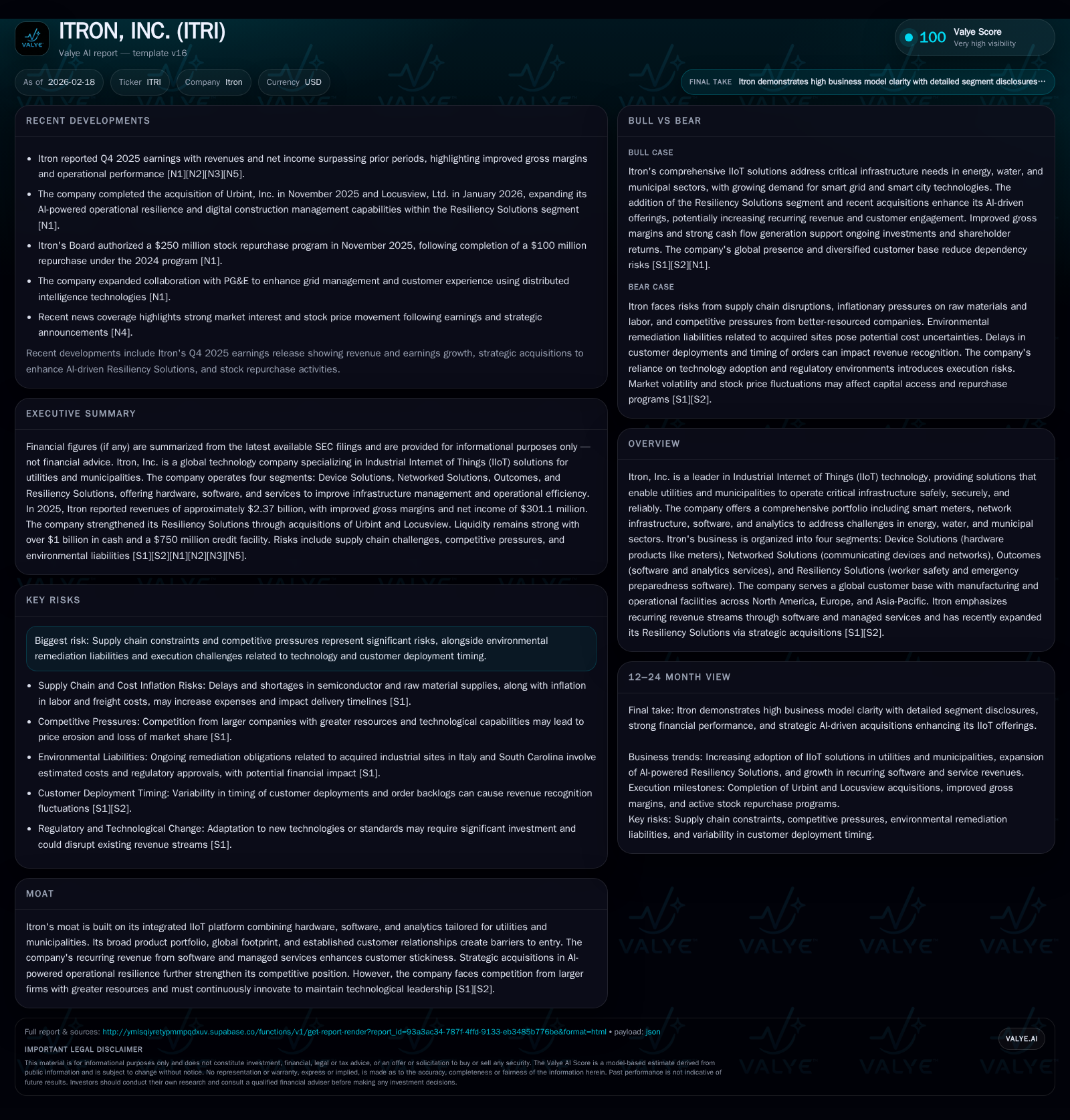
Since turning profitable in 2023, Itron has demonstrated strong earnings growth driven by disciplined margin expansion and a deliberate shift toward software and analytics services, including recent AI-powered offerings that enhance its industrial IoT platform. This evolution aligns with long industrial sales cycles and significant supply chain constraints typical of the utility technology sector. Key challenges include raw material supply risks and regulatory remediation liabilities, but the company’s robust cash flow, active share repurchases, and decent return on equity underline disciplined capital allocation. Going forward, monitoring AI adoption milestones and regulatory approvals will be critical to assessing sustained growth prospects.
Financial Growth Trajectory and Evolving Revenue Drivers
Itron’s recent financial trajectory encapsulates a pronounced turnaround from losses to robust profitability anchored by margin discipline. Operating income soared from a loss of approximately $7.4 million in FY2022 to $313 million in FY2025—a compound improvement demonstrated by an 18.5% year-over-year increase from FY2024 alone [F1]. Net income followed a similar pattern, jumping from negative $9.7 million in FY2022 to $301 million in FY2025 (+25.9% YoY). This surge was driven not only by cost initiatives but also an improved revenue composition favoring higher-margin software and services.
Operating cash flow more than quadrupled over the last four years—from $24.5 million up to $406 million in FY2025—illustrating growing cash conversion efficiency coupled with reduced capital expenditures that declined by over 25% since FY2023 [F1]. The company’s current ratio of approximately 1.8 underscores solid short-term liquidity.
Segment-wise, sustained strength in Device Solutions hardware—such as gas, water, electricity meters—and deployment services have contributed to steady revenues despite fluctuating sales cycles typical of this sector [S1][N4]. Concurrently, margins expanded due to operational efficiencies amidst supply cost volatility.
Historical performance (annual)
| FY | Net ($mm) | CFO ($mm) | OpInc ($mm) | Capex ($mm) | Net YoY |
|---|---|---|---|---|---|
| 2025 | 301 | 406 | 313 | 23 | +25.9% |
| 2024 | 239 | 238 | 264 | 31 | +146.7% |
| 2023 | 97 | 125 | 129 | 27 | +1095.9% |
| 2022 | -10 | 25 | -7 | 20 |
Note: Omitted columns lack sufficient annual XBRL coverage in the provided tags (need ≥2 annual points): Rev, Div. Source: SEC companyfacts cache [F1].
Capital returns and efficiency (annual)
| FY | Buybacks ($mm) | FCF ($mm) | ROE% |
|---|---|---|---|
| 2025 | 100 | 383 | 17.5 |
| 2024 | 100 | 208 | 17.2 |
| 2023 | 0 | 98 | 7.4 |
| 2022 | 17 | 5 | -0.8 |
Source: SEC companyfacts cache [F1].
Note: Revenue data is not available in provided tags.
Strategic Transition to Recurring Software and Analytics Revenues
A core driver behind Itron’s improving earnings profile is its strategic transition from primarily hardware-centric Device Solutions toward high-value recurring revenues from software-rich Outcomes offerings [S1][S2]. The Outcomes segment leverages advanced data analytics empowered by artificial intelligence, machine learning algorithms, and statistical models applied at the grid edge to enable utilities’ smarter asset management and operational efficiency.
The recent acquisition of Urbint’s AI-based operational resilience solutions expanded Itron’s Resiliency Solutions portfolio focused on worker safety and predictive emergency response capabilities leveraging AI modeling [S19]. Moreover, the partnership with Snowflake announced in early 2026 intends to integrate cloud-native AI-driven grid planning tools directly into Itron’s platform—a promising advance toward sophisticated distributed energy resource management (DERM) and smart grid applications [N10].
Operationally, this pivot targets enhancing customer stickiness through subscription-like software service contracts alongside managed network solutions rather than one-off equipment sales vulnerable to erratic capital spending spikes common among regulated utilities.
The Networked Solutions segment complements Outcomes with critical infrastructure including AMI- (Advanced Metering Infrastructure) enabled smart meters, multi-purpose interoperable communication networks supporting AMR-, distribution automation-, smart lighting-, and smart city sensor deployments integral to IIoT ecosystems [S16][S18]. Effectively orchestrating hardware-software integration remains central to delivering platform-based value.
Key Market Dynamics Shaping Future Growth Prospects
Itron operates within a market characterized by inherently prolonged sales cycles driven by utility customers' extensive budgeting approvals, regulatory clearances, procurement procedures involving rigorous technical validation requests for proposals (RFPs), often spanning multiple years [S1]. While government incentives promoting energy efficiency, net-zero carbon emissions mandates, and smart grid modernization programs act as catalytic tailwinds for IIoT adoption globally [S10], any delays or reductions in such subsidies could materially impact near-term demand.
Competitive pressure intensifies from larger incumbents equipped with greater R&D budgets necessitating continuing innovation investments by Itron atop its existing product base [N7]. The company must navigate regulatory landscapes whose evolving standards influence metering replacement frequency and infrastructure upgrade cycles—complexities compounded across its multinational footprint encompassing North America, EMEA, and Asia-Pacific operations [S4][S18].
Despite these factors injecting volatility into order timing rather than magnitude alone, Itron's broad product portfolio offers diversification mitigating geographic concentration risk while underscoring the importance of agility amid policy shifts.
Challenges from Supply Chain and Regulatory Hurdles
Persistent global supply chain disruptions remain salient risk factors for Itron’s Device Solutions manufacturing operations given dependencies on specific raw materials including copper-heavy brass castings for meter components as well as microprocessors and semiconductors essential for communicating devices [S1]. Single-supplier concentrations occasionally exacerbate these vulnerabilities leading to potential cost inflation or delay-induced margin erosion.
Regarding environmental compliance exposures stemming from legacy sites acquired through past transactions like Actaris S.p.A., ongoing remediation costs related to water contamination at the Frosinone facility in Italy have escalated gradually but remain largely indemnified under prior agreements with Schlumberger [S1]. In contrast, the South Carolina site presents a more contentious scenario involving disputed liability for chlorinated solvent contamination requiring continued negotiation with regulators [S1]. These proceedings introduce contingent financial obligations that should be monitored closely though currently insulated.
Capital Deployment Focus: Buybacks, Cash Flow, and ROE Trends
Capital allocation has prioritized consistent shareholder returns through repurchasing common shares totaling approximately $100 million annually across FY2024 and FY2025 following negligible buyback activity pre-2023 [F1]. Concurrently Itron sustains robust free cash flow generation—estimated at roughly $383 million most recently after deducting capex expenditures reflecting disciplined investment spending aligned with growth priorities [F1][S20].
Return on equity stands near 17.5%, indicating relatively efficient use of stockholders' equity considering the capital-intensive nature of hardware manufacturing combined with SaaS-like recurring revenues [F1]. The company maintains a net cash position bolstered by over $1 billion in cash equivalents supporting both liquidity buffers and strategic flexibility amid debt maturities approaching in convertible notes terminating in mid-2026 [S6][S7].
Notably, recent credit arrangements include a sizable revolving facility with ample undrawn capacity enabling future funding needs without immediate refinancing pressure [S5][S17]. Shareholder-friendly capital deployment balanced against prudent debt management emerges as a positive hallmark.
Milestones to Monitor: AI Partnerships and Product Innovation
A critical gauge of Itron's future momentum centers on execution effectiveness related to integrating emerging technologies within its Outcomes segment dashboard. The Snowflake collaboration exemplifies efforts to imbue grid planning capabilities with machine learning sophistication that could materially expand addressable markets especially as DER penetration accelerates utility complexity [N10][S19].
Further acquisitions akin to Urbint highlight ambitions beyond traditional metering toward comprehensive operational resilience software suites enhancing worker safety compliance via predictive incident modeling reinforced by AI insights [S19]. Measuring adoption rates of these new offerings alongside renewal metrics will illuminate sustainable recurring revenue build trends.
Conversely heightened product development complexities introduce risks concerning timing delays or quality issues given IIoT platforms’ interoperability demands across heterogeneous hardware ecosystems—a critical consideration underscored in risk factor disclosures emphasizing product mix shifts impact margins unfavorably if mismanaged [S1].
Balancing Hardware Legacy With Next-Gen IIoT Ambitions
Itron faces a challenging dual mandate: maintain legacy Device Solutions production facilities worldwide—spanning North America (South Carolina), multiple European factories—including France, Germany, Italy—and Asia-Pacific hubs servicing diverse regulations—while simultaneously advancing network infrastructure investments underpinning the transition into fully connected smart grids [S1][S4].
This balancing act entails trade-offs between commoditized standard meter shipments—which may see demand fluctuations tied closely to regulatory replacement cycles—and innovative multi-functional smart devices embedded within interoperable networks delivering real-time insights for utility customers. Competitive cannibalization remains plausible as new high-margin software-driven products potentially undercut older hardware offerings historically more lucrative per unit sale.
Global footprint diversification mitigates localized disruption risks yet requires vigilant capital allocation prioritizing scalable IT infrastructure upgrades over purely volume-driven manufacturing capacity expansions—a hallmark tension characteristic among IIoT firms serving regulated municipal clients.
This analysis reflects information derived strictly from publicly filed SEC documents and cited news sources without extrapolation beyond stated facts or estimates. It does not constitute investment advice but aims to provide a fact-based perspective on Itron Inc.'s strategic evolution within the industrial IoT sector.
Disclaimer: This is research-only, informational analysis and not investment advice. It may include AI-generated interpretation and general industry context. Always verify important details using primary sources.

Comments