
Trinity Industries Leverages Railcar Portfolio Restructuring to Boost 2025 Profitability Amid Cyclical Demand
A strategic railcar partnership restructuring drives non-cash gains and improved earnings, counterbalancing sector cyclicality.
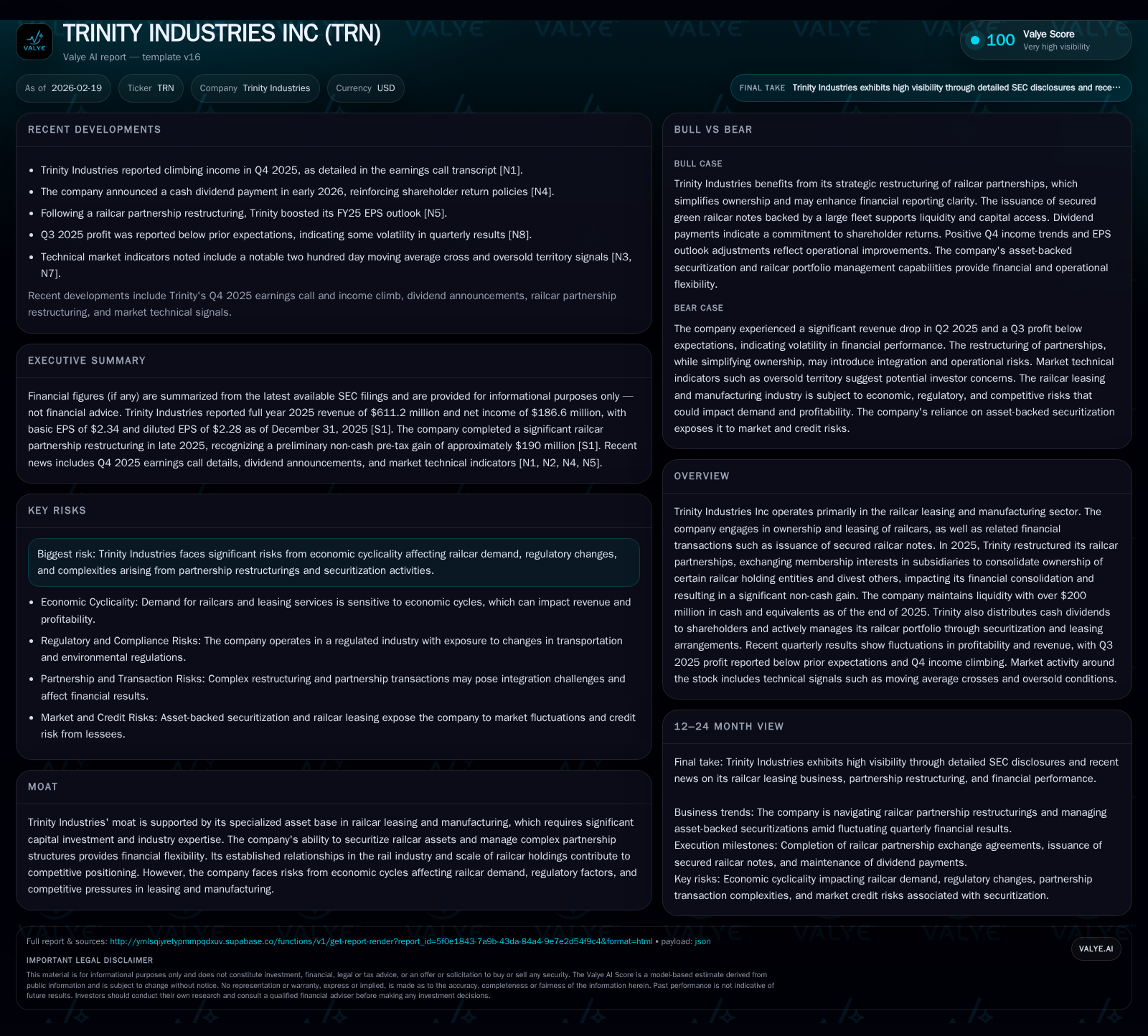
Trinity Industries Inc, a major player in railcar leasing and manufacturing, executed a significant restructuring of its railcar partnerships in 2025 that consolidated ownership and divested overlapping assets. This maneuver resulted in a substantial non-cash gain and elevated operating income for the year despite a modest revenue decline reflecting sector cyclicality. The company maintains robust liquidity with over $200 million in cash and equivalents and continues distributing dividends alongside targeted share repurchases. Looking ahead, Trinity's growth hinges on railcar demand cycles, regulatory environments, and the effectiveness of its portfolio management through securitizations and leasing arrangements.
Company Overview
Trinity Industries Inc primarily operates within the railcar leasing and manufacturing domain, blending asset ownership with complex financial transactions such as secured railcar note issuances. The company’s business model revolves around acquiring railcars, leasing them primarily within North American freight networks, and managing related securitization deals that monetize these portfolios.
Historical Performance and Drivers
Over the last four years, Trinity's revenue displayed volatility tied closely to macroeconomic conditions affecting freight volumes and railcar utilization rates—a sector known for its cyclicality rooted in industrial production and commodities transport.
Historical performance (annual)
| FY | Rev ($bn) | Net ($mm) | CFO ($mm) | OpInc ($mm) | Rev YoY | Net YoY |
|---|---|---|---|---|---|---|
| 2025 | 0.6 | 187 | 360 | 335 | -2.9% | +545.7% |
| 2024 | 0.6 | 29 | 574 | 112 | -78.9% | -72.7% |
| 2023 | 3.0 | 106 | 296 | 417 | +404.6% | +238.7% |
| 2022 | 0.6 | 31 | -13 | 114 |
Note: Omitted columns lack sufficient annual XBRL coverage in the provided tags (need ≥2 annual points): Capex. Source: SEC companyfacts cache [F1].
Capital returns and efficiency (annual)
| FY | Div ($mm) | Buybacks ($mm) | FCF ($mm) |
|---|---|---|---|
| 2025 | 99 | 71 | 314 |
| 2024 | 93 | 21 | 520 |
| 2023 | 86 | 0 | 254 |
| 2022 | 77 | 52 | -51 |
Source: SEC companyfacts cache [F1].
(Note: The large jump in revenue for FY2023 reflects categorical reclassification or aggregation; detailed segment data unavailable.)
The notable profit surge in fiscal year 2025 chiefly stems from a strategic partnership restructure executed late that year involving exchanges of membership interests among subsidiaries like Triumph Rail Holdings LLC and RIV 2013 Rail Holdings LLC [S28]. This maneuver enabled Trinity to consolidate ownership over key assets and divest overlapping holdings previously shared with external partners such as Napier Park Railcar Lease Fund LLC.
This resulted in the elimination of noncontrolling interest adjustments related to certain entities and the recognition of a substantial non-cash pre-tax gain estimated at $190 million in Q4/2025 alone [S16]. Consequently, operating income nearly tripled despite a slight drop in top-line revenues reflecting broader market softness.
Capital Allocation and Returns
Trinity demonstrates disciplined capital management balancing reinvestment with shareholder returns:
- Free cash flow (operating cash flow minus capex) remained robust at approximately $314 million for FY2025 despite a reduction in overall CFO due partly to timing of lease portfolio sales and working capital cycles [F1].
- Dividend payments increased modestly year-over-year to $98.7 million while share repurchases accelerated threefold compared to prior annum levels ($71 million vs ~$21 million), signaling management’s commitment to returning excess capital efficiently [F1].
- Equity base expanded steadily each year supporting an approximate return on equity around 17% based on reported net income against stockholders’ equity of roughly $1.08 billion at end-2025 [F1].
Recent Developments
In early January and February of 2026, Trinity updated investors on the positive impacts of its partnership restructuring on earnings expectations for fiscal year 2025 with upward EPS revisions [N3]. The company also declared another quarterly cash dividend reinforcing steady payout policy continuity [N2].
Additionally, leadership transition plans were announced including Executive Vice President Gregory B. Mitchell stepping down from his leasing and services role effective February before retiring fully later in the year [S29], potentially influencing operational strategy execution.
Industry Context & Moat
The railcar leasing industry inherently requires sizable capital outlays given long asset lifecycles combined with fluctuating freight demand linked closely to economic cycles in energy, agriculture, chemicals, and manufacturing sectors.
Trinity’s moat is anchored by its scale of owned railcars—secured often behind complex financing structures like asset-backed notes—and deeply entrenched industry relationships facilitating fleet utilization amid competition from other lessors or direct ownership by shippers.[S4]
However, downside risks persist from regulation shifts (such as emissions standards or safety mandates), technology disruption (e.g., autonomous trucks), and market downturns causing slower lease uptake or premature retirements.[S6][N1]
Future Growth Drivers & Risks
Key mechanisms that could support growth include:
- Expansion or renewal of leases tied to sustained freight volume growth or modal shifts favoring rail transport due to environmental regulations.
- Continued financial engineering through securitization transactions enabling efficient capital recycling.[S14][S24]
- Fleet modernization programs capturing demand for specialized car types correlated with commodity pockets.
Conversely limitations might arise from:
- Macroeconomic headwinds dampening industrial output impacting contract renewals or pricing power.
- Complexities introduced by evolving partnership structures requiring careful accounting treatments and operational alignment.
- Regulatory tightening raising compliance costs or restricting fleet deployment flexibility.
What To Watch Next (Analysis)
Absent explicit forward guidance within public disclosures [N3], monitoring several indicators will be key:
- Quarterly revenue trends juxtaposed against rail traffic data published by transportation agencies offer signals on lease demand dynamics.
- Updates on securitization note issuances or repayments reveal capital structure agility.
- Management commentary on contract terms and fleet utilization rates during earnings calls can elucidate margin trajectory risks.
- Progression through executive transitions may hint at strategic shifts within leasing operations.
Conclusion
Trinity Industries' recent maneuvers have sharpened its balance sheet profile while generating near-term earnings boosts that mask underlying cyclicality pressures inherent in its primary markets. Its ability to navigate regulatory complexities and maintain liquidity positions it well against peers but continued vigilance will be required over freight demand patterns and capital market conditions shaping future growth prospects.
This analysis is based on publicly available information as of February 19, 2026, including SEC filings [S1–S29], companyfacts data snapshot [F1], and recent news articles [N1–N5]. It does not constitute investment advice.
Disclaimer: This is research-only, informational analysis and not investment advice. It may include AI-generated interpretation and general industry context. Always verify important details using primary sources.

Comments