
Entergy Texas: Balancing Growth Through Data Center Demand and Regulatory Risks
Entergy Texas capitalizes on surging data center electricity demand while managing intricate regulatory and execution challenges.
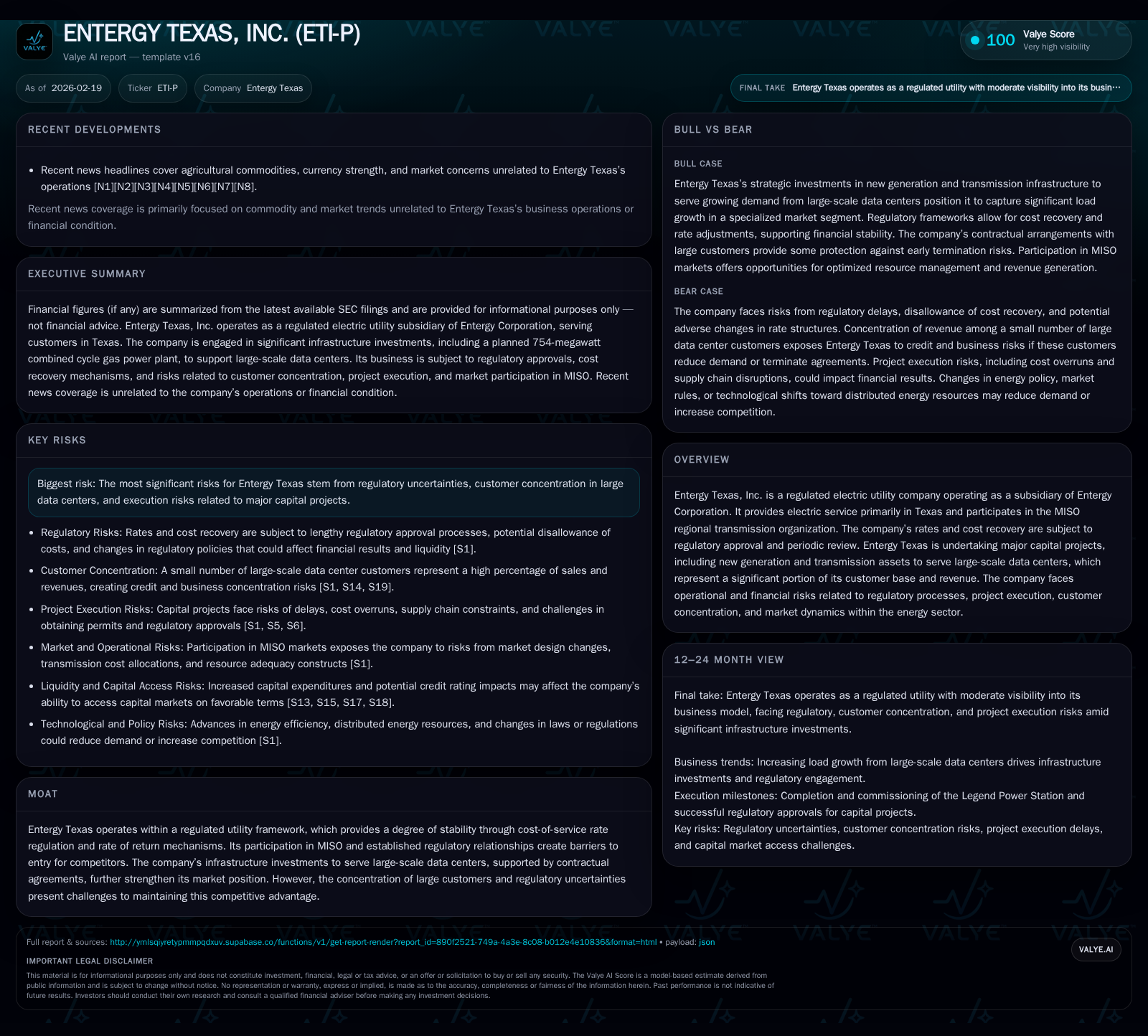
Entergy Texas, Inc. operates as a regulated utility under the cost-of-service model with significant exposure to rapidly expanding large-scale data center customers. Its historical growth has been powered by infrastructure investments tailored to meet these data centers’ energy loads, yet this customer concentration brings notable revenue volatility and credit risk. The company faces ongoing regulatory uncertainty regarding rate-setting, prudence reviews, and MISO market participation that could affect allowed returns. Future growth prospects hinge on successful execution of major generation and transmission projects to serve data center loads, balanced against regulatory review outcomes and project delivery risks. Financially, Entergy Texas must allocate capital prudently amid elevated spending, while navigating regulatory lag and evolving market conditions.
Entergy Texas at the Heart of Digital Economy's Energy Demand Surge
Entergy Texas, Inc. plays a critical role in powering rapid digital infrastructure expansions within Texas’ energy landscape. The utility’s business is shaped significantly by its service to large-scale data centers—facilities fueling artificial intelligence and cloud computing growth—which now constitute a substantial portion of its electric load and revenue base [S12]. While this concentration drives volume growth and underpins ambitious infrastructure investment, it also poses operational and financial risks through dependency on a limited number of customers operating in a volatile industry segment.
Historical Growth Drivers: Capitalizing on Data Center Load Expansion
Recent years have seen pronounced revenue increases correlated with growing electricity consumption from high-demand data center clients [S12]. These clients’ escalating energy needs have prompted Entergy Texas to undertake aggressive capital expenditure programs aimed at building generation assets and transmission lines tailored to meet their loads [N1]/[S6]. This alignment between customer demand and infrastructure development has supported steady top-line growth despite competitive market dynamics.
However, this customer concentration introduces heightened exposure to credit risk and contract renewal uncertainties. While contracts include early termination fees designed to mitigate financial volatility, these protections do not entirely eliminate risk [S24].
Historical Performance Snapshot
| Fiscal Year | Revenue Growth Drivers | Notable Investments |
|---|---|---|
| Recent Years | Significant increase due to data center load expansion [S12] | Generation and transmission capacity expansion aligned with data centers [N1]/[S6] |
Note: Specific year-over-year financial figures for Entergy Texas are not available from the provided disclosures.
Regulatory Environment: The Cost-of-Service Framework in Practice
Operating under a federally regulated cost-of-service model imposes both stability and complexity on Entergy Texas' earnings. Rates are set through formal regulatory proceedings involving detailed scrutiny of costs based largely on historical accounting periods [S1]/[S8]. These proceedings can be prolonged and involve prudence reviews of capital expenditures, operations & maintenance costs, and allowed returns.
Regulatory lag—the delay between incurring costs and securing recovery through rates—can depress returns temporarily below authorized levels [S8]. Regulators may disallow costs found imprudent or inconsistent with tariffs [S1], creating additional uncertainty. Rate refunds or adjustments post-approval may also be required.
Participation in the Midcontinent Independent System Operator (MISO) adds complexity due to evolving tariff provisions affecting transmission planning, cost allocations, and market design changes overseen by FERC [S25]/[S26]. Changes in resource adequacy constructs and transmission investments needed for new large loads imply variable regulatory risk impacting timing and magnitude of cost recovery.
Major Infrastructure Undertakings: Generation and Transmission Investments
To meet soaring demand from data centers characterized by high power density, Entergy Texas is executing significant capital projects across generation capacity expansion and transmission grid enhancements [N1]/[S6]/[S12]. These investments aim at ensuring reliable supply availability tailored to stringent operational requirements.
These projects carry execution risks typical for capital-intensive utilities: permitting delays, resource shortages amid supply chain disruptions, labor constraints, inflationary pressures on material costs [S9]. Delays or overruns could impact cash flows if slower regulatory recovery or lower-than-planned load uptake occurs.
Customer Concentration Risks: Opportunities and Exposure
Load composition heavily leans towards a few large-scale data center customers responsible for a disproportionate share of sales revenue [S24]. While contracts embed protections like early termination payments for dedicated infrastructure costs recovery, these measures are not failproof against credit events or abrupt demand reductions.
Emerging technologies driving AI workloads hosted by these data centers introduce uncertainty around long-term demand growth [S12]/[S27]. Some customers explore self-generation capabilities potentially eroding future utility sales volumes.
Navigating Project Execution Challenges and Their Implications
Execution challenges extend beyond traditional project management issues due to heightened regulatory scrutiny over capital prudence amidst elevated capex cycles focused on digital economy demands [S5]/[S6]. Regulatory disallowances related to alleged imprudent investments could materially impair returns.
Operationally, coordination among multiple contractors in tight labor markets compounded by global supply chain irregularities stresses schedules. Reputational risks also arise if delays or overruns trigger adverse publicity affecting stakeholder confidence [S11]. Given the facilities’ importance for energy system reliability supporting AI-driven economic activity, successful execution is vital for financial performance and regional energy security.
Financial Performance Overview: Returns, Cash Flows, and Capital Allocation
As a regulated utility subsidiary under cost-of-service regulation, Entergy Texas' allowed return on equity (ROE) is set within rate cases but exact subsidiary-specific ROE figures are not separately disclosed in available filings [S1]/[S8]. Regulatory lag can cause reported returns to vary temporarily below authorized levels.
Cash flow depends heavily on timely recovery of fuel costs, purchased power expenses, O&M costs, and infrastructure investments—all subject to timing variances under regulation [S7][S21]. Preferred stock dividends (e.g., ETI-P) represent fixed cash obligations within the subsidiary’s capital structure impacting distributable cash [S4][S7].
There is no information available regarding share buybacks at the subsidiary level; current capital allocation prioritizes funding ongoing capex programs aligned with demand growth while maintaining compliance with debt covenants imposed internally by Entergy Corporation’s holding structure and externally by rating agencies concerned about leverage amid elevated investments [S15][S7].
Future Growth Outlook: Catalysts and Constraints in the Texas Market
Growth prospects remain tied closely to new electric service agreements with additional large-scale data centers progressing from land acquisition through construction ramp-ups generating fresh load additions [N1][S12].
Constraints include regulatory uncertainty over future allowed ROEs; potential environmental regulations impacting generation economics; evolving technology trends such as localized generation reducing centralized load; plus competitive pressures from alternative suppliers or self-generation that could limit volumetric growth over time [S10][S27].
The mix between formula rates versus base rate cases remains fluid; shifts toward more prescriptive rate-setting could affect predictability of future cash flows.
What to Watch: Upcoming Regulatory Reviews and Project Milestones
No explicit milestone disclosures are available; stakeholders should monitor upcoming regulatory filings including next scheduled rate case submissions which will reflect updated test periods incorporating increased capex . Attention to FERC rulings on MISO tariff changes will be material due to potential wholesale cost impacts cascading into retail rates affecting margins .
Project progress updates via company presentations or state utility commission hearings will provide visibility into whether infrastructure timelines hold given inflationary/project delivery headwinds prevalent across U.S. utilities currently .
Customer contract renewals or terminations remain pivotal indicators influencing revenue predictability given inherent concentration risk serving few dominant tech-sector clients .
Disclaimer:
This report is prepared solely for informational purposes based on publicly available information without investment advice or recommendations. Readers should conduct their own due diligence before making financial decisions involving Entergy Texas or related securities.
Disclaimer: This is research-only, informational analysis and not investment advice. It may include AI-generated interpretation and general industry context. Always verify important details using primary sources.

Comments