
Pitney Bowes' Margin Recovery Contends with Secular Mailing Declines and Debt Refinancing
Pitney Bowes reported a net income turnaround in 2025 driven by cost cuts and improved operating cash flow despite ongoing revenue pressures from declining mail volumes.
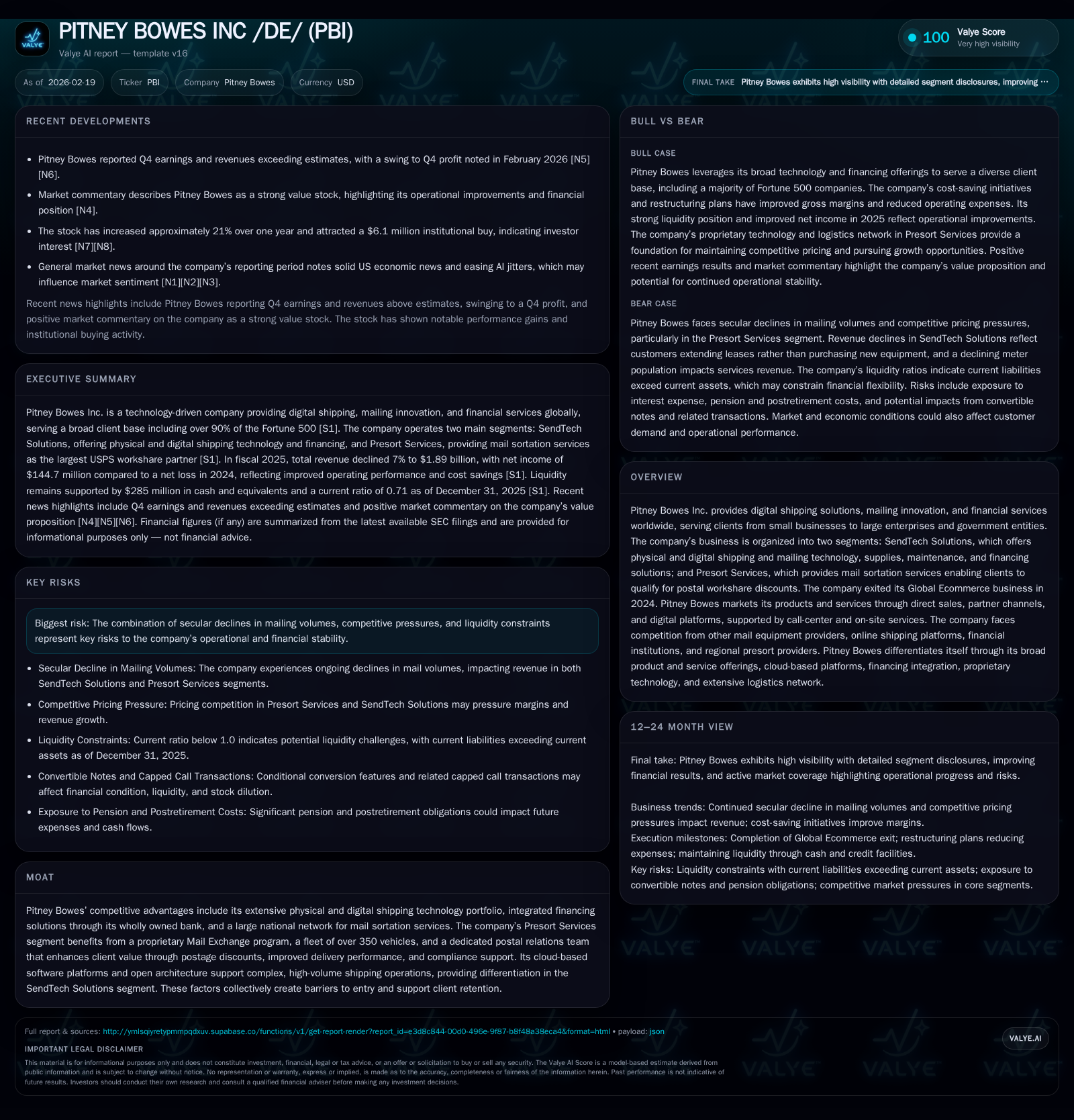
In 2025, Pitney Bowes reversed years of losses with net income of $145 million on revenues down 7% to $1.89 billion. The company’s two core segments, SendTech Solutions and Presort Services, face structural volume declines but benefit from margin expansion through cost controls and digital service growth. Pitney Bowes is actively managing its leverage via refinancing and share repurchases, while contending with competitive pricing pressures and secular mail volume contractions. Monitoring leverage ratios and segment revenue trends will be key as the company pursues incremental growth initiatives and operational efficiencies.
Historical Performance
Pitney Bowes Inc. has faced continued revenue contraction over recent years primarily due to secular declines in traditional mailing volumes and shifts toward digital communication. Revenue decreased from $3.27 billion in 2023 (reflecting legacy figures including discontinued businesses) to a more consolidated $2.03 billion in 2024 before further falling 7% YoY to $1.89 billion in 2025 [F1]. This contraction traces back mainly to the company's exit from its Global Ecommerce business in 2024—removing lower-margin operations—and persistent industry headwinds.
Despite top-line pressure, the company significantly improved profitability in 2025, reporting net income of $145 million compared to losses of $37 million the previous year, representing an over 487% swing [F1]. This came as restructuring charges declined by about a quarter YoY, pension-related costs moderated sharply, and other operating expenses decreased substantially [S1]. Importantly, adjusted segment EBIT at SendTech Solutions increased by about 7%, illustrating margin progression even as revenues dipped [S10][S20].
Historical performance (annual)
| FY | Rev ($bn) | Net ($mm) | CFO ($mm) | Capex ($mm) | Rev YoY | Net YoY |
|---|---|---|---|---|---|---|
| 2025 | 1.9 | 145 | 383 | 66 | +266.7% | +487.2% |
| 2024 | 0.5 | -37 | 229 | 72 | -84.2% | +90.3% |
| 2023 | 3.3 | -386 | 103 | -7.7% | -1143.9% | |
| 2022 | 3.5 | 37 | 176 | 125 |
Note: Omitted columns lack sufficient annual XBRL coverage in the provided tags (need ≥2 annual points): OpInc, Buybacks. Source: SEC companyfacts cache [F1].
Capital returns and efficiency (annual)
| FY | Div ($mm) | FCF ($mm) | ROE% |
|---|---|---|---|
| 2025 | 51 | 317 | -18.0 |
| 2024 | 36 | 157 | 6.5 |
| 2023 | 35 | 104.6 | |
| 2022 | 35 | 51 | 60.9 |
Source: SEC companyfacts cache [F1].
*Note: Reflects broader prior period including discontinued operations; adjusted post-Global Ecommerce wind-down.
The operating cash flow surged by roughly two-thirds between 2024 and 2025 driven by better working capital management and reduced finance receivables [F1][S18], providing much-needed liquidity for debt servicing amid an onerous maturity schedule exceeding $2 billion over the next several years [S4][S16]. Capital expenditures were curtailed modestly following prior elevated levels aligned with efforts to preserve cash [F1]. Dividend payments rose moderately reflecting management balance between shareholder returns and debt reduction.
Business Segments and Industry Positioning
Pitney Bowes operates through two main segments: SendTech Solutions and Presort Services.
SendTech Solutions encompasses physical shipping devices (frankers, mailing machines), digital shipping APIs/platforms enabling label printing, multi-carrier parcel tracking, plus financing solutions via its wholly owned Pitney Bowes Bank [S1]. This segment delivered approximately $1.26 billion in revenue during FY25 but declined ~7% YoY largely due to deferred equipment purchases amid customer lease extensions and an unfavorable product migration effect [S20]. Despite lower top-line revenue, SendTech's adjusted segment EBIT improved by nearly $27 million fueled by reductions in cost of goods sold and SG&A cost savings including workforce reductions [S20][S12]. Gross margin percentage expanded from ~64.6% to ~66.4%, signaling efficiency gains amid volume compression.
Digital delivery solutions have grown as clients increasingly seek cloud-based multi-carrier flexibility integrated into ecommerce platforms — a pivot necessary given rapid changes in shipping behavior post-pandemic [N1][S10]. The financing arm faces competition from commercial banks and leasing companies but differentiates itself through product integration capabilities that enhance client stickiness.
Presort Services, responsible for mail sorting logistics allowing customers access to USPS workshare postage discounts via bulk processing (15 billion pieces annually), experienced a slight revenue decline (4%) but maintains strategic assets including proprietary Mail Exchange programs, a nationwide fleet exceeding 350 vehicles, and dedicated postal relations teams ensuring compliance and expedited delivery [S19][S23]. Competitive pressures persist though from regional providers & large mailers developing internal capacity; maintaining pricing discipline remains critical [S19].
The company exited its Global Ecommerce business entirely as of August 2024 through an orderly wind-down after sustained losses—a reflection of broader challenges converting physical international parcel flows profitably [S19].
Future Growth Prospects and Risks
Growth drivers are constrained by secular declines in mailing volumes exacerbated by digital substitution trends—a risk explicitly acknowledged by management [S1]. SendTech's future growth depends on expanding digital shipment platform adoption, software-as-a-service upselling via enterprise shipping subscriptions, and cross-selling integrated financing solutions that offer flexibility.
Presort Services’ volume growth potential hinges on maintaining competitive pricing while leveraging scale advantages including proprietary USPS partnerships that rivals struggle to replicate [N5][S19]. Efforts to increase automation or expand service offerings could also mitigate volume stagnation risks.
On the flip side, structural pressures on postage demand continue unabated. Competitive pricing pressures in Presort Services are expected to exert margin pressure going forward alongside rising input costs [S9][S29]. Maintaining effective cost controls while investing selectively in R&D—reduced sharply in recent periods—is essential to sustaining competitive edge given innovation demands for cloud-enabled shipping tools [S12].
Financially, sizable debt maturities loom (notably Notes due March 2027), requiring refinancing or redemption actions planned before September 2026 [S6][S15][S29]. Although liquidity stands adequate at around $297 million plus revolving credit undrawn capacity, leverage metrics remain elevated with negative equity positioning underscoring solvency risk factors if operational setbacks materialize [F1][S14]. Conversion features on recent convertible notes add complexity affecting capital structure decisions [S11].
Investors should watch:
- Volume trajectory and pricing action effectiveness in Presort Services,
- Adoption rates of digital shipment solutions including API integrations,
- Progress on deleveraging initiatives including refinancing outcomes ahead of the March ’27 notes maturity,
- Ongoing adjustments of R&D expenditure balancing innovation needs with cost discipline,
- Impact of competitive encroachment particularly online shipping platforms.
Returns & Capital Allocation
Pitney Bowes’ returns metrics remain pressured due to legacy goodwill impairments and persistent losses until recent turnaround signs emerged—approximate ROE using trailing net income over equity stands negative around -18% due large negative equity base primarily from accumulated losses/amortizations over the last several years [F1].
Nevertheless, operating cash flow generation improved substantially—over $383 million last fiscal year—which management is deploying pragmatically through:
- Regular dividend payments increasing modestly,
- Share repurchase program totaling approximately $62 million deployed against inexpensive convertible note proceeds,
- Active debt repayment/refinancing steps reducing coupon costs,
- Controlled capex aligned with strategic priorities.
This balanced approach aims at stabilizing financial health without sacrificing investment needed for competitive positioning particularly within high-potential digital services domains.
Conclusion
Pitney Bowes confronts an unforgiving macro environment shaped by secular shrinkage in mailing combined with fierce competition across traditional mail technology and emerging online shipping platforms. Nonetheless, the company posted solid operational progress through margin rationalization at SendTech Solutions alongside continued scale advantages at Presort Services enabling earnings recovery in FY25.
The company’s active management of debt maturities reflects prudent stewardship amid substantial financial obligations clustered over short horizons. Maintaining focus on digital transformation strategies while fortifying core presort logistics capabilities will be critical levers for navigating the near-term landscape.
Investors are advised to track quarterly results for signs that new product offerings can arrest or reverse revenue declines, observe refinancing terms for upcoming debt maturities closely given their balance sheet implications, and evaluate management’s success guarding margins against ongoing pricing pressure.
Disclaimer: This analysis is based on publicly available information as of February 19, 2026. It is not investment advice nor a recommendation regarding any securities or investment strategies. Readers should conduct their own due diligence before making any investment decisions.

Comments