
Sherwin-Williams’ 2025 Growth Offset by Store Expansion and Suvinil Acquisition Integration
Sherwin-Williams posted modest sales growth in 2025, balancing price increases and acquisitions against volume declines and evolving store footprints.
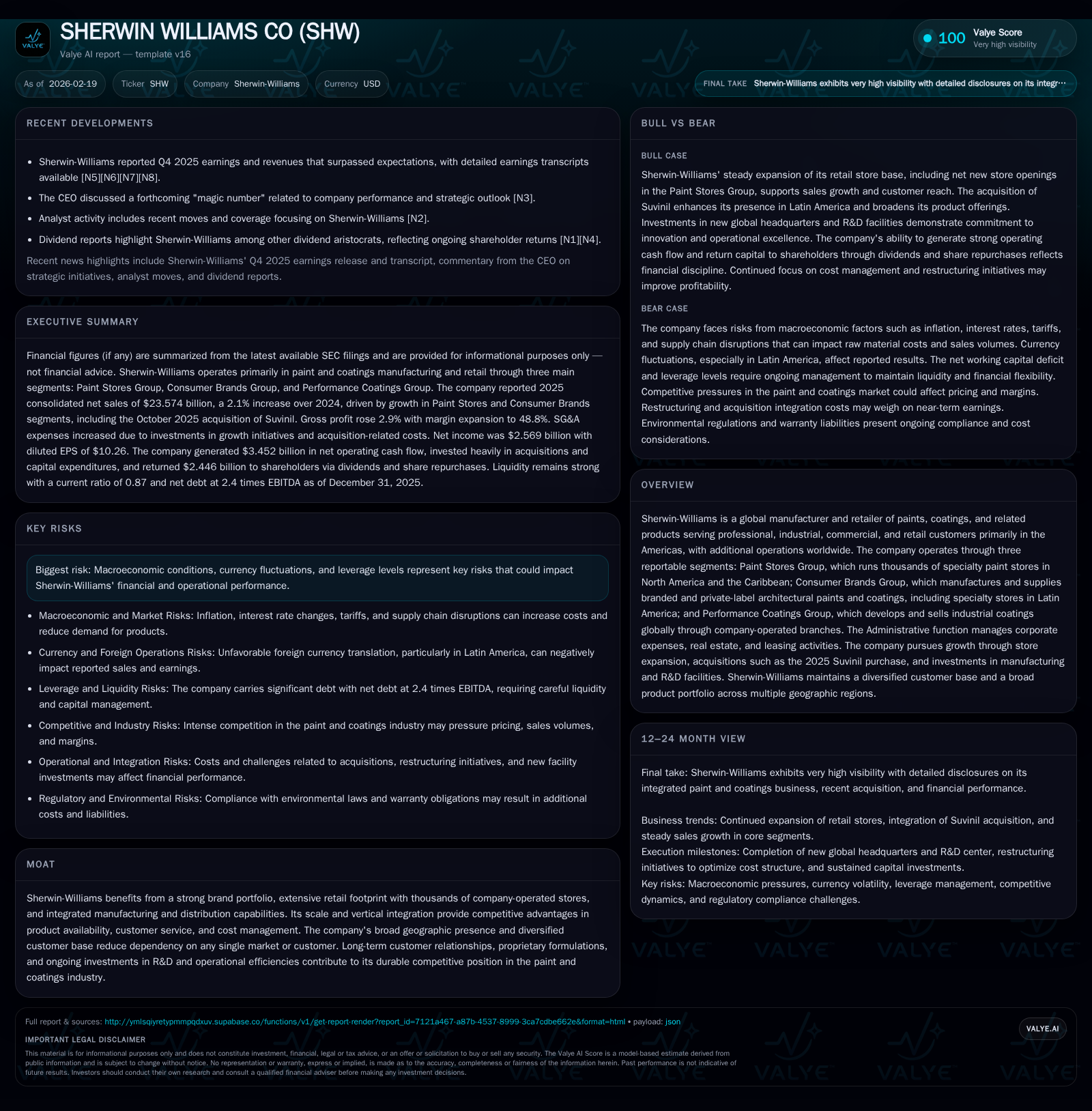
Sherwin-Williams delivered a 2.1% revenue increase in 2025 driven mainly by higher selling prices and the strategic acquisition of Suvinil, partially offset by lower sales volumes. The Paint Stores Group contributed notably through net store growth, while Performance Coatings revenues remained flat. Despite a slight net income decline, cash flow generation remains robust, supporting continued dividends and aggressive share repurchases. Key risks include environmental litigation, currency fluctuations, and macroeconomic pressures that could influence margin stability and leverage.
Past Growth and Historical Performance
Sherwin-Williams’ fiscal year 2025 results reflect steady top-line expansion tempered by margin pressures and operational recalibration following recent acquisitions. Consolidated net sales for 2025 reached $23.57 billion, representing a modest increase of 2.1% compared to $23.10 billion in 2024 [S1][F1]. This growth was fueled predominantly by higher selling prices—especially within the Paint Stores Group—and the October 2025 acquisition of Suvinil, a major Brazilian paint brand incorporated into the Consumer Brands Group.
The Paint Stores Group remains Sherwin-Williams' largest reporting segment contributing approximately $13.61 billion in revenue, up 3.2% year-over-year [S1]. This performance was supported by an aggressive net store increase of 80 locations (83 opened vs. 3 closed), bringing the total count to 4,853 stores across North America and the Caribbean [S14]. Price increases amounted to a mid-single-digit percentage gain but were offset partially by a low-single-digit decline in sales volume.
Meanwhile, the Consumer Brands Group saw revenue rise by 1.9% to $3.17 billion [S1]. The Suvinil acquisition added roughly $164.5 million or about 5.3% incrementally, which was partially masked by unfavorable foreign currency impacts (-1.1%) concentrated mainly in Latin America [S1]. Net store count contracted slightly in this segment by 27 stores during the year due to closures exceeding openings.
The Performance Coatings Group experienced flat revenues at $6.80 billion as selling price erosion related to product mix changes was counterbalanced by minor positive effects from acquisitions and foreign currency translation [S1]. This segment also saw a net decrease of seven branches (six opened versus thirteen closed) reducing its footprint to 317 branches globally.
Net income declined moderately by -4.2% from $2.68 billion in 2024 to $2.57 billion in fiscal year 2025 [F1], reflecting integration costs associated with acquisitions, ongoing inflationary pressures affecting raw material costs, and investments in operational efficiencies.
Historical performance (annual)
| FY | Net ($bn) | CFO ($bn) | OpInc ($bn) | Net YoY |
|---|---|---|---|---|
| 2025 | 2.6 | 3.5 | -4.2% | |
| 2024 | 2.7 | 3.2 | +12.2% | |
| 2023 | 2.4 | 3.5 | 4.2 | +18.3% |
| 2022 | 2.0 | 1.9 | 3.4 |
Note: Omitted columns lack sufficient annual XBRL coverage in the provided tags (need ≥2 annual points): Rev, Capex, FCF. Source: SEC companyfacts cache [F1].
Capital returns and efficiency (annual)
| FY | Div ($mm) | Buybacks ($mm) | ROE% |
|---|---|---|---|
| 2025 | 790 | 1656 | 55.9 |
| 2024 | 723 | 1739 | 66.2 |
| 2023 | 624 | 1432 | 64.3 |
| 2022 | 619 | 883 | 65.1 |
Source: SEC companyfacts cache [F1].
Note: Operating income data for FY25 unavailable at filing; dividends represent declared amounts; buybacks are gross cash outlays.
Future Growth Prospects
Sherwin-Williams’ growth outlook centers on organic expansion through new store openings—targeting approximately a 2% annual increase within the Paint Stores Group—and continued integration of strategic acquisitions like Suvinil [N1][S1]. The company’s vertical integration model—combining manufacturing capacity primarily housed under the Consumer Brands Group with extensive retail distribution via Paint Stores—provides flexibility against raw material cost inflation and supply chain variability.
Innovation through R&D investments in product formulation and operational efficiency improvements are embedded into their strategy to maintain competitive pricing power amidst commodity fluctuations . Expansion beyond North America remains incremental but strategically focused on Latin America after Suvinil’s addition.
However, several constraints could moderate growth:
- Persisting macroeconomic uncertainty including interest rates impacting capital spending on construction projects that use industrial coatings,
- Currency volatility primarily within Latin America affecting translated revenue figures,
- Rising litigation exposures related to environmental matters could divert resources,
- Operating leverage sensitivity given mix shifts between segments with differing margin profiles [S4][S9].
Forecast Milestones and Expectations
Explicit forward guidance has not been disclosed recently ([N#]). Analysts should closely monitor:
- Quarterly comparable store sales trends for signs of stabilizing volumes post-price hikes,
- Integration progress of Suvinil within Consumer Brands Group operations,
- Developments surrounding environmental litigations scheduled for potential trial dates in early-to-mid 2027 which may impact reserves,
- Interest rate environment affecting cost of capital given significant debt maturities each year through 2030,
- Capital expenditure patterns aimed at manufacturing capacity enhancements balanced against free cash flow generation forecasts.
Returns and Capital Allocation Strategy
Sherwin-Williams exhibits robust return metrics supported by FCF generation exceeding capital expenditure needs substantially. Approximate ROE based on latest available data (net income over equity) stands near an enviable ~56% for FY25 reflecting efficient capital deployment albeit potentially aided by financial leverage [F1].
Operating cash flow reached $3.45 billion in FY25, up nearly 10% from prior year levels while capital expenditures remain targeted at manufacturing expansion, compliance-related spend, and infrastructure maintenance [F1][S25]. After subtracting capex, free cash flow remains strong at approximately $3.33 billion maintaining capacity for shareholder returns.
The company maintains an active capital return program combining increasing dividends—which celebrated its 47th consecutive annual increase with an announced quarterly dividend raise early in calendar year 2026—with substantial share repurchase activity totaling approximately $1.66 billion in FY25 [F1][S25]. Share repurchases remain authorized for roughly an additional 29 million shares providing flexibility subject to market conditions.
Sherwin-Williams maintains an adequate liquidity position with a current ratio near ~0.87 despite sizable working capital requirements typical for its sector [F1][S12]. Long-term debt balances grew moderately to ~$9.67 billion with a balanced maturity profile stretching out through the early 2030s bolstered by credit agreement extensions incorporating customary covenants [S5][S15][S27]. Compliance with leverage covenants remains intact but will require monitoring especially post-acquisition periods.
Industry-Specific Context
The coatings industry is inherently cyclical yet benefits from non-discretionary maintenance-driven demand alongside new construction stimuli serving as key volume drivers. Price elasticity is constrained given switching costs tied to brand loyalty among professional contractors—a strength Sherwin-Williams leverages via its vertically integrated network.
Inventory days outstanding tightened slightly from prior year at ~88 days versus ~93 in FY24 indicating efficient inventory management under inflationary pressures [F1][S12]. Accounts receivable days extended slightly reflecting credit policies adapting amidst economic conditions.
Ongoing innovation efforts target sustainability trends such as low-VOC formulations appealing increasingly to regulatory-conscious markets which could support premium pricing structures moving forward.
Risks Highlighted From Filings & Recent News
Material risks outlined include exposure to environmental litigation related primarily to historical lead-based paint manufacturing practices with potential liabilities uncertain yet potentially material given ongoing multi-jurisdictional lawsuits extending into at least early 2027 trials [S4][S8][S10].
Macroeconomic swings influencing raw material input prices alongside foreign exchange volatility particularly impacting Latin American results must be watched closely; hedging policies mitigate but do not eliminate risks completely [S18]. Leverage levels post-acquisitions place importance on cash flow stability amid interest rate normalization [S19][S20].
Conclusion Summary
Sherwin-Williams demonstrated resilience in fiscal year 2025 with moderate revenue growth driven largely by pricing discipline coupled with inorganic expansion through its Brazilian subsidiary Suvinil acquisition alongside steady organic store additions domestically. Maintaining operating margins will depend on managing supply chain costs amid inflationary trends while leveraging scale-associated efficiencies across manufacturing and retail distribution channels. Shareholder returns continue robustly via sustained dividend raises paired with meaningful share buybacks supported by strong operating cash flows. Ongoing legal exposures related to legacy environmental matters remain a watchpoint but presently do not threaten liquidity or capital allocation strategy materially. Strategic focus on innovation aligned with regulatory trends and geographic diversification preserves Sherwin-Williams’ durable moat within the competitive landscape of architectural paints & coatings.
This report is prepared solely for informational purposes based on currently available public documents and does not constitute investment advice or recommendations regarding Sherwin-Williams Company securities or any other investment decisions.
Disclaimer: This is research-only, informational analysis and not investment advice. It may include AI-generated interpretation and general industry context. Always verify important details using primary sources.

Comments