
Targa Resources Boosts Operating Income Through Fee-Based Contracts and Infrastructure Expansion
The midstream operator’s revenue and net income growth reflect operational efficiency gains amid regulatory challenges and commodity price volatility.
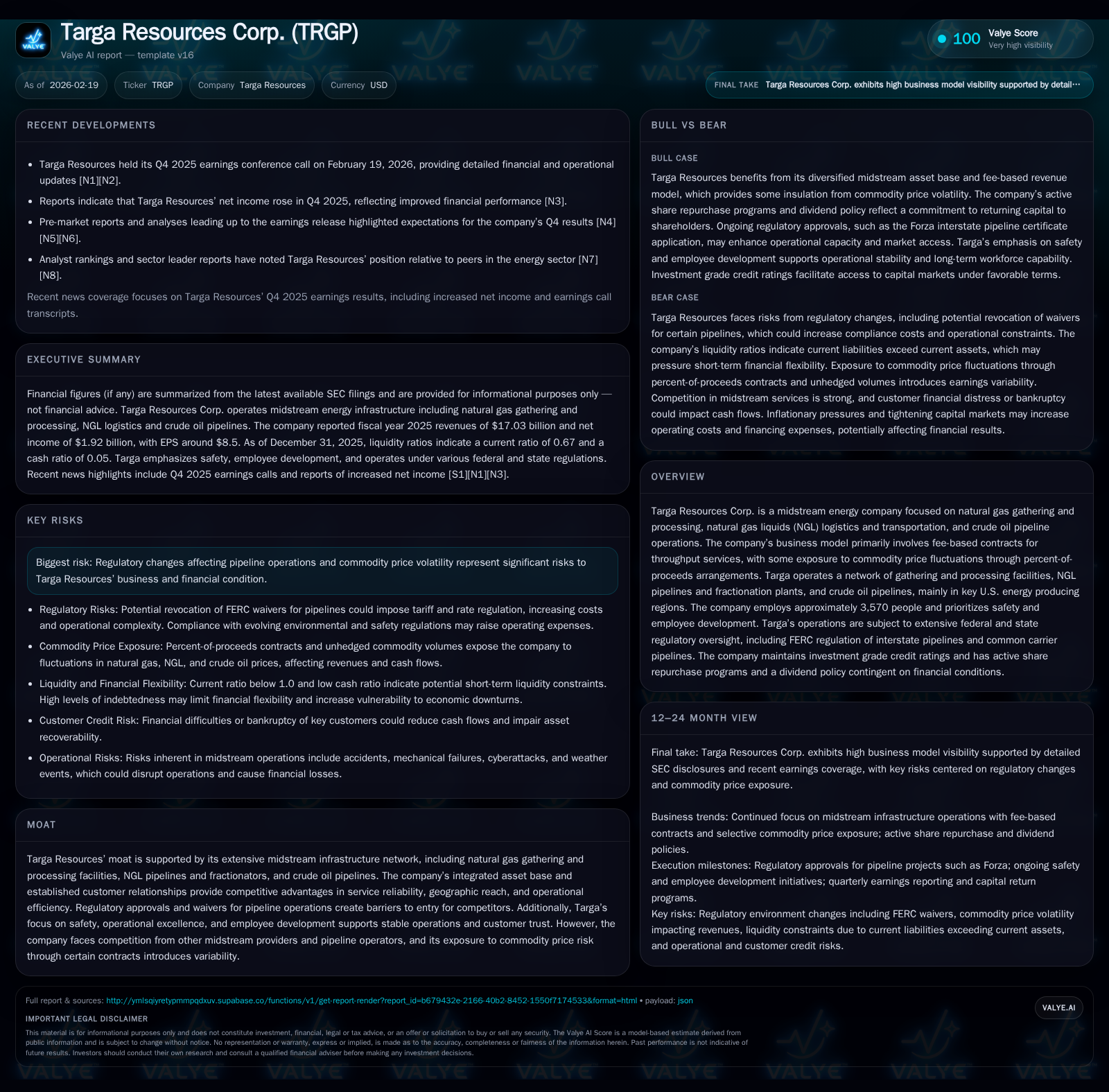
Targa Resources Corp. (TRGP) has steadily grown over recent years by leveraging its extensive network of natural gas gathering, processing, NGL logistics, and crude oil pipeline assets concentrated in key U.S. basins. Fee-based contracts underpin stability in earnings, supported by a diversified asset base and established customer relationships. In 2025, revenue grew modestly (+3.9%) alongside a robust increase in operating income (+23.6%), reflecting improved operational efficiency and scale effects. Looking ahead, Targa's growth prospects hinge on expansion projects such as the proposed Forza interstate pipeline awaiting FERC approval and organic capacity additions, balanced against heightened regulatory scrutiny—especially pipeline safety mandates—and commodity price fluctuations that can affect throughput volumes and percent-of-proceeds contract income. The company maintains investment-grade credit ratings and strong operating cash flow, supporting ongoing capital expenditures and returning capital via modest dividends in prior periods. Monitoring FERC regulatory developments and commodity cycle dynamics will be critical to assessing future performance trajectories.
Company Overview
Targa Resources Corp. is a prominent midstream energy company operating an integrated asset base primarily focused on gathering and processing natural gas, logistics and transportation of natural gas liquids (NGLs), as well as crude oil pipeline operations predominantly across major U.S. producing regions such as Texas, Louisiana, Oklahoma, North Dakota, New Mexico, and West Texas . With approximately 3,570 employees, Targa emphasizes operational safety, employee development, and customer service reliability.
Its business model heavily features fee-based contracts for throughput services that provide predictable cash flows insulated from commodity price volatility to a certain extent; however, portions of its contracts incorporate percent-of-proceeds arrangements exposing earnings to commodity prices fluctuations . The company's midstream infrastructure encompasses natural gas gathering systems feeding processing plants; an extensive network of NGL pipelines connected via key hubs like Mont Belvieu; fractionation facilities where mixed NGLs are separated into purity products; plus crude oil pipelines including systems under common carrier regulation by FERC.
Historical Financial Performance and Drivers
Over the period spanning fiscal years 2023 through 2025 (latest data available), Targa demonstrated consistent top-line growth accompanied by stronger profitability:
Historical performance (annual)
| FY | Rev ($bn) | Net ($mm) | CFO ($bn) | OpInc ($bn) | Rev YoY | Net YoY |
|---|---|---|---|---|---|---|
| 2025 | 17.0 | 1923 | 3.9 | 3.3 | +3.9% | +46.6% |
| 2024 | 16.4 | 1312 | 3.6 | 2.7 | +2.0% | -2.5% |
| 2023 | 16.1 | 1346 | 3.2 | 2.6 | ||
| 2021 | 20.9 | 1196 | 2.4 | 1.7 |
Note: Omitted columns lack sufficient annual XBRL coverage in the provided tags (need ≥2 annual points): Capex, Div, Buybacks. Source: SEC companyfacts cache [F1].
Capital returns and efficiency (annual)
| FY | FCF ($mm) | ROE% |
|---|---|---|
| 2025 | 584 | 62.7 |
| 2024 | 684 | 50.6 |
| 2023 | 826 | 49.1 |
| 2021 | 1047 | 44.8 |
Source: SEC companyfacts cache [F1].
Source: SEC XBRL data filings [F1].
Revenue grew moderately by nearly +4% in FY2025 after lower single-digit gains previously; however, operating income surged +23.6%, driven by improved margin management, operational efficiencies from scale expansion, and possibly favorable contract mixes skewed toward fee-based contracts with less commodity sensitivity compared to prior years [F1]. The spike in net income (+46%) further indicates leverage effects on profitability post operational improvements.
Operating cash flow rose steadily (+7%) reflecting strong core business performance with controlled working capital needs despite increased capex investments (+12%), signaling ongoing expansion projects designed to enhance throughput capacity or extend geographic reach of assets.
Financial leverage combined with profitable capital deployment produced an exceptionally high approximate ROE near ~62%, illustrating effective use of equity even as the company carries substantial debt typical within midstream energy infrastructure firms.
Competitive Positioning and Moat
Targa’s moat is anchored in its expansive midstream infrastructure network comprising interconnected natural gas gathering lines feeding multiple processing plants; NGL pipelines extending from production-rich basins to fractionators at Mont Belvieu—a premier liquids hub; plus key crude oil pipelines under regulatory oversight providing open access services under FERC-regulated tariffs or waivers where applicable [S10] [S14].
This integration facilitates reliable service delivery with flexibility across commodity segments—gas, liquids, and crude—which enhances customer retention through embedded logistical convenience not easily replicated by competitors relying on less comprehensive asset operations.
Regulatory approvals required for pipeline construction/operation impose substantial barriers for entrants given lengthy permit processes especially on tribal lands like Fort Berthold Reservation where Targa operates part of its Badlands assets subject to tribal authority enforcement alongside federal/state laws [S8], discouraging immediate competition.
Nonetheless, intense competition persists among major interstate/intrastate pipeline operators, master limited partnerships (MLPs), oil & gas producers with captive midstream assets as well as independent midstream companies vying for supply volumes in key producing regions for gathering capacity or takeaway options especially during periods where regional production surges lead to constrained takeaway bottlenecks or price differentials incentivize expansion moves by multiple players simultaneously [S10].
In fractionation too, Targa faces rivals at Mont Belvieu plus decentralized facilities elsewhere competing for mixed NGL supply although the scale advantage at Mont Belvieu remains critical given its connectivity to export terminals and petrochemical consumers.
Growth Prospects and Key Catalysts
Looking forward into the medium term horizon:
Infrastructure Expansion: One notable development is the pending application for FERC certificate approval to construct and operate the Forza interstate natural gas pipeline connecting West Texas assets outward toward national markets—expected to expand throughput capability materially upon completion pending regulatory milestones [S21] [N1]. This project illustrates Targa's strategy of targeted organic growth leveraging existing footholds.
Capacity Projects: Incremental expansions at gathering systems and processing plants remain under consideration as producers invest in new drilling or increased completions subject to commodity pricing environments influencing activity levels.
NGL Logistics & Export: Given global demand dynamics for propane and ethane exports facilitated via Gulf Coast ports served by Targa’s pipeline system segments including those between Mont Belvieu, Galena Park TX, Lake Charles LA—the company stands positioned to capture rising export volumes if U.S.-based petrochemical demand remains robust or international markets firm up post-pandemic trade disruptions [S14].
Acquisition Opportunities: While no explicit acquisitions have been cited recently per filings or news sources up to Q4 FY25 results ([N1]), M&A remains a potential avenue especially targeting add-on assets complementary geographically or technologically within existing operating areas.
Growth ceilings could materialize if:
- Regulatory environment tightens significantly adding operational costs or limiting expansion projects,
- Commodity prices soften materially causing producer output pullbacks reducing gathered volumes,
- Increased competition leads to erosion in contracted rates or volume commitments impacting margins,
- Customer creditworthiness declines limiting throughput or triggering renegotiations of gathering agreements [S24][S4][S7].
Returns & Capital Allocation
Targa's financial data shows solid generation of operating cash flow supporting maintenance capital expenditures alongside growth investments:
- FY25 CFO stood around $3.9 billion compared with capex of $3.33 billion resulting in positive free cash flow approximated at $584 million after reinvestment needs are addressed ([F1]).
- Historically small dividends have been paid though data beyond FY2015 is not available from tags; buyback programs have occurred but appear limited relative to free cash flow generation indicating a cautious approach prioritizing balance sheet maintenance amid infrastructure investment cycles ([F1]).
- Equity has grown moderately indicating retained earnings fueling expansion while debt leverages the asset base — debt rating remains investment grade (BBB/Baa2) supporting access to reasonably priced capital markets for refinancing or new project funding ([S6],[S20]).
This disciplined capital allocation underlines a focus on sustainable growth balanced against financial strength.
Regulatory Environment & Risks
Pipeline safety regulations imposed by PHMSA remain an important ongoing focus requiring systematic integrity management programs targeting high consequence areas (HCAs) along natural gas and hazardous liquid pipelines imposing inspection costs upwards of roughly $12-$15 million annually between now and at least 2028 plus potential remedial spend not fully predictable yet ([S15][S16]).
Navigating evolving state laws regulating hydraulic fracturing activities could adversely influence upstream drilling activity affecting throughput volumes ([S19]). Moreover:
- Jurisdictional reclassification efforts could drive formerly unregulated gathering assets into regulated status increasing cost burdens due to tariff requirements or compliance mandates ([S8][S13]).
- Environmental regulations remain dynamic with possible new emissions fees levied under federal statutes such as the Inflation Reduction Act amendments affecting GHG emissions which could elevate operating costs ([S11][S25]).
- Adverse legal actions or opposition from community groups around permitting could delay project execution creating risks around growth timing ([S22]).
- Cybersecurity risks related to handling critical infrastructure data may raise compliance overheads or litigation exposures ([S25]).
- Commodity price volatility influences customer operations directly impacting fee-throughput volumes on some percent-of-proceeds agreements bringing earnings variability ().
What To Watch Next (Analysis)
Key milestones impacting outlook include:
- FERC decision timeline regarding Forza pipeline certificate application will indicate near-term expansion prospects.
- Quarterly throughput volumes versus prior year baselines will reveal sensitivity amid prevailing commodity prices.
- Regulatory developments on PHMSA rule interpretations or state-level fracking legislation could materially shift cost structures.
- Customer credit trends during any commodity downturn phases given counterparties’ financial pressures potentially affecting receivables risk.
- Capital deployment efficacy—new project completions translating into meaningful incremental net income enhancements over coming fiscal years.
In sum, Targa Resources balances commendable organic growth grounded in diversified midstream asset exposure against significant regulatory complexities inherent in U.S energy infrastructure sectors alongside cyclical upstream activity dependencies.
Disclaimer: This analysis is presented solely for informational purposes based on publicly available information as of February 2026 without making any investment recommendation.
Disclaimer: This is research-only, informational analysis and not investment advice. It may include AI-generated interpretation and general industry context. Always verify important details using primary sources.

Comments