
Travel & Leisure Co.: Balancing Revenue Growth and Expense Pressures
Travel & Leisure Co. shows consistent revenue growth countered by rising expenses that pressure profitability and shape its capital deployment strategy.
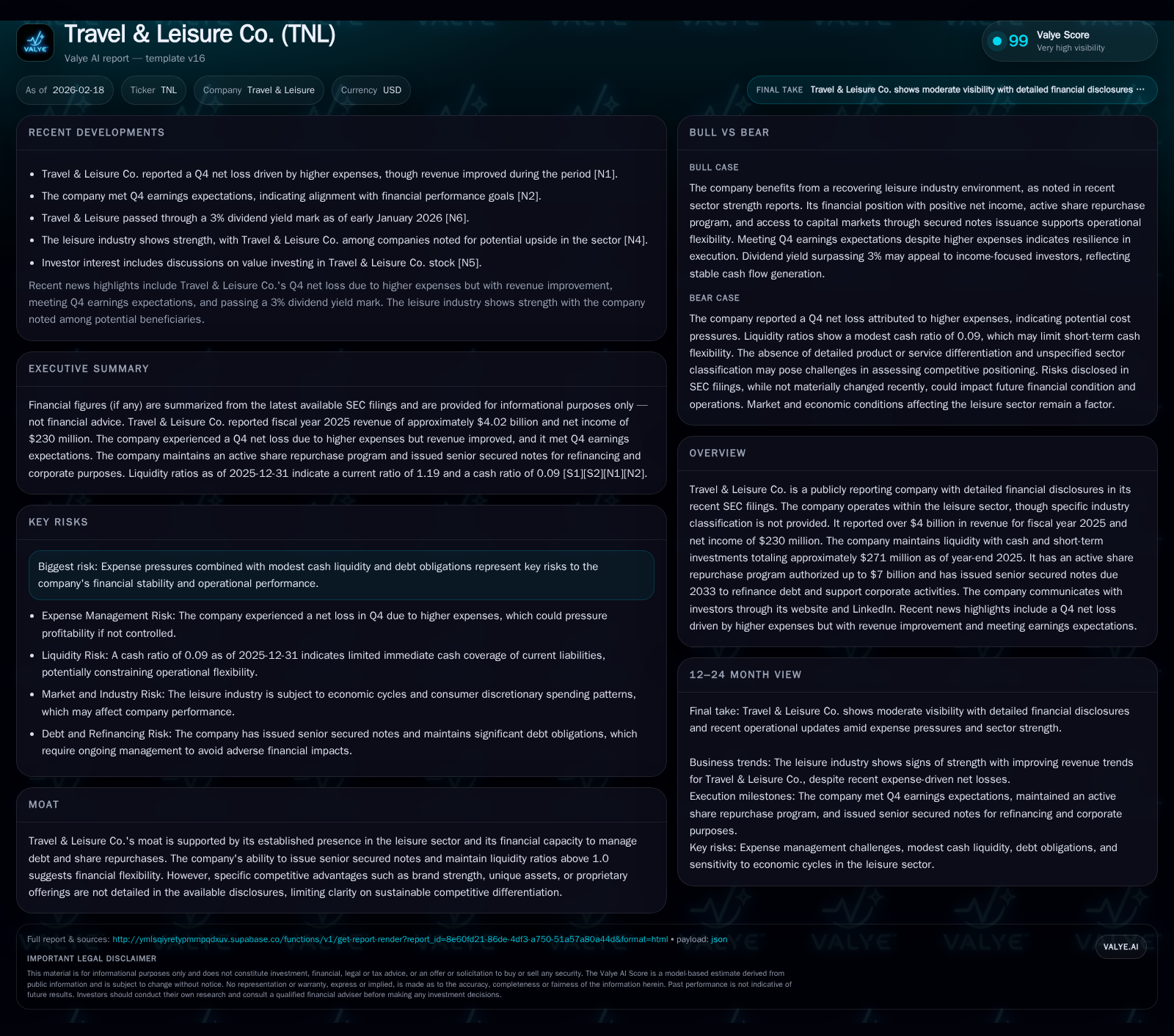
Travel & Leisure Co. achieved a 4.1% revenue increase in fiscal 2025, reaching $4.02 billion, yet faced a 24.6% decline in operating income and a 44% drop in net income amid escalating expenses. The company refinanced its debt through 2033 senior secured notes, sustaining liquidity with $253 million in cash equivalents and maintaining a current ratio of roughly 1.19. Aggressive share repurchases continued alongside steady dividends, supported by strong free cash flow generation despite profitability headwinds. Going forward, expense management and liquidity maintenance remain critical amid sector cost volatility and debt servicing obligations.
Historical Growth: Revenue Increases vs Earnings Contraction
Travel & Leisure Co.’s financial trajectory through fiscal year (FY) 2025 exhibits a clear pattern of revenue expansion coupled with tightening profitability margins. Revenues rose steadily from $3.57 billion in FY2022 to $4.02 billion in FY2025, corresponding to compounded annual growth driven by sustained demand within the leisure segment and potential portfolio optimizations [F1]. Specifically, the latest fiscal year saw a 4.1% increase over the prior year’s $3.86 billion revenue figure.
However, this top-line strength contrasts markedly with contracting profits. Operating income slipped from $733 million in FY2024 to $553 million in FY2025, a sharp contraction of nearly 25%. This decline underscores significant upward pressure on operational expenses that outpaced revenue gains.
Net income declined even more steeply by approximately 44%, retreating to $230 million from $411 million the year prior [F1]. The disparity between growing revenues and shrinking net results highlights the mounting earnings pressure likely influenced by escalating operating costs including SG&A, cost of services, or other consumables typical to travel and leisure businesses.
Historical performance (annual)
| FY | Rev ($bn) | Net ($mm) | CFO ($mm) | OpInc ($mm) | Rev YoY | Net YoY |
|---|---|---|---|---|---|---|
| 2025 | 4.0 | 230 | 640 | 553 | +4.1% | -44.0% |
| 2024 | 3.9 | 411 | 464 | 733 | +3.0% | +3.8% |
| 2023 | 3.8 | 396 | 350 | 720 | +5.1% | +10.9% |
| 2022 | 3.6 | 357 | 442 | 653 |
Note: Omitted columns lack sufficient annual XBRL coverage in the provided tags (need ≥2 annual points): Capex. Source: SEC companyfacts cache [F1].
Capital returns and efficiency (annual)
| FY | Div ($mm) | Buybacks ($mm) | FCF ($mm) |
|---|---|---|---|
| 2025 | 149 | 301 | 523 |
| 2024 | 142 | 234 | 383 |
| 2023 | 136 | 309 | 276 |
| 2022 | 135 | 351 | 390 |
Source: SEC companyfacts cache [F1].
Note: Percent changes calculated where data for consecutive years exist.
Expense Dynamics Driving Recent Profitability Trends
The core challenge to Travel & Leisure Co.’s profitability lies within its rising expense profile against improving revenues—a phenomenon echoed across many travel-related segments contending with inflationary wage increases, fuel price volatility, and supply chain disruptions impacting operational cost bases [N3][S5]. Quarterly commentary revealed a Q4 net loss attributed largely to such elevated costs despite continued revenue improvements during the same period.
Within leisure operations, overhead including property maintenance, customer service staffing levels, and marketing/administrative expenses are highly variable yet critical for maintaining brand preference and experience quality—factors that frequently render expense control difficult when demand patterns fluctuate seasonally or due to macroeconomic factors.
More granular breakdowns are limited in public disclosures; however, risk narratives explicitly identify "expense pressures" as material risks influencing earnings stability going forward [S5]. These may encompass higher SG&A components or increased amortization/depreciation from recent investments, further squeezing reported operating margins.
Financial Structure: Debt Refinancing and Liquidity Position
In August 2025, Travel & Leisure Co. completed a key refinancing move, issuing $500 million of senior secured notes due in August 2033 with a coupon rate of approximately 6.125%, replacing an earlier tranche due October 2025 carrying a higher interest burden (6.60%) [S7][S8][S12]. This strategic extension delayed imminent principal repayments while slightly reducing ongoing financing costs.
These notes are senior secured obligations backed by liens on certain assets but are subject to typical structural subordination risks tied to subsidiary claims beyond collateral values—a common feature within diversified leisure enterprises managing complex capital stacks [S8]. An optional redemption feature allows prepayment ahead of maturity under defined terms.
Liquidity metrics indicate cash plus short-term investments at approximately $253 million as of December 31, 2025, complemented by a current ratio near 1.19 calculated from reported current assets versus liabilities [F1]. Such coverage suggests moderate buffer capacity against short-term obligations but requires ongoing monitoring given elevated debt levels and leveraging related covenants.
Additional amendments during December included repricing of term loans under credit facilities to lower floating-rate floors aiding incremental financing flexibility [S11][S13]. These efforts collectively underpin the firm’s capacity to navigate upcoming debt maturities while funding ongoing operating needs.
Capital Allocation Priorities: Share Repurchases, Dividends, and Investment
Despite subdued net earnings trends, Travel & Leisure Co. maintained an assertive shareholder return strategy throughout FY2025 by executing $301 million in share repurchases under a sizable $7 billion authorization framework initiated originally in August ‘07 and expanded multiple times up through May ‘24 [F1][S2][S4]. Approximately one-third of the repurchase lane was utilized during FY2025 alone alongside stable dividend payments totaling roughly $149 million—indicating sustained prioritization of capital returns.
From a free cash flow perspective—derived here as operating cash flow minus capital expenditures—the company generated around $523 million in FY2025, reflecting robust operational cash conversion despite rising capital intensity (+44%) [F1]. This considerable FCF supports balancing repurchases and dividend sustenance even amidst earnings compression.
Investment outlays rose appreciably likely signaling enhancements either within property facilities or technology infrastructure crucial for competitive positioning—in line with sector norms where experiential upgrades directly influence customer retention and pricing power.
This capital discipline juxtaposes against the negative equity position (-$981 million), which reflects accumulated deficit effects hindering return on equity metric presentation but not necessarily constraining cash-based allocation decisions presently.
Outlook Considerations: Investment Plans and Risk Factors to Monitor
Looking ahead, Travel & Leisure Co.’s strategic success will hinge on several interlocking factors:
- Effective management of escalating operating expenses remains paramount given the direct impact on earnings leverage seen in recent periods [N3][S5].
- Continued access to capital markets for refinancing existing debt at favorable terms is crucial given structural leverage evident on the balance sheet ([S7], refinancing notes).
- Maintaining liquidity ratios near or above current thresholds safeguards operational resilience through fluctuating demand cycles typical for leisure activities.
- Potential macroeconomic uncertainties affecting discretionary spending on travel could constrain growth trajectories; thus vigilance is required around consumer sentiment shifts noted during investor communications ([N1],[S2]).
- Capital allocation must remain agile to balance ongoing share repurchases with dividend commitments without impairing investment capacity or solvency metrics.
- No material changes have been reported regarding risk factors since prior filings; ongoing legal contingencies appear contained within disclosed provisions ([S2],[S5]).
Investors should watch for updates regarding cost containment initiatives disclosed in forthcoming quarterly reports or earnings calls as bellwethers for margin recovery potential.
Valuation Marks: ROE and Free Cash Flow Implications
Despite posting profitable net income on an absolute basis ($230 million), Travel & Leisure Co.’s computed return on equity is deeply negative at roughly -23%, primarily owing to shareholders’ deficit-equity position nearing -$981 million as of fiscal year-end—reflecting the legacy of accumulated losses or goodwill impairments common in asset-heavy leisure sectors struggling with episodic industry-wide disruptions ([F1]).
Positive free cash flow generation mitigates some concerns as it empowers capital return programs without reliance on external funding sources currently; CFO expanded significantly (+37%) outpacing capex rises supports this robust internal liquidity creation scenario.
Given cyclical nature of leisure demand and sensitivity to macroeconomic conditions influencing both utilization rates and pricing power, these factors collectively influence valuation considerations distinctively from pure earnings multiples relying solely on book equity or net profits.
In sum, Travel & Leisure Co.'s financial narrative is one juxtaposing strong top-line momentum against constraining expense escalation impacting profitability measures while its prudent yet aggressive capital management via refinancing and buybacks signals trust in mid-term recovery prospects supported by solid cash flows amidst structural balance sheet complexities.
Disclaimer: This report is for informational purposes only and does not constitute an offer or solicitation to buy or sell securities nor investment advice.
Disclaimer: This is research-only, informational analysis and not investment advice. It may include AI-generated interpretation and general industry context. Always verify important details using primary sources.

Comments