
Wabash National’s Recovery and Innovation Drive in Transportation Equipment
Examining Wabash National’s operational rebound, product innovation, and capital management shaping near-term prospects in a volatile industry.
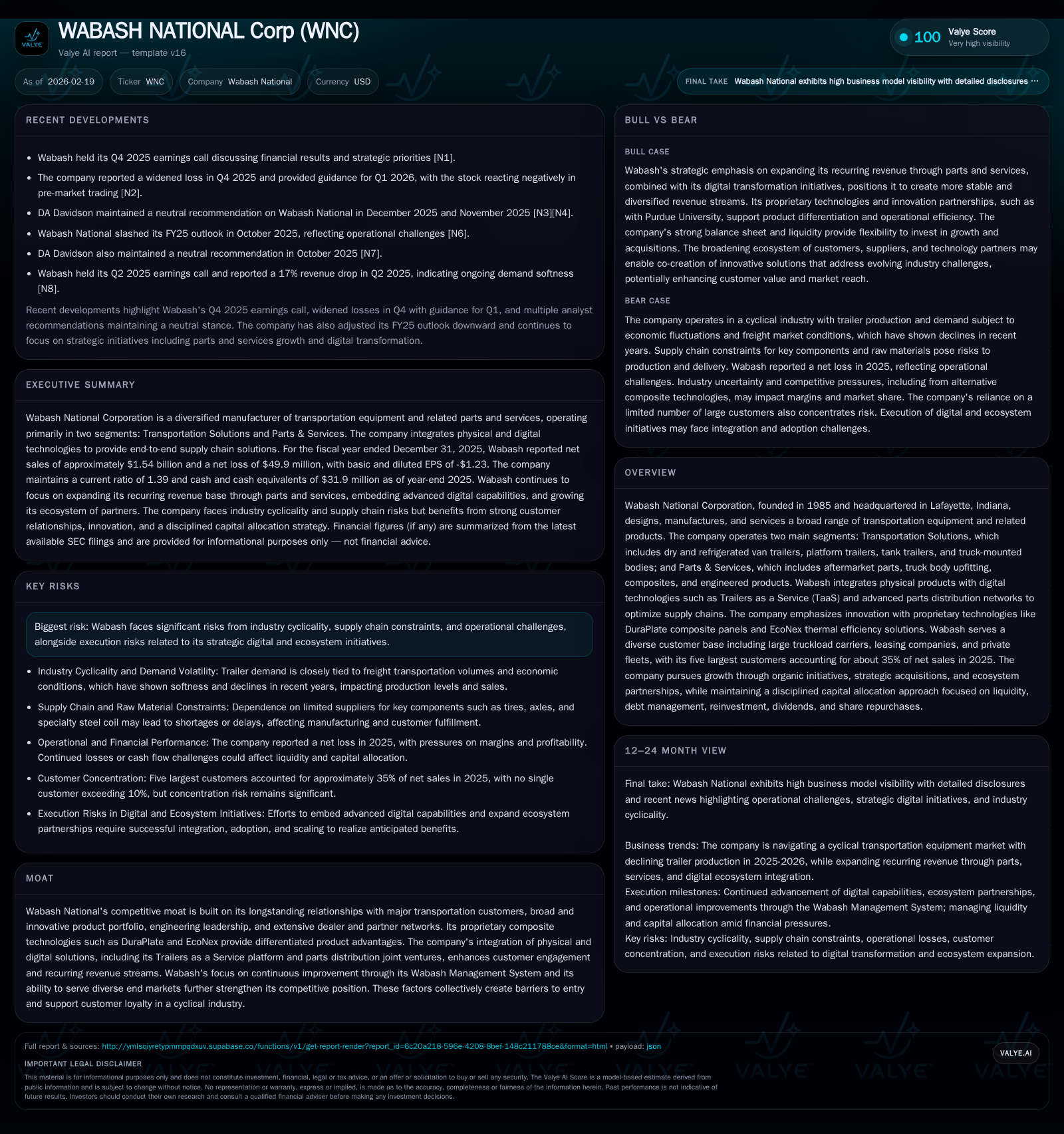
Wabash National Corporation demonstrated significant operating income recovery in FY2025 after a substantial loss in FY2024, driven by core manufacturing strength and strategic innovation in composite and thermal efficiency technologies. Despite improved operating margins, net income remained negative due to non-operating charges, while cash flows contracted markedly amid working capital pressures. The firm maintains disciplined capital allocation with sustained dividends and reduced buybacks, supported by a $350 million revolving credit facility expiring in 2027 and $400 million senior notes maturing in 2028. Its Trailers as a Service platform and parts distribution network underpin an evolving digital ecosystem aimed at boosting recurring revenues and customer retention, though cyclical demand and supply chain constraints remain key headwinds.
From Legacy Strengths to Recent Performance Volatility
Established in 1985 with headquarters in Lafayette, Indiana, Wabash National has cultivated a strong market position through engineering leadership and a broad portfolio encompassing dry van trailers, refrigerated vans, tank trailers, platform trailers, truck bodies, composites, and aftermarket products [S1]. The firm's legacy strength lies in its proprietary composite materials (e.g., DuraPlate®), aerodynamic design elements, and longstanding customer relationships across major trucking fleets and leasing firms .
Recent years have exhibited pronounced financial volatility symptomatic of cyclical end markets and legacy operational issues. Notably, the company swung from a steep operating loss of -$356 million for FY2024 to an operating income of approximately $308 million in FY2025—a remarkable improvement exceeding 186% year-over-year [F1]. This rebound reflects operational improvements driven by cost controls, pricing initiatives, demand stabilization post-COVID disruptions, and the effectiveness of the Wabash Management System focused on lean operations [S1].
Despite recovering operating profitability, net income remained negative at about -$50 million for FY2025 due primarily to non-operating charges including legal settlements related to legacy litigation matters [F1],[S15],[S22]. This divergence highlights ongoing legacy headwinds requiring close monitoring.
Product Innovation Supporting Competitive Edge
Wabash's competitive advantage is anchored by differentiated physical products infused with advanced technologies aimed at optimizing total cost of ownership for transportation customers [S23],. Core innovations include DuraPlate® composite panels that combine structural strength with reduced weight to enhance fuel economy—critical amid industry focus on emissions reduction and payload efficiencies.
EcoNex™, the company’s proprietary thermal management solution, improves refrigerated trailer insulation without compromising durability [S23]. Aerodynamic features such as EPA SmartWay®-verified AeroSkirt™ further reduce highway drag enhancing fuel efficiency.
On the digital front, Wabash integrates physical hardware with its expanding Trailers as a Service (TaaS™) platform offering connected trailer fleets combined with maintenance services via subscription models . This complements growing aftermarket parts distribution through joint ventures like Wabash Parts LLC that bolster recurring revenue streams beyond new trailer sales cycles [S28].
This physical-digital integration deepens client engagement while providing data insights that support iterative product development.
Financial Trends: Growth Amid Profitability Swings
Historical performance (annual)
| FY | Net ($mm) | CFO ($mm) | OpInc ($mm) | Capex ($mm) | Net YoY |
|---|---|---|---|---|---|
| 2025 | -50 | 12 | 308 | 25 | -4742.5% |
| 2024 | -1 | 117 | -356 | 72 | -102.0% |
| 2023 | 50 | 320 | 312 | 98 | +21.5% |
| 2022 | 41 | 124 | 167 | 57 |
Note: Omitted columns lack sufficient annual XBRL coverage in the provided tags (need ≥2 annual points): Rev. Source: SEC companyfacts cache [F1].
Capital returns and efficiency (annual)
| FY | Div ($mm) | Buybacks ($mm) | FCF ($mm) |
|---|---|---|---|
| 2025 | 14 | 34 | -13 |
| 2024 | 15 | 71 | 45 |
| 2023 | 16 | 76 | 222 |
| 2022 | 16 | 34 | 67 |
Source: SEC companyfacts cache [F1].
Note: Some prior year revenue figures are not fully available from provided tags; marked accordingly.
Revenue growth of nearly 9% in FY2025 signals stabilization following prior disruptions [F1]. Operating income turnaround was driven by improved gross margins supported by enhanced pricing on composite-enabled trailers plus operational efficiencies from the Wabash Management System [S1].
However, net losses widened due to legacy legal settlements recognized as special charges with partial insurance recoveries recorded subsequently [S15],[S22].
Operating cash flow declined sharply from $117 million to just under $12 million primarily due to inventory increases (+$77 million), reflecting cautious supply chain positioning ahead of anticipated demand shifts alongside lengthened receivable cycles [S14],[S20]. Capital expenditures retrenched significantly amid liquidity preservation efforts.
Resultant free cash flow was negative approximately $13 million (operating cash flow less capex), highlighting tightening internal funding capacity requiring vigilant oversight.
Capital Structure & Liquidity Position
As of December 31, 2025, Wabash held approximately $32 million in cash alongside $45 million drawn under its $350 million revolving credit facility maturing September 2027—with options for extension or expansion subject to lender approval [S4],[S6],[S7].
The company also carries unsecured senior notes totaling $400 million due October 15, 2028 bearing fixed interest at 4.50%, paying semiannual coupons [S12],[S16]. These debt agreements include customary covenants restricting dividends (around $13.8 million paid annually), share repurchases—which declined substantially from about $71 million in FY2024 down to roughly $33.8 million in FY2025—and other leverage-related limitations designed to protect creditors [S9],[S16],[S17].
Liquidity measured as cash plus borrowing availability contracted materially from approximately $422 million at end-2024 down to roughly $235 million at end-2025 due mainly to working capital inflation compressing cash flow generation [S7],[S17]. Despite this decline, the company remains compliant with all debt covenants including fixed charge coverage ratios above minimum thresholds [S4],[S9].
Management signals readiness to evaluate refinancing alternatives for senior notes approaching maturity late-2028; timing depends on future capital market conditions [S6],[S16]. This prudent approach balances sector cyclicality risks against resilient client relationships.
Customer Base & Ecosystem Development
Wabash serves major truckload carriers such as J.B Hunt Transport Inc., Crete Carrier Corp., Werner Enterprises Inc., private fleets including Dollar General Corporation and PepsiCo Inc., plus leasing companies like Ryder System Inc., Penske Truck Leasing Co., L.P.—providing diversified exposure across transportation verticals [S26],[S28].
Sales channels include factory direct accounts targeting high-volume customized units alongside independent dealerships serving mid-sized or regional fleets enhancing geographic reach [S26].
The growing Parts & Services segment encompasses aftermarket parts distribution via joint ventures such as Wabash Parts LLC plus truck body upfitting—supporting efforts toward recurring revenue streams beyond initial trailer sales cycles ,[S28].
The Trailers as a Service (TaaS™) platform bundles hardware offerings with maintenance contracts delivering digital fleet visibility—an emerging channel extension contributing toward ecosystem-driven customer retention that mitigates cyclicality typical of new equipment orders.
This dual physical-digital integration enhances client engagement while generating valuable data insights for iterative innovation.
Risks: Supply Chain & Market Cyclicality Challenges
Key risk factors stem from pronounced industry cyclicality influenced by macroeconomic trends affecting freight volumes such as housing starts, energy prices, regulatory changes impacting logistics demand patterns [S11],[S21],[S27]. Delays in fleet replacement amid economic uncertainty may compress order backlogs causing margin pressures.
Supply chain constraints persist involving specialty steel coils, aluminum extrusions for lightweight composites; landing gear assemblies; axles; suspensions; tires—all subject to variable lead times or cost shocks exacerbated by tariffs or commodity price volatility [S25],[S27]. These bottlenecks complicate production scheduling necessitating inventory juggling strategies reflected in working capital fluctuations noted earlier.
Wabash mitigates these pressures leveraging entrenched supplier relationships supplemented by forward purchasing strategies alongside lean management processes targeting root cause elimination of inefficiencies causing wasteful delays or cost overruns ,[S1]. Nonetheless some unpredictability remains inherent limiting short-term earnings visibility.
Outlook: Milestones & Financial Health Indicators To Watch
While explicit formal guidance is unavailable post-FY2025 earnings release ([N1],[N2]), investors should monitor:
- Stabilization or growth of operating cash flow near positive double-digit millions enabling working capital funding without incremental borrowings,
- Continued compliance with debt covenants especially fixed charge coverage ratios ahead of revolver maturity September 2027,
- Progress metrics for TaaS platform adoption rates tracking subscriber growth or service contract expansions signaling digital ecosystem traction,
- New order backlog trends aligned with freight volume rebounds indicating manufacturing utilization gains,
- Refinancing strategy developments for Senior Notes maturing October 2028 reflecting management’s strategic financial flexibility.
Achievement across these milestones would evidence effective navigation through liquidity pressures while leveraging product innovation momentum toward sustainable profitable growth.
This analysis synthesizes reported financial data alongside qualitative disclosures without making investment recommendations or forecasts beyond publicly available information within cited sources.
Disclaimer: This is research-only, informational analysis and not investment advice. It may include AI-generated interpretation and general industry context. Always verify important details using primary sources.

Comments