
Grand Canyon Education's Revenue Growth and Strategic Evolution in 2025
Grand Canyon Education delivered top-line expansion in 2025 powered by its integrated education services model centered on Grand Canyon University, while facing margin pressures and concentrated partner risks.
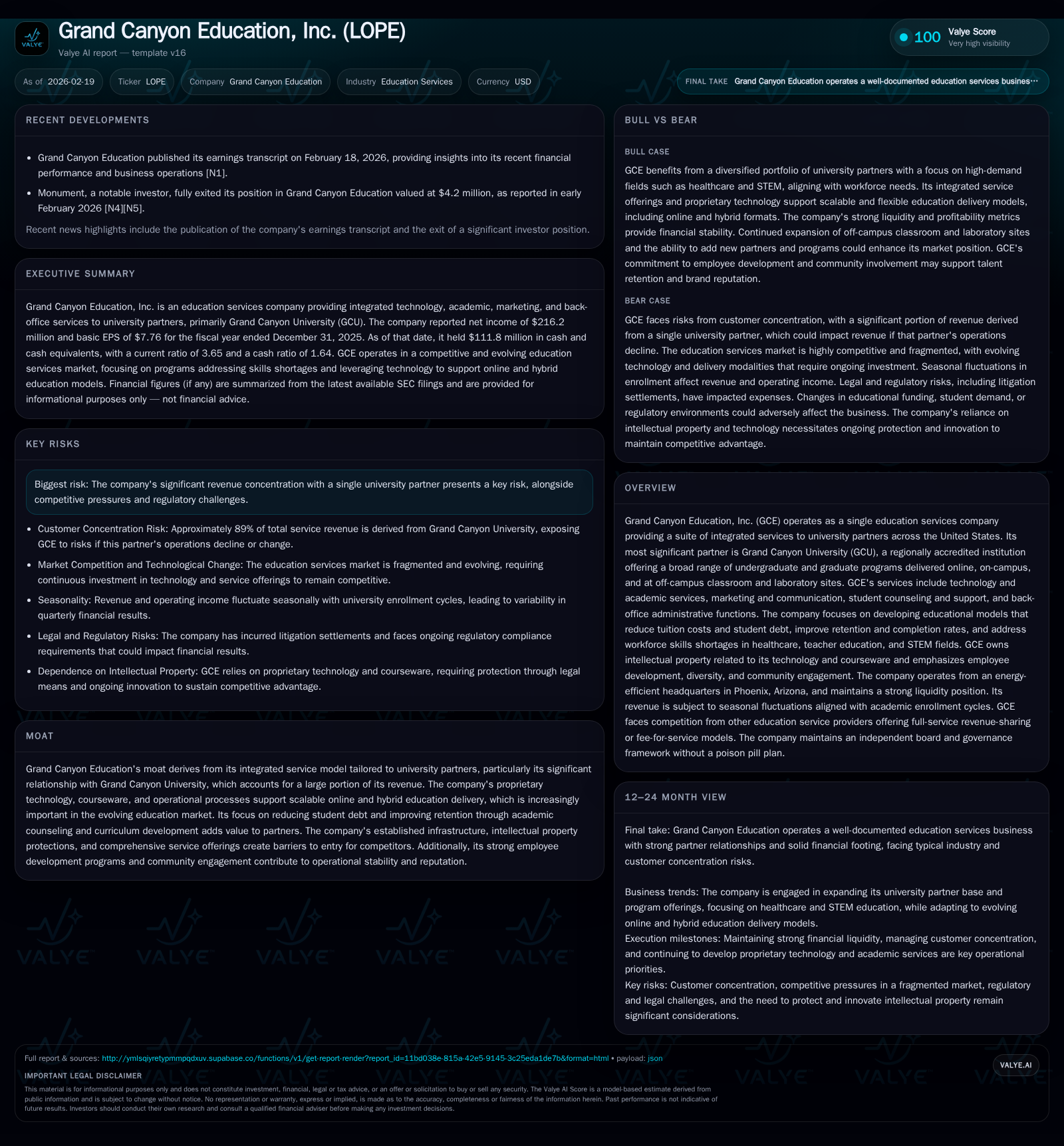
Grand Canyon Education, Inc. (GCE) grew revenue by approximately 15% in fiscal 2025 driven by service agreements with university partners, particularly Grand Canyon University (GCU), which accounted for nearly 89% of revenues. Despite robust top-line gains, operating income and net income declined modestly due to margin compression from higher costs and certain one-time expenses. The company’s moat benefits from proprietary technology and an integrated service approach that enhances retention and reduces student debt burdens. Substantial share repurchases continue to be a key capital allocation priority, sustained by strong cash flows and a solid balance sheet. Going forward, growth will hinge on expanding scalable educational models addressing workforce shortages in STEM and healthcare, while regulatory scrutiny and partner concentration remain notable risks.
Financial Growth Patterns and Shifts Through 2025
Grand Canyon Education posted notable revenue growth of approximately 15% year-over-year in fiscal 2025 to reach roughly $1.46 billion [F1]. This acceleration reflects expanded service contracts primarily with its core university partner, Grand Canyon University (GCU). However, this top-line momentum contrasted with softness in profitability metrics; operating income dropped about 3.4% to $266 million as the company scaled up investments in enhanced academic counseling pedagogy and marketing initiatives aimed at improving student retention [F1][S1]. Net income similarly contracted by roughly 4.4% to $216 million despite overall revenue expansion.
Operating cash flow declined by around 5.7% year-over-year to $273 million, evidencing some margin pressure amid higher operating costs [F1]. The company's asset-light model confers operating leverage but is tempered by strategic spending on technology improvements and enrollment support services to maintain competitive differentiation [S18]. Capital expenditures have remained modest relative to revenue scale, consistent with the technology-driven education services business.
Historical performance (annual)
| FY | Net ($mm) | CFO ($mm) | OpInc ($mm) | Net YoY |
|---|---|---|---|---|
| 2025 | 216 | 273 | 266 | -4.4% |
| 2024 | 226 | 290 | 275 | +10.4% |
| 2023 | 205 | 244 | 249 | +11.0% |
| 2022 | 185 | 221 | 238 |
Note: Omitted columns lack sufficient annual XBRL coverage in the provided tags (need ≥2 annual points): Rev, Capex, Div, FCF. Source: SEC companyfacts cache [F1].
Capital returns and efficiency (annual)
| FY | Buybacks ($mm) | ROE% |
|---|---|---|
| 2025 | 265 | 28.9 |
| 2024 | 173 | 28.9 |
| 2023 | 137 | 28.5 |
| 2022 | 604 | 29.0 |
Source: SEC companyfacts cache [F1].
Note: Capex data not explicitly available for recent years; buybacks reflect robust share repurchase activity [F1]
Core Business Model: Integrated Education Services and Partner Concentration
The essence of Grand Canyon Education’s value proposition lies in its integrated services platform tailored primarily for Grand Canyon University, which represents about 89% of its total service revenue [S6][S7]. Under long-term master service agreements, the company provides a comprehensive suite of offerings including technology infrastructure enabling scalable online program delivery, academic counseling pedagogy designed to improve retention and completion rates, marketing and communication efforts targeting student recruitment, student support services, and essential back-office administrative functions [S1][S6].
This tuition share model aligns the incentives of GCE with those of GCU, as payment is linked proportionally to tuition revenues generated by the university partner. This arrangement allows GCU to reduce tuition costs or increase scholarships—helping reduce student debt burdens—while enabling GCE to benefit from enrollment growth [S1][S13]. The company’s proprietary technology platforms combined with faculty-led curriculum development create barriers to entry for competitors who must replicate both pedagogical effectiveness and scalable delivery capability.
Importantly, the regional accreditation of GCU ensures compliance within stringent regulatory frameworks governing higher education institutions—a critical factor given increasing scrutiny over incentive compensation bans impacting education services providers operating under revenue-sharing contracts [S13][S27]. However, this high dependency on a single university partner inherently concentrates execution risk; any decline in GCU’s enrollment or regulatory challenges affecting its operations would materially affect GCE’s financial results [S7][S13].
Key Financial Metrics and Return Analysis
Grand Canyon Education displayed an approximate return on equity (ROE) of about 28.9% in fiscal 2025 based on net income against a robust stockholders’ equity base near $747 million [F1]. This high ROE underscores capital efficiency achieved through the company’s asset-light service delivery model and sizeable recurring revenue streams stabilized by contractual tuition share arrangements.
The balance sheet exhibits strength with a current ratio around 3.65x measured by current assets versus liabilities totaling approximately $400 million against $110 million respectively at year-end [F1]. This liquidity cushion supports operational flexibility amid demand fluctuations arising from seasonal enrollment cycles as well as potential capital deployment opportunities.
A notable divergence exists between net income declines alongside an operating cash flow reduction of roughly 5.7%, indicating working capital dynamics or timing differences rather than fundamental cash generation issues [F1][S18]. The company’s consistent positive free cash flow profile positions it well for ongoing investments in software enhancements, content development, and strategic share repurchases.
Capital Deployment: Share Repurchases and Cash Flow Utilization
Capital allocation at Grand Canyon Education prominently features aggressive share repurchase programs reflecting management’s confidence in intrinsic business value [S4][S8]. In fiscal year 2025 alone, approximately $264.8 million was spent on buybacks compared with $173.2 million the previous year—a significant ramp-up maintaining upward pressure on per-share earnings metrics while offsetting dilution from equity-based compensation plans [F1][S8][S9]. Shares repurchased via open market purchases or privately negotiated transactions have cumulatively exceeded $2.2 billion since inception.
No dividends have been issued during the timeframe analyzed; this absence reflects a strategic preference towards deploying excess cash flow into stock buybacks rather than distributable payouts [F1][S10]. Cash balances near $112 million as of December 31, 2025 augment liquidity reserves providing tactical flexibility for share repurchases or opportunistic investments [F1][S14].
The company also addresses tax withholding obligations through shares repurchased specifically in lieu of income taxes associated with restricted stock vesting—a nuanced practice easing balance sheet equity effects without diluting shareholder interests excessively over time [S4][S8].
Operational Headwinds and Marketplace Constraints
Despite compelling growth drivers, GCE faces operational headwinds stemming principally from significant reliance on GCU for the overwhelming majority of its revenue base—a concentration risk uncommon among diversified education services companies [S7][S13]. Additionally, competitive pressures intensify as rivals pursue innovative service offerings including unbundled fee-for-service models versus traditional full-service bundled contracts favored by GCE [S17]. Rapid evolution in delivery modalities incorporating artificial intelligence heightens necessity for continuous investment to avoid obsolescence or margin erosion.
Regulatory developments represent another critical constraint area; Department of Education guidance regarding incentive compensation arrangements introduces ambiguity requiring strict adherence to exceptions allowing bundled services without violating prohibition norms—a legal environment made more complex by pending litigation involving alleged misleading graduate program disclosures connected indirectly with GCE operations on behalf of GCU [S13][S15][S27].
Notably, the company continues leveraging workforce development programs including generous employee tuition benefits through its partnership with GCU along with extensive employee learning curricula fostering leadership skills—measures that bolster internal human capital resilience amid a tight labor market [S1].
Future Prospects: Innovation, Workforce Focus, and Market Positioning
Looking ahead, Grand Canyon Education aims to expand education models strategically addressing acute workforce shortages concentrated in healthcare professions, teacher education sectors, as well as STEM fields aligned with labor market demands [S1][N1][S3]. Initiatives supporting dual credit opportunities alongside online prerequisite courses seek to reduce time-to-degree completion thereby mitigating student debt burdens—a growing concern influencing enrollment decisions.
Technological innovation remains core to future growth vectors as investments escalate in hybrid education delivery platforms capable of scaling efficiently across multiple partners while maintaining academic excellence via proprietary courseware enhancements developed internally or licensed externally [N1][S3]. The pipeline for onboarding additional university partners beyond GCU presents incremental upside but necessitates adapting contractual terms compatible within evolving regulatory frameworks.
The company has articulated objectives towards broadening footprint into complementary markets such as K12 faculty services alongside extending backend administrative offerings further improving margins through operating leverage gains [N1][S1]. However, these ambitions will need prudent execution balancing risk exposures inherent in partner dependency versus prospects from diversified contract wins.
What to Watch: Earnings Signals and Strategic Milestones
Investors should closely monitor upcoming quarterly results focusing on quarterly revenue growth trajectories originating from both core GCU enrollments as well as any nascent partner expansions disclosed through SEC filings or earnings transcripts [N1][S3]. Changes in marketing spend efficiency relative to enrollment yield ratios provide early indicators regarding scalability of academic counseling pedagogy investments.
Share repurchase volumes remain another key metric reflecting management confidence; any material amendments or suspensions under existing buyback authorizations could signal shifts in corporate cash flow outlook or broader economic uncertainties affecting discretionary capital deployment strategies [N1][S8].
Finally, regulatory developments surrounding incentive compensation interpretations alongside progress within ongoing litigations over program representations represent potential event catalysts affecting valuation sentiment—thus careful legal updates tracking are warranted within due diligence frameworks [N1][S13].
Disclaimer: This report is intended solely for informational purposes based on publicly available data as of February 19, 2026. It does not constitute investment advice or recommendations regarding buying or selling securities. Readers should conduct their own analysis prior to making investment decisions.
Disclaimer: This is research-only, informational analysis and not investment advice. It may include AI-generated interpretation and general industry context. Always verify important details using primary sources.

Comments