
ExxonMobil's Earnings Dynamics and Lower-Emission Expansion in 2025
The firm balances financial discipline in traditional hydrocarbon operations with pioneering investments into carbon capture, hydrogen, and specialty products.
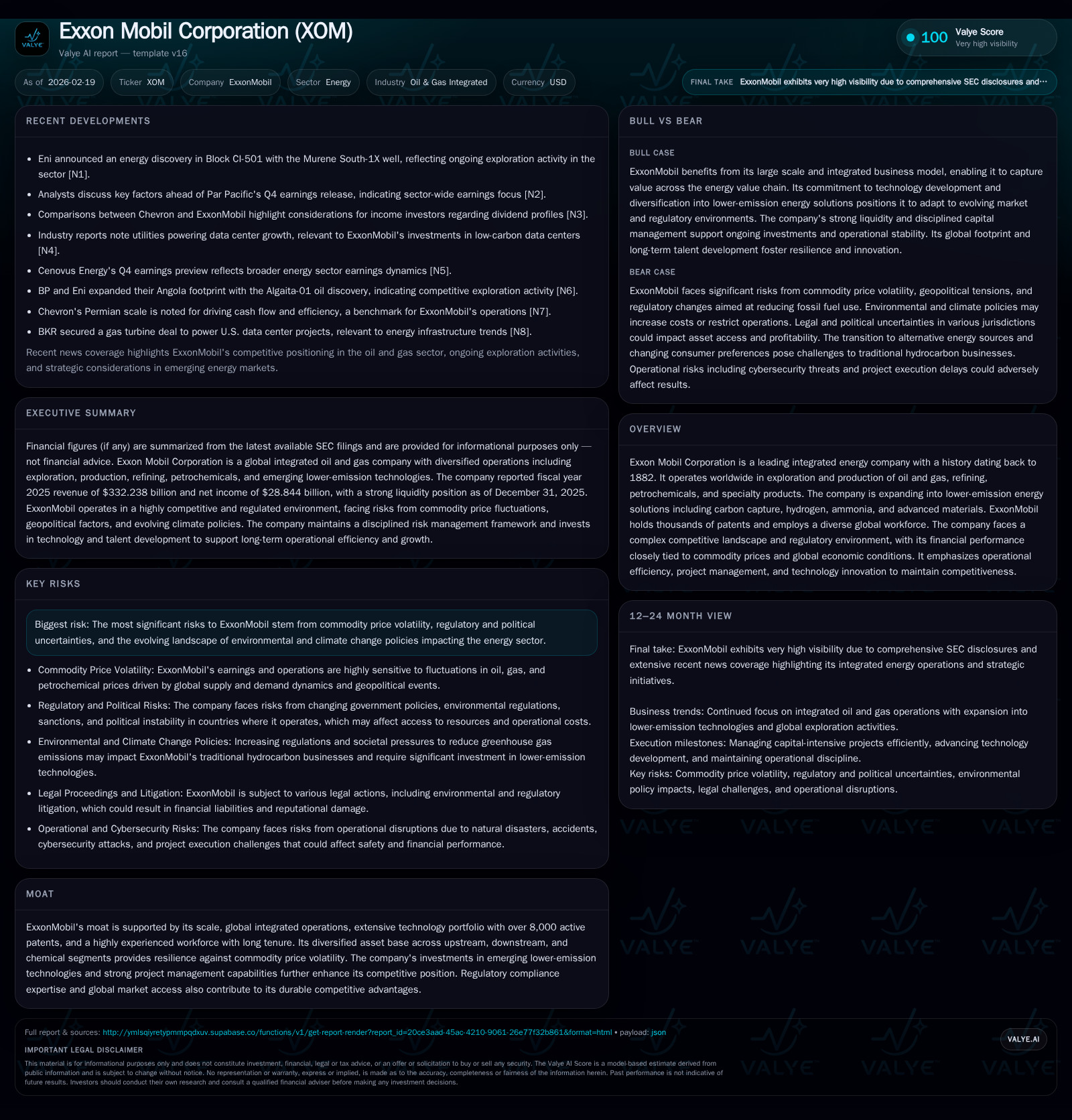
ExxonMobil navigated a modest revenue and earnings decline in 2025, reflecting commodity price volatility and macroeconomic headwinds. Growth was buoyed by upstream production gains and operational efficiency improvements that supported a Q4 earnings surprise. The company reinforced its capital allocation discipline through sustained dividends and elevated share repurchases, even as capex increased to support growth and transition initiatives. Strategic investments in lower-emission technologies like integrated CCUS, blue hydrogen scaling, advanced materials, and ammonia underscore ExxonMobil’s commitment to energy transition amid evolving regulatory and geopolitical challenges. Key milestones include project ramp-ups in Turkey’s Black Sea/Mediterranean regions and potential repositioning in Venezuela. With an extensive patent portfolio and global operational footprint, ExxonMobil aims to leverage its integrated business model to sustain competitiveness while innovating for a lower-carbon future.
Historical Financial Performance: Revenue, Profitability, and Cash Flow Trends
ExxonMobil’s FY2025 financial results illustrate the interplay of resilient operational execution against an unfavorable commodity pricing environment. Revenues contracted by around 5%, dropping from $349.6 billion in FY2024 to $332.2 billion in FY2025 [F1]. This revenue dip symbolizes the sector-wide pressure from fluctuating crude benchmarks and refined product margins, which particularly weighed on the Energy Products segment.
The net income figure followed suit with a steeper decline of 14.4%, falling to $28.8 billion from $33.7 billion the year prior [F1]. The disparity between revenue and net income contraction points to margin compression exacerbated by higher operational costs downstream.
Operating cash flows remained relatively stable but reduced by roughly 5.5%, arriving at $51.97 billion compared to $55.0 billion in FY2024 [F1]. Notably, capital expenditures increased significantly by 16.7% to $28.36 billion [F1]. This uptrend in capex signals strategic reinvestment into both sustaining current asset productivity and expanding the company’s footprint in emerging lower-emission technology sectors.
Historical performance (annual)
| FY | Rev ($bn) | Net ($bn) | CFO ($bn) | Capex ($bn) | Rev YoY | Net YoY |
|---|---|---|---|---|---|---|
| 2025 | 332.2 | 28.8 | 52.0 | 28.4 | -5.0% | -14.4% |
| 2024 | 349.6 | 33.7 | 55.0 | 24.3 | +1.5% | -6.5% |
| 2023 | 344.6 | 36.0 | 55.4 | 21.9 | -16.7% | -35.4% |
| 2022 | 413.7 | 55.7 | 76.8 | 18.4 |
Note: Omitted columns lack sufficient annual XBRL coverage in the provided tags (need ≥2 annual points): OpInc. Source: SEC companyfacts cache [F1].
Capital returns and efficiency (annual)
| FY | Div ($bn) | Buybacks ($bn) | FCF ($bn) |
|---|---|---|---|
| 2025 | 17.2 | 20.3 | 23.6 |
| 2024 | 16.7 | 19.6 | 30.7 |
| 2023 | 14.9 | 17.7 | 33.5 |
| 2022 | 14.9 | 15.2 | 58.4 |
Source: SEC companyfacts cache [F1].
Note: Operating income data is not available from provided tags; Return on Equity approximated below.
The approximate return on equity (ROE) for FY2025 stands at about 11.1%, calculated using net income of $28.8 billion against equity of approximately $259 billion [F1]. Free cash flow (FCF), defined as CFO minus capex, was approximately $23.6 billion — underscoring the firm’s capacity for shareholder returns alongside growth investments.
Segment Drivers Behind ExxonMobil's Past Growth and 2025 Operational Highlights
Growth in ExxonMobil's upstream segment has been pivotal during recent periods, partially offsetting challenges downstream caused by refining margin squeezes or cyclical demand shifts [N6][N7]. The Q4 earnings beat reported reflects increased production volumes achieved through both organic development projects and acquisitions.
Operational efficiency improvements have remained central to sustaining profitability within core oil & gas segments amid fluctuating commodity prices [S1]. The company continues to innovate hydraulic fracturing techniques coupled with seismic imaging advancements leveraging AI capabilities embedded in proprietary workflows—an application increasingly vital given the rising technical complexity of new field developments [S22].
Project management proficiency has been highlighted in maintaining timelines amidst regional geopolitical tensions—such as those related to operations in Turkey’s Mediterranean concessions—and ongoing recovery of Venezuelan assets as per recent accords discussed below [N10][N8]. These factors underline ExxonMobil's robust project execution culture that sustains production ramps despite external headwinds.
Strategic Shift Toward Lower-Emission Technologies: Initiatives and Market Context
A defining theme of ExxonMobil’s recent strategy involves a deliberate pivot toward lower-emission energy solutions while sustaining core hydrocarbons profitability [S1]. Commitments include advancing integrated Carbon Capture, Utilization, and Storage (CCUS) facilities designed to reduce Scope 1 and Scope 2 emissions from operated assets towards net-zero goals.
The company is scaling blue hydrogen projects—leveraging natural gas reforming with CCUS—to supply emerging markets with low-carbon fuel alternatives while increasingly investing in ammonia production technologies as a versatile energy carrier for export markets [S1].
ExxonMobil also develops advanced materials like Proxxima™ resin systems that serve emerging needs for lightweight composites supporting decarbonization in transportation sectors [S1]. These initiatives benefit from ExxonMobil's expansive patent portfolio exceeding 8,000 active patents, underpinning technological differentiation critical for commercializing next-generation energy products at scale [S22].
However, realizing these opportunities remains policy-dependent; stable government incentives including carbon pricing mechanisms or direct subsidies are essential for achieving commercial viability amid technology cost curves still descending from early adopters’ phases [S4].
External Constraints: Commodity Volatility, Geopolitical Risks, and Regulatory Environment
Commodity price volatility continues to exert outsized influence on upstream margin realizations—positive impacts can drive cash flow spikes but downside risks remain material when crude or natural gas prices soften unexpectedly [S1]. Downstream profitability faces pressures from imported refined product prices influenced by global supply chain disruptions.
Geopolitical events compound uncertainties: recent agreements such as the memorandum of understanding with Turkey’s TPAO covering Black Sea/Mediterranean exploration offer promising resource access yet entail sovereign risk management complexities [N10]. Venezuela's government reopening poses potential upsides via heavy oil reserves restoration but entails exposure linked to regulatory stability and sanctions landscapes [N8].
On the regulatory front, tightening environmental standards—including drilling moratoria exemplified by Brazil’s Foz do Amazonas pause—signal increasing compliance costs and permit delays affecting new projects' timelines or economics [N1][N11]. Additionally, evolving climate change policies introduce risks surrounding greenhouse gas restrictions inclusive of carbon taxes or cap-and-trade schemes that may alter product pricing structures or investment decisions [S4][S8].
Legal proceedings disclosures highlight exposures related not only to environmental liabilities but also litigation risks embedded globally where enforcement frameworks vary widely impacting operational predictability [S14]. Cybersecurity threats stand out too among business continuity risk vectors given ExxonMobil’s reliance on digitized control systems spanning exploration through refining operations [S12][S16].
Capital Allocation Philosophy: Dividends, Buybacks, and Investment in Growth Areas
ExxonMobil manifests disciplined capital allocation balancing shareholder returns with growth funding priorities [F1]. Dividend payments rose modestly to about $17.2 billion in FY2025 supported by consistent high free cash flow generation despite marginal profit dips.
Concurrently, share repurchase programs accelerated again to over $20 billion annually—a level reflecting board confidence in underlying cash conversion capability even given cyclical market pressures.
Capex budgeting stepped up notably, emphasizing expanding resource bases as well as funding transitioning business segments like CCUS installations or blue hydrogen plants that align with long-term sustainability targets [F1][S22]. Such capex prioritization indicates an evolving investment mix aiming to underpin multidecade resilience across energy market cycles.
Future Growth Potential: Emerging Markets, Technology Leverage, and Production Outlook
Looking forward, several pillars underpin ExxonMobil’s growth trajectory:
- Expansion into frontier basins offshore Turkey backed by recently signed accords provides near-term prospect maturation pathways alongside incremental reserves additions facilitated via advanced seismic analytics integration into exploration campaigns [N10]
- Possible ramp-up from Venezuelan heavy oil recovery efforts garners longer-dated production upside contingent on political normalization supporting export activities [N8]
- Accelerated commercialization of low-carbon technologies driven by proprietary research into CCUS process improvements along with scale-up blueprint for blue hydrogen offer differentiation leverage given rising industrial adoption mandates internationally ([S1],[S11])
- Ongoing deployment of AI-enhanced reservoir modeling optimizes recovery factors facilitating improved unit economics amid constrained capex efficiency demands at large-scale assets ([S22])
However, these ambitions face intermediate constraints including the need for durable policy frameworks to stabilize low-carbon market incentives along with commodity price cycles that dictate near-term cash reinvestment capacity versus shareholder return tradeoffs.
Key Milestones to Monitor: Quarterly Results, Project Launches, and Policy Developments
Investors should closely monitor quarterly reports which provide updates on upstream production volumes relative to planned expansions alongside downstream margin trends that reflect refining crack spread movements impacted by global demand fluctuations [N9][S3].
Project commissioning timelines within Turkey’s Mediterranean leases or announcements regarding Venezuela joint ventures will be critical markers assessing growth materialization versus geopolitical risk exposure.
Regulatory acts affecting permitting regimes or emission targets—such as new state-level climate laws or international trade tariff adjustments on hydrocarbon exports—carry potential medium-term impacts on capital projects scheduling or earnings profiles.
Tracking progress on commercial-scale projects for CCUS hubs or blue hydrogen plants will signpost how effectively ExxonMobil translates technological R&D leadership into monetizable business lines beyond fossil fuels alone.
Competitive Moat amid Transition: Scale, Patents, and Talent Management
ExxonMobil sustains one of the most formidable competitive moats anchored by its massive integrated infrastructure spanning exploration through chemical manufacturing alongside an expansive intellectual property library exceeding 8,000 active patents powered by continuous R&D investment targeted at both efficiency gains and breakthrough energy solutions ([S7],[S10],[S22]).
Its highly experienced workforce benefits from deep institutional knowledge aligning long cycle project expertise with cutting-edge technical innovations such as data-centric asset optimization leveraging AI—imperative for navigating complex reservoir environments globally.
Moreover, the firm’s diversified global footprint enables risk spread across differing regional economic conditions while capturing value through multiple market channels ranging from crude sales through specialty petrochemical products.
This breadth combined with sophisticated project portfolio management contributes significant resilience through commodity up/downturns while facilitating scaling into emerging lower-emission industries where technological barriers remain high for new entrants.
Disclaimer: This analysis is based on historical SEC filings and news sources provided as of February 2026 without speculative forecasts or investment recommendations.
Disclaimer: This is research-only, informational analysis and not investment advice. It may include AI-generated interpretation and general industry context. Always verify important details using primary sources.

Comments