
Blue Owl Technology Finance Faces Leverage and Liquidity Constraints with Mixed Cash Flow Signals
The business development company shows strong net income growth but confronts operating cash flow volatility and capital structure challenges.
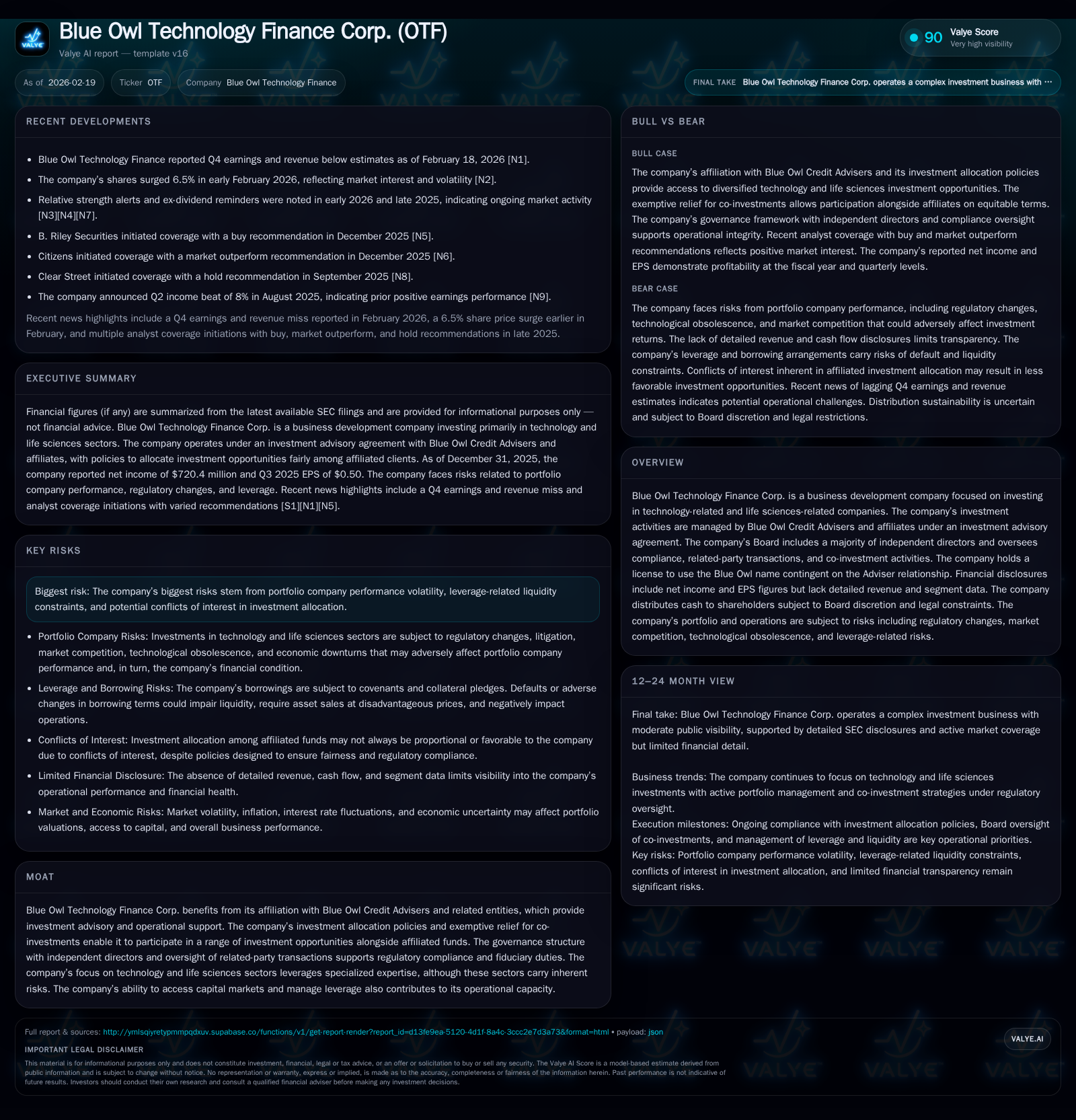
Blue Owl Technology Finance Corp. (OTF) reported significant net income growth in fiscal 2025 but offset by a sharp decline in operating cash flows. As a BDC focused on technology and life sciences lending, OTF relies heavily on debt financing that subjects the company to regulatory leverage limits and refinancing risks. The company’s affiliate-linked governance structure offers specialized expertise but introduces allocation conflicts. Its ability to maintain distributions and pursue growth will depend on managing liquidity amid capital markets uncertainties and portfolio credit risks.
Historical Financial Performance
Blue Owl Technology Finance Corp. specializes in lending primarily to technology-related and life sciences companies. The company's strategy focuses on providing customized credit solutions mainly via secured first-lien loans and unitranche credit facilities. While segment-level revenue data is unavailable, the net income trajectory offers a clear view of profitability trends.
Historical performance (annual)
| FY | Net ($mm) | CFO ($mm) | Net YoY |
|---|---|---|---|
| 2025 | 720 | -916 | +125.7% |
| 2024 | 319 | 64 | -13.5% |
| 2023 | 369 | 708 |
Note: Omitted columns lack sufficient annual XBRL coverage in the provided tags (need ≥2 annual points): Rev, OpInc, Capex, Buybacks, FCF. Source: SEC companyfacts cache [F1].
Capital returns and efficiency (annual)
| FY | Div ($mm) | ROE% |
|---|---|---|
| 2025 | 394 | 9.0 |
| 2024 | 230 | 8.8 |
| 2023 | 209 | 10.5 |
Source: SEC companyfacts cache [F1].
Table: Blue Owl Technology Finance Corp Annual Summary [F1]
Net income grew substantially in fiscal year 2025, benefiting from favorable investment performance within its portfolio of tech-sector credits. However, operating cash flow reversed sharply into negative territory, a notable warning sign about cash generation dynamics or potential working capital changes impacting liquidity.
Equity capital increased markedly, partially due to retained earnings but also likely equity issuance aligned with regulatory capital demands under the Investment Company Act of 1940 (modified asset coverage ratio). Dividend distributions climbed commensurately, maintaining the company's requirement as a regulated Business Development Company (BDC) to distribute most net investment income.
Buybacks recommenced in FY2025 at $73 million, signaling management's efforts to support the stock price amid volatile operating cash flows.
Capital Structure and Leverage
OTF employs significant leverage, with approximately $6.3 billion of outstanding debt against total assets around $14.7 billion at December 31, 2025 [S10]. The regulatory asset coverage requirement mandates maintaining an asset-to-debt ratio of at least 150%, down from the previous standard of 200%, under legislation affecting BDCs [S13]. This modified leverage ceiling allows somewhat higher borrowing capacity but increases risk exposure.
The company's indebtedness is largely secured by collateral interests in portfolio loans, primarily senior secured first-lien positions [S6]. However, this leverage magnifies both gains and losses—management illustrated that a -10% portfolio return could translate to a -23% loss for common shareholders [S10]. Notably, some loan investments are covenant-lite or include unitranche structures with subordination risks potentially impairing recovery prospects [S16].
Refinancing risk is elevated given upcoming debt maturities concentrated between mid-2026 and later years with callable unsecured notes issued early in 2026 [S9][S12]. Market disruptions or rising interest rates could increase borrowing costs or limit access to new financing.
Governance and Advisory Relationship
Blue Owl Credit Advisers manages OTF's investment activities under an advisory agreement coupled with licensing rights for the Blue Owl brand . The complex interlocking roles—executives overlap between OTF, the adviser entity, and affiliated vehicles—introduce potential conflicts of interest related to allocating investment opportunities fairly among related clients [S1].
An investment allocation policy seeks equitable participation over time; nevertheless, the concentrated focus on technology-sector firms exposes OTF's portfolio returns to sector-specific volatilities including disruption risk from rapid technological change or competitive pressures [S23][S24].
Loss of key personnel at Blue Owl Credit Advisers poses a significant operational risk given OTF’s dependence on their expertise for sourcing and managing investments [S12].
Future Growth Prospects and Risks
Growth drivers for OTF hinge on its adviser’s ability to source scalable investment opportunities within technology and life sciences middle-market companies that can benefit from flexible credit solutions . Leveraging relationships cultivated by Blue Owl Credit Advisers enhances deal flow access.
However, future growth is capped by:
- Regulatory limits on leverage restricting capital deployment volume.
- Potential tightening of credit markets increasing funding costs or constraining refinancing options.
- Portfolio credit risk from covenant-lite structures or highly leveraged borrowers vulnerable to market downturns [S16][S17].
- Competition intensifying from both traditional banks incentivized by regulators and alternative lenders possessing greater scale or differentiated capabilities [S24].
- Macro factors such as inflation escalation or geopolitical tensions negatively impacting borrower performance or capital markets stability [S1].
Capital Allocation Policies and Shareholder Returns
OTF pays quarterly dividends consistent with BDC rules requiring distribution of taxable income; FY2025 dividends rose sharply reflecting increased earnings capacity at $394 million paid out versus $230 million in FY2024 [F1][S14]. While dividend yield information is not disclosed herein, steady increases demonstrate intent to maintain shareholder distributions despite uneven operating cash flows.
Share repurchases resumed modestly at $73 million in FY2025 under a stock repurchase program aimed at supporting market price stability [S14]. However, buybacks remain small relative to dividends indicating prioritization of regular income distributions.
Return on equity measured approximately 9% for FY2025 based on reported net income over ending equity; this ROE is moderate given leverage levels but may reflect conservative valuation adjustments or amortization effects inherent in BDC accounting practices [F1].
Key Milestones & What to Watch Next (Analysis)
Absent specific guidance disclosed for upcoming quarters or years, investors should track:
- Quarterly operating cash flows for signs of stabilization or persistent cash usage pressure.
- Asset coverage ratio adherence as a regulatory covenant limiting further borrowing capacity.
- Refinancing activity relating to upcoming secured credit facility maturities through late-2020s.
- Portfolio credit performance including default rates or covenant breach statistics especially given recent macroeconomic uncertainties.
- Any changes in advisory arrangements or key personnel departures that could impact investment sourcing or asset management quality.
- Market reaction to announced dividend levels and buyback program adjustments signaling confidence in sustainable earnings.
Sector Context Analysis
In private credit markets targeting tech middle-market companies, BDCs like OTF often face wide variability in loan covenants reflecting borrower bargaining power during late-cycle periods. Covenant-lite structures improve borrower flexibility but increase downside risk for lenders during economic contractions — particularly when paired with leverage on the lender’s balance sheet itself. Investor scrutiny typically focuses sharply on liquidity management given the illiquid nature of underlying assets compounded by quarterly distribution demands .
Furthermore, competition from banks emboldened by favorable regulatory incentives can compress yield spreads reducing margin potential for BDCs reliant on floating rate loans tied to benchmark rates like SOFR plus spreads . Interest rate volatility driven by Federal Reserve policy shifts remains a key external variable influencing both funding costs and prepayment behavior across portfolios such as OTF’s.
Conclusion / Disclaimer
Blue Owl Technology Finance Corp.’s recent results show encouraging net income growth underpinning robust earnings capacity within its targeted sectors. Nevertheless, sharp operating cash flow deterioration alongside substantial leverage requires close monitoring of liquidity metrics and refinancing execution against a backdrop of regulatory constraints. The intertwined adviser relationship offers expertise and pipeline advantages while embedding conflicts that necessitate governance vigilance.
Given these facets — combined with industry competitive pressures and macroeconomic uncertainties — understanding OTF’s evolving capital structure dynamics and portfolio credit quality remains critical for appreciating its operational resilience going forward.
This report is for informational purposes only and does not constitute investment advice or recommendations.
Disclaimer: This is research-only, informational analysis and not investment advice. It may include AI-generated interpretation and general industry context. Always verify important details using primary sources.

Comments