
PACCAR Inc Faces Revenue Decline Amid Shifting Truck Market Dynamics
PACCAR’s diversified segments and strategic investments cushioned profit pressures caused by falling truck deliveries and tariff complexities in 2025.
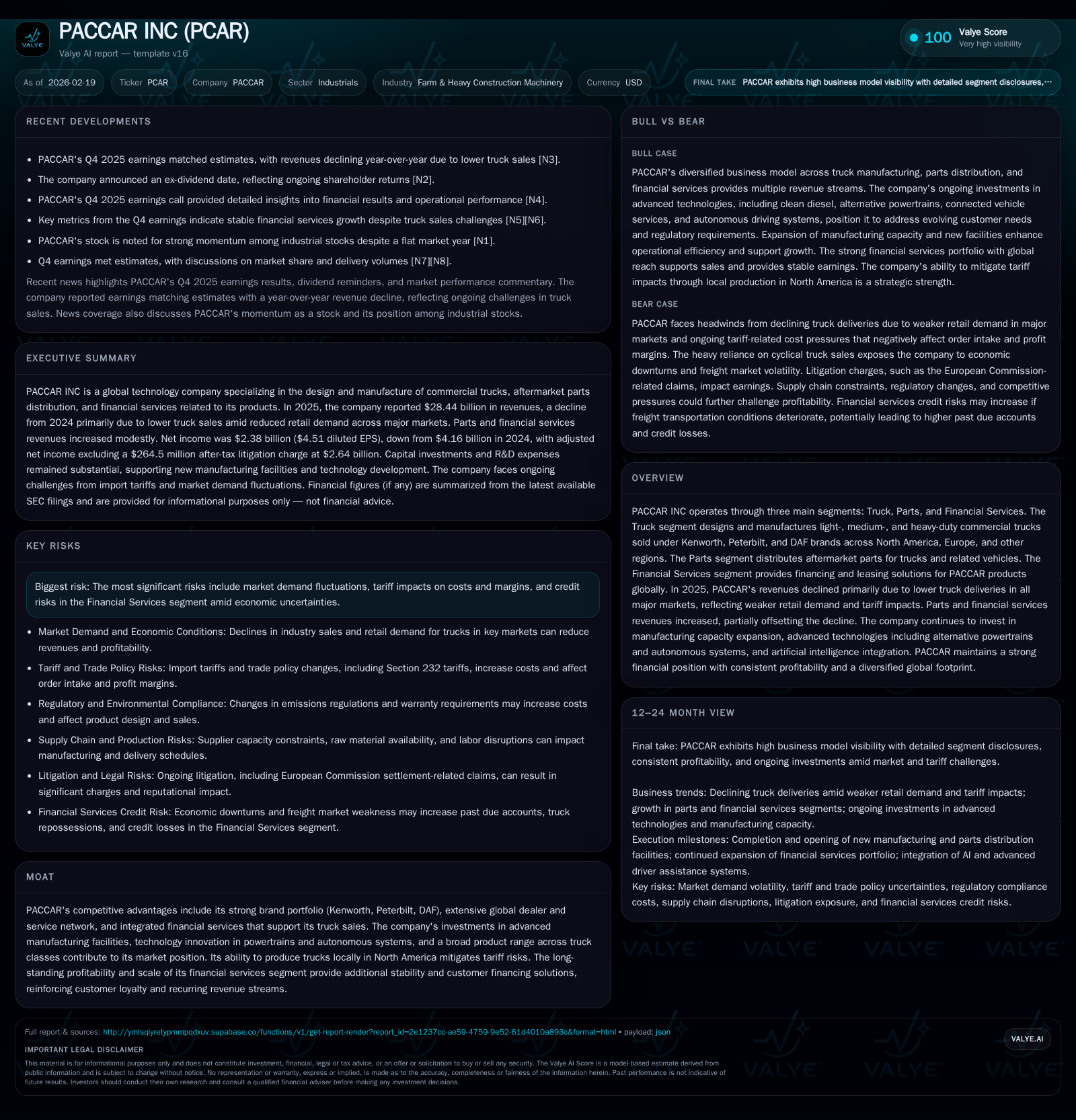
PACCAR experienced a significant revenue decline of 15.5% in 2025, primarily driven by weaker truck deliveries across all major markets and tariff headwinds. However, growth in the Parts and Financial Services segments partially offset this softness, reflecting the company's resilient multi-segment business model. PACCAR maintained strong profitability through operational adjustments and sustained capital investments focused on technology and capacity expansion. Looking ahead, while the company anticipates relatively stable Financial Services assets and moderate Parts sales growth, the lingering impact of tariffs and evolving market demand remain key variables.
PACCAR's Multi-Segment Revenue Mix: Growth and Setbacks in 2025
PACCAR reported a notable revenue contraction in its fiscal year 2025 results, with total net sales dropping to $28.44 billion from $33.66 billion in 2024—a decrease of approximately 15.5% [F1][S1]. This decline was primarily driven by the Truck segment, where revenues fell sharply by roughly $5.47 billion (22%), down to $19.37 billion from $24.84 billion the prior year. The steep fall reflected lower new truck deliveries across all main geographic markets including North America, Europe, Mexico, South America, and Australia [S1][S14].
Conversely, PACCAR's Parts segment exhibited resilience during industry headwinds, registering revenue growth to $6.87 billion compared to $6.67 billion in 2024, representing about a 3% increase [S1][S10]. This growth stemmed from higher aftermarket parts sales volumes within the U.S., Canada, and Europe—leveraging PACCAR’s extensive dealer service network that supports superior aftermarket penetration [S10]. The Financial Services segment also contributed positively with revenues rising approximately 5%, reaching $2.21 billion driven by portfolio expansion and improved yields on financing products globally [S1][S14].
The shifts resulted in the Truck segment's share of total revenues declining to roughly 68% in 2025 from 74% a year earlier, while Parts expanded its proportion to nearly a quarter of company revenues and Financial Services grew to represent about 8% [S13]. This diversification helped partially offset severe top-line pressures concentrated in new vehicle sales.
Historical performance (annual)
| FY | Rev ($bn) | Net ($bn) | CFO ($bn) | Capex ($mm) | Rev YoY | Net YoY |
|---|---|---|---|---|---|---|
| 2025 | 28.4 | 2.4 | 4.4 | 743 | -15.5% | -42.9% |
| 2024 | 33.7 | 4.2 | 4.6 | 839 | -4.2% | -9.5% |
| 2023 | 35.1 | 4.6 | 4.2 | 695 | +21.9% | +52.8% |
| 2022 | 28.8 | 3.0 | 3.0 | 525 |
Note: Omitted columns lack sufficient annual XBRL coverage in the provided tags (need ≥2 annual points): OpInc. Source: SEC companyfacts cache [F1].
Capital returns and efficiency (annual)
| FY | Div ($bn) | Buybacks ($mm) | FCF ($bn) |
|---|---|---|---|
| 2025 | 2.3 | 36 | 3.7 |
| 2024 | 2.3 | 5 | 3.8 |
| 2023 | 1.5 | 4 | 3.5 |
| 2022 | 1.0 | 2 | 2.5 |
Source: SEC companyfacts cache [F1].
*Partial data or not available for segments.
**Net income based on reported GAAP results including identified extraordinary items.
The Declining Truck Market: Impacts on Sales and Margins
Declines in truck deliveries underscore the tougher macroeconomic environment impacting PACCAR’s core business unit during the year [S14]. Total new truck deliveries slid by approximately 22%, falling from about 185,300 units in full-year 2024 to roughly 144,200 units in FY25 [S13]. North America suffered a steep delivery drop of around 27%, while Europe & other regions declined by approximately 4–31% depending on geography.
The downturn was attributed chiefly to weaker retail demand driven by economic factors and freight market softness coupled with tariff impacts starting March of that year [S1][N1][N7]. Cost pressures mounted as average truck costs rose by over $960 million due to regulatory compliance content increases (notably EPA emissions-related), tariff charges under Section 232 trade actions effective November 2025, higher material prices, as well as increased warranty accruals [S9]. Factory overhead fell slightly due to reduced volume absorption but failed to outweigh cost inflation.
Trade tensions proved a meaningful margin headwind despite PACCAR’s strategically localized production footprint across Ohio, Texas, Washington state (USA), Mississippi (engines), plus European facilities [S1][S6][S11]. Local manufacturing mitigated tariff expenses for trucks sold domestically within NAFTA markets but did not fully insulate parts distribution or other supply chain components affected by import duties.
Resultantly, truck gross margins halved from approximately 13.9% in FY24 to just under 7.5% in FY25 reflecting combined pricing pressure from both competitive dynamics and escalating input costs [S9]. Operating leverage deteriorated substantially as lower unit volume constrained fixed cost absorption.
Aftermarket Parts and Financial Services: Bright Spots in a Challenging Year
PACCAR’s Parts segment delivered positive momentum counterbalancing some truck revenue weakness through robust aftermarket parts demand driven by PACCAR’s entrenched dealer network quality [S10]. Sales prices increased significantly (+$307 million impact) as parts pricing reflected inflationary pass-throughs including tariffs; however direct material costs rose proportionally increasing cost of sales by about $214 million [S10]. Despite these cost pressures, parts gross margin held near historical levels at roughly ~30%, dipping only modestly compared to prior year [S10][S20].
Financial Services grew revenues moderately thanks to an expanding loan and lease portfolio now totaling approximately $22.80 billion across four continents covering financing for PACCAR vehicles globally [S1][S14]. Higher portfolio yields alongside retail loan growth drove interest income gains despite macroeconomic credit risk challenges including upticks in delinquencies notably in Brazil and Mexico [S14][S22]. Finance margin improvement benefitted both from volume growth (+$120 million interest/fees) and favorable yield management even as borrowing costs increased [$48 million impact] under changing interest rate environments [S17].
However, rising credit provisions reflect increasing past dues (30+ days past due accounts jumped from ~1.3% to ~2.4%) linked principally with economic weakness in Latin America markets plus isolated fleet operator difficulties within North America [S21][S22]. Loan modifications fluctuated upward corresponding with these conditions.
Capital Spending and R&D: Future-Proofing Through Innovation and Expansion
PACCAR sustained meaningful capital investment despite overall demand softness with expenditures totaling approximately $728 million in FY25 compared to ~$796 million spent last year—a moderate reduction of about -8% aligned with cautious capacity scaling plans amid uncertain short-term outlooks [F1][S6][S28]. R&D expenses remained steady near $445 million focusing on technologies vital for long-term competitiveness.
Key capital projects included completion of a robotic chassis paint facility (46k sq ft) in Chillicothe, Ohio enabling flexible automated production; a $35 million engine remanufacturing facility plus enhancements of engine factories at Columbus Mississippi (USA) and Netherlands sites supporting sustainability objectives through powertrain lifecycle extension; launching a new expansive parts distribution center (~180k sq ft) in Calgary Canada that optimizes service parts logistics for regional dealers/customers [S6][N2][N7].
R&D priorities emphasize clean diesel engine advances coupled with accelerated adoption of alternative powertrains including battery electric platforms developed via joint ventures such as Amplify Cell Technologies; integration of connected vehicle services leveraging AI; flexible manufacturing systems fostering rapid technology upgrades; plus expanded deployment of autonomous driver assistance systems—each aimed at enhancing product differentiation against increasingly stringent emissions regulations defined under EPA27 limits reaffirmed during the period [S11][S12].[N2]
Earnings Performance and Return Metrics: Assessing Profitability Amid Revenue Slippage
Net income decreased markedly year-over-year by approximately -43% (to about $2.38 billion) due largely to the diminished top line combined with an exceptional after-tax charge totaling ~$265 million related to civil litigation exposures arising within European jurisdictions [F1][S1][S13]. Adjusted net income excluding this litigation expense stood at around $2.64 billion representing improved underlying earnings power but still reflecting significant contraction relative to prior years [$4.16 billion in FY24] given margin compression trends across trucks particularly [S1].[N6]
Return on beginning equity (ROE) halved from an impressive peak near 26% for FY24 down toward ~13.6% reported GAAP (and ~15% adjusted non-GAAP), far underscoring cyclical earnings challenges compounded by external factors beyond operational control including tariffs and regional economic softness [F1][S19]. Operating cash flow remained solid albeit down slightly (-4.9%), totaling approximately $4.42 billion yielding free cash flow near $3.67 billion subtracting capex spend [F1], supporting consistent shareholder returns via dividends ($2.27 billion paid matching prior distributions) supplemented with modest share repurchases ($36 million)—the latter indicating conservative share buyback activity amid prevailing uncertainty otherwise favoring balance sheet strength retention [F1][S15].[N12]
Tariff Challenges and Geographical Production Strategies
The adverse impact of U.S.-imposed import tariffs commencing March 2025 under Section 232 provisions created meaningful headwinds on trucking product order intake as well as profit margins despite prompt mitigation efforts pursuing localized manufacturing footprints for North American customer shipments primarily via Ohio, Texas, Washington state plants complemented by engine output hubs domestically plus assembly plants overseas [S1][N7][N1].[N7]
While localized production minimized direct Section 232 tariff expenses for trucks destined for U.S., Canadian, Mexican markets (NAFTA region), ancillary supply chain elements—particularly parts subject to cross-border sourcing—and export shipments elsewhere encountered residual tariff-induced cost escalation negatively influencing unit economics amidst already challenging market demand dynamics [S9].[N7]
Regulatory clarity regarding EPA reinforcement on NOx limits stabilized compliance-related costs but potential policy shifts remain an uncertainty impacting ongoing product development expense profiles alongside global freight fundamentals that define future industry cycle timing windows.[N7]
Liquidity Profile, Debt Structure, and Capital Allocation Priorities
As of December 31 2025 PACCAR maintained substantial liquidity resources supported by cash balances plus committed bank credit lines totaling nearly $5.6 billion most of which remained unused signaling financial flexibility aligned with robust investment-grade credit ratings at A+/A1 levels facilitating efficient capital market funding access particularly through commercial paper programs operated via its Financial Services segment subsidiaries globally including issuance proceeds supporting loan lease portfolio funding underpinning receivable collection cycles [$7+ billion mid-term notes outstanding among various regional finance arms] [S4][S7][S8].[N3]
Borrowing maturities extending beyond one year amount close to total commitments indicating manageable upcoming refinancing needs barring material rating downgrades or market shocks.[S18] Capital allocation discipline manifested through sustained dividend increases ($2.72/share declared for FY25 up vs prior year), together with restrained stock repurchase activity (~$36 million vs smaller prior year spend), evidencing priority on balance sheet solidity amidst macro uncertainties while preserving shareholder returns ability.[F1][S15]
Working capital funding primarily derives from Operating Cash Flow supplemented prudently from debt management within Financial Services leveraging strong collection performance offsetting growing credit risks inevitable during economic downturn phases.[F1][S18]
2026 Outlook: Market Expectations and Operational Considerations
PACCAR projects US & Canada heavy-duty retail truck sales ranging between about 230k–270k units maintaining close proximity to last year's levels (~233k units); European registrations anticipated fairly steady within roughly ~280k–320k units while South American new truck markets may soften modestly toward ~100k–110k units reflecting ongoing demand uncertainties.[S6] The company expects Parts revenue growth between about +4–8% assuming persistent aftermarket demand resilience tied closely with fleet maintenance patterns.[S11]
Financial Services average earning assets are expected broadly flat versus FY25 acknowledging improving used-truck values reflected positively early within quarterly results,[N3] but tempered caution prevails considering potential credit loss spikes if freight transportation deteriorates amid unfavorable economic conditions raising potential delinquencies or repossessions.[S11]
Capital investment budget announced between roughly $725–775 million retaining emphasis on automation scale-up inclusive of next-generation clean diesel/alternative powertrain systems augmented by AI-enhanced manufacturing process improvements alongside connectivity solutions positioning for regulatory-driven product evolution.[S19]
Risks centralize around continued tariffs influencing cost structures unpredictably especially pending U.S Supreme Court rulings related to International Emergency Economic Power Act implications,[N7] freight cyclical volatility affecting fleet replacement rates impacting order intake timing,[N3] plus emerging credit risks requiring vigilant loan portfolio management strategy refinement across multinational finance operations.[N7][N22]
This analysis is based solely on available quantitative disclosures and official statements without speculative forecasts or investment advice regarding PACCAR Inc or related industry sectors.
Disclaimer: This is research-only, informational analysis and not investment advice. It may include AI-generated interpretation and general industry context. Always verify important details using primary sources.

Comments