
Two Harbors Investment Corp. Faces Capital and Market Volatility Constraints Amid Merger Plans
Specialized mortgage servicing and Agency RMBS REIT navigates asset volatility, leverage risks, and integration catalysts.
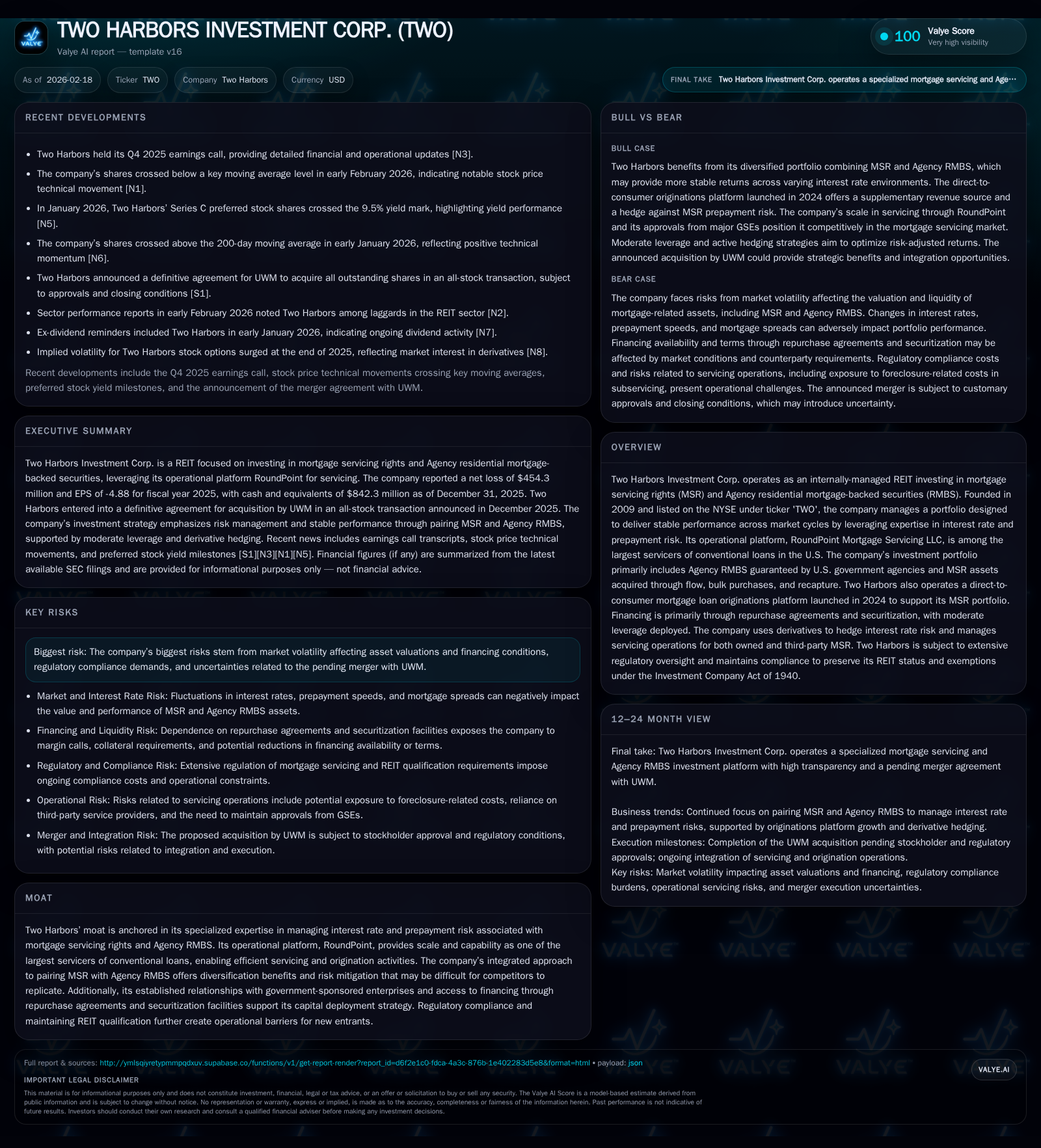
Two Harbors Investment Corp. builds its strategy around a diversified portfolio of mortgage servicing rights (MSR) and Agency residential mortgage-backed securities (RMBS), leveraging proprietary risk management expertise and operational scale through RoundPoint Mortgage Servicing. Historically, Two Harbors has delivered volatile net income results influenced by market rates and prepayment dynamics but continues generating positive operating cash flow. The recent pivot includes launching a direct-to-consumer origination platform in 2024 and an announced all-stock merger with UWM in late 2025, both key catalysts for future growth while exposing the company to integration risks and capital access constraints amid market volatility. Capital allocation balances dividend payments with no buybacks in recent years, while leverage through repurchase agreements remains central to financing but sensitive to collateral value fluctuations.
Company Overview
Two Harbors Investment Corp. (NYSE: TWO) is an internally-managed real estate investment trust (REIT) specializing principally in investments tied to U.S. residential mortgages through two interrelated asset classes: mortgage servicing rights (MSR) and Agency residential mortgage-backed securities (RMBS). Founded in 2009, its platform leverages proprietary expertise in managing interest rate exposure and prepayment risk — common complexities inherent in mortgage-related assets.
Operational scale is bolstered by its wholly owned subsidiary RoundPoint Mortgage Servicing LLC, ranked among the largest servicers of conventional loans nationally. This platform not only supports servicing capabilities required to administer loans underlying its MSR holdings but also services loans on behalf of third-party MSR owners, expanding fee-based revenues.
The company's portfolio is anchored by agency-backed RMBS — securities guaranteed by government-sponsored enterprises such as Fannie Mae and Freddie Mac or government agencies like Ginnie Mae — providing credit support that limits credit risk exposure even as interest rate dynamics introduce valuation volatility. The MSR acquisition strategy uses flow purchases, bulk deals, and recaptures from refinancing borrowers, seeking diversification benefits versus standalone RMBS portfolios.
In late 2024, Two Harbors augmented this integrated model with the launch of a direct-to-consumer residential mortgage origination platform designed primarily to complement the existing MSR portfolio by enabling home loan originations that can be retained internally or sold with servicing rights recaptured. This vertical extension may deliver some countercyclical balance relative to refinancing volume variability.
Historical Performance
Financial results at Two Harbors exhibit expected cyclical swings tied to macroeconomic variables influencing borrowing costs and prepayment behavior across the mortgage lifecycle:
Historical performance (annual)
| FY | Net ($mm) | CFO ($mm) | Net YoY |
|---|---|---|---|
| 2025 | -454 | 89 | -252.4% |
| 2024 | 298 | 201 | +380.3% |
| 2023 | -106 | 344 | -148.3% |
| 2022 | 220 | 623 |
Note: Omitted columns lack sufficient annual XBRL coverage in the provided tags (need ≥2 annual points): Rev, OpInc, Capex, FCF, ROE%. Source: SEC companyfacts cache [F1].
Capital returns and efficiency (annual)
| FY | Div ($mm) | Buybacks ($mm) |
|---|---|---|
| 2025 | 171 | 0 |
| 2024 | 188 | 0 |
| 2023 | 198 | 7 |
| 2022 | 235 | 0 |
Source: SEC companyfacts cache [F1].
Net income proved volatile with sharp swings from gains to large losses indicative of sensitivity to interest rate changes, prepayment speeds, and the timing of hedging gains or losses. Operating cash flow remains solidly positive throughout the period but shows erosion recently as tighter spreads and more challenging market conditions prevail.
Dividend distributions have been largely maintained near $170–$235 million annually but have declined slightly consistent with profit cycles. Stock buybacks ceased after minimal activity in FY2023 indicating capital deployment preference toward dividends or deleveraging rather than repurchasing shares during heightened uncertainty.
Return on equity approximates negative ~14.7% for the latest year based on last annual net loss relative to shareholders' equity; reflecting the impact of mark-to-market asset movements and valuation markdowns resulting from adverse market shifts.
Capital Structure & Financing Strategy
Two Harbors employs moderate leverage primarily through repurchase agreements — short-term financing arrangements whereby assets are sold to lenders with agreements to repurchase at future dates — secured against its Agency RMBS portfolio as well as MSR assets. Typical advance rates vary:
- Approximately 95-97% advance on Agency RMBS market value,
- Around 60-70% advance on MSR valuations,
- Haircuts applied accordingly (3-5% for RMBS; up to ~40% for MSR), reflecting liquidity risk differentials.
This ambidextrous financing approach allows significant portfolio exposure amplification yet entails margin call risks should collateral values deteriorate abruptly. To mitigate sudden liquidity stresses from margin calls or haircut increases — prevalent during market turbulence — management targets operating leverage levels below maximum capacity supported by existing advance rates.
Warehouse lines of credit facilitate Two Harbors’ direct-to-consumer loan originations business by funding mortgage loans until sale into the secondary market within typically two months.
Derivative instruments including swaps, futures, options, forward contracts such as TBAs (to-be-announced pools), caps, swaptions and other hedges are actively used to align asset-liability durations and suppress undesired interest rate sensitivity.
By law Two Harbors maintains compliance for REIT tax status which requires distributing virtually all taxable income annually to shareholders while avoiding classification as an investment company under the Investment Company Act of 1940 via designated taxable REIT subsidiaries (TRSs).
Growth Prospects & Catalysts
Looking forward several factors may influence Two Harbors’ performance trajectory:
Merger with UWM: Announced December 17, 2025 [S1], this all-stock transaction will convert stockholders’ equity into UWM Class A common shares at a ratio of roughly 2.33x plus fractional cash compensation. Completion will realign corporate strategy around expanded mortgage finance services including originations platforms with enhanced scale; integration execution will require attention given differing operational footprints.
Direct-to-consumer Origination Platform: Launched mid-2024 [S24], this internal production channel supports organic growth of MSR assets via recapture on refinancings plus new loan originations outside existing servicing portfolios (including second lien loans). While intended as a hedge against faster-than-expected prepayments that reduce MSR values through recapture instead of outright sales [S22], it faces stiff industry competition alongside headwinds from rising interest rates limiting refinancing volumes.
Portfolio Management: Ongoing adjustments balancing Agency RMBS holdings against MSR exposure seek stable returns amid changing interest rate environments; focus remains on buying assets at favorable spreads over debt costs while controlling risk concentrations.
Hedging & Risk Analytics: Sophisticated modeling of prepayment speeds amidst volatile rate paths offers competitive advantage that underpins portfolio resilience versus peers lacking comparable data science infrastructure [S11].
Operational & Market Risks
Several key risks outlined in recent regulatory filings warrant attention:
Interest Rate & Prepayment Sensitivity: Sudden increases in rates can depress asset values sharply; accelerated prepayments reduce expected servicing fees on MSRs [S10].
Financing Market Dynamics: Dependence on short-term repurchase markets exposes Two Harbors to lender margin calls and potential refinancing challenges especially during periods of stress or counterparty downgrades [S13].
Regulatory Compliance: Ongoing legal complexity around residential mortgage regulations and REIT qualification rules demands significant governance resources [S26]. Loss of exemption under the Investment Company Act or failure to meet REIT criteria could disrupt business model fundamentally.
Competition: Intense rivalry from much larger entities including banks, other REITs, government programs reflecting Federal Reserve interventions impacts pricing power for target securities and servicing contracts [S18].
Technology & Cybersecurity: Heavy reliance on IT for transaction processing exposes vulnerabilities related to system failures or breaches [S19].
Integration Risk: The pending merger with UWM creates execution uncertainty alongside potential culture clashes or customer retention challenges that could affect near-term operations [N1].
Capital Allocation Trends
Dividends have remained a priority component of returns while share repurchases have been suspended since FY2024 after nominal activity previously [F1]. This pattern reflects balancing maintaining attractive yield profiles typical for mortgage REIT investors versus preserving liquidity amid volatile earnings.
Operating cash flow trends suggest waning margins or increased capital requirements though remaining positive suggests ongoing core cash generation capability even during loss years [F1]. Capital expenditures data are unavailable within tagged disclosures but would presumably relate mainly to technology investments supporting servicing platforms.
No formal return on equity guidance was disclosed [N2], hence focus should remain on monitoring leverage ratios relative to collateral valuations alongside dividend coverage adequacy.
Monitoring Points & What To Watch Next (Analysis)
- Completion status and terms reshaping from the Two Harbors-UWM merger agreement announced late-2025.
- Performance metrics coming out of the direct-to-consumer origination platform to assess whether it successfully hedges expected negative MSR prepayment effects.
- Quarterly margin calls under repurchase facilities during periods of interest rate spikes or Treasury sell-offs impacting collateral prices.
- Regulatory developments potentially affecting servicing activities or REIT compliance frameworks including amendments affecting GSEs or federal agencies backing Agency RMBS.
- Competitive dynamics for subservicing clients and loan origination market share development given macroeconomic headwinds particularly rising borrowing costs reducing refinance activity.[N2][N3]
Conclusion
Two Harbors Investment Corp.’s strategic combination of MSR ownership backed by strong servicing operations alongside a substantial Agency RMBS portfolio delivers stable but complex exposure to residential mortgage markets moderated through deep analytical capability in interest rate risk management. Its integrated service originations platform aims at refining internal growth levers yet remains nascent amid challenging macro factors impacting refinancing demand.
The announced all-stock merger with UWM represents a transformational pivot point redefining shareholder value alignment although it introduces near-term integration execution uncertainties and alters capital structure profoundly.
Financing structures built around short-term repurchase agreements bring inherent vulnerability to collateral value fluctuations requiring careful leverage stewardship amidst evolving credit environments. Dividend commitment continuity underscores prioritization on shareholder yield despite sporadic earnings volatility inherent within Agency RMBS/MSR asset classes affected heavily by rapid interest rate changes.
Investors should maintain vigilance regarding regulatory compliance complexity alongside operational risks around technology continuity and subservicing competition that could materially influence future financial outcomes apart from broader housing market cyclicality effects.
Disclaimer: This analysis is provided solely for informational purposes without any investment recommendation or advice. It relies exclusively on publicly available data as cited without projecting undisclosed forward-looking financial metrics.
Disclaimer: This is research-only, informational analysis and not investment advice. It may include AI-generated interpretation and general industry context. Always verify important details using primary sources.

Comments