
Outlook Therapeutics Battles Regulatory Setbacks Amid EU Market Launch and US FDA Review
The biotech firm ventures into the ophthalmic bevacizumab niche with European approvals but faces U.S. regulatory headwinds and financial pressures.
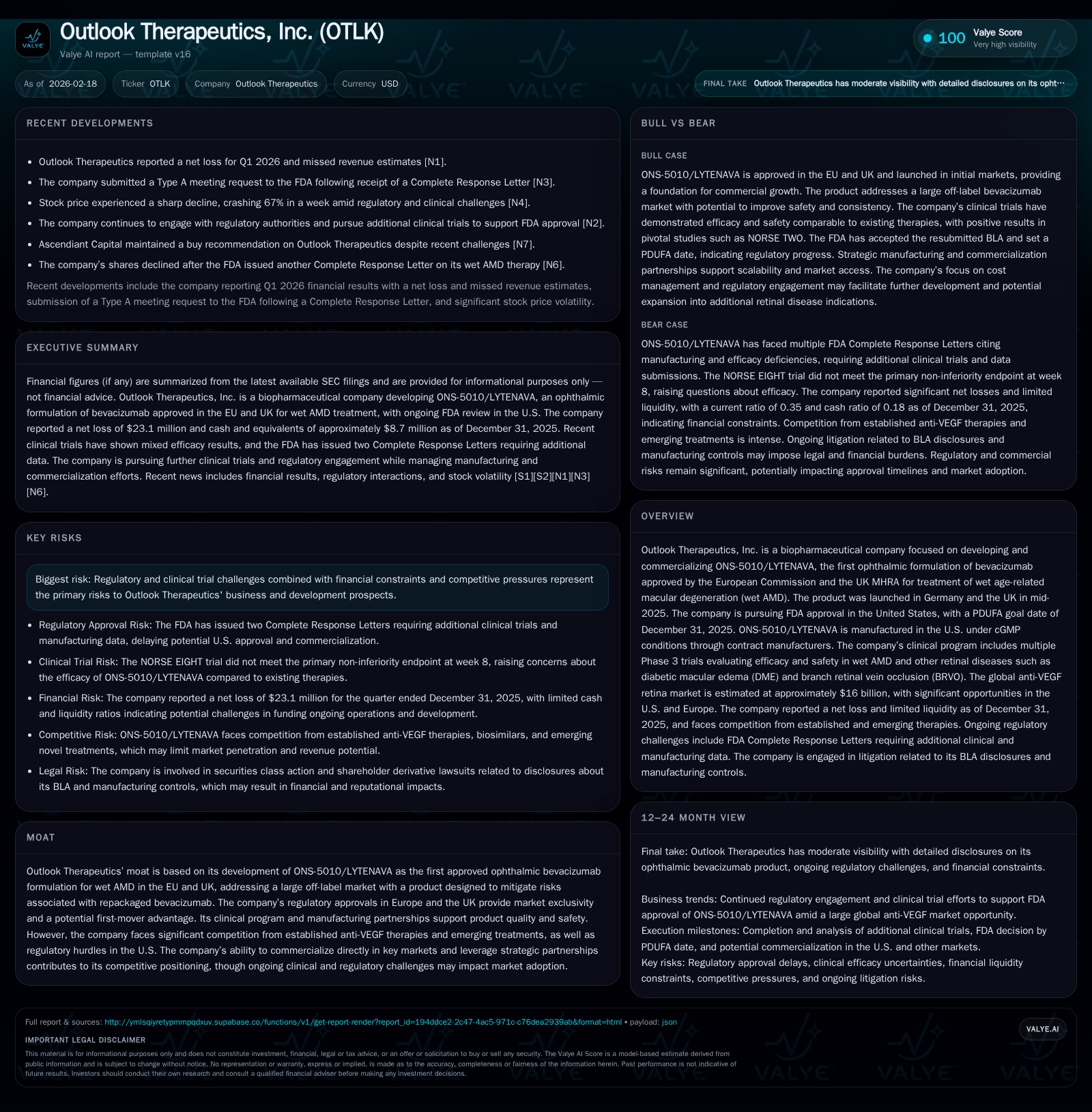
Outlook Therapeutics, Inc. achieved a significant milestone in 2025 by launching ONS-5010/LYTENAVA, the first approved ophthalmic bevacizumab formulation for wet age-related macular degeneration in the EU and UK. While this provides a foothold in a $16 billion global anti-VEGF retina market, the company confronts regulatory challenges in the U.S., including a Complete Response Letter (CRL) from the FDA and ongoing clinical trial demands. Financially, Outlook remains unprofitable with steep operating losses and negative cash flows, relying heavily on external capital to advance its pipeline. The company's competitive positioning hinges on its ability to mitigate risks related to off-label bevacizumab use with a regulatory-approved alternative, though entrenched competitors and patent landscapes complicate growth prospects.
Company Background and Historical Performance
Outlook Therapeutics, Inc., a clinical-stage biopharmaceutical company, centers its development efforts on ONS-5010/LYTENAVA—the first ophthalmic formulation of bevacizumab approved by the European Commission (EU) and UK's MHRA for wet age-related macular degeneration (wet AMD). The product was launched directly in Germany and the UK markets in mid-2025 [S1]. Prior to this achievement, bevacizumab had only been approved for cancer indications but was widely used off-label for retinal diseases like wet AMD; those uses totaled approximately 2.7 million injections annually in the U.S. and roughly 2.8 million annually across Europe [S1].
The company possesses multiple patent families protecting formulations related to its candidates, including ONS-5010, with patents expiring predominantly between 2034 and 2037 [S24]. This IP portfolio provides some defensive positioning though it does not confer broad market exclusivity.
Year-over-year revenue growth has stagnated around low single-digit millions (approximately $8.1 million reported historically through FY2020) with no evident material commercial revenue contribution before the recent launch [F1]. Operating income has been negative annually since at least FY2022, reflecting heavy R&D spending to advance clinical programs.
Historical Financial Summary
Historical performance (annual)
| FY | Net ($mm) | CFO ($mm) | OpInc ($mm) | Net YoY |
|---|---|---|---|---|
| 2025 | -62 | -52 | -67 | +17.2% |
| 2024 | -75 | -69 | -72 | -27.8% |
| 2023 | -59 | -43 | -53 | +10.7% |
| 2022 | -66 | -57 | -63 |
Note: Omitted columns lack sufficient annual XBRL coverage in the provided tags (need ≥2 annual points): Rev, Capex, Div, Buybacks, FCF. Source: SEC companyfacts cache [F1].
Capital returns and efficiency (annual)
| FY | ROE% |
|---|---|
| 2025 | 193.9 |
| 2024 | 103.1 |
| 2023 | 408.5 |
| 2022 | -756.0 |
Source: SEC companyfacts cache [F1].
Note: Revenue data beyond FY2020 unavailable; operating income, net income, CFO, equity reflect trailing nine months ending September each year where indicated [F1]
The persistent operating losses primarily stem from ongoing Phase 3 clinical trials, manufacturing scale-up under cGMP conditions via contract manufacturers such as FujiFilm Diosynth Biotechnologies, commercialization infrastructure investments for European launches, and associated corporate overhead [S21].
Industry Context
The global retina therapeutics market focused on anti-VEGF agents approximates $16 billion [S1]. Leading products include Genentech/Roche's Lucentis® (ranibizumab), Regeneron/Bayer's Eylea® (aflibercept), Genentech/Roche's Faricimab® (Vabysmo®), Novartis' Beovu® (brolucizumab), alongside emerging biosimilars targeting ranibizumab and aflibercept [S26]. Novel modalities include gene therapies (e.g., Regenxbio/AbbVie's RGX-314), tyrosine kinase inhibitors delivered intravitreally or suprachoroidally, integrin inhibitors, and WNT pathway modulators aiming at enhanced durability or alternative mechanisms [S26].
Off-label use of repackaged Avastin®, lacking formal ophthalmic approval for retinal indications until Outlook’s EU authorization of ONS-5010/LYTENAVA, persists due to cost advantages relative to branded therapies [S1]. Off-label bevacizumab accounts for an estimated one-third of U.S. anti-VEGF retina prescriptions—a critical addressable segment if conversion to approved products occurs [S1]. However, safety risks from off-label repackaging contamination issues support Outlook's proposition for a regulated ophthalmic-specific bevacizumab formulation.
Growth Prospects
The launch of ONS-5010/LYTENAVA represents an initial growth catalyst as Outlook directly markets in Germany and the UK since mid-2025 [S1]. The company targets expansion into additional European markets leveraging EMA marketing authorizations with potential supplemental Health Technology Assessment negotiations affecting reimbursement levels [S15][S16]. Approval ambitions in the United States remain pivotal given its dominant $8.5 billion anti-VEGF retina market size [S1]. The FDA Biologics License Application awaits decision following delays.
On August 29th, 2025 Outlook received a Complete Response Letter (CRL) from FDA citing chemistry, manufacturing, controls (CMC) deficiencies impacting approval prospects [N3][S1]. The company requested a Type A meeting to clarify pathways forward [N3]. This setback introduces near-term uncertainty surrounding U.S. entry timing—the largest single anti-VEGF market—and could materially postpone anticipated revenue streams.
Additional Phase 3 clinical trials underway explore indications beyond wet AMD—specifically diabetic macular edema (DME) and branch retinal vein occlusion (BRVO)—offering medium-term diversification contingent on positive outcomes [S1]. Yet incremental capital requirements are substantial.
International expansion opportunities hinge on navigating heterogeneous reimbursement landscapes amid healthcare system cost-containment initiatives (e.g., price control laws globally) as well as securing distribution/supply chain partnerships beyond direct sales models [S15][S16][S27].
Financial Position & Capital Allocation
FY2025 financials reveal net loss of approximately $62 million with operating cash outflows surpassing $51 million [F1]. Equity turned negative near $32 million indicating accumulated deficit pressure amid sustained investment phases [F1]. Liquidity constraints surface from a current ratio of approximately 0.35—current liabilities ($49 million) overshadow current assets ($17 million)—underlining pressing working capital needs absent new cash infusions or debt arrangements [F1][S27].
No dividends or share buyback programs exist or are foreseeable given capital preservation focus; management prioritizes clinical development financing plus supporting post-European launch commercial scale-up [F1][S3]. Outsourced manufacturing under cGMP contracts constitutes sizable fixed costs influencing cash burn pace but is critical for compliance especially after CMC issues during FDA review [S18][N3].
Investors should monitor milestones such as FDA regulatory updates post Type A meeting outcome expected by end-2025 PDUFA target date; Phase 3 readouts from additional retinal disease indications; expansion of geographic marketing footprints beyond Germany/UK; potential strategic collaborations or co-promotion; as well as cash runway extension via capital raises or partnerships.
Competitive & Regulatory Risks
Outlook operates within an intensely competitive space populated by well-capitalized multinational pharma firms with entrenched brands enjoying clinician familiarity plus ongoing biosimilar launches poised to depress pricing dynamics further [S26]. Emerging gene therapies could disrupt standard-of-care if long-acting efficacy data is compelling.
Regulatory risks extend beyond initial approval hurdles: post-marketing safety investigations may be mandated due to unresolved CMC deficiencies; REMS programs could impose prescribing constraints; changes in manufacturing sites/processes require FDA pre-approval; promotion restricted strictly to labeled claims limits marketing flexibility versus incumbents encouraging broad label usage [S18][S20].
Legal proceedings create operational overhang: securities class action lawsuits allege misstatements regarding evidentiary support for ONS-5010/LYTENAVA efficacy during BLA filings coupled with unresolved manufacturing control issues that precipitated stock price drops; derivative actions claim fiduciary breaches related to same matters—all contributing potential financial liabilities though magnitude/timing remain uncertain [S4][S6].
Healthcare compliance complexities arise from evolving U.S./foreign laws governing drug pricing transparency, anti-kickback statutes affecting remuneration practices with healthcare providers, data privacy laws impacting patient data use during clinical trials (including GDPR variants), alongside governmental efforts to curtail pharmaceutical costs via reimbursement reforms including Medicare Drug Price Negotiation Program under the Inflation Reduction Act which could compress margins over time [S10][S13][S16][S19].
Manufacturing & Supply Chain Considerations
ONS-5010/LYTENAVA is produced domestically under cGMP conditions via contract manufacturing partners including FujiFilm Diosynth Biotechnologies and PCI San Diego—a strategy balancing quality rigor against scalability risks linked to single-source reliance typical in specialty bio-manufacturing sectors [S21][F1]. Management continues evaluating pre-filled syringe suppliers designed to enhance administration safety profiles minimizing contamination risk prevalent in compounded off-label bevacizumab treatments.
Operational continuity depends heavily on these third-party manufacturers maintaining quality standards rigorously amid increased inspection scrutiny by regulatory agencies both pre-approval and post-commercialization—a non-trivial compliance domain requiring ongoing investment and oversight [S18][S21].
Intellectual Property Landscape
Outlook holds multiple patent families covering antibody formulations and purification methods relevant to their biosimilar candidates with expirations predominantly stretching into mid-to-late 2030s providing moderate window of exclusivity especially outside Europe where ONS-5010 benefits from regulatory exclusivities linked to novel medicine status granted upon EU authorization [S24][S26][S28]. This patent coverage supports competitive defense against generic replication but does not fully insulate against other anti-VEGF alternatives whose IP estates cross-license or independently innovate new therapeutic class variants.
Returns, Dividends & Buybacks Disclosure
The company’s SEC filings do not provide explicit data on returns metrics such as ROE beyond derived approximations nor do they disclose dividend payments or share buybacks within available filings up to FY2025 [F1]. Approximate return on equity calculated using latest annual net loss relative to equity indicates a negative figure reflective of accumulated deficits rather than positive shareholder returns (~193% loss based on simplified calculation). No dividends have been paid historically nor are any declared or planned according to public disclosures.[F1]
Conclusion & Monitoring Considerations
Outlook Therapeutics stands at an inflection point transitioning from development stage into early commercialization within Europe while navigating key milestones required for U.S. market entry amid heightened scrutiny following FDA CRL issuance. Financial liquidity poses constraints while ongoing R&D investment remains high coupled with legal cloud risk.
Key points warrant close observation: FDA engagement progress following Type A meeting request; commercial traction across European launch markets; effectiveness reports from Phase 3 expansions into DME/BRVO indications; potential recapitalization avenues addressing working capital gaps; evolving competitive landscape dynamics driven by biosimilars/gene therapies uptake kinetics; resolution status of pending securities litigation impacting corporate governance narratives.
This profile underscores that while ONS-5010/LYTENAVA initiates access into a lucrative anti-VEGF niche by targeting off-label bevacizumab replacement demand through superior regulation-driven product quality assurances—a recognized need—execution risks across regulatory approvals, reimbursement negotiations, manufacturing supply reliability, litigation exposures, and ongoing capital adequacy set heavy execution burdens ahead before sustainable profitability arrives.
This analysis is based on public information sourced from SEC filings ([F1], [S#]), recent news releases ([N#]), industry context data, and should not be construed as investment advice or recommendations.
Disclaimer: This is research-only, informational analysis and not investment advice. It may include AI-generated interpretation and general industry context. Always verify important details using primary sources.

Comments