
Datadog’s Growth Acceleration Versus Rising Cost Pressure and Profitability Tradeoffs
Datadog has delivered robust revenue growth driven by multi-product adoption and international expansion, but faces margin compression from increasing cloud costs and investments.
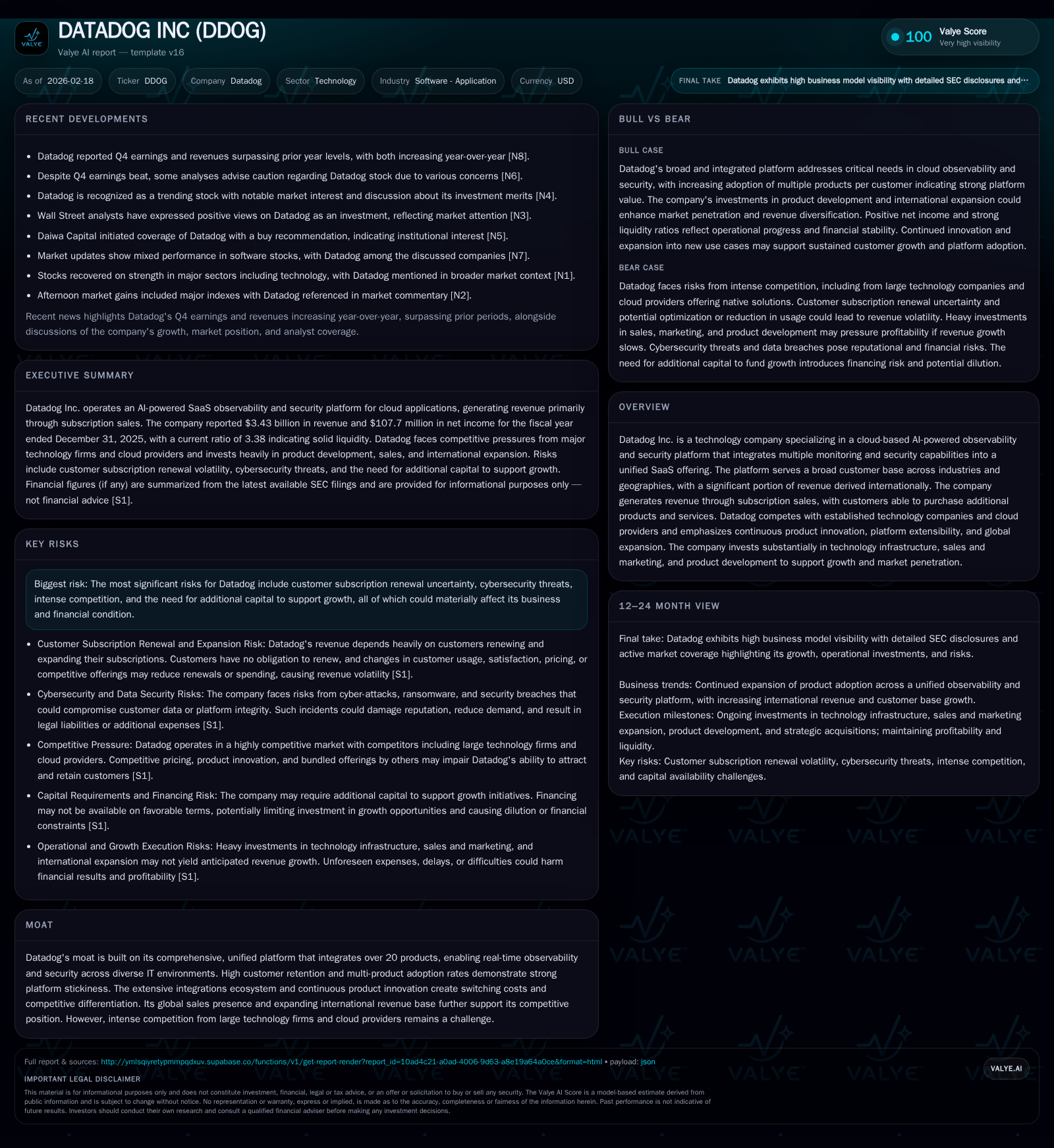
Datadog Inc. has maintained a strong growth trajectory with revenues growing 28% year-over-year in 2025, propelled mainly by expansion within its existing customer base and greater multi-product adoption. The company’s integrated AI-powered observability and security platform supports diverse cloud environments and continues to see growing traction globally, with nearly a third of revenues now from outside North America. However, rising third-party cloud infrastructure expenses have compressed gross margins by a percentage point, while heavy investments in R&D and sales & marketing have shifted operating income back into negative territory in 2025 despite a positive net income result. The company’s robust operating cash flow and solid cash reserves provide financial flexibility as Datadog balances competing priorities of innovating its platform, scaling internationally, and navigating intensifying competition. Return metrics show a return on equity of approximately 2.9% in 2025, with free cash flow generation exceeding $900 million annually since FY2023, supporting ongoing investment without dividends or buybacks disclosed.
Company Overview
Datadog Inc. operates an AI-driven SaaS platform delivering unified observability and security monitoring across complex IT environments that span public clouds, private clouds, on-premises infrastructures, and hybrid architectures [S1]. The company targets enterprises undergoing digital transformation and cloud migration by providing real-time insights that accelerate application development cycles, improve operational reliability, enhance security posture, and support business decision-making. Datadog's platform integrates over 20 distinct products ranging from infrastructure monitoring to application performance management (APM), log management, cloud security posture management (CSPM), network performance monitoring, synthetics testing, and user experience analytics [S7].
Its subscription-based business model leverages a 'land-and-expand' approach: customers start with one or two modules then progressively adopt additional products as their workloads grow or new needs arise [S6]. This strategy fosters increasing usage intensity within accounts without requiring professional services for implementation, as the products emphasize ease of deployment and fast time-to-value [S1].
Historical Growth and Performance
Datadog has exhibited rapid growth over the past three years with annual revenues reaching $3.43 billion in FY2025, up from $2.68 billion in FY2024 and $2.13 billion in FY2023 representing compound annual growth rates exceeding 25% [S1], driven primarily by:
- Expanding subscriptions among an increasing number of customers (approximately 32,700 at end-2025 vs ~30,000 at end-2024) [S5]
- A growing proportion of large accounts generating more than $100K ARR (4,310 accounts at end-2025 vs 3,610 prior year) [S9]
- Increasing multi-product adoption with customer usage profiles becoming more embedded within the Datadog ecosystem (e.g., nearly one-third of customers now use six or more modules) [S7]
- Geographic expansion fueling international revenue consistently contributing about 29% of total revenues across recent years [S6]
Historical performance (annual)
| FY | Net ($mm) | CFO ($mm) | OpInc ($mm) | Capex ($mm) | Net YoY |
|---|---|---|---|---|---|
| 2025 | 108 | 1050 | -44 | 50 | +18056.8% |
| 2024 | -1 | 871 | 54 | 35 | -101.2% |
| 2023 | 49 | 660 | -33 | 28 | +196.8% |
| 2022 | -50 | 418 | -59 | 35 |
Note: Omitted columns lack sufficient annual XBRL coverage in the provided tags (need ≥2 annual points): Rev, Div, Buybacks. Source: SEC companyfacts cache [F1].
Capital returns and efficiency (annual)
| FY | FCF ($mm) | ROE% |
|---|---|---|
| 2025 | 1001 | 2.9 |
| 2024 | 836 | -0.0 |
| 2023 | 632 | 2.4 |
| 2022 | 383 | -3.6 |
Source: SEC companyfacts cache [F1].
Note: Revenue figures are not available from provided XBRL tags but referenced from SEC narratives [S1]. Operating cash flow represents net cash provided by operating activities; capital expenditures are payments to acquire property plant & equipment; stockholders' equity reflects shareholder investment plus retained earnings [F1].
While net income swung between losses and profits due to variable investment levels and tax effects, operating income mirrored the company's reinvestment cycles: positive in FY2024 ($54 million), but negative again in FY2025 (-$44 million) as R&D (+34%) and sales & marketing (+26%) spending surged proportionally with revenue growth [F1][S11][S16]. These expenses reflect aggressive hiring for engineering/product teams supporting continuous innovation along with expanded global sales efforts.
Despite these margin pressures at the operating level, Datadog consistently generated strong free cash flow exceeding $900 million annually since FY2023 after capex investments—indicative of solid cash conversion from subscription revenues [F1]. The current ratio stood at a comfortable ~3.4x with over $400 million held in cash alongside more than $4 billion in marketable securities [F1], underscoring liquidity strength.
Drivers Behind Growth Acceleration
Multi-Product Expansion Powering Land-and-Expand Model
A hallmark of Datadog’s success is the deepening product footprint within existing customers: roughly 84% use two or more products while adoption of four+ products rose to approximately 55%, six+ products now account for one-third of customers with continued growth into even higher tiers [S7]. This reflects not only cross-selling effectiveness but also platform architecture designed for extensibility across monitoring domains.
Moreover, the dollar-based net retention rate improved to about 120% trailing twelve months as of December 31st, 2025 capturing value expansion within installed accounts via usage growth rather than solely new client acquisition [S9]. Effective monetization inside the customer base is crucial amid competitive dynamics.
International Expansion Bolstering Addressable Market Reach
Geographic diversification contributed meaningfully with international sales stable near one-third of total revenues despite ongoing U.S.-centric incumbent customer concentration [S6]. Datadog maintains direct sales presence across key global hubs including Amsterdam, Dublin, London, Paris, Seoul, Singapore, Sydney and Tokyo enabling local acquisition efforts plus compliance with regional data privacy regulations such as GDPR critical for enterprise buyers [S25][S21].
As hyperscale cloud adoption accelerates worldwide—especially in Asia-Pacific—Datadog positions itself as a preferred monitoring tool able to navigate hybrid multicloud IT landscapes.
Continuous Product Innovation Anchored by AI Integration
AI capabilities embedded throughout Datadog’s platform facilitate anomaly detection, predictive analytics, log triage automation and security threat response enhancing differentiated value beyond baseline telemetry ingestion [S1][S22]. The addition of new features drives platform stickiness while addressing evolving client requirements around cloud-native complexity.
The company's significant R&D budget increase (+34% YoY) funds development teams working on next-generation capabilities including broader AI-powered tooling while investing heavily in scalable backend infrastructure for high throughput telemetry processing—a non-trivial technological challenge given exponential data volume rises linked to containerized microservices architectures prevalent today.
Profitability Challenges Amid Investment Cycle
Gross margin compression from prior years’ 81% down to about 80% in FY2025 primarily stems from increases (33% YOY) in third-party cloud hosting expenses paid to hyperscalers reflecting heightened ingestion volumes and expanded service footprints [S11]. This cost pressure illustrates the margin squeeze faced broadly by observability vendors reliant on public cloud infrastructure providers.
Operating leverage weakened as expense growth outpaced top-line gains:
- Research & development increased by $395 million (+34%), largely related to headcount growth among engineers/product teams plus infrastructure investments;
- Sales & marketing expenses rose by nearly $200 million (+26%), driven primarily by personnel costs alongside intensified advertising campaigns targeting developer communities;
- General & administrative costs remained roughly stable at ~8% of revenue [S11].
These factors together contributed to an operating loss of $44 million in FY2025 compared to an operating profit in FY2024 despite rising net income benefiting partially from other income components (e.g., interest income on sizable marketable securities portfolio) [F1].
Capital Allocation & Financial Positioning
While dividends are not part of Datadog’s capital return policy currently—the company reinvests heavily—the financials reveal:
- Strong free cash flow generation exceeding $900 million annually provides runway for sustained investment without external financing needs;
- Capital expenditures grew sharply (+43%) signaling upgrades to physical data centers or proprietary software infrastructure aimed at improving PUE (Power Usage Effectiveness), latency reduction or enhanced redundancy essential for enterprise-grade SaaS availability requirements;
- Equity increased substantially reflecting retained earnings accumulation supporting future organic growth initiatives [F1];
- No data available on share buybacks or dividend payments indicating capital returns are secondary to aggressive market penetration efforts at present.
Liquidity remains robust:
- Over $400 million in cash plus equivalents alongside several billion in liquid securities create a strong buffer against macroeconomic uncertainties that could delay IT spend cycles;
- Current ratio above 3x suggests ample short-term asset coverage versus liabilities.
Industry Context & Competitive Dynamics Analysis
The application software sector for cloud observability remains fiercely competitive due to entrenched players including native cloud provider tools (AWS CloudWatch, Azure Monitor), established software firms like Cisco's AppDynamics or Elastic NV focused on logging solutions [S17][S20]. Pricing pressures exist owing to commoditization risks when hyperscalers integrate basic monitoring capabilities natively into their ecosystems.
To defend market share against such incumbents requires:
- Persistent innovation combining observability & security workflows,
- Platform extensibility allowing hybrid/multi-cloud deployments,
- Superior data analytics utilizing ML/AI,
- Comprehensive global compliance frameworks minding rapidly evolving regulations,
- Highly responsive customer success management maintaining high renewal rates—especially important given potential macro headwinds impacting IT budgets internationally.
Product differentiation leveraging real-time unified telemetry across ITOps (IT operations), DevOps pipeline visibility & SecOps enables Datadog's moat albeit challenged by competing offers integrating deeply into dominant public clouds.
Key Risks To Monitor Going Forward
According to disclosures:
- Macroeconomic volatility may dampen discretionary IT spend leading customers delaying renewals or expansions impacting subscription growth trajectories [S1][S2];
- Escalating cybersecurity threats place greater emphasis on trustworthiness bolstering need for continuous uptime/security compliance potentially increasing costs;
- Regulatory risks around data privacy laws globally require ongoing investment impacting margins especially through localization/encryption mandates;
- Competitive pressures could intensify with cloud providers bundling observability services affecting pricing power;
- Uncertainties around scaling international partnerships could limit market penetration effectiveness if local market nuances aren't addressed adequately;
- Capital allocation balance between continued aggressive R&D/sales spend versus achieving sustainable operating profitability is a persistent managerial tradeoff.
What To Watch Next: Catalysts And Milestones
Absent explicit guidance disclosures for forthcoming quarters/year ([N3],[N4] give no clear forward numbers), investors should monitor:
- Continued quarterly revenue acceleration particularly from existing large customer expansions;
- Changes in gross margins signaling cost control effectiveness against cloud provider price inflation;
- Trends in product adoption breadth within cohorts identifying stickiness improvements or fatigue;
- Progress reports on international sales penetration metrics alongside any updates on channel/partner arrangements;
- Operating expense trajectories indicating ability to achieve operating leverage as scale increases;
- Updates on AI-driven feature rollouts augmenting analytic depth or operational automation capabilities.
These indicators will provide signals on whether Datadog can sustain its SaaS platform momentum amidst structural cost pressures inherent in public cloud-dependent models.
Disclaimer: This analysis is strictly informational relying solely on publicly disclosed data sources (SEC filings dated February 18th 2026 and relevant news citations). It does not constitute investment advice or recommendations.
Disclaimer: This is research-only, informational analysis and not investment advice. It may include AI-generated interpretation and general industry context. Always verify important details using primary sources.

Comments