
Robinhood's Growth Surge and Regulatory Tightrope in Expanding Retail Finance
Robinhood Markets accelerates revenue growth through product diversification and geographic expansion while navigating intensified regulatory scrutiny and evolving market risks.
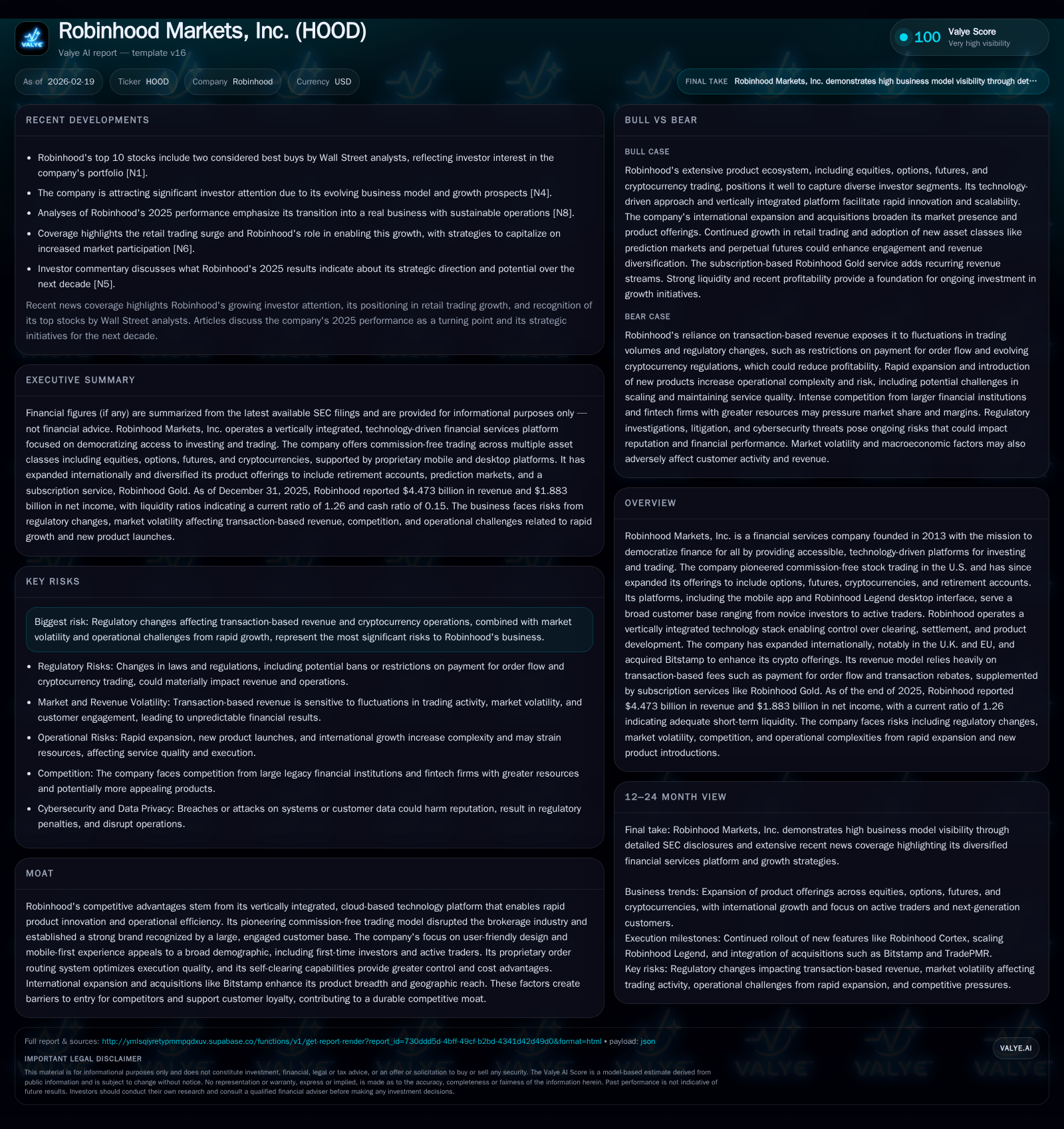
Robinhood Markets, Inc. has transformed its revenue trajectory from losses to robust profitability, driven by rapid user growth, international expansion, and a broadening of product offerings including crypto and futures. The company's vertically integrated technology stack and commission-free model underpin a durable competitive moat. However, regulatory investigations, litigation settlements, evolving rules on payment for order flow (PFOF), and intensified competition pose significant challenges. Robinhood’s capital allocation reflects confidence via substantial share repurchases, even as it manages regulatory-driven compliance costs and operational risks. Monitoring quarterly performance volatility and evolving regulatory frameworks will be critical to assessing sustained growth prospects.
Company Overview and Historical Performance
Founded in 2013 with the mission to democratize finance for all, Robinhood Markets disrupted retail brokerage through its pioneering commission-free trading platform that eliminated account minimums—a move that forced the entire industry to follow suit. Its mobile-first design attracted novice investors while simultaneously building functionality for active traders.
Financially, Robinhood has demonstrated a remarkable turnaround over the past four years. Revenue expanded from approximately $1.36 billion in FY2022 to $4.47 billion by FY2025 — an annualized compound growth rate exceeding 50% over this span [F1]. Correspondingly, net income swung from losses of over $1 billion negative in early years to nearly $1.9 billion positive in FY2025 [F1]. This was accompanied by a transformation in cash flow metrics; operating cash flow turned positive $1.64 billion in FY2025 after volatile earlier years marked by negative flows (e.g., -$157 million CFO in FY2024) [F1].
Financial Summary
Historical performance (annual)
| FY | Rev ($bn) | Net ($mm) | CFO ($mm) | Rev YoY | Net YoY |
|---|---|---|---|---|---|
| 2025 | 4.5 | 1883 | 1638 | +51.6% | +33.5% |
| 2024 | 3.0 | 1411 | -157 | +58.2% | +360.8% |
| 2023 | 1.9 | -541 | 1181 | +37.3% | +47.4% |
| 2022 | 1.4 | -1028 | -852 |
Note: Omitted columns lack sufficient annual XBRL coverage in the provided tags (need ≥2 annual points): OpInc, Capex, Div, FCF. Source: SEC companyfacts cache [F1].
Capital returns and efficiency (annual)
| FY | Buybacks ($mm) | ROE% |
|---|---|---|
| 2025 | 653 | |
| 2024 | 257 | 17.7 |
| 2023 | 608 | -8.1 |
| 2022 | -14.8 |
Source: SEC companyfacts cache [F1].
Note: Capex figures are limited; available data shows a decline but insufficient for trend analysis.
The financial transformation coincided with the company's launch of new products such as retirement accounts and futures trading alongside the core offerings of stocks, options, and cryptocurrencies [S1][N6]. The vertical integration—controlling clearing operations and routing—has allowed tighter cost control and faster time-to-market for innovations [S5].
Growth Drivers
Robinhood’s future growth is anchored in several avenues:
- Product Diversification: Expansion into futures, retirement accounts with tax advantages, event contracts and cryptocurrencies broadens revenue beyond equities trading commissions and PFOF fees [S1][N6][N7].
- Geographic Expansion: Notable growth into Europe (U.K., EU licensing regimes) introduces complex dual licensing requirements which increase compliance burdens but open new markets; acquisition of Bitstamp enhances crypto custody capabilities internationally [S26][S1].
- Technology Ecosystem: Proprietary vertically integrated technology stack supports scalable cloud-native architecture enabling efficient trade execution and rapid feature deployment [S5][N7].
These drivers are balanced against significant headwinds:
- Increasing regulatory scrutiny on payment for order flow (PFOF) threatens a key revenue stream with potential margin compression or structural changes [S1][S2][S12].
- Market volatility directly impacts trading volumes affecting transaction-based revenues.
- Intensifying competition from both legacy brokers adopting zero commissions and fintech entrants compresses margins and challenges differentiation [S25].
- Compliance costs rise amid international expansion and ongoing regulatory investigations.
Regulatory Environment & Litigation Risk
Robinhood operates under heightened domestic and international regulatory scrutiny due to its innovative product suite including derivatives/futures/crypto offerings as well as historical operational incidents such as platform outages [S6][S14][N13].
Significant settlements include:
- January 2025 SEC settlement costing $45 million related to broker-dealer compliance including suspicious activity reporting (SAR) filings and data security incidents;
- March 2025 FINRA settlement involving penalties totaling $26 million plus restitution payments concerning customer identification programs (CIP) and trade reporting irregularities [S6][S14].
Additional penalties paid to California authorities related to cryptocurrency custody disclosures amounted to approximately $3.9 million [S14]. Ongoing investigations also focus on social media marketing practices [S13].
These regulatory matters have prompted substantial investments in compliance infrastructure, including independent consultant reviews addressing application features and cybersecurity postures [S14][S18].
Evolving regulations pose uncertainty particularly around PFOF bans or restrictions that comprise a significant portion of Robinhood’s transaction-based revenues [S12]. Cybersecurity risks remain salient given the platform's data-centric operations.
Capital Allocation & Financial Health
Robinhood maintains strong liquidity with cash & equivalents totaling approximately $4.26 billion at fiscal year-end 2025 versus current liabilities near $28.8 billion—reflecting broker-dealer segregated client funds arrangements typical for the industry [F1].
The company actively returned capital through share repurchases totaling $653 million in FY2025 within an authorized program capped at $1.5 billion which remains open-ended without expiration date [F1][S11]. No dividends have been paid historically according to available data.
Approximate return on equity (ROE) stands around 23.6%, calculated using FY2025 net income divided by FY2024 equity base — indicative of improved profitability leveraged by scaled volumes combined with cost discipline [F1].
Industry Context & Competitive Positioning
The retail brokerage sector remains intensely competitive with low switching costs among digital platforms offering largely commoditized services such as commission-free trading. Robinhood’s competitive edge derives from its intuitive mobile-first user experience tailored toward younger or first-time investors combined with its vertically integrated technology stack enabling rapid innovation cycles [S5]. Legacy banks provide broader wealth management services but lack Robinhood’s brand resonance among millennials. However, competitors replicating zero-commission models exert margin pressure challenging sustainable differentiation strategies [S25].
Key Metrics Summary Table
| Metric | FY2022 | FY2023 | FY2024 | FY2025 |
|---|---|---|---|---|
| Revenue ($B) | 1.36 | 1.87 | 2.95 | 4.47 |
| Net Income ($B) | -1.03 | -0.54 | 1.41 | 1.88 |
| Operating Cash Flow ($B) | -0.85 | 1.18 | -0.157 | 1.64 |
| Stock Repurchases ($M) | - | 608 | 257 | 653 |
| Approx ROE (%) | - | - | - | 23.6* |
| *Calculated using FY2025 net income / FY2024 equity base; equity data not available for all years. |
What To Watch Next (Analysis)
Given absence of explicit forward guidance in filings or news, k key monitoring points include:
- Quarterly trading volume trends as proxies for transaction-based revenue health;
- Regulatory developments impacting PFOF fees along with enforcement actions affecting fee structures;
- Progress on obtaining international licenses especially within EU jurisdictions impacting cross-border expansion;
- Execution progress on product roadmap milestones for futures/retirement/event contracts adoption;
- Changes or acceleration in capital return programs reflecting management confidence or capital conservation needs;
- Litigation developments given ongoing class actions related to platform outages or data breaches.
Conclusion
Robinhood Markets exhibits a compelling financial resurgence built on innovative commission-free brokerage services augmented by international expansions and diversified product offerings aligned with its mission to democratize finance globally. However, this growth coincides with multi-jurisdictional regulatory challenges requiring substantial compliance investments alongside intensified market competition. The company’s ability to sustain revenue momentum while preserving regulatory trust will be key determinants shaping medium-term trajectory. Capital allocation decisions notably sizable stock buybacks signal management confidence but also expose sensitivity to share price dynamics if market conditions shift unexpectedly. Careful attention should be paid to quarterly results volatility driven by macro market factors combined with evolving industry regulation – factors that could meaningfully influence future operating performance.
This analysis is based on publicly available information from company filings, news sources referenced herein, and sector context knowledge as of February 19, 2026. It does not constitute investment advice or recommendations regarding the purchase or sale of securities.
Disclaimer: This is research-only, informational analysis and not investment advice. It may include AI-generated interpretation and general industry context. Always verify important details using primary sources.

Comments