
Rambus Inc Balances Growth and Patent Licensing Risks in AI and Memory Markets
Rambus Inc. leverages its patent portfolio and innovation in memory interfaces to drive strong operating income growth, while managing semiconductor cyclical risks and customer concentration.
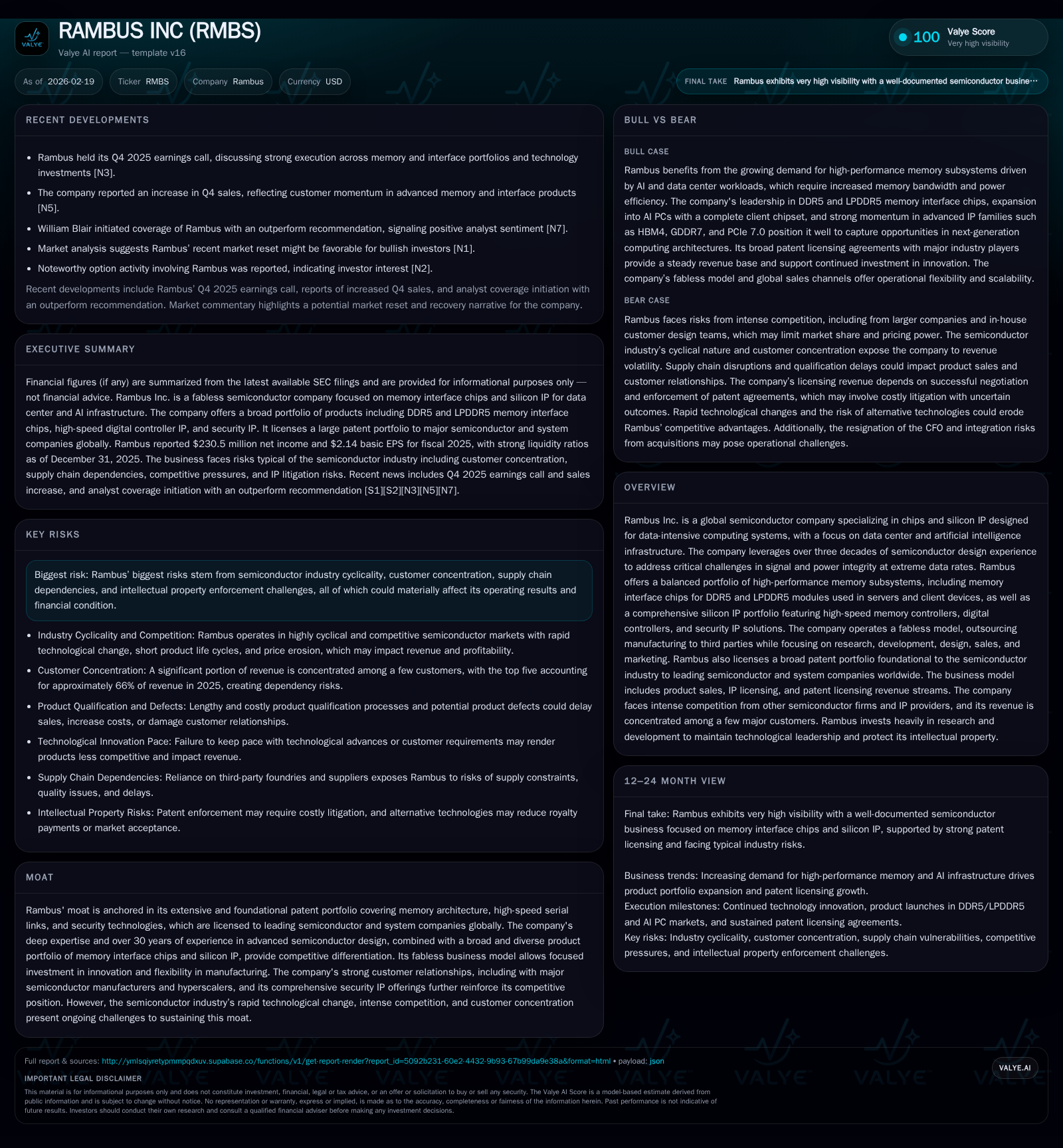
Rambus Inc., a fabless semiconductor company with three decades of expertise in high-speed memory interface chips and silicon IP for AI and data centers, delivered robust operating income growth of 42.2% in FY2025 driven by DDR5 product adoption and expanding digital and security IP portfolios. Despite net income volatility historically due to cyclical industry dynamics and licensing uncertainties, recent trends point to sustainable growth fueled by AI infrastructure demands. The company maintains a healthy balance sheet with $182.8 million cash and strong operating cash flow conversion, although customer revenue concentration and ongoing IP litigation risks remain key challenges. Future milestones include scaling licensing revenues amid new standard adoption and navigating geopolitical export controls impacting silicon IP deployment.
Company Overview
Rambus Inc. (NASDAQ: RMBS) operates as a fabless semiconductor firm specializing in high-performance memory interface chips and silicon intellectual property (IP) targeting data-intensive computing applications such as data centers and artificial intelligence (AI) infrastructure systems [S1]. With over thirty years of experience in semiconductor design, Rambus focuses on solving critical signal integrity, power efficiency, and security challenges associated with extreme data rates in memory subsystems for DDR5/LPDDR5 modules serving server-class and client markets.
This historical specialization anchors Rambus’s moat through a vast patent portfolio exceeding 2,000 issued patents globally across memory architectures, high-speed serial link technologies, and security IP solutions — all underpinning its licensing business model [S26]. The company’s dual revenue streams come from product sales of chips—primarily its DDR5 Registering Clock Drivers (RCD)—and royalties/licensing fees derived from its foundational patents embedded across various customers' semiconductor products worldwide.
Historical Performance
Absent direct revenue figures from public filings, analysis relies on operating income and net income trends supported by cash flow data. Rambus exhibited consistent improvement in profitability over the past four fiscal years:
Historical performance (annual)
| FY | Net ($mm) | CFO ($mm) | OpInc ($mm) | Capex ($mm) | Net YoY |
|---|---|---|---|---|---|
| 2025 | 230 | 360 | 260 | 27 | +28.2% |
| 2024 | 180 | 231 | 183 | 31 | -46.1% |
| 2023 | 334 | 196 | 154 | 23 | +2433.4% |
| 2022 | -14 | 230 | 77 | 17 |
Note: Omitted columns lack sufficient annual XBRL coverage in the provided tags (need ≥2 annual points): Rev, Div. Source: SEC companyfacts cache [F1].
Capital returns and efficiency (annual)
| FY | Buybacks ($mm) | FCF ($mm) | ROE% |
|---|---|---|---|
| 2025 | 7 | 333 | 16.9 |
| 2024 | 113 | 200 | 16.0 |
| 2023 | 101 | 173 | 32.2 |
| 2022 | 100 | 213 | -1.8 |
Source: SEC companyfacts cache [F1].
Note: Revenue not available from provided data [F1]. Free cash flow (FCF) approximated as CFO minus Capex.
The notable jump in operating income (+42%) and sustained net income growth (+28%) in FY2025 reflect expanding adoption of Rambus's DDR5 RCD products into server markets alongside growth of its broader silicon IP portfolio for HBM4, GDDR7 graphics memories, PCIe Gen7 interfaces, and embedded security offerings integrated within accelerated computing platforms [S1][N1]. Prior swings include a steep recovery from a net loss in FY2022 attributable to cyclical softness in semiconductor demand impacting licensing renewals and product sales.
Operating cash flows demonstrate strong conversion consistent with Rambus’s asset-light fabless model accompanied by conservative capital expenditure focused mainly on R&D capabilities expansion — the company invested $27 million capex in FY2025 after prior elevated levels supporting technology development initiatives [F1][S14].
The firm also moderated share repurchases significantly after large buyback programs during FY2023-24, suggesting disciplined capital allocation balancing shareholder returns versus reinvestment needs.
Strategic Positioning & Moat
At its core Rambus’s strength lies in the interplay between proprietary chip products for modern memory standards (notably DDR5 for both servers and growing client segments such as AI PCs) plus an extensive licensing franchise rooted in patented innovations spanning physical interfaces, clocking technologies, data link protocols, and hardware-based security modules essential for protecting sensitive workloads today [S1][S26].
This intellectual property moat benefits from decades-long industry relationships with top-tier semiconductor manufacturers and hyperscale system integrators who depend on compliant silicon IP blocks underpinned by intricate patent estates that are not easily replaced or circumvented.
Competition exists both from internal development efforts at large chip firms (including major foundries exploring integrated alternatives) as well as rival IP suppliers offering overlapping architectures or lower cost propositions possibly eroding market share or royalty base [S6]. Moreover, perennial risks attached to enforcing complex licensing agreements amid potentially shifting regulatory requirements around encryption technologies can introduce volatility.
Growth Drivers & Challenges
Growth Catalysts:
- AI Infrastructure Demand: Escalating AI workloads require enormous memory bandwidth improvements; Rambus’s DDR5 RCD chips enable higher capacity server DIMMs critical for training models at scale.
- Expansion into Client AI Systems: Launching complete client chipsets supporting DDR5/LPDDR5 modules enables penetration beyond traditional data center realms into advanced user endpoints such as AI-enabled PCs [S1].
- Silicon IP Portfolio Expansion: Strong momentum captured across next-gen HBM4 (high bandwidth memory), GDDR7 graphics memory controllers, PCI Express Gen7 digital controllers expand addressable markets among semiconductor OEMs developing custom accelerators.
- Security IP Adoption: Growing cyber threat vectors for AI apps boost demand for hardware-enforced security features embedded at chip level — an area where Rambus holds established leadership.
Constraints & Risks:
- Customer Concentration Risks: Approximately two-thirds of revenue derives from top five customers; loss or reduced orders substantially impact results [S6][S13].
- Semiconductor Industry Cyclicality: Market downturns can depress royalty flows and delay new contract signings; long license cycles further amplify revenue uncertainty [S2][S7].
- Litigation & Intellectual Property Enforcement: Ongoing risk of costly multi-jurisdictional patent disputes could divert resources or limit licensing ability if adverse rulings emerge [S9][S19].
- Geopolitical & Export Controls: Encryption tech embedded within products faces export restrictions affecting geographic coverage; compliance burdens increase overhead risk [S17][S25].
- Technology Obsolescence Risk: Rapid evolution demands continual R&D investment; failure to innovate could cede market share or weaken IP value proposition [S14].
Capital Allocation & Financial Health
Rambus exhibits prudent capital management consistent with an innovative fabless semiconductor entity emphasizing R&D spend while generating healthy operating cash flows:
- The ROE approximates nearly 17% based on FY2025 net income relative to equity reflecting efficient capital utilization given modest asset intensity [F1].
- Operating cash flow exceeds discretionary capex by over tenfold underscoring a self-sustaining business generating substantial free cash flow (about $333 million most recently).
- Share repurchases were sharply curtailed during FY2025 compared with prior years indicating either cautious conservatism due to market conditions or retention of liquidity for strategic flexibility [F1].
- No dividend payments indicated possibly prioritizing reinvestment or debt reduction strategies as no explicit dividend data available.
The company's current ratio stands above eight times providing solid short-term liquidity headroom given conservative current liability levels relative to liquid assets including $183 million cash on hand at the end of FY2025 ensuring operational stability despite cyclicality concerns.
Outlook & Milestones to Monitor
While Rambus has not publicly issued explicit guidance for upcoming periods within the available source set, key performance signposts include:
- Expansion rate of royalties/license renewals tied closely to customer product ramp cycles especially those adopting next-gen JEDEC DDR5/LPDDR5 standards.
- Market penetration progress with emerging silicon IP families around HBM4/GDDR7 memories and new PCIe Gen7 controllers impacting royalty base diversification.
- Customer diversification efforts mitigating concentration risk especially amid consolidation trends within semiconductor manufacturing supply chains.
- Outcomes of any ongoing or future intellectual property litigations which could materially influence licensing revenue continuation or loss.
- Responses to evolving export control regimes on encryption technology that may restrict market accessibility particularly involving China/Taiwan-related end markets.
- Success metrics related to new client chipset deployments expanding Rambus presence beyond traditional server markets into AI-enabled client devices.
Analysts are also watching management’s capital deployment decisions regarding potential M&A activity versus organic investment given the dynamic technology landscape requiring agility combined with scale.
Recent Developments
Noteworthy recent events include appointment of Victor Peng—a seasoned industry leader—to corporate board enhancing strategic oversight capabilities during this important growth phase [S3]. Public market observers highlight Rambus’s positive earnings surprise commentary from Q4 FY2025 reinforcing bullish sentiment about product ramp strength amidst broader semiconductor sector volatility [N1],[N3],[N8],[N9],[N10],[N11].
Conclusion
Rambus Inc strategically positions itself at the nexus of accelerating AI-driven compute demand via proprietary memory subsystem chipsets combined with a defensive yet monetizable patent portfolio central to next-generation chip designs globally. The company skillfully balances growth opportunities presented by advancing standards adoption alongside inherent risks intrinsic to an industry marked by cyclicality, intense competition from larger incumbents pursuing internal alternatives, geopolitical export complexities, regulatory uncertainties around encryption tech use, customer concentration exposure, and the perennial necessity of rigorous intellectual property defense.
Financially robust with strong operating leverage evidenced by improving profitability metrics coupled with abundant free cash flow generation capacity allows Rambus latitude for sustaining innovation investments while executing measured buybacks contributing incremental shareholder value without sacrificing capital structure health.
Investors should monitor evolving licensing contracts renewals vs term expirations along with milestones relating to technology transition effectiveness into client segments beyond servers where Rambus targets future expansion possibilities. Parallel attention toward geopolitical factors influencing export rights compliance as well as legal proceedings concerning patent infringements remain crucial risk parameters affecting forward financial outlooks.
Disclaimer: This analysis is based on publicly available information including SEC filings as referenced ([F1],[S#]) along with recent news articles ([N#]). It does not constitute investment advice or recommendations concerning the purchase or sale of securities.
Disclaimer: This is research-only, informational analysis and not investment advice. It may include AI-generated interpretation and general industry context. Always verify important details using primary sources.

Comments