
BrightSpire Capital Navigates CRE Debt Market Challenges with Diversified Portfolio and Strategic Financing
The CRE credit REIT’s 2025 financials reveal revenue pressures amid yield compression, offset by disciplined capital allocation and a robust financing framework.
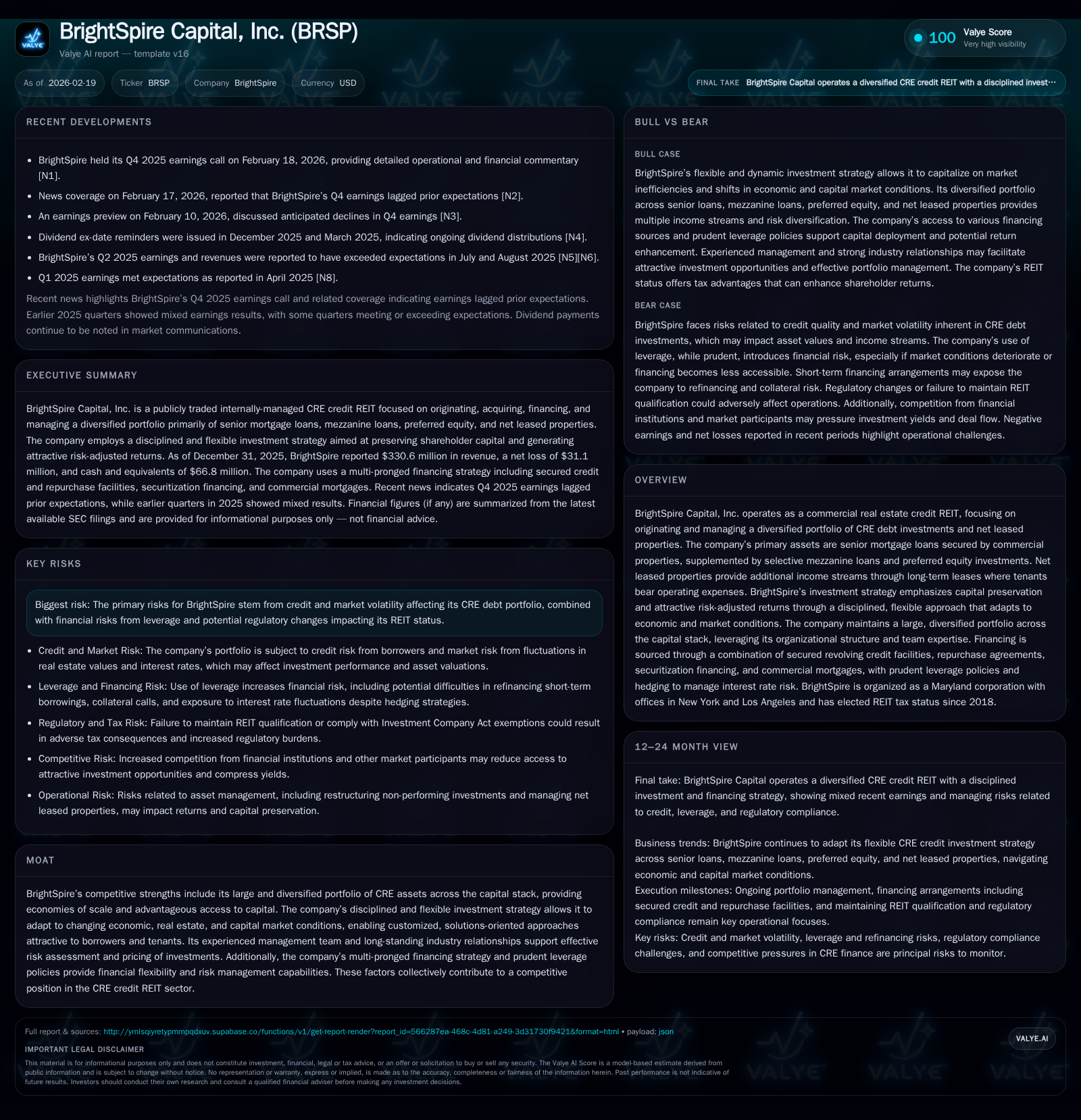
BrightSpire Capital, Inc. (BRSP) is an internally-managed CRE credit REIT focused on senior mortgage loans, mezzanine debt, preferred equity, and net leased properties. Its revenue declined by 7.9% in 2025 to $330.6 million from $358.8 million in 2024, continuing a multi-year downward trend since 2023. Net losses narrowed substantially to $31.1 million in 2025 from $132 million in 2024, reflecting portfolio stabilization efforts despite ongoing market headwinds. Operating cash flow decreased by 29.4% year-over-year, highlighting challenges in liquidity conversion. The company maintains steady dividends exceeding $80 million annually and resumed modest share repurchases after a pause in 2023. BrightSpire’s investment strategy emphasizes capital preservation with flexible risk-adjusted returns across the capital stack, supported by a complex multi-facility financing structure exceeding $3 billion that enhances flexibility but exposes the firm to margin call risks amid market volatility. Key risks include credit quality volatility, leverage-related liquidity constraints, regulatory compliance pressures, and competitive dynamics. Future performance hinges on refinancing of short-term facilities, hedging effectiveness against interest rates, and portfolio management execution [F1][S1][S4][S21][N1].
Company Overview and Business Model
BrightSpire Capital, Inc. (BRSP) operates as an internally-managed commercial real estate (CRE) credit REIT focusing primarily on originating and managing a diversified portfolio composed mainly of senior mortgage loans secured by commercial properties. The company also selectively invests in mezzanine loans and preferred equity interests that often include profit participations aligned with property performance or borrower outcomes [S1]. Additionally, it holds net leased properties under long-term leases where tenants shoulder operating expenses such as insurance and maintenance.
Founded in August 2017 and headquartered in New York City with offices also in Los Angeles, BrightSpire elected REIT tax status beginning fiscal year 2018 and conducts its core activities through its operating subsidiary BrightSpire Capital Operating Company, LLC [S1].
Historical Financial Performance
The company’s revenues have declined from a peak of $415.1 million in FY2023 to $330.6 million in FY2025 (a cumulative drop of approximately 20%), reflecting compression of yields amid heightened competition within the CRE debt markets [F1]. Net income swung from positive territory ($45.8 million) in FY2022 to recurring losses thereafter; however, the magnitude of net losses has improved meaningfully from a loss of nearly $132 million in FY2024 to $31.1 million in FY2025.
Operating cash flows have remained positive but softened considerably since FY2023 — decreasing by almost 30% year-over-year in FY2025 — illustrating challenges converting earnings into free cash flow amidst increased debt servicing or working capital demands.
Equity capital has contracted alongside losses but remains substantial at approximately $938 million as of December 31, 2025.
Historical performance (annual)
| FY | Rev ($mm) | Net ($mm) | CFO ($mm) | Rev YoY | Net YoY |
|---|---|---|---|---|---|
| 2025 | 331 | -31 | 73 | -7.9% | +76.4% |
| 2024 | 359 | -132 | 103 | -13.6% | -748.8% |
| 2023 | 415 | -16 | 138 | +13.8% | -134.0% |
| 2022 | 365 | 46 | 125 |
Note: Omitted columns lack sufficient annual XBRL coverage in the provided tags (need ≥2 annual points): OpInc, Capex, FCF. Source: SEC companyfacts cache [F1].
Capital returns and efficiency (annual)
| FY | Div ($mm) | Buybacks ($mm) | ROE% |
|---|---|---|---|
| 2025 | 83 | 11 | -3.3 |
| 2024 | 99 | 7 | -12.6 |
| 2023 | 104 | 0 | -1.2 |
| 2022 | 99 | 18 | 3.3 |
Source: SEC companyfacts cache [F1].
Note: Operating income and capital expenditures are not available from provided tags.
The revenue contraction corresponds with sector-wide yield compression driven by increased competition for CRE debt assets [S12]. The sharp net loss recorded in FY2024 was likely influenced by elevated credit losses or mark-to-market adjustments during periods of market stress [N2][N3]. The reduced net loss for FY2025 suggests partial recovery or effective portfolio management.
Operating cash flow declines imply challenges sustaining liquidity despite positive underlying returns which may be affected by higher financing costs or timing variances.
Capital return priorities remain evident with steady dividend distributions exceeding $80 million annually alongside resumption of modest share buybacks following a pause in FY2023 [F1][S21].
Portfolio Composition and Investment Strategy
BrightSpire’s investment portfolio is diversified across multiple layers of the capital stack: predominantly senior mortgage loans secured by commercial real estate assets complemented by mezzanine loans subordinate to first mortgages but senior to borrower equity interests [S1][S22]. Preferred equity investments offer upside potential typically through payment-in-kind returns linked to property or borrower performance.
Net leased properties contribute stable income streams through long-term lease arrangements requiring tenants to cover operating expenses including taxes and maintenance costs [S1]. This diversification reduces dependence on any single asset class or risk factor.
The firm employs a disciplined yet adaptive investment approach that calibrates leverage prudently relative to asset cash flow stability and prevailing economic cycles [S4]. Interest rate hedging instruments such as swaps or caps are utilized selectively to mitigate exposure to rising borrowing costs.
Financing Structure and Leverage Considerations
BrightSpire utilizes a multi-faceted financing platform consisting of:
- A secured revolving credit facility with a capacity of $120 million,
- Approximately $2.1 billion in secured revolving repurchase agreements,
- Nearly $982 million in non-recourse securitization financing,
- Approximately $382 million in commercial mortgage loans,
- Additional asset-level financings totaling over $34 million as of December 31, 2025 [S4][S5][S8].
This leverage enhances capital efficiency but introduces sensitivity to collateral value fluctuations that can trigger margin calls under repurchase agreements [S11][S13]. Such collateral calls may require additional liquidity or asset sales under unfavorable conditions.
Compliance with regulatory covenants includes maintaining REIT qualification status, stock exchange listing requirements (NYSE), restrictions on incurring additional liens or debt beyond permitted thresholds without lender approval [S9]. Failure to meet these obligations could accelerate debt repayment demands or reduce liquidity access.
Management retains discretion over leverage levels without stockholder approval but aligns decisions with assessments of asset credit quality and cost-of-capital factors [S4][S18].
Risks Impacting Business Execution
Key risks identified include:
- Credit quality deterioration arising from borrower defaults or weakening tenant businesses impacting interest/principal collections,
- Liquidity pressures triggered by margin calls on short-term leveraged financings,
- Changes in regulatory frameworks potentially affecting REIT status or triggering registration as an investment company imposing operational constraints,
- Competitive threats from lenders with lower funding costs or fewer regulatory restrictions which may compress yields further [S10][S12][S14][S16].
Retention of experienced loan originators and broker relationships is essential for deal sourcing amid intense competition [S10]. Losses here could impede growth trajectories.
Environmental liabilities related to property ownership or collateral require thorough due diligence pre-acquisition given potential material impacts [S6][S24].
Growth Outlook & Catalysts for Monitoring
Growth opportunities depend heavily on external economic conditions influencing CRE demand-supply balance alongside access to capital markets:
- Market dislocations may present attractive pricing opportunities across senior loans and subordinated positions leveraging BrightSpire’s flexible mandate.
- Enhancements in underwriting technology will be critical amid increasingly complex borrower profiles.
- Refinement of interest rate hedging strategies will influence borrowing cost management.
- Terms and renewal prospects for critical short-term financing facilities warrant careful observation given reliance on repo markets for leverage.
- Management commentary during earnings releases provides insight into loan pipeline health and portfolio seasoning trends [N1][N3].
Explicit forward guidance is limited; thus stakeholders should monitor loan-to-value ratios, delinquency metrics within the CRE debt book, lease term changes on net leased properties, plus securitization refinancing developments described broadly within annual report disclosures [S4][S7][S18].
Returns Profile & Capital Allocation Philosophy
Despite persistent net losses at the bottom line level, BrightSpire prioritizes principal protection while delivering consistent dividend income supported by recurring loan interest receipts [F1][S21]. Approximate return on equity was negative at about -3.3% for FY2025 reflecting ongoing markdowns or elevated credit-related expenses during this mid-cycle phase.[F1]
Capital deployment emphasizes steady dividends averaging roughly one-quarter of revenues annually combined with opportunistic share repurchases aimed at enhancing per-share value when accretive under current market conditions.[F1]
Concluding Summary
BrightSpire Capital faces significant headwinds amid CRE lending spread compression intensified by competition from banks easing Volcker Rule constraints alongside shadow banking entrants wielding diverse funding sources. Its diversified portfolio strategy offers resilience while its complex leverage structure provides operational flexibility yet increases sensitivity to collateral valuation shifts.[F1][S22] Success depends on sustained origination capability enhancement coupled with rigorous portfolio surveillance to navigate volatile market phases.[N1] Investors should monitor upcoming refinancing events for short-duration facilities alongside evolving regulatory landscapes that may impose greater operational constraints. While profitability remains challenged currently, narrowing losses combined with positive operating cash flows suggest underlying stabilization necessitating continued adaptive risk management.[F1]
This analysis is based solely on provided SEC filings [F1], news transcripts [N#], and does not constitute investment advice.
Disclaimer: This is research-only, informational analysis and not investment advice. It may include AI-generated interpretation and general industry context. Always verify important details using primary sources.

Comments