
Generac's Financial Contraction Challenges Growth in Emerging Energy Solutions
Generac faces declining profitability amid cost pressures while shifting its strategy toward integrated energy ecosystems.
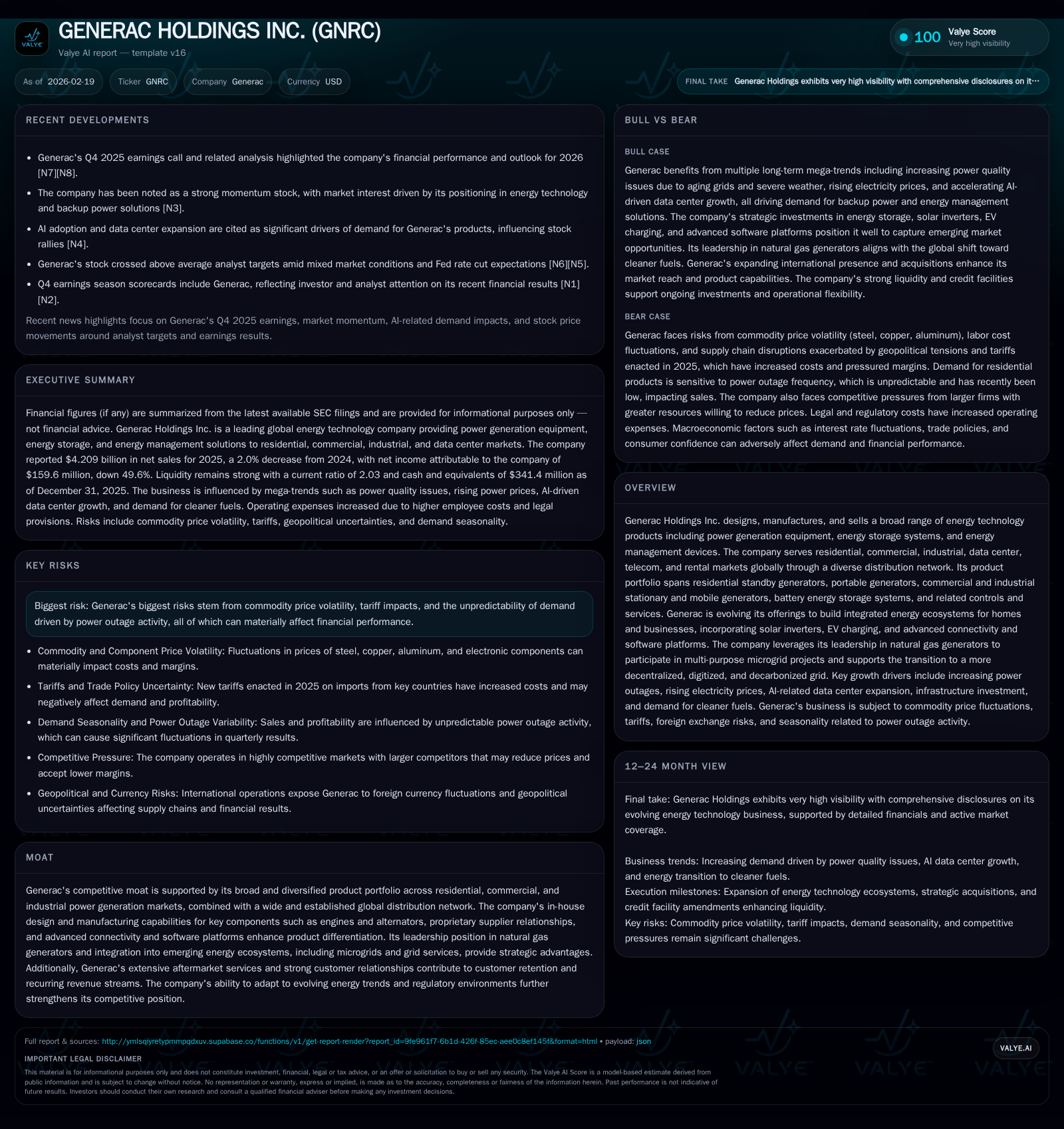
Generac Holdings Inc. reported a significant contraction in operating income and net income in 2025 after several years of growth, pressured by commodity price volatility, tariffs, and uneven demand due to fluctuating power outages. The company is pivoting toward expanding its energy technology portfolio—including battery storage, solar inverters, and multi-purpose microgrids—aiming to build integrated residential and commercial ecosystems. Despite shrinking margins and cash flow reductions, Generac maintains strong covenant compliance, continues share repurchases at a moderated pace, and plans critical product and market developments in 2026 that will be key indicators of its operational recovery and strategic execution.
From Double-Digit Growth to Significant Earnings Contraction: A Historical View
Generac Holdings Inc. experienced a pronounced inflection in financial performance during fiscal year 2025 following two years of robust earnings expansion. Operating income plunged from approximately $537 million in 2024 to $289 million in 2025 representing a steep -46.1% year-over-year decline [F1]. Net income echoed this downtrend with about a 49.6% drop to roughly $160 million [F1]. This reversal contrasts with steady growth phases seen between 2022–2024 when operating income more than quadrupled.
The earnings contraction largely stems from diminished demand for residential standby generators—a segment historically sensitive to the frequency and severity of power outages. The company noted that the mild disruption environment in 2025 relative to the prior year’s multiple major hurricanes significantly dampened sales volumes [S1], [S18]. While commercial & industrial (C&I) products saw modest growth (+4.9%), it was insufficient to offset residential declines causing overall net sales to contract roughly -2% [S18]. Gross profit margin dipped slightly from 38.8% in 2024 to 38.3%, pressured by cost inputs despite aggressive pricing actions [S18].
Operating expenses surged by more than $190 million (17.2%) year-over-year including notable spikes in legal reserves tied to patent disputes and regulatory matters plus increased warranty provisioning linked to Department of Energy programs [S18], [S23]. These expenditures collectively weighed on profitability alongside the raw material headwinds.
Historical performance (annual)
| FY | Net ($mm) | CFO ($mm) | OpInc ($mm) | Capex ($mm) | Net YoY |
|---|---|---|---|---|---|
| 2025 | 160 | 438 | 289 | 170 | -49.6% |
| 2024 | 316 | 741 | 537 | 137 | +227.4% |
| 2023 | 97 | 522 | 151 | 129 | +36.0% |
| 2022 | 71 | 59 | 107 | 86 |
Note: Omitted columns lack sufficient annual XBRL coverage in the provided tags (need ≥2 annual points): Rev. Source: SEC companyfacts cache [F1].
Capital returns and efficiency (annual)
| FY | Div ($) | Buybacks ($mm) | FCF ($mm) |
|---|---|---|---|
| 2025 | 293000 | 148 | 268 |
| 2024 | 273000 | 153 | 605 |
| 2023 | 0 | 252 | 393 |
| 2022 | 309000 | 346 | -28 |
Source: SEC companyfacts cache [F1].
*Large percentage changes from smaller base values in prior years; exact YoY changes omitted for brevity.
Note: Revenue figures were not disclosed via XBRL tags for these periods [F1].
Powering Through Challenges: Commodity Costs, Tariffs, and Demand Variability
Generac’s earnings retreat was exacerbated by significant increases in raw material costs—steel, copper, aluminum—and advanced electronic components integral to its generators and energy storage systems [S1]. The lack of long-term fixed-price supply contracts exposes the company to cyclical price swings intensified by global supply-demand imbalances.
Early-2025 saw an escalation of U.S.-imposed tariffs affecting imports primarily from China, Vietnam, and India—the consequence being higher landed costs for component parts which compressed gross margins despite implemented price increases across many product lines [S2]. While management has pursued supply chain rationalization initiatives aiming to mitigate these tariff impacts through alternative sourcing and productivity improvements, the full benefit remains gradual.
Demand variability tied directly to unpredictable power outage activity represents another core challenge for Generac’s forecasting ability and operational planning [S1], [S9]. Mild weather-related disruptions depressed baseline consumer urgency for standby generators, further complicated by shifts away from portable generator purchases post-pandemic surge adjustments.
Expanding Energy Ecosystems: Residential to Multi-Purpose Microgrids
Amid these headwinds, Generac is strategically pivoting towards building integrated energy ecosystems spanning residential homes through to large commercial & industrial microgrids—reflecting an industry-wide shift toward decentralized grid solutions [N1], [S2], [S20]. This encompasses expanding portfolios with battery energy storage systems, solar power inverter technologies, electric vehicle (EV) charging infrastructure, along with enhanced connectivity devices enabling advanced grid-edge software capabilities.
Natural gas generators anchor the company's expansion into multi-purpose microgrid applications that address resilience requirements beyond standby power alone—serving data centers, telecom operations, industrial facilities—in part leveraging their cleaner fuel profile relative to diesel alternatives [S20]. Such deployments increasingly integrate customer-sited distributed energy resources (DERs) managed via IoT-enabled platforms fostering deeper participation in emerging grid services markets.
This holistic approach enhances Generac's competitive moat by differentiating through proprietary engine production capabilities complemented by sophisticated software ecosystems enhancing operational intelligence and renewable integration potential—a critical advantage against commoditized generator providers [S20].
Capital Allocation Under Pressure: Debt, Buybacks, and Dividend Trends
Financial stewardship amid earnings pressure reveals measured capital deployment discipline at Generac. The company holds about $2.63 billion in stockholders’ equity versus net secured debt levels approximating $1.19 billion across various term loan tranches with no borrowings under revolver facilities as of end-2025 [F1], [S4]–[S6], illustrating prudent leverage management.
Leverage ratios remain strong with net secured leverage near 1.32x and total leverage around 1.39x against covenant ceilings of up to 3.75x; interest coverage exceeds an ample ~11.76x threshold ensuring ample debt service capacity [S4]–[S6].
Share repurchases persisted though slightly moderated at approximately $148 million deployed during fiscal year 2025 compared with $153 million prior year [F1], reflecting a supportive but conservative buyback posture given cash flow retrenchment pressures (-40.9% reduction year-on-year) [F1]. Dividend distributions are essentially nominal (<$300k annually), consistent with management’s prioritization of buybacks over dividends amid profit variability [F1], [S16].
Capital expenditures accelerated by over 24%, standing at nearly $170 million as investments focus on facilities upgrades, research & development including internal software platforms critical for enforcing integrated ecosystem architectures alongside manufacturing efficiencies designed to combat inflationary input costs long-term [F1], [S28]. This reflects a calculated balancing act maintaining innovation momentum while guarding liquidity on a reduced free cash flow backdrop (~$268 million estimated) [F1].
Cash & equivalents remain strong at approximately $341 million as of December 31, 2025 providing liquidity headroom despite earnings pressure [F1].
What to Watch in 2026: Key Milestones and Market Catalysts
Absent explicit quantitative guidance from recent earnings calls ([N4]), investor outlook reflections ([N5]) emphasize vigilance on three pivotal factors shaping near-term trajectory:
- Power Outage Frequency: Recovery or continued softness directly influences baseline residential standby generator demand cycles.
- Tariff Landscape Evolution: Potential easing or escalation materially affects pricing strategy effectiveness and margin restoration efforts.
- Product Launches & New Market Penetration: Monitoring the commercialization progress of solar inverter solutions, EV chargers, expanded microgrid projects alongside sustaining momentum within data center segments remain critical barometers.
These metrics serve as principal 'watchlist' items providing real-time insights into whether strategic investments translate into tangible growth amid macroeconomic challenges.
Assessing Generac’s Operational Levers: Innovation, Distribution, and Software Platforms
Generac's operational backbone leverages vertically integrated manufacturing notably producing air-cooled engines up to ~28kW internally plus heavily value-engineered liquid-cooled natural gas engines designated proprietary OEM status; alternators too are largely manufactured within proprietary networks optimizing design controls ensuring product reliability advantages vital for both residential standby units and large-scale commercial deployments [S20].
These engineering competencies underpin a B2B aftermarket service model extending beyond initial sales via extensive dealer networks supplying installation support, maintenance contracts, warranty servicing fortified by expanding remote monitoring capabilities enabled through IoT technology platforms folded into advanced energy management systems offering customers improved efficiency optimization—creating stable recurring revenue streams reinforcing the competitive moat amid intensifying market competition [S20].
On connectivity fronts Generac’s investments into software-enabled solutions aim at improving user engagement facilitating participation in ancillary grid services programs positioning the company's products as pivotal components within evolving DER portfolios required for future decarbonized grid infrastructure envisioned industry-wide [S25].
Nevertheless looming legal contingencies including patent litigation cost accruals alongside warranty provisions pertaining particularly to Puerto Rico’s DOE program add layers of expense burden warranting continuing attention as they temper earned gains during this transitional period [S18], [S23].
This document reflects an independent detailed analysis based strictly on public filings ([F1],[N#],[S#]) without investment recommendation intent or forward-looking assurances beyond explicitly stated company commentary references.
Disclaimer: This is research-only, informational analysis and not investment advice. It may include AI-generated interpretation and general industry context. Always verify important details using primary sources.

Comments