
Armour Residential REIT Leverages Agency MBS Amid Rising Interest Rate and Liquidity Pressures
Specialized agency mortgage-backed securities investing drives significant earnings turnaround, tempered by market margin calls and external management risks.
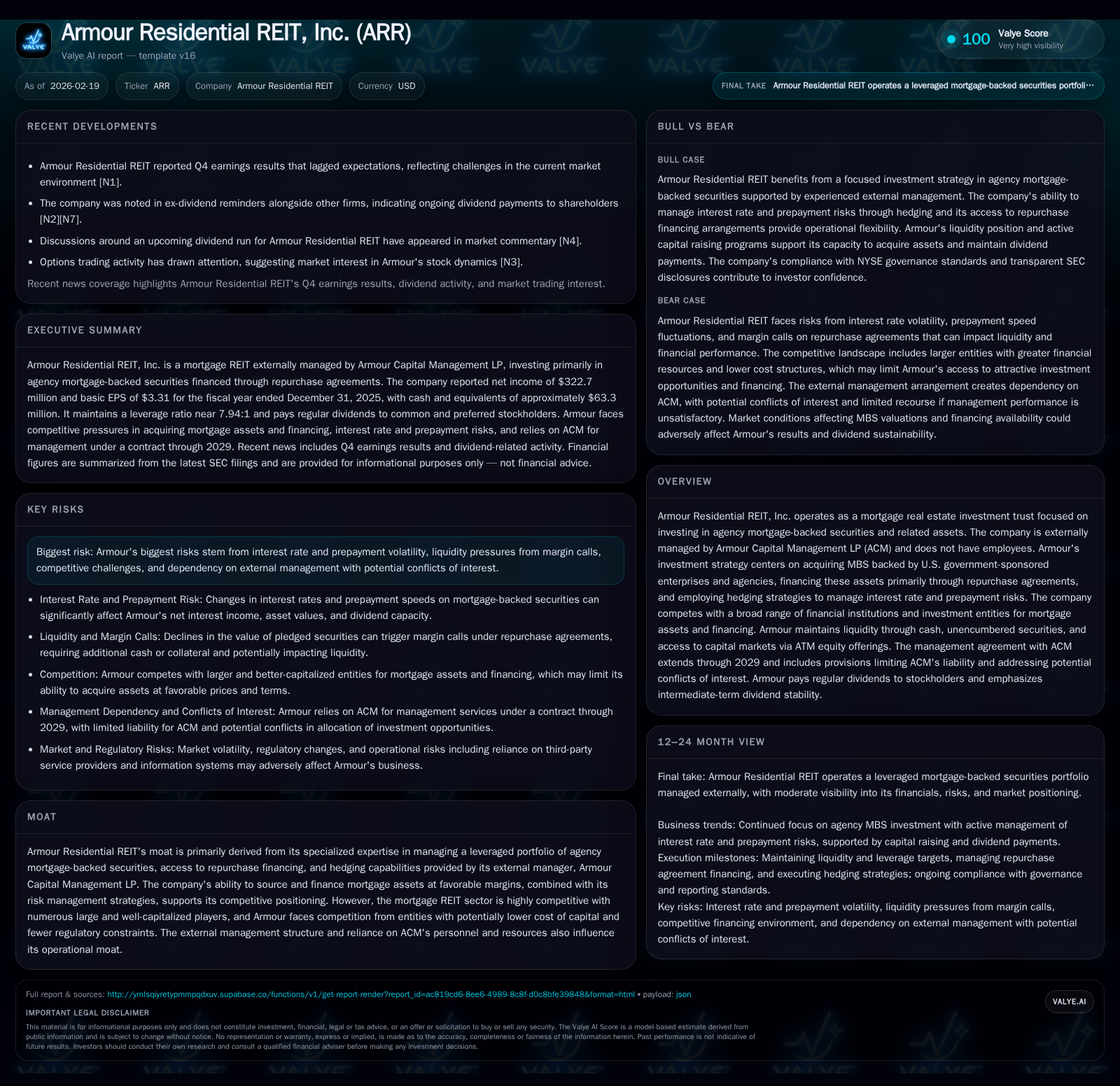
Armour Residential REIT (ARR) specializes in agency mortgage-backed securities (MBS) with a highly leveraged balance sheet financed primarily via repurchase agreements. After several years of net losses, ARR reported a major net income turnaround in 2025 driven by portfolio growth and market recovery. The company’s future growth hinges on navigating ongoing interest rate volatility, prepayment risk, and liquidity constraints exacerbated by margin call timing and competitive pressures in financing costs. External management by Armour Capital Management LP underpins expertise but also adds operational dependencies and potential conflicts. Capital allocation shows consistent dividend payouts supported by operating cash flow, alongside modest share buybacks.
Company Overview
Armour Residential REIT, Inc. (NYSE: ARR) operates as an externally managed mortgage real estate investment trust focused solely on investing in agency mortgage-backed securities (MBS) guaranteed or issued by U.S. government-sponsored enterprises (GSEs) such as Fannie Mae, Freddie Mac – both under FHFA conservatorship – and Ginnie Mae. The company holds no employees directly; its portfolio management, risk oversight, trading activity, financing arrangements, and operations are conducted under contract by Armour Capital Management LP (ACM), which employs approximately 20 personnel dedicated to ARMOUR's activities [S1][S22].
ARR’s investment strategy centers around acquiring agency MBS backed by residential mortgages, financing these assets predominantly through repurchase agreements that provide high leverage relative to equity (~8:1 net of reverse repos), and employing derivative contracts for hedging interest rate exposure and managing prepayment risks [S6][S18].
The agency MBS universe is highly liquid relative to broader fixed income but remains sensitive to macroeconomic dynamics including Federal Reserve policy shifts, fiscal regulation, housing markets, and the legal status of GSE conservatorship – all factors that influence collateral valuations and access to financing. ARMOUR emphasizes sourcing MBS portfolios with favorable prepayment profiles based on loan size, age, geography, borrower credit characteristics, and originator data to mitigate negative amortization risks [S16].
Historical Financial Performance
ARMOUR has experienced volatile earnings over recent years reflecting swings in interest rates, prepayment assumptions, and derivative valuations inherent to agency MBS investing. According to financial data extracted from filings [F1], the company reported the following net income trajectory:
Historical performance (annual)
| FY | Net ($mm) | CFO ($mm) | Net YoY |
|---|---|---|---|
| 2025 | 323 | 124 | +2341.8% |
| 2024 | -14 | 261 | +78.8% |
| 2023 | -68 | 133 | +70.5% |
| 2022 | -230 | 124 |
Note: Omitted columns lack sufficient annual XBRL coverage in the provided tags (need ≥2 annual points): Rev, OpInc, Capex, FCF. Source: SEC companyfacts cache [F1].
Capital returns and efficiency (annual)
| FY | Div ($mm) | Buybacks ($mm) | ROE% |
|---|---|---|---|
| 2025 | 284 | 20 | 14.3 |
| 2024 | 163 | 1 | -1.1 |
| 2023 | 228 | 10 | -5.3 |
| 2022 | 154 | 8 | -20.7 |
Source: SEC companyfacts cache [F1].
Notably, ARR swung from significant net losses between 2022-24 into a robust profit of $322.7 million in 2025 [F1]. This dramatic improvement stemmed largely from recovering asset prices amid stabilizing interest rates coupled with disciplined hedging strategies leading to decreased premiums amortization losses [N1][S1].
Operating cash flows have remained positive despite earnings volatility:
| FY | CFO (USD mn) | CFO YoY % |
|---|---|---|
| 2022 | +124.1 | - |
| 2023 | +132.8 | +7.0% |
| 2024 | +261.5 | +96.9% |
| 2025 | +124.2 | -52.5% |
While CFO nearly doubled in 2024 reflecting strong principal repayments and repo funding growth, it retracted in 2025 amid intensified margin calls from derivatives clearing requirements and swap portfolio adjustments [F1][S9][S16].
Stockholders' equity expanded steadily due to retained earnings and capital raises:
| FY | Equity (USD bn) |
|---|---|
| 2022 | 1.11 |
| 2023 | 1.27 |
| 2024 | 1.36 |
| 2025 | 2.26 |
The near doubling of equity in the latest year was substantially attributable to successful ATM offerings yielding proceeds used for reinvestment into higher yielding MBS segments plus the earnings retention [F1][S18].
Capital structure remains dominated by secured debt via repurchase agreements totaling approximately $17.9 billion at year-end 2025 up from $10.7 billion at end-2024 [S6][S18], maintaining leverage ratios around eight times shareholders’ equity.
Future Growth Prospects
ARMOUR's future profitability is linked fundamentally to its ability to source attractive agency MBS investments at favorable spreads over funding costs while successfully deploying sophisticated hedge instruments to navigate interest rate path uncertainties that impact valuation and prepayment behavior [S1]. Key growth drivers include:
- Market recovery or stabilization: Improved pricing of agency securities enhances unrealized gains.
- Access to cost-effective repo financing: Maintaining diversified lender relationships mitigates tightening liquidity risks.
- Efficient risk management: Sharpened prepayment forecasting models reduce premium amortization losses.
- Potential portfolio expansion: Additional capital raises enable scaling investment assets while preserving yield spreads.
Constraints on growth principally arise from:
- Volatile interest rate environment: Rising rates increase derivative margin requirements and may compress net spreads.
- Regulatory developments: Changes in GSE conservatorship terms or capital regulations may impair asset liquidity or financing.
- Competitive pressures: Larger mortgage REITs or alternative capital sources with lower borrowing costs may crowd out opportunities.
- External management dependency: ARMOUR’s reliance on ACM for portfolio decisions introduces execution risk tied to key personnel retention [S15][S24].
These factors necessitate close monitoring of federal policies impacting conforming loans MBS markets and repo counterparty appetite that could alter leverage capacity or asset repricing [N1][S4].
Forecasts / Milestones / Expectations
The company did not provide explicit forward guidance for revenue or earnings within the latest SEC filings but disclosed a consistent strategy of raising capital primarily via ATM offerings when market conditions permit achieving proceeds close to book value [S8][S18]. This incremental capital supports expanding asset holdings within their targeted sector.
Investors should watch closely for developments including:
- Changes in FHFA conservatorship policy affecting GSE guarantees.
- Movement in benchmark interest rates influencing borrowing costs and asset valuations.
- Quarterly updates on asset composition shifts towards longer duration or different coupon strata.
- Update disclosures regarding repurchase agreement counterparties' credit terms or concentration.
- ACM management agreement renewals or key personnel changes influencing operational continuity.
Recent articles highlighted continuing challenges meeting Q4 earnings estimates due partly to margin pressures but affirming resilient distribution policies [N1][N7]. Options market activity suggests investor positioning around potential volatility spikes near upcoming dividend dates [N4][N11].
Returns / Capital Allocation
ARR maintains a disciplined capital allocation approach prioritizing regular cash dividends alongside opportunistic share repurchases:
| FY | Dividends Paid (USD mn) | Buybacks (USD mn) |
|---|---|---|
| 2022 | 154 | 7.7 |
| 2023 | 228 | 9.9 |
| 2024 | 163 | 1.3 |
| 2025 | 284 | 19.9 |
Dividend payments substantially exceed buybacks reflecting the REIT’s mandate emphasizing shareholder yield generation; partial dividend distributions consist of return of capital estimated at nearly one-fifth of total dividends paid recently [S13][F1].
Return on equity for the trailing twelve months ended Dec-25 approximates a solid ~14% derived from net income versus average equity balances [F1], indicating effective deployment of leveraged capital despite volatile market conditions.
Operating cash flow generation supports distributed income levels though fluctuations reflect hedging derivatives adjustments affecting liquidity demands intrinsic to leveraged mortgage security portfolios [F1][S9].
Management fee expense is controlled with ACM voluntarily waiving fees periodically keeping net effective fees below historical highs despite growing asset base—reflecting economies of scale beyond $1 billion gross equity thresholds [S11][S14].
Industry Context & Competitive Landscape Analysis
Agency mortgage REITs like ARMOUR operate within a niche but fiercely competitive segment competing not only against traditional finance entities—banks, insurance companies—but also large-scale specialty mortgage REITs able to deploy variable leveraging techniques including more diverse asset classes such as non-agency RMBS or commercial mortgage-backed securities (CMBS).
ARMOUR's moat primarily derives from ACM's specialized expertise managing agency MBS portfolios focused on maximizing spread returns while maintaining adequate hedging of duration risk amid unpredictable prepayments common in single-family residential loan pools backed by GSEs (versus private-label securitizations). The company's ability to sustain low-cost repo borrowings through diversified counterparties—including a concentrated relationship with BUCKLER accounting for ~47% borrowings—imparts operational flexibility though introduces concentration risk that competitors without similar affiliations might avoid [S6][S15].
Regulatory environment risks include potential restructuring of GSE conservatorship frameworks which could strip perceived implicit government backing impacting liquidity premiums demanded by investors—and possibly impair repo market funding availability elevating borrowing costs broadly sector-wide [S1]. Furthermore, increasingly stringent margin rules for centrally cleared swaps raise derivative collateral demands potentially reducing leverage efficiency relative to historical bilateral swaps benchmarks [S17][S23]
Lastly, ARMOUR’s dependence on external management compels ongoing diligence regarding ACM's staffing resilience as well as alignment incentives—highlighted by clauses limiting liability save for willful misconduct—potentially exposing stockholders if adverse events occur in portfolio execution or financing maneuvers [S21][S24].
Risks Summary
Most significant risks revolve around:
- Interest rate shifts causing abrupt valuation changes imposing heavy margin calls forcing possible distressed asset sales.[S12]
- Unpredictable prepayment rates reducing expected premium revenue disrupting cash flow expectations[S16]
- Repo market tightening or lender withdrawal increasing cost or reducing availability of financing critical for sustaining leverage ratios[S15]
- Dependency on ACM's sustained commitment & performance under limited liability contract terms reducing direct corporate control[S21]
- Regulatory changes affecting GSE support altering market confidence and tradability of agency MBS collateral[S1]
- Model reliance inaccuracies impacting investment decisions leading to mispriced assets or suboptimal hedge coverage[S19]
In particular, monthly timing mismatches between actual principal paydowns received from GSEs/borrowers versus collateral value adjustments cause liquidity stresses requiring reserve buffers or reactive portfolio actions which might crystallize losses[S19].
Conclusion
Armour Residential REIT has demonstrated an impressive financial rebound reversing prior year weaknesses into strong profitability anchored on strategic leverage of agency mortgage-backed securities utilizing repurchase financing combined with sophisticated hedging practices implemented by its experienced external manager ACM. This competence enabled record net income performance alongside consistent dividend distributions serving investor yield needs despite cyclical headwinds inherent in fixed-income markets.The firm’s future depends critically on effective risk navigation amid complex regulatory considerations surrounding U.S government housing finance system reforms coupled with competitive funding dynamics for high leverage agencies REIT portfolios.Investors should evaluate ARMOUR’s capital structure resilience especially its liquidity buffers given substantial reliance on repo markets vulnerable during volatility spikes,and understand operational dependency linked to ACM’s stewardship as core differentiator.The evolving macro backdrop marked by Fed policy trajectory shifts could materially influence earnings trajectories making attendant monitoring imperative.
The analysis above is based solely on publicly available company filings up to February 19, 2026 ([F1],[N#],[S#]) without any forward-looking statements beyond documented facts or speculation beyond stated analysis guidelines.
Disclaimer: This is research-only, informational analysis and not investment advice. It may include AI-generated interpretation and general industry context. Always verify important details using primary sources.

Comments