
Herbalife Ltd. Competes with Personalized Coaching and Community-Driven Nutrition Sales
Herbalife leverages a global network marketing program emphasizing member innovation and regulatory compliance amidst evolving industry dynamics.
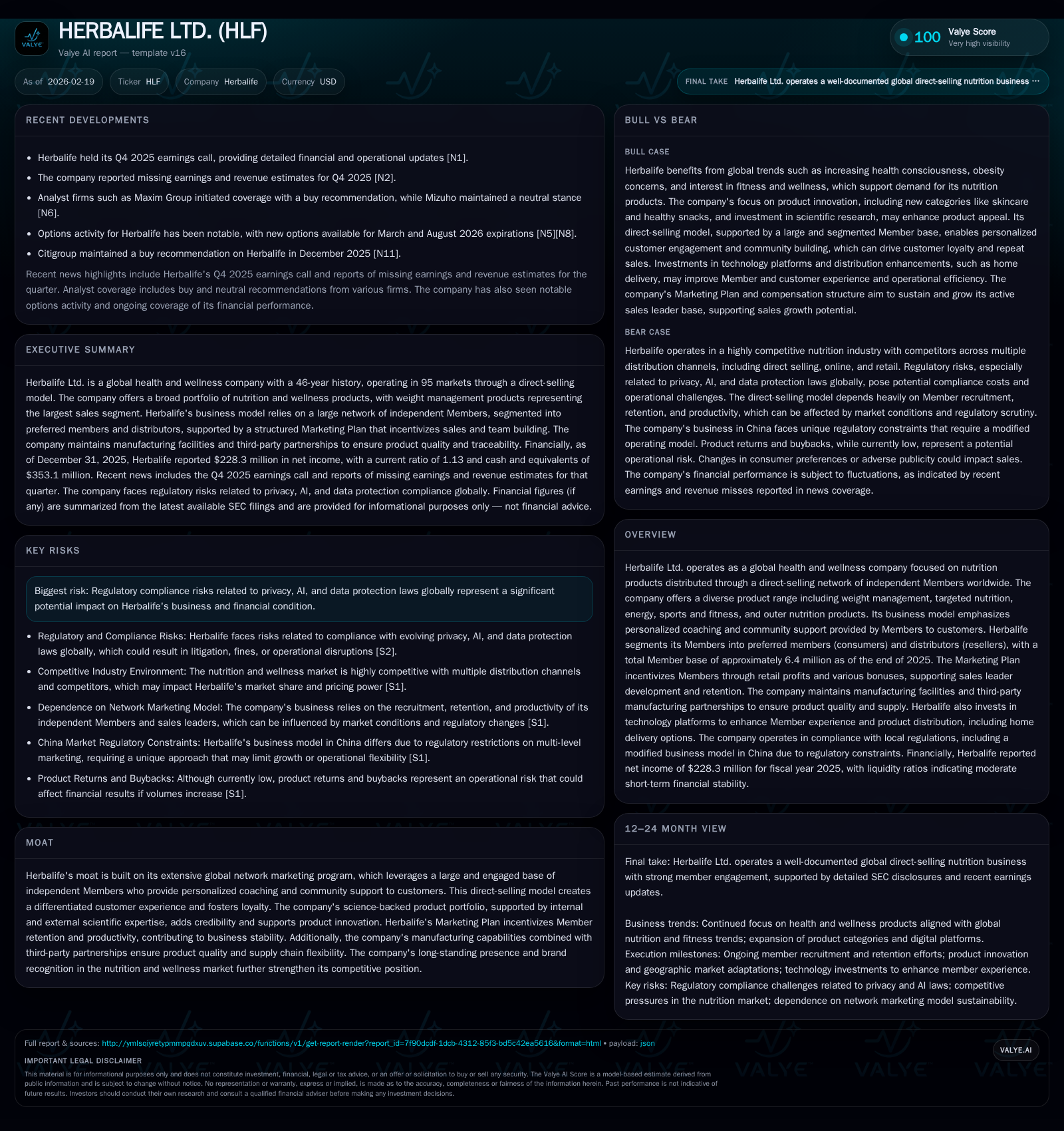
Herbalife Ltd., a leader in direct-selling nutrition products, bases its growth on a robust network of 6.4 million Members worldwide who provide personalized coaching and community support. Despite a rebound in operating income in 2025, net income declined, reflecting ongoing margin pressures and regulatory challenges. The company’s diverse product portfolio, segmented Member base, and innovative marketing strategies like Nutrition Clubs underpin its sales momentum. However, increasing regulatory scrutiny on privacy, AI, and health claims impose operational constraints that Herbalife navigates through technology investments and compliance initiatives.
Member-Driven Growth: Historical Operating and Financial Performance
Herbalife Ltd.’s financial trajectory over the past four fiscal years illustrates resilience powered by its deep-rooted direct-selling model yet marks complexity beneath headline profitability gains. The company’s operating income rebounded robustly to $481 million in FY2025 from $386 million in FY2024—a notable 24.6% year-over-year increase after an erosion post-FY2022’s $545 million peak [F1]. However, net income declined modestly to $228 million (-10.2% YoY), reflecting pressures such as increased selling expenses or cost of sales that squeezed margins despite top-line growth.
Operating cash flow was robust at $333 million in FY2025 (+16.8% YoY), supporting continued investment albeit at reduced capital expenditure levels ($80 million in FY2025 vs. $122 million in FY2024, marking a 34.1% decrease) [F1]. This translates into healthier free cash flow generation ($253 million in FY2025), providing balance sheet flexibility against persistent negative equity (-$515 million) contributing to an approximate negative ROE of -44%—a consequence of accumulated deficits despite recurring profitability.
Historical performance (annual)
| FY | Net ($mm) | CFO ($mm) | OpInc ($mm) | Capex ($mm) | Net YoY |
|---|---|---|---|---|---|
| 2025 | 228 | 333 | 481 | 80 | -10.2% |
| 2024 | 254 | 285 | 386 | 122 | +78.8% |
| 2023 | 142 | 358 | 356 | 135 | -55.7% |
| 2022 | 321 | 353 | 545 | 156 |
Note: Omitted columns lack sufficient annual XBRL coverage in the provided tags (need ≥2 annual points): Rev, Div. Source: SEC companyfacts cache [F1].
Capital returns and efficiency (annual)
| FY | Buybacks ($mm) | FCF ($mm) | ROE% |
|---|---|---|---|
| 2025 | 8 | 253 | -44.3 |
| 2024 | 8 | 163 | -31.7 |
| 2023 | 11 | 223 | -13.4 |
| 2022 | 147 | 196 | -25.4 |
Source: SEC companyfacts cache [F1].
Note: Revenue figures are not available from provided tags.
Shifting Segment Mix and Product Innovation as Growth Drivers
Herbalife’s diverse product spectrum underpins its global reach across weight management (54.5%), targeted nutrition (30%), energy/sports/fitness (~12%), and smaller outer nutrition segments [S6]. The weight management category encompasses flagship formulas like Formula 1 Healthy Meal replacement shakes and metabolism boosters pivotal to its customer retention strategy.
Innovation extends beyond products into how they are marketed by Members adapting to shifting consumer preferences for convenience, personalization, and wellness lifestyles globally [S29]. For instance, the Nutrition Clubs pioneered by Members in Mexico operationalize daily consumption models—serving prepared single servings that promote not only habitual product intake but also community engagement around shared health goals [S5]. Complementary programs including Fit Camps and Weight Loss Challenges exemplify ‘Daily Methods of Operations’ (DMOs), designed to sustain interaction frequencies crucial for long-term loyalty.
Scientific rigor supports this innovation pipeline via internal R&D augmented by Global Advisory Boards comprising leading nutritionists and fitness experts who guide ingredient selection and product efficacy claims [S29]. Recent launches like HL/Skin skincare line and metabolic health supplements indicate Herbalife’s extension into adjacent wellness categories aligned with consumer trends.
Regulatory Landscape and Its Impact on Business Model Adaptations
Herbalife operates under heavy regulatory scrutiny shaping its direct selling practices worldwide. The U.S. FTC Consent Order stemming from multi-year investigations mandates clear Member segmentation between preferred customers and distributors ensuring compensation is linked to genuine retail activity rather than inventory loading or recruitment incentives [S4, S10]. It specifically restricts misleading lifestyle or income promises, reinforcing transparent marketing communications.
Globally, Herbalife navigates complex food supplement regulations such as the European Food Safety Authority’s constraints on health claims approved for labeling necessitating reformulations or label modifications to maintain market access [S4]. Privacy laws intensify compliance complexity as Herbalife collects biometric-level health data through digital platforms used by millions of Members—subjecting the company to overlapping mandates including GDPR (EU), CCPA (California), China PIPL, India’s Digital Personal Data Protection Act among others [S7, S17, S28].
The advent of AI applications embedded within Herbalife’s Pro2col platform amplifies regulatory challenges related to algorithmic transparency and data security heightening operational risks [S2], reflecting broader industry-wide concerns about AI governance.
Global Expansion Strategy Balancing Localization and Compliance
Entering new markets involves rigorous pre-launch engagement with local regulators requiring certification or approvals that can involve ingredient testing or mandatory product reformulations to comply with national standards—actions that slow rapid deployment but ensure sustained compliance integrity [S4, S20, S23]. For example, Herbalife’s manufacturing partnerships geographically spread across continents facilitate localized ingredient sourcing adhering to traceability standards integral to their 'seed to feed' quality model.
India, China (where multilevel marketing is prohibited but direct selling is allowed), Latin America, and North America remain core markets where incremental adjustments accommodate differing legal frameworks while leveraging standardized production capabilities within proprietary manufacturing sites alongside CGMP-compliant third-party facilities ensuring quality control consistency globally [S11,S14,S24].
Financial Health Snapshot: Operating Income, Net Income, Cash Flows, and Capital Allocation
Financially, Herbalife exhibits strength in operating cash generation contrasting with persistent equity deficits weighing on traditional ROE metrics (~-44%) driven by accumulated net losses over time offsetting recent profitability gains [F1]. Capital expenditures have moderated sharply since the peak in FY2022 reflecting a strategic shift toward efficiency post-global transformation initiatives completed in FY2024 focused on enhancing operational scalability through technology investments like SaaS applications replacing legacy IT infrastructure [S22,S23].
Share repurchases are moderate relative to past levels (~$8 million annually since FY2023 compared with $146 million in FY2022), consistent with a conservative capital allocation approach amidst growth-focused investments and regulatory uncertainties restricting aggressive buybacks [F1]. Dividends remain non-existent indicating prioritization of reinvestment over shareholder payouts.
Marketing Plan Incentivization: Retention and Productivity of Members
Member motivation is central to sustained sales volume underpinned by a structured Marketing Plan offering retail profit from discounted product purchases plus bonuses contingent on team sales performance for distributors achieving sales leader status [S24,S6]. The plan calculates compensation using volume points translating into multi-tiered bonuses fostering recruitment while emphasizing active retailing rather than mere stockpiling.
This plan aligns closely with building a loyal community as illustrated through education events both virtual and physical that disseminate best practices among sales leaders enhancing DMOs that promote daily customer contacts helping mitigate churn risk within the network marketing program [S15]. Approximately 70% of sales leaders requalify annually underscoring reasonable retention given sector norms where high attrition is common [S27].
Technology Integration to Enhance Member Experience and Data Security
Investment in the Pro2col platform beta marks a step toward advanced data analytics capturing detailed Member-customer interactions enabling tailored marketing strategies which aim to boost productivity but concomitantly raise cybersecurity exposure requiring ongoing mitigation investments [S2]. Parallel enhancements include mobile ordering upgrades facilitating home delivery aligning with shifting consumption habits especially prominent during pandemic aftermaths affecting supply chain dynamics.
These digital tools also support compliance monitoring addressing member conduct requirements tied to multiple regulatory frameworks globally safeguarding brand trust while handling sensitive personal health information under various stringent laws imposing escalating compliance costs [S17].
Emerging Risks from Data Privacy and AI Regulations
Growing enforcement across jurisdictions on biometric data usage combined with nascent AI-specific rules inject substantial compliance uncertainty impacting how Herbalife collects processes personal information while developing machine learning-based platforms [S16,S18]. Noncompliance could trigger litigation exposure financial penalties reputational harm reducing member engagement particularly critical given reliance on digital platforms for business operations.
Moreover regulatory interpretations vary widely complicating uniform policy enforcement challenging subsidiaries managing local nuances requiring continuous legal vigilance increasing administrative burden consequently balancing growth ambitions versus risk containment efforts [S9,S19].
Investor Watchlist: What to Monitor Next in Earnings and Market Position
Market attention should focus on quarterly earnings execution relative to evolving revenue guidance upward revised for FY26 amid mixed Q4 results pointing toward operational execution risks amid macroeconomic uncertainties [N1,N3]. Further innovation cadence reflected through new product introductions across metabolic health supplements or healthy lifespan brands will indicate ability to sustain innovation-led growth vectors crucial within fast-evolving wellness markets dominated increasingly by personalization trends.
Watch also regulatory developments particularly any FTC or international rulings affecting marketing claims or Member incentives potentially constraining network marketing economics [N2]. Progress on digital platform deployments including robustness against cyber threats will remain significant given strategic importance as enabler of member productivity underlying Herbalife’s competitive advantage based on personalized coaching networks.
This analysis synthesizes current public disclosures without providing investment recommendations or price targets. Readers should consider company filings directly for comprehensive understanding.
Disclaimer: This is research-only, informational analysis and not investment advice. It may include AI-generated interpretation and general industry context. Always verify important details using primary sources.

Comments