
Amrize Ltd Emerges as an Integrated Force in North American Building Solutions
Following its 2025 spin-off from Holcim Ltd, Amrize leverages scale, a broad product portfolio, and disciplined capital strategies to build a foundation for sustainable growth.
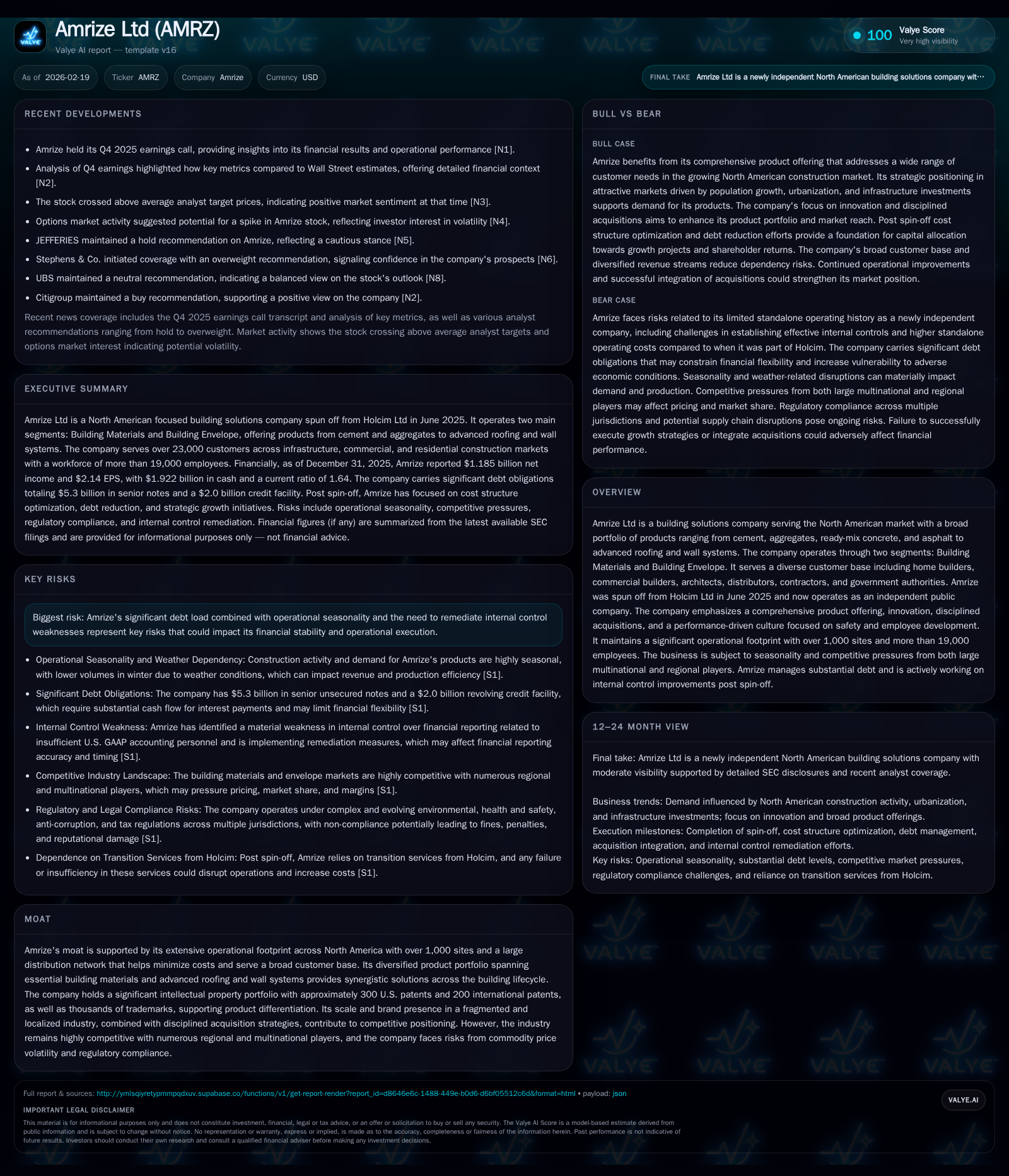
Amrize Ltd transitioned into a standalone entity after its spin-off in mid-2025, inheriting a vast operational footprint with over 1,000 sites across North America and a diversified portfolio spanning cement, aggregates, ready-mix concrete, asphalt, and advanced building envelope solutions. The company reported solid profitability and cash flow metrics for 2025 with $1.91 billion operating income and $1.18 billion net income, supported by strong operating cash flow of $2.21 billion. Its future growth outlook rests on synergistic bolt-on acquisitions and innovation within its two core segments amid challenges posed by seasonality, high debt leverage, raw material volatility, and competitive pressures in a fragmented industry. Capital allocation is constrained by Swiss legal frameworks impacting share repurchases and dividends. Key areas to monitor include margin resilience during seasonal downturns, deleveraging progress, acquisition execution, and internal control remediation milestones.
From Spin-Off to Standalone: Setting the Stage for Growth
The June 2025 spin-off from Holcim Ltd marked a defining structural pivot for Amrize Ltd as it emerged as a leaner standalone public company dedicated exclusively to North American building solutions [S1][N1]. By shedding extraneous corporate overhead inherent in its previous conglomerate ownership structure, Amrize recalibrated its organizational focus around capital efficiency and customer intimacy. Early management actions targeted reduction of external borrowings during H2 2025 while maintaining significant liquidity buffers—positioning the company to fund organic expansions alongside bolt-on acquisitions [S1]. This autonomy allowed Amrize to put into place operational discipline tailored to the fragmented residential/commercial construction materials market it now serves.
The strategic rationale underpinned by spin-off was clear: streamline costs while sharpening product integration efforts spanning foundational materials through the building envelope. Management articulated goals anchored on long-term profitable growth driven by innovation and disciplined capital deployment [S5]. This operational independence also facilitated more granular resource allocation aligned with customer segments ranging from homebuilders to government infrastructure projects.
Diverse Product Lines Driving Historical Performance
Amrize’s business operations bifurcate into two reportable segments reflective of distinct yet complementary product ecosystems [S6][S19]:
Building Materials: This segment encompasses essential construction inputs including cement — produced with customized blends meeting project-specific requirements — alongside aggregates (crushed stone, sand, gravel), ready-mix concrete tailored for logistical and weather variables, asphalt paving products plus other downstream materials [S19]. These components anchor fundamental infrastructure builds and new construction activity.
Building Envelope: The envelope segment integrates advanced roofing and wall systems critical for energy efficiency and structural protection in commercial and residential buildings. Products include single-ply membranes for waterproofing roofs; various insulations aligning with thermal performance mandates; shingles providing durability and aesthetics; sheathing boards reinforcing walls against moisture intrusion; along with protective coatings and application aids such as adhesives and tapes [S19][S24].
This broad portfolio enables Amrize to offer end-to-end solutions across construction lifecycles from foundations to roofs thus generating cross-segment synergies via bundled offerings addressing diverse builder needs.
Operating Income and Profitability Metrics Through 2025
While revenue data is not available in the provided tags [F1], core profitability statistics reflect solid initial financial footing post-spin-off:
Historical performance (annual)
| FY |
|---|
| 2025 |
Note: Omitted columns lack sufficient annual XBRL coverage in the provided tags (need ≥2 annual points): Rev, Net, CFO, OpInc, Capex, Div, Buybacks, FCF, ROE%. Source: SEC companyfacts cache [F1].
Operating income of nearly $1.91 billion coupled with net income exceeding $1.18 billion equates to an approximate return on equity near 8.9%, based on year-end equity of about $13.26 billion [F1]. These metrics indicate efficient conversion of earnings despite costs associated with establishing standalone operations.
Robust operating cash flow generation translated into roughly $1.42 billion free cash flow after capital expenditures underscores healthy internal financing capacity critical for funding growth projects or debt servicing [F1].
Navigating Seasonality and Competitive Pressures
Seasonality imposes meaningful constraints on Amrize’s volume stability given its exposure primarily within North American markets characterized by cold winters which curb construction activity [S21]. Demand typically dips significantly during Q1 due to adverse weather limiting site work; Q4 also shows moderated volumes though less pronounced. This cyclical pattern necessitates operational flexibility managing working capital cycles amid fluctuating throughput.
Competition remains intense especially within ready-mix concrete markets where low capital entry barriers result in numerous regional players alongside multinational competitors like Cemex or Heidelberg Materials [S6]. Cement production presents somewhat higher barriers but still faces pricing pressure stemming from transportation costs relative to end product prices—a critical factor given the localized nature of markets requiring proximity between plants and customers for cost-effective delivery.
Within the Building Envelope segment competition centers around innovation leadership as well as distribution reach given product differentiation potential through energy-efficient roofing systems increasingly aligned with governmental sustainability criteria [S24]. Established incumbents such as Carlisle or CertainTeed compete alongside specialized entrants catering to niche geographies.
Strategic Growth Drivers: Bolt-On Acquisitions & Innovation
Management emphasizes disciplined acquisition approaches focusing on "bolt-on" deals within highly fragmented aggregates/concrete markets where scale advantages translate directly into improved logistics efficiencies [S9]. Similarly, measured expansion within advanced roofing/wall systems leverages intellectual property portfolios supporting differentiated product technologies favorable for evolving energy codes compliance [S1][S9].
Innovation hubs foster incremental upgrades as well as development of products responding swiftly to regulatory shifts toward sustainable construction practices—amplifying differentiated value propositions amid intensifying competitive landscapes.
Capital Structure & Liquidity Position at Year-End 2025
As of December 31, 2025 [F1][S8]:
- Senior unsecured notes outstanding approximate $5.3 billion,
- Revolving credit facility commitments total $2 billion,
- Cash & equivalents stand at roughly $1.92 billion,
- Current assets at ~$4.68 billion versus current liabilities around $2.86 billion yield a current ratio near 1.64.
This capital structure mix underscores moderate leverage common within asset-intensive industries but leaves manageable liquidity cushions essential to navigating seasonal variability or unexpected expenditure spikes [S8]. However refinancing risk exists since access conditions post-spin-off differ compared to prior Holcim-backed arrangements.
Shareholder Returns: Dividends & Buybacks Constrained by Swiss Law
No dividends or share repurchases have been declared or completed since spin-off as of end-2025 according to available data [F1][S4][S7]. Swiss law mandates shareholder authorization for share cancellations linked to buybacks along with minimum distributable reserves conditions constraining immediate capital return programs.
Swiss withholding tax structures impose up to a 35% levy on distributions unless allocated appropriately between share capital reduction or capital reserves from tax contributions – complicating dividend policy further especially given concurrent U.S excise tax (~1%) on certain repurchases by foreign entities listed stateside [S4][S7].
Therefore, capital returns currently remain contingent on legal approvals while management balances growth investment needs against shareholder remuneration ambitions.
Risks Impacting Execution: Leverage & Operational Controls
Substantial leverage at over $5 billion face value senior notes poses refinancing risk under adverse credit market environments or if operating cash flows falter due to seasonal downturns or raw material cost surges impacting margins disproportionately [S8][S12].
Additionally internal control remediation efforts flagged post-spin-off raise governance concerns potentially impacting financial reporting reliability or execution discipline [S12]. Seasonality exacerbates earnings volatility typical in building materials industries.
Raw material availability risks persist given dependencies on petroleum-based inputs for envelope products alongside mineral resources critical for cement/aggregates supply chains which may be affected by geopolitical factors or trade disruptions increasing cost burdens [S20][S24].
Environmental regulations tightening emissions limits or mandating sustainability disclosures introduce compliance cost headwinds that could impair profitability if not managed proactively [S25][S28]. Legal proceedings currently routine but could pose reputational risks if escalated unexpectedly [S12][S26].
Key Milestones & Metrics To Monitor Going Forward
Investors should track quarterly earnings releases closely for margin trends balanced against seasonal demand shifts [N1][N2]. Deleveraging pace relative to cash flow generation will indicate capital structure stability while acquisition announcements will signal management’s execution discipline around bolt-on growth targets [N3].
R&D breakthroughs translating into commercialized innovations provide leading indicators of competitive differentiation particularly within energy-efficient building envelope products crucial under evolving sustainability standards.
Regulatory filings disclosing progress on internal control improvements will reveal governance strengthening post-spin-off critical for investor confidence.
Overall sustained performance improvements against seasonal headwinds combined with judicious capital deployment remain principal barometers defining Amrize’s medium-term trajectory toward integrated building solutions leadership across North America.
Disclaimer: This analysis is based solely on publicly available information from SEC filings dated February 18, 2026 ([S1]-[S29]), recent earnings call transcripts ([N1]-[N3]) as well as validated company facts ([F1]). No forward-looking statements or investment advice are offered herein.
Disclaimer: This is research-only, informational analysis and not investment advice. It may include AI-generated interpretation and general industry context. Always verify important details using primary sources.

Comments