
SkyWest Expands Fleet and Operations While Managing Major Airline Partnerships and Regulatory Challenges
SkyWest, the largest U.S. regional airline, leverages capacity purchase agreements for steady revenues amid pilot supply constraints and evolving industry regulations.
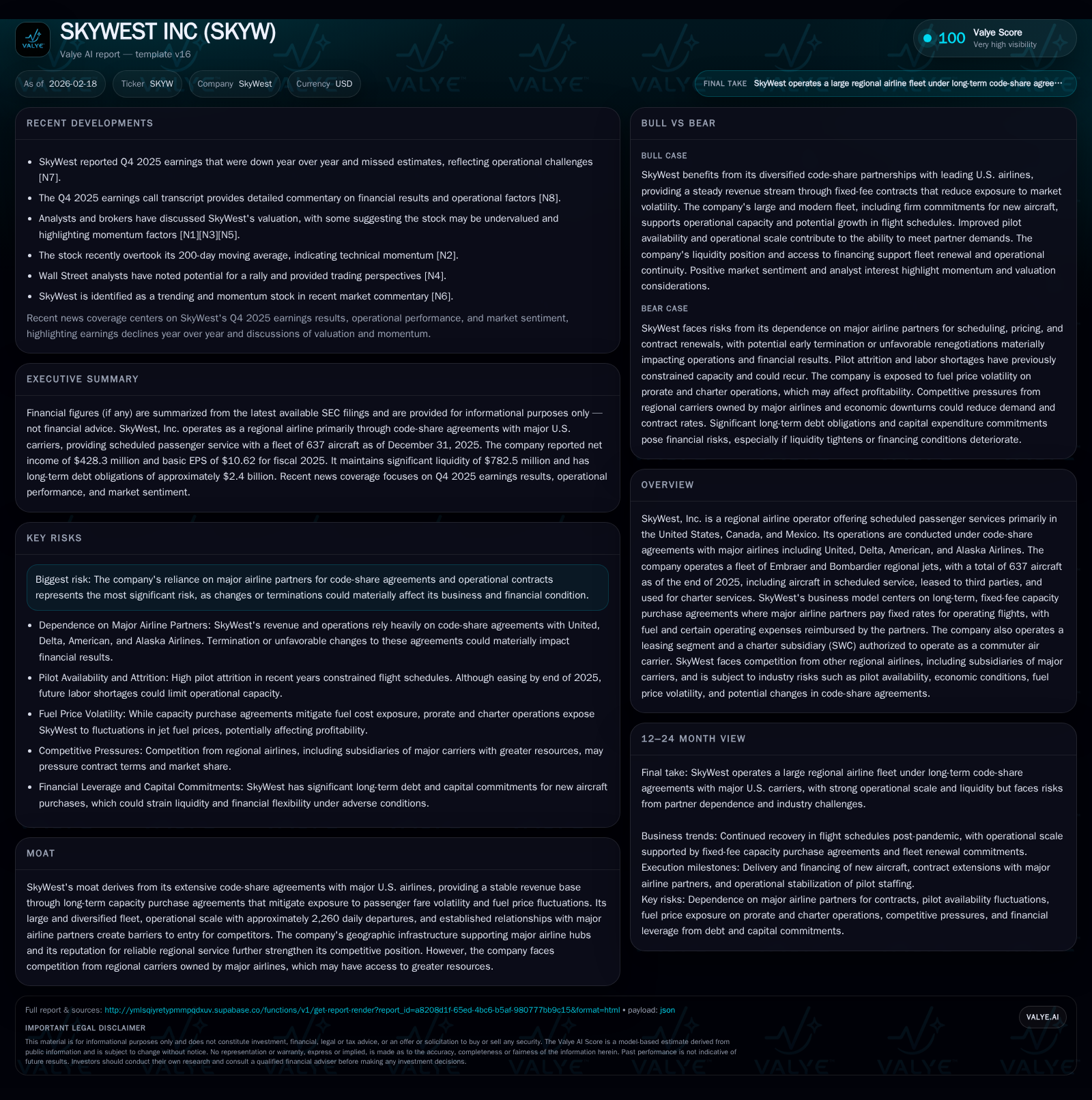
SkyWest Inc. operates a sizable regional airline fleet under fixed-fee capacity purchase agreements with major U.S. carriers, providing a stable revenue base insulated from passenger fare volatility. The company expanded its fleet to 637 aircraft by end-2025 and increased daily departures to about 2,260, driven by recovery in flight schedules as pilot attrition issues eased. While operating income and net income showed steady improvement through 2025 supported by efficient code-share partnerships, growth is capped by scope clauses limiting regional aircraft size and number. SkyWest also faces risks from reliance on major partners, regulatory compliance mandates, and operational disruptions linked to weather and service providers. Capital allocation includes measured share repurchases but no dividends since 2020, alongside commitments for $2.3 billion of new E175 aircraft acquisitions.
Company Overview
SkyWest Inc., established in 1972, stands as the largest regional airline operator in the United States, specializing in scheduled passenger services via code-share agreements with United, Delta, American Airlines, and Alaska Airlines [S21]. Contrary to independent commercial airlines that assume fare risk and direct ticketing responsibilities, SkyWest operates under capacity purchase agreements where its major airline partners pay fixed fees primarily based on flight completions and block hours [S15][S17]. These contracts mitigate SkyWest’s exposure to revenue volatility linked to fluctuating passenger demand or fare prices.
As of December 31, 2025, SkyWest’s fleet comprised 637 aircraft—including Embraer E175 regional jets and several Bombardier CRJ variants—with roughly 487 deployed under active code-share agreements and another subset leased or deployed in charter services via its subsidiary SWC [S21][S22]. The carrier provided about 2,260 daily departures distributed approximately as: United Express (940 flights), Delta Connection (680), American Eagle (420), and Alaska Airlines (210) flights [S21]. Its hub infrastructure supports key airports like Chicago O’Hare, Dallas/Fort Worth, Denver, Detroit, Los Angeles, Minneapolis-St. Paul, Phoenix, Salt Lake City, San Francisco and Seattle.
Historical Performance and Growth Drivers
From a financial perspective, SkyWest exhibited steady growth leading into the mid-2020s after pandemic-related disruptions. Operating income surged from $104 million in FY2023 to approximately $618 million in FY2025 reflecting restored flight schedules and operational efficiencies [F1]. Net income followed a similar trajectory ending FY2025 at $428 million. Operating cash flows expanded robustly to over $940 million in FY2025 from about $736 million two years earlier [F1]. Capital expenditures have remained moderate relative to operating cash flow—around $32 million in FY2025—as the company strategically manages investments amid fleet expansion plans.
Historical performance (annual)
| FY | CFO ($mm) | OpInc ($mm) | Capex ($mm) |
|---|---|---|---|
| 2025 | 940 | 618 | 32 |
| 2024 | 692 | 495 | 45 |
| 2023 | 736 | 104 | 13 |
| 2022 | 480 | 181 | 13 |
Note: Omitted columns lack sufficient annual XBRL coverage in the provided tags (need ≥2 annual points): Rev, Net, Div, Buybacks, ROE%. Source: SEC companyfacts cache [F1].
Capital returns and efficiency (annual)
| FY | FCF ($mm) |
|---|---|
| 2025 | 908 |
| 2024 | 648 |
| 2023 | 723 |
| 2022 | 467 |
Source: SEC companyfacts cache [F1].
Note: Revenue data not reported past FY2019; YoY calculations available only for operating income.
Operationally, the gradual easing of pilot shortages contributed importantly to increased departure counts—from approximately 691k completed flights in FY2023 to over 863k by FY2025—and higher block hours flown [S6]. Pilot attrition peaked between mid-2022 and mid-2023 due to intense hiring by mainline carriers but stabilized during late 2024 enabling SkyWest to meet contractual flying schedules requested by partner airlines [S9]. This improvement alleviated previous underutilization and boosted revenue recognition under fixed-fee contracts.
Business Model Nuances and Industry Context
SkyWest’s fundamental value proposition lies in its extensive suite of long-term code-share relationships where the company effectively acts as an operational contractor rather than a traditional airline revenue operator [S21][S25]. Through these capacity purchase agreements:
- Major carriers manage fares, booking systems, inventory controls,
- SkyWest receives predetermined payments per departure hour or block hour,
- Fuel costs and certain direct expenses are reimbursed or borne by partners,
- Incentives are tied to operational metrics like completion rates.
This fixed-fee structure insulates SkyWest from direct exposure to passenger traffic declines or fare competition but caps upside participation in ticket price increases or ancillary revenue gains [S15]. It does however introduce significant dependency risks on partner contracts that can be terminated or renegotiated (notably United and Delta contribute over three quarters of aircraft under agreements) [S11][S25].
The company's scale confers competitive moat benefits including geographic reach across prominent hub airports which creates high switching costs for partners considering alternate regional carrier arrangements . However competitors include regional subsidiaries owned directly by major airlines (Endeavor Air for Delta; Envoy/PSA/Piedmont for American; Horizon for Alaska), which may benefit from deeper capital access or preferential contract renewals [S4][S9]. Additionally, low-cost carriers expanding point-to-point networks indirectly affect demand patterns on routes fed by SkyWest’s hubs.
Labor availability—especially pilots—remains critical given scope clauses that limit maximum regional aircraft size (~76 seats) operated by legacy contract flights [S9][S25]. Such contractual "scope limitations" restrict fleet growth potential despite increasing demand on certain hubs.
Future Growth Prospects
Growth avenues for SkyWest hinge on:
- Increasing utilization of existing regional jets as pilot supply stabilizes,
- Incrementally adding newer E175 jets aligned to partner network optimization plans; firm orders pegged at a substantial $2.3 billion cost with deliveries anticipated over next several years [S5],
- Expanding prorate routes where SkyWest shares ticket revenues directly with partners allowing more profit participation but with passenger/yield risk [S16][S20],
- Developing charter operations with SWC leveraging recent commuter authority granted in late 2025 potentially diversifying revenue streams,
- Potential ventures into emerging electric VTOL (eVTOL) markets through partnership agreements with Eve Holding Inc.—an embryonic but strategically significant investment aligned with sustainability trends [S22].
Constraints remain material primarily due to partner-imposed scope clauses limiting total regional jet capacity within their networks plus competition for these flying contracts from parent-owned regionals [S9][S25]. Additionally, tariff-driven cost inflation on imported Embraer parts raises sourcing costs while regulatory frameworks could tighten safety & environmental compliance burdens going forward [S16][S27].
Earnings Milestones & Market Sentiment
While official guidance remains limited post-FY2025 results release (Q4 earnings reported January '26 missed estimates slightly due to elevated maintenance costs and scheduling inefficiencies during winter months [N1][N2]), management indicated confidence in returning full-year profitability growth driven by stabilized operations and lower attrition impacts moving forward [N3]. Analysts' growing focus on improved cash flows alongside strategic fleet refresh bolsters bullish investor conversations despite cyclical headwinds affecting regional aviation broadly .
Key milestones include tracking deferred revenue recognition related to capacity purchase agreements where approx $265 million was received but not yet recognized as revenue at FY-end—a timing item sensitive to utilization rates in upcoming periods [S23]. Also noteworthy is the reinstatement of share buybacks following removal of pandemic-era restrictions along with sustained liquidity buffers exceeding $780 million ensuring flexibility around capital deployment needs [F1][S8].
Capital Allocation & Financial Returns
SkyWest’s capital allocation strategy reflects a cautious balance:
- No dividends paid since restrictions lifted post-pandemic support programs ended; dividend policy remains discretionary based on financial condition [S8],
- Significant share repurchase authorization ($500 million total approved across programs initiated in May '23 & extended May '25) demonstrates a focus on enhancing shareholder returns amid capital market volatility,
- Strong operating cash flow generation (
$940 million FY25) exceeds modest capex ($32 million), resulting in free cash flow near $908 million supporting debt repayments and aircraft acquisitions, - Equity base has grown consistent with retained earnings accumulation reaching roughly $2.75 billion at end-FY25,
- Return on equity approximates a solid mid-teens level (~15.6%) indicating effective capital use given industry cyclicality [F1].
Debt load remains meaningful (~$2.4 billion long-term debt largely tied to fleet financing), but is managed within bounds supported by contracted revenue streams thread through long-term code-share agreements which typically include protections against partner credit defaults [S10][S26]. SkyWest maintains liquidity reserves including ~$707 million cash plus undrawn revolver capacity ~75 million USD providing near-term flexibility.
Operational Risks & Industry Challenges
Several operational risks persist:
- Continued dependence on major airline partners’ willingness to extend or renew fixed-rate contracts,
- Exposure to labor market dynamics especially pilot recruitment/retention affecting flying schedule capacities,
- Vulnerability to third-party supplier delays impacting maintenance turnaround times and grounded aircraft reactivation efforts;
- Weather-related disruptions given high operational volumes at severe climate hubs (Chicago O’Hare winter snarls historically affect completion rates);
- Regulatory uncertainties encompassing FAA certification standards changes plus evolving environmental mandates;
- Cybersecurity threats without current insurance coverage heightening operational disruption risks;
- Geopolitical tensions potentially increasing fuel price volatility despite reimbursement provisions under existing agreements;
- Competition from vertically integrated regionals owned by majors leveraging broader resource bases constraining contract wins.
Overall risks revolve around managing concentrated counterparty exposure underscored by code-share reliance coupled with operational commitment scales that are less flexible than fully independent operators.
Sustainability & Innovation Initiatives
Recognizing climate pressure within aviation sector emissions (~6.3 million metric tons CO₂-equivalent emissions reported in FY25 attributed mainly to jet fuel usage under partner-managed procurement), SkyWest collaborates closely with partners exploring sustainable aviation fuels adoption and progressively electrifying ground equipment fleets contributing incremental carbon footprint reductions efforts [S26][S22]. The new eVTOL partnership further highlights strategic positioning towards emerging urban air mobility solutions although commercial viability timelines remain nascent.
Conclusion & Outlook Considerations
SkyWest occupies a pivotal role within the U.S. regional airline ecosystem anchored by strong capacity purchase agreements offering defensible recurring revenues while displaying disciplined financial stewardship evidenced by improving profit metrics and robust cash flows through FY25. However growth carries inherent bounds dictated by partner-imposed scope limits alongside external challenges from labor supply dynamics and evolving regulation landscapes.
Future performance will hinge critically on:
- Successful delivery integration of committed aircraft orders enhancing fleet modernization,
- Stable retention of key partner contracts amidst competitive tenders,
- Effective management of operational supply chain risks including maintenance part availability,
- Navigating regulatory changes especially pertaining environmental compliance,
- Scaling prorate route profitability alongside cautious expansion of charter activities.
Investors looking beyond headline valuations should closely monitor upcoming quarterly production statistics compared against contract utilization cushions plus deferred revenue recognition flows reflecting underlying contractual health.
This analysis is based on publicly available information including SEC filings dated February 17, 2026 (10-K), recent earnings call transcripts January ‘26,, industry reports contained herein labeled Valye excerpts,and XBRL financial data snapshots cited as [F1]. This document does not provide investment advice or recommendations.
Disclaimer: This is research-only, informational analysis and not investment advice. It may include AI-generated interpretation and general industry context. Always verify important details using primary sources.

Comments