
Palatin Technologies’ Strategic Pivot: From Clinical Challenges to Collaboration-Driven Growth
Palatin leverages its melanocortin receptor peptide platform and Boehringer Ingelheim partnership to drive future growth despite regulatory and liquidity risks.
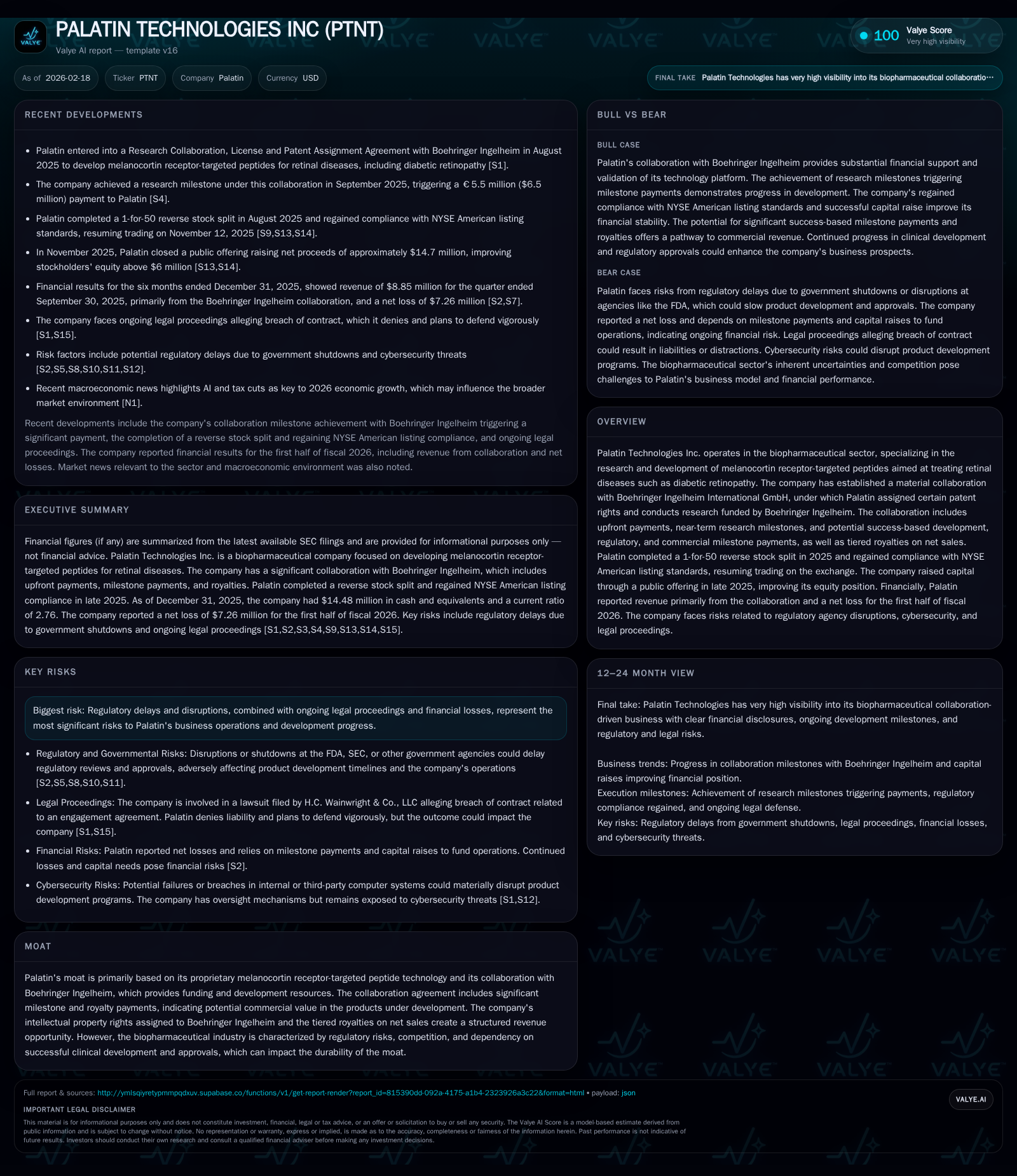
Palatin Technologies has faced substantial operational losses and regulatory challenges in recent years, underscored by zero revenue in FY2025's first half and ongoing legal disputes. Their breakthrough collaboration with Boehringer Ingelheim, featuring upfront payments and milestone-triggered funding tied to novel melanocortin-targeted peptides for retinal diseases, stands as a critical growth catalyst. The company’s 2025 capital restructuring through a reverse stock split and equity offering restored NYSE American listing compliance, securing necessary liquidity for ongoing R&D. Monitoring milestone achievements and FDA regulatory developments will be essential to assess Palatin’s transition from clinical-stage losses toward commercial maturity.
Reviving Growth: Historical Performance and Revenue Drivers
Palatin Technologies’ financial narrative over the past four fiscal years reveals significant volatility, chiefly shaped by milestone payments tied to its strategic collaboration with Boehringer Ingelheim. Revenue escalated from approximately $1.47 million in FY2022 to nearly $4.49 million in FY2024 before collapsing to zero in the first half of FY2025 [F1]. This stark drop stems largely from the timing of collaboration revenues rather than operational contraction.
Operating losses narrowed from approximately $36.6 million in FY2022 to $17.5 million in the most recent twelve months ended June 30, 2025—a notable 22.4% improvement YoY—reflecting controlled expenses but still substantial cash consumption [F1]. Net losses mirrored this pattern, decreasing 41.8% YoY but remaining deeply negative at $17.3 million for FY2025 H1 [F1]. A crucial event accounting for a chunk of revenue came during Q3 FY2025 when the upfront payment from Boehringer recorded approximately $8.8 million in revenue, lifting quarterly performance temporarily [S10]. Despite this transient spike, Palatin reported zero revenue for the prior full fiscal year ending June 30, 2025 [F1], underscoring irregular income streams dependent on milestone deliveries within its R&D pipeline.
Historical performance (annual)
| FY | Rev ($mm) | Net ($mm) | CFO ($mm) | OpInc ($mm) | Rev YoY | Net YoY |
|---|---|---|---|---|---|---|
| 2025 | 0 | -17 | -21 | -17 | -100.0% | +41.8% |
| 2024 | 4 | -30 | -31 | -22 | -7.5% | -8.0% |
| 2023 | 5 | -28 | -28 | -32 | +230.5% | +23.9% |
| 2022 | 1 | -36 | 0 | -37 |
Note: Omitted columns lack sufficient annual XBRL coverage in the provided tags (need ≥2 annual points): Capex, Div, Buybacks. Source: SEC companyfacts cache [F1].
Capital returns and efficiency (annual)
| FY | FCF ($mm) | ROE% |
|---|---|---|
| 2025 | -21 | 362.3 |
| 2024 | -32 | 26669.9 |
| 2023 | -29 | -20542.5 |
| 2022 | 0 | -222.5 |
Source: SEC companyfacts cache [F1]. +66 off | | FY2022 | 1,468,457 | N/A | -36,588,448 | N/A | -36,198,299 | N/A | 18,358 | N/A | 261,374 |
Note: Capex data omitted for inconsistent annual figures beyond these years.
Melanocortin Receptors: Core Technology and Collaboration Framework
Central to Palatin’s scientific moat is its proprietary platform targeting melanocortin receptors via specialized peptides engineered to treat retinal conditions such as diabetic retinopathy—an area marked by significant unmet medical needs due to complications of diabetes impacting vision.
The August 14th, 2025 research collaboration and license agreement with Boehringer Ingelheim International GmbH constitutes a pivotal strategic juncture [S23]. Palatin assigned specific patent rights pertaining to their peptide technology while remaining engaged as an active collaborator conducting BI-funded research over an initial two-year period with potential six-month extension rights , [S23]. The deal embeds multiple monetization layers: a €2 million upfront payment ($2.3 million USD), near-term research milestones up to €18 million ($21 million USD), success-based development and regulatory milestones aggregating around €260 million ($302 million USD), plus tiered royalties on future net sales tied directly to any resulting commercialized products.
This structured milestone-and-royalty framework aligns incentives between both parties while anchoring Palatin's future revenue potential firmly within the successful clinical progression and eventual market adoption of these peptide therapies—characteristics typical of biopharmaceutical commercialization paradigms where early R&D risk is offset by backend contingent monetization.
Capital Infusion and NYSE American Compliance: Structural Reset in 2025
Palatin's financial stability significantly benefitted from structural capital actions taken in calendar year 2025 aimed at counteracting delisting threats arising from depressed stock price levels.
A critical maneuver was the August 11 reverse stock split executed at a ratio of one-for-fifty shares which consolidated share count thereby increasing per-share pricing metrics [S10]. Following this action and subsequent public equity offerings commencing November 12th—raising gross proceeds near $15.8 million pre-deductions—the company regained compliance with NYSE American continued listing standards including achieving greater than $6 million in stockholders' equity as mandated [S10], [S13]. These moves reinstated trading on the NYSE American exchange under ticker PTN after suspension since May 7th of that year due to rule breaches related primarily to share price trading thresholds [S22], [S20].
This equity raise strengthened Palatin’s balance sheet enabling sustained investment into its pipeline alongside managing working capital demands amidst operating losses symptomatic of early-stage biotech ventures.
Regulatory Environment and Risk Landscape: FDA Uncertainties and Legal Exposure
Palatin’s developmental trajectory faces headwinds amplified by broader regulatory dynamics affecting FDA review mechanisms coupled with company-specific legal disputes.
Periodic U.S. federal government shutdowns have intermittently curtailed FDA operations leading to furloughs that slow down critical drug review timelines directly impacting companies reliant on FDA approval cycles for progressing clinical assets to market [S2], [S3], [S7]. Given Palatin's product candidates remain largely pre-commercial under development within regulated environments for retinal diseases, these delays could inhibit timely submission acceptance or prolong decision-making timelines—a notable inherent risk in biopharma innovation pipelines.
Moreover, Palatin confronts litigation initiated by H.C. Wainwright & Co., LLC alleging breach of contract related to engagement agreements involving warrants issuance under prior arrangements filed February 13th, 2025 [S1], [S6]. Although Palatin denies liability asserting affirmative defenses,[S1] ongoing legal proceedings pose procedural uncertainty and potential financial exposure that may divert management attention or capital resources if judgments ensue.
These factors collectively contribute material risk dimensions intertwined with operational execution capabilities.
Financial Health Check: Operating Losses, Cash Flow Stress, and Equity Trends
Despite innovation advances leveraged via licensing milestones and capital infusions, Palatin continues grappling with challenging cash flow profiles emblematic of clinical-stage biopharmaceutical companies prioritizing R&D investments over near-term profitability.
Operating income remained negative at approximately $17.46 million loss for FY2025 H1 albeit improving versus previous years’ wider deficits indicating effective expense control though not yet closing the loss gap [F1]. Concurrently net income loss reflects similar patterns with around $17.3 million deficit impacting retained earnings negatively driving total stockholders’ equity into deficit territory approximately negative $4.78 million mid-2025 down from positive values in prior years signaling balance sheet stress [F1].
Operating cash flow exhibited significant outflow near $21.3 million for the same period underscoring high cash burn rates primarily funding pipeline activities while capital expenditures remained nominal signaling absence of fixed asset accumulation aligned with focus on intangible R&D assets rather than physical infrastructure growth [F1].
Consequently contextually adjusted ROE metrics appear distorted given negative equity base precluding meaningful positive returns representation; no dividend distributions or capital return programs have been reported consistent with reinvestment mandates common among growth-phase biotechs [F1], .
Forecasting Growth Milestones: What the Boehringer Ingelheim Deal Entails
Forward-looking assessment hinges critically on progress against outlined collaborative milestones that trigger substantial financial inflows reflecting achievable endpoints along scientific validation pathways.
Near-term identifiable benchmarks include research phase accomplishments eligible for up to €18 million in payments with reported milestones such as one announced for September 22nd, 2025 triggering €5.5 million ($6.5 million) payments evidencing active collaboration momentum [S27]. Longer horizon upside incorporates success-based development aspects totaling several hundred million dollars pegged to later phase clinical successes alongside regulatory approvals culminating in commercial market launches attracting tiered royalty income streams situated as sustainable recurring revenue enablers intrinsic to biotech partnership agreements .
Absent explicit company guidance projecting exact timing or amounts beyond contractual maxima, investors would prudently track clinical development progress data releases including Investigational New Drug submissions acceptance dates or Phase trial readouts as proxies for measurable inflection points indicative of validating technical risk reduction.
Investment Considerations: Capital Allocation, Returns, and Liquidity Management
Palatin exhibits disciplined capital amassment predominantly through equity issuance without recourse to debt financing indicative of cautious leverage management given developmental risk profile typical within early-stage therapeutic developers [F1],[S10],[S12],[S15]. This strategy ensures strong liquidity buffer post-November 2025 raise facilitating uninterrupted R&D spend alongside corporate operations notwithstanding persistent operational losses.[F1]
With no dividends or share repurchases disclosed across filings spanning mid-2024 through late-2025, management clearly prioritizes reinvestment into pipeline expansion consistent with long-term value creation principles unique to innovation-driven biopharma setups where tangible ROI realization often spans multiple years post-FDA approvals.
The heavily negative equity position combined with ongoing net losses suggests current ROE calculations are not meaningful predictors of financial performance; instead focus shifts toward milestone achievement cadence compounded by royalty earning potential derived from licensing framework forming core intrinsic value drivers sustaining shareholder value over time.
Overall liquidity appears adequate presently but continuation depends heavily on securing further milestone payments or successful financing rounds given extended runway prerequisites inherent in clinical drug development cycles.
Disclaimer: This analysis is based solely on publicly available information including SEC filings and news sources as cited herein up through February 18th, 2026.The content herein does not constitute investment advice or recommendations to engage in any securities transactions.Palatins' future performance remains subject to significant clinical development risks,and investors should consider all relevant factors independently before making any decisions.
Disclaimer: This is research-only, informational analysis and not investment advice. It may include AI-generated interpretation and general industry context. Always verify important details using primary sources.

Comments