
Cohu Inc’s Innovation and Recurring Revenue Strategies Amid Semiconductor Cyclicality
Cohu Inc leverages product diversity, R&D, and recurring revenue to navigate profitability pressures in a volatile semiconductor industry.
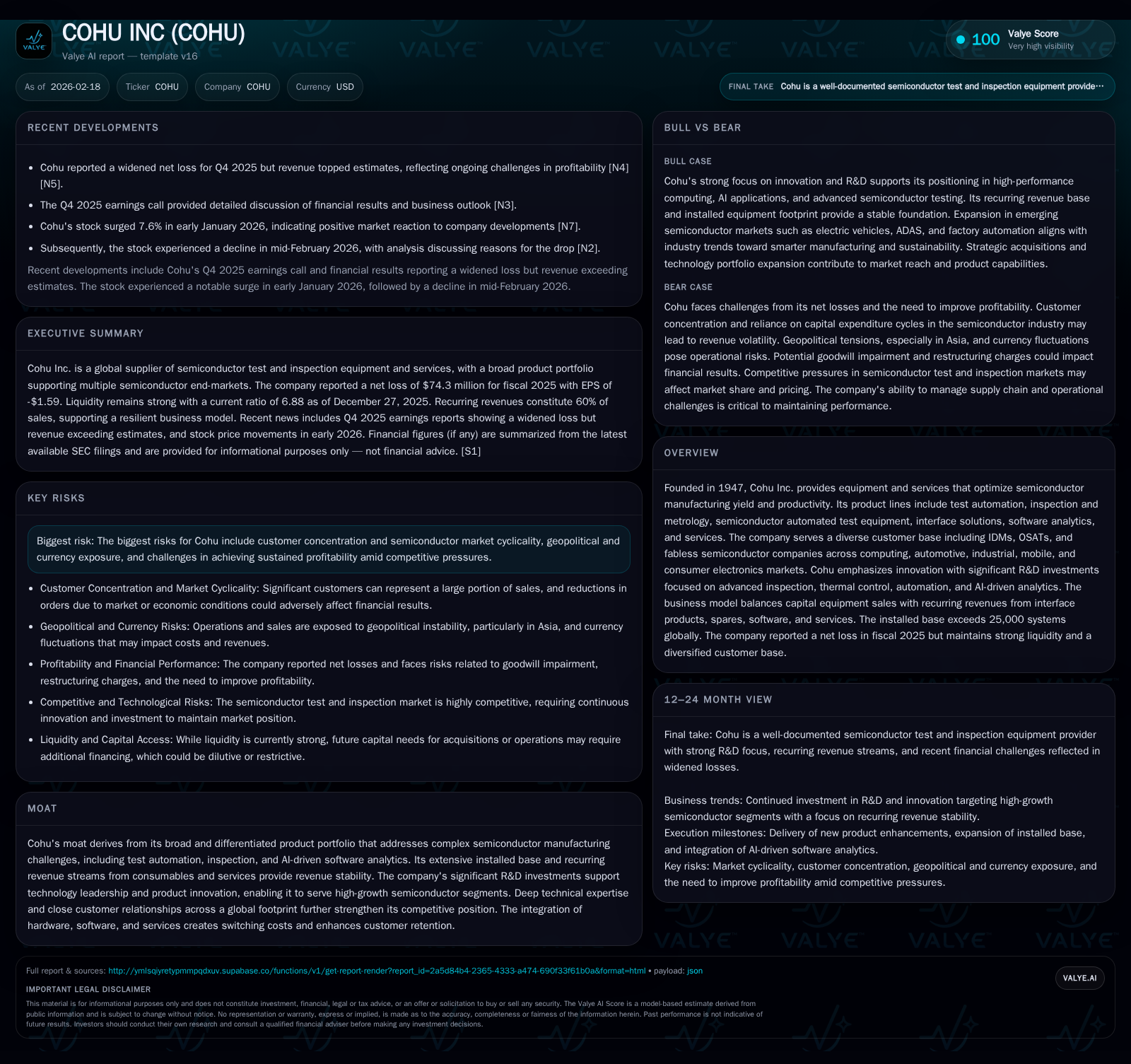
Cohu Inc, a longstanding supplier of semiconductor test and inspection equipment, has seen significant swings in profitability over recent years due to cyclical demand and competitive pricing pressures. Despite operating losses in fiscal 2024 and 2025, the company is investing heavily in R&D targeting high-growth semiconductor segments such as high-bandwidth memory inspection and AI-related processors. Its sizeable installed base and recurring revenue from interface products and software analytics provide resilience against market volatility. Capital allocation remains disciplined with opportunistic buybacks but no dividends amid recovery efforts. Close monitoring of margin improvements, new design wins, and supply chain normalization will offer key insight into Cohu's growth trajectory.
Historical Financial Performance and Operating Dynamics
Cohu Inc’s financial journey over the past four fiscal years reveals stark contrasts shaped by semiconductor industry cyclicality and investment dynamics. The company reported robust operating income of $125.6 million in FY2022 before profitability faltered with operating losses of approximately -$71.7 million in FY2024 and -$69.8 million in FY2025—a modest 2.6% improvement year-over-year yet still indicative of sustained challenges [F1]. Net income mirrored this trend, swinging from a positive $96.8 million in FY2022 to net losses widening to -$74.3 million by the end of FY2025.
Operating cash flow presents a more optimistic narrative; after plunging alongside earnings in FY2024 to just $2.8 million liquidated from operations, CFO rebounded sharply to $31.7 million in FY2025—an increase of over 1040% that signals effective working capital management despite ongoing earnings pressure [F1]. Capital expenditures also escalated notably, nearly doubling from $10.6 million in FY2024 to $20.9 million in FY2025 as Cohu amplified investment into its product suite encompassing active thermal control units and advanced automation solutions essential for next-generation semiconductor device testing [S15]. The company’s historical equity base declined from $950 million in FY2023 to $785 million at FY2025-end impacted by cumulative losses, reflecting an approximate negative return on equity of -9.5% for the latest fiscal period [F1].
Historical performance (annual)
| FY | Net ($mm) | CFO ($mm) | OpInc ($mm) | Capex ($mm) | Net YoY |
|---|---|---|---|---|---|
| 2025 | -74 | 32 | -70 | 21 | -6.4% |
| 2024 | -70 | 3 | -72 | 11 | -348.0% |
| 2023 | 28 | 101 | 43 | 16 | -70.9% |
| 2022 | 97 | 113 | 126 | 15 |
Note: Omitted columns lack sufficient annual XBRL coverage in the provided tags (need ≥2 annual points): Rev, Div. Source: SEC companyfacts cache [F1].
Capital returns and efficiency (annual)
| FY | Buybacks ($mm) | FCF ($mm) | ROE% |
|---|---|---|---|
| 2025 | 9 | 11 | -9.5 |
| 2024 | 27 | -8 | -8.1 |
| 2023 | 24 | 85 | 3.0 |
| 2022 | 51 | 98 | 10.4 |
Source: SEC companyfacts cache [F1].
Note: Revenue data not available from provided filings.
This pattern underscores Cohu’s transition from growth-phase profitability toward heavy investment focused on innovation amidst semiconductor sector headwinds.
Drivers Behind Recent Profit Erosion
The contraction of operating margins through fiscal years 2024 and 2025 traces largely to several intertwined factors highlighted across quarterly earnings commentary [N1], press releases [N2][N5], and risk disclosures [S12]. Competitive pricing pressures intensified as peers such as Teradyne staged aggressive technology advancements prompting downward pressure on Cohu’s test automation system ASPs (average selling prices). Furthermore, a shift toward increased sales mix of lower-margin recurring revenue products—while stabilizing revenues—contributed to overall compressed gross margins.
Inflationary cost escalations across labor and critical components simultaneously squeezed profitability; regulatory constraints disrupted timely procurement of specialized test sockets systematically used within the interface segment [S13], necessitating operational workarounds that increased production expense.
The cyclical nature of semiconductor capital expenditure spending exacerbated these effects as customers curtailed orders amid global macroeconomic uncertainties including geopolitical tensions primarily impacting Asia-Pacific sales channels where majority revenues derive from [S16]. Consequently, product mix distortions intensified with increased weighting toward software analytics subscriptions and consumables rather than upfront systems sales known for higher margin capture.
Lastly, strategic R&D spend ramp-ups intended for long-term competitive positioning actually magnified short-term operating losses as internal costs outpaced near-term revenue recognition derived from newly launched product lines employing sophisticated active thermal management subsystems designed specifically to contain test-cell power consumption [N1][S15].
Innovating for High-Growth Semiconductor Markets
Despite near-term margin pressures, Cohu’s underpinning growth strategy centers on aggressive innovation targeting expanding niches within the semiconductor ecosystem noted explicilty in annual filings [S1][S18][S15]. Key focus segments include high-bandwidth memory (HBM) inspection solutions optimized through deep learning-based vision metrology offering six-sided optical plus infrared defect detection across advanced packaging formats—critical for next-gen compute accelerators.
The company is developing enhanced automated test equipment (ATE) architectures tailored towards AI-centric high performance processors encompassing CPUs, embedded neural processing units (NPUs), GPUs (discrete/integrated), ASICs/xPUs vital to AI inference workloads. These designs feature proprietary active thermal control units ensuring precise temperature regulation mitigating device performance skew during intense test cycles—a distinctive technological moat akin to reducing thermal-induced parametric yield loss often overlooked by competitors.
Silicon carbide (SiC) and gallium nitride (GaN) wide bandgap devices represent another promising frontier where Cohu is embedding robotic automation elements like automated guided vehicles (AGVs) within test cells enhancing throughput while reducing manual intervention—aligning with factory sustainability goals through minimized energy consumption per test.
Complementing hardware innovation are AI-driven software analytics platforms leveraging digital twin constructs powered by proprietary DTQL® scripting languages enabling prescriptive maintenance and online process controls anchored by machine learning algorithms enhancing operational yield consistency across disparate fab environments.
These R&D pursuits collectively expand Cohu’s serviceable available market estimated around $3 billion encompassing automotive ADAS sensors, electric vehicles power modules, physical AI accelerators, industrial automation chips plus consumer electronics demanding stringent quality assurance frameworks [S15][S18][S23].
Navigating Market Cyclicality and Customer Concentration Risks
The semiconductor industry’s inherently cyclical demand exposes companies like Cohu to recurrent revenue volatility as capital budgets fluctuate sharply with macro-financial shifts [S24][S20]. While semiconductors’ wide application base offers diversification benefits across automotive, industrial, mobile computing sectors—the OEM customer pool remains concentrated: ten largest customers accounted for roughly 60% of total sales in recent years posing significant counterparty risk if any major account reduces orders or switches suppliers unexpectedly [S12][S5].
STMicroelectronics stands as the largest single customer albeit below the materiality threshold at nearly 12% of consolidated net sales in fiscal 2025; nevertheless such concentration requires close relationship management given outsourcing trends among IDMs toward OSATs may disrupt direct instrument placements over time [S7][S16].
Competitive landscape intensity further complicates matters; established rivals Teradyne and Advantest continuously invest in scaling their technology roadmaps putting pressure on price points especially within test automation systems where feature parity becomes commoditized quickly [N3][N6]. Currency fluctuations affecting global supply chains compound complexity while government export restrictions have introduced logistical challenges particularly impacting Asia-Pacific routing where majority customer sites reside leading to possible shipment delays or cost escalations affecting gross margin stability [S16][S29].
Recurring Revenue Growth and Installed Base Leveraging
Beyond capital equipment sales highly sensitive to cyclicality, Cohu benefits from a resilient recurring revenue base comprising interface products like test contactors/power probe cards along with spares, configuration tooling upgrades, software analytics licenses subscriptions plus comprehensive service agreements supporting the installed equipment fleet exceeding 25,000 units worldwide spanning more than 280 manufacturing facilities across 108 customers situated globally over 31 countries [S1][S11][F1].
Approximately 60% of consolidated net sales stemmed from these recurring sources as of fiscal year-end 2025—a moderate decline compared to ~65% share in prior years but signaling durable underpinning cash inflows crucial for managing operating leverage given capital spending lulls affecting system revenues which comprised only about 40% recently compared to historical highs near half total revenues previously reported [S19][F1].
Such subscription-like annuity business supports customer OPEX preferences allowing predictable budgeting while enhancing stickiness due to interdependencies among hardware-software-service ecosystems forming switching cost barriers tightening Cohu’s client retention metrics across numerous fab environments globally.
Moreover, field service engineers embedded regionally work closely assisting capacity ramp adoption smoothing upgrade cycles while real-time monitoring platforms drive proactive maintenance reducing unplanned downtime risks incentivizing long-term contractual relationships reinforced through digital service portals integrated tightly with ERP back-ends accentuating operational transparency benefiting both parties alike [S21][F1].
Capital Allocation Patterns and Shareholder Returns
From a capital stewardship standpoint through fiscal year 2025 Cohu has exercised measured discipline balancing substantial investments into R&D innovations ($92.2 million expended)—among the highest historically—with capex nearly doubling reflecting scale-up plans for new generation product platforms leveraging factory automation with Lean Six Sigma manufacturing principles enabled via strategic partner Jabil operations at Penang displayed clearly in filings [F1][S15][S17].
Despite sustained net losses translating into negative returns on equity about -9.5%, operational cash flows remain consistently positive lately indicating effective working capital management partially driven by extended receivables collections or inventory adjustments possibly tied to supply chain dynamics rather than pure earnings quality erosion [F1].
Dividend payments were discontinued after fiscal year 2020 acknowledging profit recovery priority while share repurchases continued albeit downscaled dramatically from $50+ million levels during peak profit years toward $8.6 million spent last year reflecting cautious redeployment strategies preserving liquidity buffers amid uncertain cyclical outlooks supported by a strong current ratio nearing seven times short-term obligations demonstrating ample financial flexibility sustaining continued investments without resorting materially to external funding sources currently observed [F1][S27].
Key Near-Term Milestones and Investor Watchpoints
While explicit forward guidance remains limited publicly post the Q4 earnings release signaling ongoing restructuring initiatives focused on cost optimization alongside efforts to commercialize recently developed R&D outputs notably related to active thermal control units supporting broader AI-centric processor test applications investors should prioritize scrutinizing several metrics: gross margin trajectory shifts reflecting pricing power restoration or cost containment; sequential growth or stability signs within recurring versus systems revenue streams indicating product cycle health; design wins announcements especially penetrating high-growth verticals accelerating pull-through; backlog developments revealing demand visibility despite volatile end-markets; supply chain normalization impact quantifiable via improved delivery timeliness or reduced component premium escalation—all acting as bellwethers confirming whether strategic investments translate effectively into sustainable financial improvement amidst broader semiconductor industry variability observed currently [N1][N2] (analysis).
This analysis synthesizes company disclosures highlighting how Cohu Inc draws upon its breadth of technologically differentiated offerings combined with sizeable recurring revenue models alongside committed capital investments in emerging semiconductor testing frontiers enabling pathway toward operational resilience despite persistent sector headwinds including competitive intensity and macroeconomic cyclicality risks common across capital equipment suppliers serving consolidated IDM/OSAT/fabless customer bases internationally.
This report is prepared solely for informational purposes based on publicly available reported data without recommendation regarding securities transactions.
Disclaimer: This is research-only, informational analysis and not investment advice. It may include AI-generated interpretation and general industry context. Always verify important details using primary sources.

Comments