
Tactile Systems Technology Advances Profitability Amid Specialized Device Demand
Tactile Systems leverages strong payer relationships and reimbursement coverage to convert niche medical device demand into robust profitability.
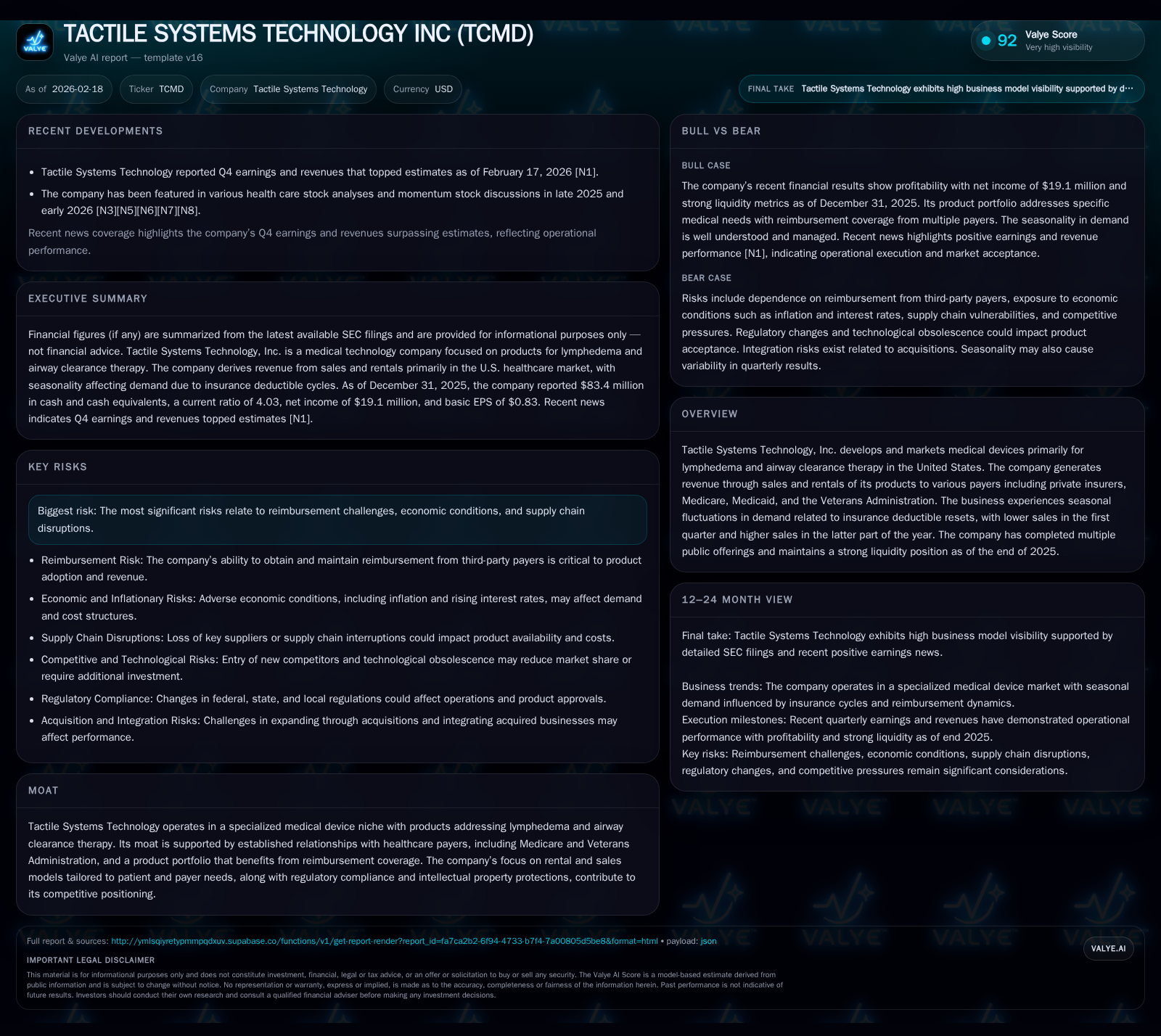
Tactile Systems Technology, operating in the specialized niche of lymphedema and airway clearance devices, has transitioned from operating losses in 2022 to solid profitability by 2025. This was driven by stable revenues fueled by reimbursements from Medicare, Medicaid, the Veterans Administration, and private insurers. Seasonality tied to insurance deductible resets affects quarterly demand patterns, with higher sales later in the year. The company has strengthened liquidity and amended its credit facility to support an active share repurchase program. Future growth depends on ongoing reimbursement stability and supply chain management.
From Losses to Profit: Reviewing Historical Growth and Operating Performance
Tactile Systems Technology demonstrated a meaningful financial turnaround over recent years. After enduring a significant operating loss of approximately $12.8 million in fiscal 2022, the company reversed course to achieve an operating income of $29.3 million by the end of 2025—a remarkable improvement reflecting a compound operating income growth trajectory including a +32% increase YoY from 2024’s $22.2 million [F1]. Net income mirrored this recovery pattern, improving from a loss of about $17.9 million in 2022 to a positive $19.1 million in 2025 (+12.5% YoY), encompassed within sustained revenue generation.
While explicit annual revenues for recent years are not provided beyond the Q3-2018 figure of approximately $36.3 million, company disclosures indicate relatively stable revenue with seasonality effects impacting intra-year patterns rather than annual volatility [S1][N1]. Operating cash flow (OCF) progression underpins improved operational efficiency; climbing from $5.2 million in 2022 to about $42.8 million in the latest reported year, underscoring enhanced cash conversion alongside steady capital expenditure around $2.4 million annually [F1]. The approximate return on equity for FY2025 stands at 8.7%, calculated using net income over equity [F1], reflecting moderate but positive returns characteristic of specialized medical device firms managing capital conservatively.
Historical performance (annual)
| FY | Net ($mm) | CFO ($mm) | OpInc ($mm) | Capex ($mm) | Net YoY |
|---|---|---|---|---|---|
| 2025 | 19 | 43 | 29 | 2 | +12.5% |
| 2024 | 17 | 41 | 22 | 2 | -40.5% |
| 2023 | 29 | 36 | 18 | 2 | +259.6% |
| 2022 | -18 | 5 | -13 | 2 |
Note: Omitted columns lack sufficient annual XBRL coverage in the provided tags (need ≥2 annual points): Rev, Div. Source: SEC companyfacts cache [F1].
Capital returns and efficiency (annual)
| FY | Buybacks ($mm) | FCF ($mm) | ROE% |
|---|---|---|---|
| 2025 | 27 | 40 | 8.7 |
| 2024 | 4 | 38 | 7.8 |
| 2023 | 34 | 14.7 | |
| 2022 | 3 | -14.7 |
Source: SEC companyfacts cache [F1].
Note: Revenue YoY % omitted due to lack of recent multi-year data; Dividends omitted due to unavailability.
Payer Relationships and Reimbursement: Cornerstones of Competitive Moat
A fundamental pillar supporting Tactile Systems’ resilient financial performance lies in its well-established payer relationships across key government programs—Medicare, Medicaid, and the Veterans Administration—as well as private insurer networks [N1][S1]. This multifaceted reimbursement ecosystem ensures coverage that is vital for patients relying on durable medical equipment (DME), particularly devices addressing lymphedema and airway clearance therapy.
Such reimbursement arrangements confer competitive advantage as these payers generally include approved billing codes and benefit structures that facilitate rental and sales revenue streams for Tactile’s product lineups without undue administrative barriers or coverage uncertainties seen elsewhere in fragmented markets.
The company's compliance with regulatory standards buttresses payer confidence further; this includes adherence to FDA device classifications, claims documentation protocols, and periodic audits—all critical given stringent Medicare reimbursement scrutiny [S1]. This regulatory alignment reduces risk of sudden policy changes that could adversely impact revenue recognition.
By embedding itself within payer systems characterized by structured claims adjudication timelines and multi-year coverage policies, Tactile Systems secures a moat less accessible for new entrants lacking such relationships or compliance rigor.
Seasonality Effects and Demand Drivers in Lymphedema and Airway Clearance Devices
Tactile’s business displays classic durable medical equipment seasonality patterns driven by patients' insurance deductible resets at calendar year start [N1][S1]. The first quarter typically encounters muted demand owing to high out-of-pocket costs patients incur before meeting deductibles under commercial insurance plans.
Consequently, device sales and rentals tend to accelerate in the latter half of the year, notably third and fourth quarters, when patients have satisfied deductibles reducing their effective payment burden.
This cadence is further amplified by patient behaviors toward maximizing flexible spending accounts prior to annual expiration dates, boosting late-year order volumes.
It is crucial to note that this seasonality does not affect government payers like Medicare or Veterans Administration programs where patient cost-sharing models differ or are absent—leading to more stable reimbursement flows within those segments.
Understanding payer claims processing timelines is also paramount: delays between device delivery and claims settlement mean that revenue recognition may lag physical shipments slightly—a factor managed carefully within Tactile’s financial operations.
Liquidity Strength and Credit Facility Amendments: Capital Structure Overview
Over recent years, Tactile Systems has engaged proactively with lenders to maintain liquidity flexibility aligned with evolving business needs [S4]–[S8]. Noteworthy milestones include amending its credit agreements multiple times:
- Increased revolver capacity from $25 million up to $40 million,
- Extended maturity dates through July 31, 2028,
- Transitioned benchmark interest rates from LIBOR to SOFR plus credit spreads,
- Adjusted covenants removing minimum EBITDA test but preserving maximum leverage ratios around roughly ≤1.75x total debt-to-EBITDA,
- Implemented fixed charge coverage minimums enabling stable cash flow appraisal.
As of mid-2025, no outstanding borrowings existed under the revolving credit line following proactive term loan payoffs totaling nearly $24.4 million using cash reserves [S8]. Quarterly scheduled principal repayments on prior term loans occurred at roughly $750K installments maintaining amortization discipline.
The company complies comfortably with leverage covenants benefiting from positive free cash generation while retaining capacity for incremental borrowings if strategic opportunities arise.
The secured nature of obligations—with liens on substantially all assets—reflects prudent lender protections customary for middle-market med-tech firms ensuring favorable borrowing terms persist amidst macroeconomic uncertainties.
Capital Allocation Strategy: Share Repurchases, Cash Flows, and Investment
Capital deployment decisions highlight an emphasis on shareholder value enhancement through aggressive share repurchases rather than dividend distributions [F1][S18][S21].
In fiscal year 2025 alone, Tactile expended approximately $26.56 million on stock buybacks—the majority under a repurchase authorization capping at $30 million—compared with just about $3.5 million spent the prior year [F1][S21]. These buybacks directly reduce dilution effects from employee incentive plans and signal management's confidence in ongoing cash flow generation.
Operating cash flow nearing $42.8 million supports these purchases sustainably while allowing continued modest capital expenditures averaging around $2.4 million annually directed mostly toward maintenance capex rather than material growth capex [F1].
No dividends have been declared or paid during this period per available disclosures; thus, capital returns rely exclusively on buybacks providing flexible shareholder reward mechanisms aligned with internal investment priorities.
Notably, share repurchases are conducted within compliance limits set forth by amended credit agreements which require no default post-repurchase and maintain specified leverage thresholds ensuring continued financial stability [S5][S7][S21].
Future Growth Prospects: Market Opportunities and Constraints
Looking ahead, Tactile Systems maintains opportunity channels primarily through expansion within its core therapeutic niches—lymphedema management and airway clearance therapy devices—which remain underpenetrated relative to clinical need [N2][S1]. Larger demographic trends like aging populations and rising chronic respiratory illnesses aid addressable market growth potential.
Regulatory approval pipelines or updates aligned with advanced device features offer avenues for incremental portfolio enrichment though no specific product launches have been flagged recently [N2]. Sustaining strong reimbursement status across public payer programs will be crucial amid evolving health policy environments prone to cost containment pressures.
Supply chain robustness emerges as another critical consideration given global industry-wide component shortages historically affecting med-tech manufacturing; active mitigation strategies involving diversified sourcing are implied though not detailed explicitly [S1].
Investors should weigh these factors alongside positive external sentiment as indicated by Piper Sandler upgrading TCMD shares early in January reflecting improved operational narratives balanced against cautious regulation watchfulness [N2].
Key Metrics to Watch: Upcoming Milestones and Investor Expectations
Absent explicit future guidance from management disclosures or filings ([N1],[S3]), stakeholders should monitor several high-frequency indicators:
- Quarterly earnings relative to expected seasonal sales variation especially Q1 softness vs Q4 strength,
- Updates on debt reduction progress adapting credit agreement covenants,
- Share repurchase program continuation metrics,
- Any regulatory announcements impacting reimbursement coverage,
- Supply chain status updates linked particularly to component availability influencing production cadence.
Notably, the Q4 FY2025 results outperformed consensus estimates evidencing operational momentum entering the new fiscal year [N1], making forthcoming quarterly reports key validation points of sustainability for profitability gains observed.
Disclaimer: This is research-only, informational analysis and not investment advice. It may include AI-generated interpretation and general industry context. Always verify important details using primary sources.

Comments