
CEL-SCI’s Multikine Advances Amid Financing and Regulatory Challenges
CEL-SCI focuses on pivotal Phase 3 immunotherapy in head and neck cancer while managing substantial capital needs.
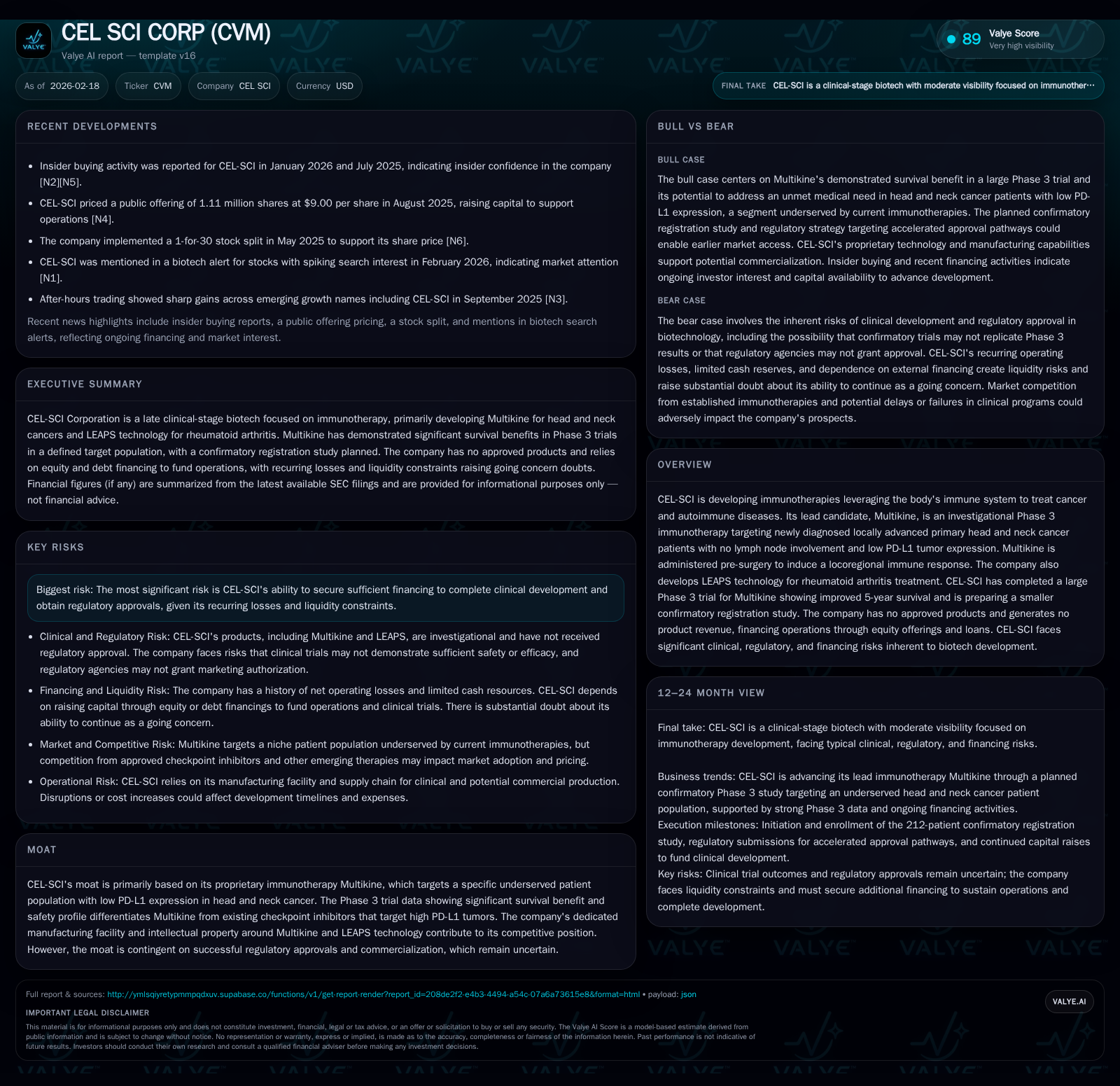
CEL-SCI Corporation is a clinical-stage biotech company pioneering immunotherapies, chiefly its lead candidate Multikine targeting locally advanced head and neck cancer with low PD-L1 expression. The company completed a large Phase 3 trial demonstrating over 70% 5-year survival benefit in the target group versus about 45% for controls. CEL-SCI is preparing a smaller confirmatory registration study requiring an estimated $30-$35 million, contingent on raising sufficient capital amid recurring losses and liquidity constraints. The company has no approved products or revenue, relying on equity issuances and loans for funding, and faces inherent risks related to clinical outcomes, regulatory approvals, and financing. Multikine’s differentiation lies in its pre-surgical administration and targeting of an underserved patient population relative to current checkpoint inhibitors.
Company Overview
CEL-SCI Corporation is a clinical-stage biotechnology enterprise concentrated on developing immunotherapies that enhance the body's immune response to fight cancer and autoimmune diseases. The flagship candidate, Multikine (Leukocyte Interleukin, Injection), is an investigational Phase 3 immunotherapy specifically designed to treat newly diagnosed locally advanced primary head and neck cancer patients exhibiting no lymph node involvement and low PD-L1 tumor expression. In contrast to many immunotherapies administered post-surgery or in metastatic scenarios, Multikine is given pre-surgically with the intent to induce a locoregional immune response.
Additionally, CEL-SCI develops LEAPS (Ligand Epitope Antigen Presentation System) technology aimed at treating rheumatoid arthritis but this pipeline segment remains early stage with relatively smaller spending allocation.
Historical Performance and Financial Summary
The company has no approved products or commercial revenue streams; it is solely dependent on external capital sources—principally equity offerings, convertible debt instruments, loans, and grants—to support ongoing operations [S1][S2]. Operating losses have been consistent and significant reflecting ongoing clinical development costs concentrated primarily on the Multikine program.
Financial Highlights (Fiscal Years Ending September 30)
Historical performance (annual)
| FY | Net ($mm) | CFO ($mm) | OpInc ($mm) | Capex ($) | Net YoY |
|---|---|---|---|---|---|
| 2025 | -25 | -17 | -25 | 38109 | +7.9% |
| 2024 | -28 | -19 | -26 | 94875 | +14.3% |
| 2023 | -32 | -23 | -31 | 361892 | +12.3% |
| 2022 | -37 | -18 | -36 | 637892 |
Note: Omitted columns lack sufficient annual XBRL coverage in the provided tags (need ≥2 annual points): Rev, Div, Buybacks. Source: SEC companyfacts cache [F1].
Capital returns and efficiency (annual)
| FY | FCF ($mm) | ROE% |
|---|---|---|
| 2025 | -17 | -159.2 |
| 2024 | -19 | -214.3 |
| 2023 | -23 | -243.6 |
| 2022 | -19 | -114.1 |
Source: SEC companyfacts cache [F1].
Note: R&D expense not available for all years; Capex reflects investments primarily in manufacturing facilities critical for clinical manufacturing scale-up [F1].
Operating Metrics Commentary
- Operating Income & Net Losses: The company reported operating losses of nearly $25 million in fiscal year 2025, slightly improved compared to prior periods but reflecting sustained burn largely driven by clinical activities around Multikine [S1][F1].
- R&D Spend: Research expenses reduced by approximately $2.3 million (13%) year-over-year primarily due to decreased stock-based compensation costs rather than substantive cuts in clinical trial or personnel-related spend; nearly entire R&D budget concentrated on Multikine [S3][S7].
- Cash Flow: Operating cash flow remains significantly negative at around $17 million annually indicative of heavy operational burn as the firm progresses trials without sales revenue [F1].
- Capital Expenditures: Capex has declined substantially year-over-year as construction phases of dedicated manufacturing facilities were largely complete though maintenance of these specialized assets continues [S9][F1].
- Equity Base: The equity increased through persistent share offerings enabling continued funding of development programs [S12][F1].
Product Pipeline & Development Status
Multikine Therapeutic Profile & Clinical Data
Multikine's core value proposition centers on treating an underserved subset of head and neck cancer patients—those without lymph node involvement identified via PET scans who also display low PD-L1 tumor expression measured through biopsy analysis [S24]. This delineation taps into approximately 70% of the broader patient cohort historically underserved by existing checkpoint inhibitors such as Keytruda which are most effective only in high PD-L1 expressors.
The comprehensive Phase III trial began enrolling patients in December 2010 after validation of CEL-SCI's proprietary manufacturing facility capable of GMP-grade production essential for clinical supply continuity [S22]. Enrollment completion occurred in September 2016 with primary endpoint achievement reported in April 2020 followed by database lock December that year [S22]. These efforts culminated in statistically significant survival benefits: Multikine treatment yielded a five-year overall survival rate of approximately 73% compared to roughly 45% for standard-of-care control subjects within the target population—a hazard ratio of approximately 0.35 indicating about two-thirds reduction in risk of death [S24][S27]. This robust efficacy was accompanied by a favorable safety profile without additional toxicities relative to standard care.
Regulatory Pathway & Confirmatory Study Planning
Following FDA discussions initiated around May 2024, CEL-SCI secured a pathway forward involving a separate confirmatory randomized controlled registration study focused exclusively on the target population (~212 patients). The confirmatory study aims to validate prior findings in a smaller cohort over an estimated enrollment timeline near fifteen months post-capital raise completion [S21]. This strategy attempts to leverage conditional or accelerated approval mechanisms recognized by leading regulatory agencies including FDA, EMA (Europe), MHRA (UK), Health Canada as well as regional filings like an application filed under Breakthrough Medicine Designation with Saudi Arabia's SFDA via collaboration with Dallah Pharma [S1][S21].
The confirmatory trial will randomize patients between Multikine plus standard-of-care versus standard-of-care alone with interim analyses potentially supporting early regulatory submissions pending enrollment completion [S21].
LEAPS Program
Separate research under the LEAPS platform targets autoimmune indications such as rheumatoid arthritis but remains preclinical or early phase with limited financial allocation; recent expense patterns even suggest credits due to prior period adjustments rather than current active spending [S13][S15].
Capital Structure & Liquidity Considerations
CEL-SCI operates under considerable liquidity pressure inherent in late-stage biotech development absent commercial products or revenues:
- Cash balances decreased by several million dollars over trailing quarters driven by persistent negative operating cash flows approximating $4 million quarterly as the company advances toward confirming study initiation [S18][S20][F1].
- The estimated cost for the confirmatory registration study stands at roughly $30-$35 million requiring incremental financing which may be challenging given market conditions and company history [S4][S5][S21].
- Historically, capital has been raised through equity offerings (including exercise of pre-funded warrants), short-term loans, along with occasional research grants; continuing dilution risk exists as stock-based compensation inflates outstanding shares amidst attempts to conserve capital [S12][S16].
- No dividends or share repurchases have been declared nor expected given cash burn profile [F1][S23].
- Going concern disclosure is explicitly noted, emphasizing uncertainty about sustaining operations without successful financing rounds or alternative strategic partnerships [S12][S16].
Operating Expenses Breakdown & Cost Dynamics
Research and Development Expenses:
- Fiscal year ended September 30, 2025 recorded $15.9 million R&D expenses down from $18.2 million the prior year mostly due to share-based compensation expense reductions (~$2.1 million decrease) despite slightly higher spending on supplies/materials linked to clinical manufacturing activities [S3][S7].
- Clinical trial-specific costs remain relatively modest (~$615K annually), reflecting trial maturity phases and operational efficiencies under CRO contracts.
- Personnel-related costs steady around $5.9 million indicating stable scientific staffing levels critical for execution.
- Depreciation charges (~$3.9 million) reflect amortization related to manufacturing infrastructure built out since late stage clinical trial inception.
General and Administrative Expenses:
- Slight increase (+9%) noted over fiscal year likely driven by elevated legal/accounting fees tied to regulatory filings plus intensified investor relations/public relations expenditures supporting fundraising efforts [S10][S17][S19].
- Employee stock compensation charges have trended downwards aiding expense moderation.
- Interest net expense decreased marginally reflecting reducing finance lease liabilities following principal repayments.
Market Context & Competitive Positioning Analysis (Industry Context)
The global cancer immunotherapy market is poised for substantial growth projected toward nearly $200 billion by 2030 at roughly a mid-single digit CAGR driven by increasing adoption of targeted therapies over conventional chemo/radiotherapy regimens coupled with expanding regulatory approvals internationally. Within this landscape:
- Checkpoint inhibitors dominate current immunotherapy usage but mainly benefit patients with high PD-L1 tumor expression,
- Multikine’s niche targeting of low PD-L1 tumors represents an important complementary therapy addressing an evident unmet need,
- Given its unique pre-surgical administration timing—directly after diagnosis before tumor resection—Multikine sets itself apart from other agents given post-operatively or only when surgery is infeasible,
- Successful marketing approval could establish standards incorporating preoperative immune priming analogous to neoadjuvant approaches increasingly embraced across oncology specialties.
However, typical biotech challenges persist including navigating complex regulatory pathways across multiple jurisdictions while securing sufficient funding to conclude pivotal trials that ultimately determine commercialization viability.
Returns & Capital Allocation Strategy
Given CEL-SCI’s current status as a development-stage company without revenues or profits:
- Traditional return metrics such as ROE are deeply negative (-159% approximate based on last fiscal year net loss relative to equity), reflecting unprofitable R&D investments essential at this stage [F1],
- No dividends or share repurchases occur nor are anticipated,
- Capital allocation centered exclusively on funneling proceeds toward completing clinical trials/preparations for commercialization;
- Significant portion of annual expenses relate directly or indirectly to multiyear investments into proprietary manufacturing capabilities ensuring consistent quality/compliance required for biologics scale-up,
- Substantial dilution potential persists due to ongoing equity issuances combined with employee option exercises necessary for incentivizing talent retention amid prolonged development timelines.
Monitoring capital raises alongside key milestones such as commencement/enrollment progress of confirmatory study will be essential indicators of operational trajectory going forward.
Conclusion & Monitoring Points
CEL-SCI represents a classic late-stage biotech firm balancing promising clinical data against inherent risks regarding capital sufficiency and regulatory milestones. Its lead product candidate Multikine has compelling Phase III survival data demonstrating meaningful benefit within an underserved subpopulation of head and neck cancer patients distinguished by low PD-L1 expression untreated prior to surgery. Nevertheless:
- Approval hinges upon successful execution of smaller-scale confirmatory registration trials funded via substantial upcoming capital raises totaling $30-$35 million,
- Financing availability remains uncertain amidst sustained multi-year operating losses exceeding $100 million cumulatively since inception,
- Investors/watchers should track announcements regarding financing completions, FDA feedback on trial protocols/submissions, enrollment progress reports from the confirmatory study, and any regulatory designations such as breakthrough therapy or conditional marketing authorizations.
Without successful navigation through these developmental inflection points CEL-SCI faces continued financial strain jeopardizing project continuity despite technological promise.
Disclaimer: This document summarizes publicly available information up to February 2026 concerning CEL-SCI Corporation (CVM). It does not constitute investment advice or recommendations but aims to provide analytical insights into company fundamentals, developmental progress, industry context, and financial health.
Disclaimer: This is research-only, informational analysis and not investment advice. It may include AI-generated interpretation and general industry context. Always verify important details using primary sources.

Comments