
Core Natural Resources Faces Regulatory Delays and Financial Challenges in 2025
Core Natural Resources contended with postponed mine approvals and trade-related headwinds, culminating in a significant earnings decline and focused liquidity management throughout 2025.
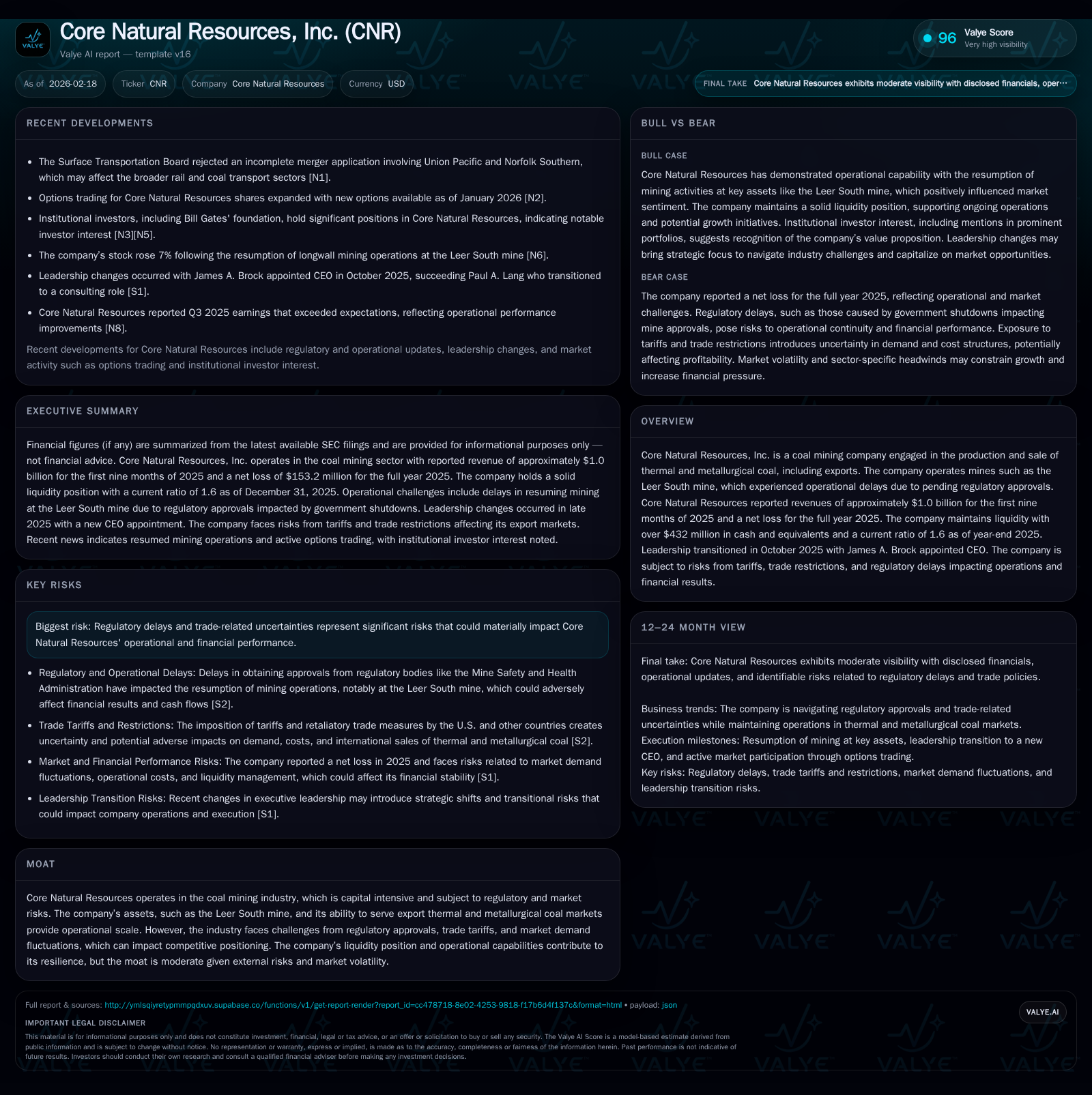
In 2025, Core Natural Resources, Inc. experienced a notable revenue decline and reported its first annual net loss in recent years, primarily due to regulatory delays at the Leer South mine and adverse global trade conditions. Despite these challenges, the company maintained strong liquidity and a solid current ratio. Capital expenditures increased substantially as Core invested in asset rehabilitation while continuing dividends and share repurchases, reflecting a balanced approach to capital allocation amid operational uncertainties. The outlook depends on regulatory approvals, trade policy developments, and strategic execution under new leadership.
Recent Revenue Trends and Profitability Decline
Core Natural Resources witnessed a substantial contraction in revenue over recent years, with approximately $1 billion generated during the first nine months of 2025 compared to $2.57 billion reported in 2023 [F1]. This represents an estimated year-over-year decline of roughly 13%, largely attributable to operational interruptions at key assets including the Leer South mine [S2]. The company transitioned from consistent net profits—$656 million in 2023 and $286 million in 2024—to incurring a net loss of $153 million for full-year 2025 [F1]. Operating income similarly reflected this downturn, registering a loss near $182 million in 2025 [F1]. These figures highlight significant pressure on Core’s financial results stemming from both operational constraints and external market factors.
Historical performance (annual)
| FY | Rev ($bn) | Net ($mm) | CFO ($mm) | Capex ($mm) | Rev YoY | Net YoY |
|---|---|---|---|---|---|---|
| 2025 | -153 | 306 | 285 | -153.5% | ||
| 2024 | 2.2 | 286 | 476 | 178 | -12.9% | -56.3% |
| 2023 | 2.6 | 656 | 858 | 168 | +22.2% | +40.5% |
| 2022 | 2.1 | 467 | 651 | 172 | +67.0% |
Note: Omitted columns lack sufficient annual XBRL coverage in the provided tags (need ≥2 annual points): OpInc, ROE%. Source: SEC companyfacts cache [F1].
Capital returns and efficiency (annual)
| FY | Div ($mm) | Buybacks ($mm) | FCF ($mm) |
|---|---|---|---|
| 2025 | 26 | 224 | 21 |
| 2024 | 16 | 71 | 298 |
| 2023 | 75 | 399 | 690 |
| 2022 | 71 | 479 |
Source: SEC companyfacts cache [F1].
Note: Operating income multi-year data is insufficient for inclusion.
Regulatory Challenges at Leer South Mine
A critical factor contributing to operational disruptions was the delay in resuming longwall mining operations at the Leer South mine in West Virginia due to pending federal regulatory approvals [N1][S9][S10][S15]. Specifically, approval from the Mine Safety and Health Administration (MSHA) for repositioning longwall equipment was delayed by government shutdowns and regulatory processes [S9][S10]. This postponement deferred production restarts, directly impacting output volumes and expected cash flows throughout much of fiscal year 2025 [S10]. The complex nature of repositioning longwall mining equipment requires stringent safety oversight, making timely MSHA sign-offs essential to operational recovery.
Trade Tariff Impacts on Export Markets
In addition to domestic regulatory hurdles, Core faced heightened risks from international trade policies affecting thermal and metallurgical coal export markets [S9][S10][S15]. U.S.-imposed tariffs on steel and aluminum provoked retaliatory tariffs from key trading partners such as the European Union, Canada, Mexico, and China [S9]. These reciprocal trade measures disrupted demand patterns for coal used in steelmaking inputs and increased operating costs.
Such geopolitical tensions introduced price volatility as customers adjusted purchasing behaviors amidst uncertain industrial demand . Given that export thermal coal sales represent a meaningful component of Core’s revenue mix [S14], these tariff-related challenges complicated market access and pricing dynamics.
Balance Sheet Strength Supports Liquidity
Despite earnings losses, Core maintained robust liquidity entering early-2026. Cash and cash equivalents totaled approximately $432 million at year-end with current assets around $1.34 billion against current liabilities near $838 million—yielding a current ratio close to 1.6x [F1]. This liquidity position mitigates short-term solvency concerns while supporting ongoing operational needs.
Furthermore, Core’s equity base approached $3.7 billion by end-2025, providing financial flexibility to withstand cyclical headwinds or pursue additional capital if necessary [F1][S7][S11][S12]. Recent SEC filings indicate manageable debt maturities alongside accessible credit facilities [S7][S19][S20], reinforcing balance sheet resilience amid operating losses.
Capital Allocation Amid Challenging Environment
Capital deployment decisions during this period reflect Core’s strategic balancing act [F1][S17][S18]. Capital expenditures rose sharply by nearly 60% year-over-year to about $285 million in fiscal year 2025 as investments focused on maintenance projects and equipment repositioning at mines like Leer South.
Simultaneously, dividend payments continued but declined markedly from previous years to approximately $26 million paid during the year [F1], suggesting cautious preservation of cash alongside shareholder distributions.
Share repurchases remained active at $224 million despite constrained free cash flow—estimated modestly positive at roughly $21 million—indicating management’s commitment to returning capital or confidence in valuation levels.
This juxtaposition between elevated reinvestment spending versus sustained shareholder returns underscores ongoing tension between growth restoration efforts and rewarding investors.
Outlook: Key Factors for Investors
Without explicit forward guidance from Core post-transition [N3], investors should monitor several critical factors:
- Progress on MSHA permitting influencing restart timing for Leer South mine operations [N1][S3]
- Developments or easing in U.S.-led tariffs or retaliatory trade actions affecting coal export markets fundamentally [N1]
- Execution of operational turnaround strategies under CEO James A. Brock who assumed leadership in October 2025 amidst these challenges [S17][S18]
- Quarterly production updates from core assets such as West Elk mine alongside cost management initiatives signaling stabilization potential.
Close attention to regulatory announcements, trade policy shifts, operational metrics, and management commentary will be essential to gauge whether headwinds abate or intensify going forward.
Disclaimer: Analysis is based solely on publicly available SEC filings, news releases, and company disclosures through February 18, 2026. It does not constitute investment advice but provides an informed overview of Core Natural Resources’ recent financial performance and strategic context.
Disclaimer: This is research-only, informational analysis and not investment advice. It may include AI-generated interpretation and general industry context. Always verify important details using primary sources.

Comments